Cotinine vs Nicotine: What Nicotine Screening Programs Actually Measure


Ask for a “nicotine test” and what you’ll actually get is a cotinine test — and that’s not a technicality, it’s the reason the test works at all. Employers and insurers who understand the difference build screening programs that hold up; those who don’t end up with results they can’t interpret. Here’s what your program is really measuring, and why it matters.
Cotinine vs Nicotine: What Do Screening Programs Actually Measure?
Nicotine screening programs measure cotinine, not nicotine. Nicotine clears the body in about a day, so testing for it directly would miss most regular users, while cotinine (nicotine’s primary metabolite) lasts days and reliably indicates habitual use. That’s why every practical “nicotine” test targets cotinine, typically at a 200 ng/mL cutoff set to separate active users from incidental secondhand exposure. The two things that complicate results are nicotine-replacement therapy (patches and gum still produce cotinine) and heavy secondhand exposure, which is why consequential results should be lab-confirmed. This guide explains the cotinine-versus-nicotine distinction, what it means for your cutoff, and why urine is the common testing matrix.
Nicotine disappears; cotinine sticks around
Nicotine itself is metabolized fast — it has a half-life of roughly two hours, so it’s largely gone from the body within a day of exposure. If you tested for nicotine directly, you’d catch only someone who used within the last few hours, and you’d miss a pack-a-day smoker who happened not to have smoked that morning. That’s useless for screening.
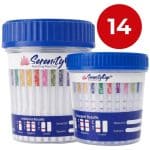
Cotinine is nicotine’s primary metabolite, and it’s far more stable, with a half-life measured in days rather than hours. It builds up in regular users and clears slowly, which gives you a dependable read on whether someone is a habitual user rather than whether they happened to vape in the last two hours. Every practical “nicotine” screen — including our cotinine urine test strips — targets cotinine for exactly this reason.
What this means for your cutoff
Because cotinine is the marker, the cutoff you choose is a cotinine cutoff, and the standard is 200 ng/mL. That level is set to separate active users from people with incidental secondhand exposure. Someone who shares an office smoke break area or lives with a smoker can pick up small amounts of cotinine; the 200 ng/mL threshold is high enough that this incidental exposure typically doesn’t trigger a positive, while an actual user’s levels sit well above it. A much lower cutoff would start flagging non-users — a fairness and accuracy problem in any employment or insurance context.
Active use vs exposure: the distinction your program lives on
The whole point of a nicotine screen is to distinguish a user from a non-user, and cotinine at the right cutoff does that. But two things complicate it, and a good program plans for both. Nicotine-replacement therapy — patches, gum, lozenges — contains nicotine and produces cotinine, so someone quitting with NRT can test positive despite not smoking. And heavy secondhand exposure, while usually below the 200 ng/mL cutoff, exists on a spectrum. This is why non-negative results that drive a real decision should be confirmed at a lab, which can quantify the cotinine level and give you a defensible number rather than a line.
Why urine is the common matrix
Cotinine can be measured in urine, saliva, or blood. Urine is the most established and cost-effective for screening programs — the cotinine urine strips give a clear result at the 200 ng/mL cutoff and are easy to confirm at a lab if challenged. Saliva tests exist and are convenient for on-the-spot collection; blood is the most precise but the least practical for routine screening. For most employer and insurance programs, urine cotinine is the sensible default.
Building a program on the right measurement
Once you know you’re measuring cotinine, the rest follows: standardize on the 200 ng/mL cutoff, apply testing uniformly, account for NRT when interpreting results, and confirm non-negatives before any consequence. And check your state law — some jurisdictions protect lawful off-duty tobacco use, which affects whether you can act on a positive at all. The measurement is solid; the program design is what makes it fair and defensible.
FAQ
Why do nicotine tests measure cotinine instead of nicotine?
Nicotine clears the body in hours; cotinine, its metabolite, lasts days and reliably indicates habitual use rather than a single recent exposure.
Will nicotine gum or patches cause a positive?
Yes — NRT contains nicotine and produces cotinine, so it can trigger a positive. Account for this when interpreting results.
Does the standard cutoff catch secondhand smoke?
The 200 ng/mL cutoff is set to filter most incidental secondhand exposure while catching active users.
What sample type is best for nicotine screening?
Urine cotinine is the common, cost-effective default; lab confirmation can quantify the level for high-stakes decisions.