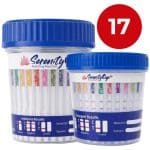
17 Panel Drug Test Cups
A 17 panel drug test cup screens one urine sample for seventeen drugs, with results in about
5 minutes. It builds on the classic 12 panel drug test by adding gabapentin, alcohol (EtG), fentanyl
and two more drugs that change by version. We make two 17 panel Serenity Cup® versions. Both test the
same 15 drugs. The 120 mL cup with gabapentin, kratom and TCA adds kratom and tricyclic antidepressants.
The 90 mL economy cup with ketamine and tramadol adds those two instead. Both are labeled Forensic Use Only.
Prices run from $3.49 (120 mL) and $3.29 (90 mL) per cup at 25 cups, down to $1.99 per cup at 20,000+.

Showing all 2 results

17 Panel Multi Drug Test Cup 90 ML Detects GABA/1000, ETG/300, FEN/20, KET/1000, & TRA/100 as low as $1.89
AMP, BAR, BUP, BZO, COC, EtG, FEN, GAB, KET, MDMA, MET, MTD, OPI/MOR, OXY, PCP, THC, TRAForensic UseAs low As$1.89 $1.89 - $3.09
17 Panel Drug Test Detects Gabapentin, Kratomn, ETG, TCA & Fentanyl, – As low as $1.89
AMP, BAR, BUP, BZO, COC, EtG, FEN, GAB, KRA, MDMA, MET, MTD, OPI/MOR, OXY, PCP, TCA, THC, GABAForensic UseAs low As$1.89 $1.89 - $3.09Features of a 17 Panel Drug Test Cup
-
- Seventeen drugs, one cup: Collect and test in one step, with no dipping.
- Results in about 5 minutes: Read within the time window in the package insert.
- Temperature strip: Fresh urine reads 90–100°F within 4 minutes of collection.
- Click-top lid: Leak-resistant for storage or for shipping a non-negative sample to a lab.
- Two sizes: 120 mL standard or 90 mL economy.
- Forensic Use Only: For courts, probation, corrections, treatment and compliance programs. Not for clinical diagnosis or home use.
What drugs are covered in a 17 Panel Cup?
| Strip | Substance | Cutoff (ng/mL) | What it picks up | 120 mL | 90 mL |
|---|---|---|---|---|---|

|
Amphetamines | 1000 | Adderall, Vyvanse, street amphetamine | ✓ | ✓ |

|
Barbiturates | 300 | Butalbital, phenobarbital | ✓ | ✓ |

|
Buprenorphine | 10 | Suboxone, Subutex | ✓ | ✓ |

|
Benzodiazepines | 300 | Xanax, Valium, Klonopin | ✓ | ✓ |

|
Cocaine | 300 | Powder cocaine, crack | ✓ | ✓ |

|
Ethyl glucuronide | 300 | Recent drinking | ✓ | ✓ |

|
Fentanyl | 20 | Fentanyl (opiate strips miss it) | ✓ | ✓ |

|
Gabapentin | 1000 | Neurontin | ✓ | ✓ |

|
Ecstasy | 500 | Ecstasy, Molly | ✓ | ✓ |

|
Methamphetamine | 1000 | Crystal meth | ✓ | ✓ |

|
Methadone | 300 | Methadone treatment | ✓ | ✓ |

|
Opiates (morphine) | 300 | Heroin, morphine, codeine | ✓ | ✓ |

|
Oxycodone | 100 | OxyContin, Percocet | ✓ | ✓ |

|
Phencyclidine | 25 | Angel dust | ✓ | ✓ |

|
Marijuana | 50 | Cannabis, edibles, vapes | ✓ | ✓ |

|
Kratom | 500 | Mitragynine | ✓ | — |

|
Tricyclic antidepressants | 1000 | Amitriptyline, nortriptyline | ✓ | — |

|
Ketamine | 1000 | Ketamine | — | ✓ |

|
Tramadol | 100 | Ultram | — | ✓ |
A cutoff is the concentration at or above which a strip reads positive. Our guide to how cutoff levels work explains why the same drug can read differently on different tests.
How to Use a 17 Panel Drug Test Cup
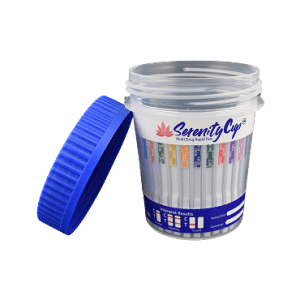
Step 1 – Collect
Open the sealed pouch just before use. The donor fills the cup to the line. Close the lid until it clicks.
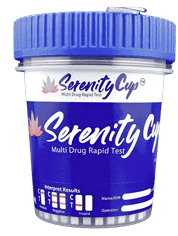
Step 2 – Check temperature
Within 4 minutes, check that the temperature strip shows a reading between 90 and 100°F. A reading outside that range can mean a cooled or substituted sample; recollect per your policy.
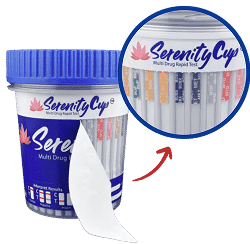
Step 3 – Read
Peel off the label and read at 5 minutes. Do not read after the time limit in the insert.

Positive (preliminary)
Only the control line (C) shows for a drug. The drug is at or above the cutoff. Confirm by GC-MS or LC-MS/MS before acting.

Negative
Lines at C and T. A faint T line still counts as negative.

Invalid
No C line. Retest with a new cup. If it happens again, call 561-897-9238 with the lot number.
What a 17 Panel Cup Covers, Drug Class by Drug Class?
There is no single standard 17 panel. Labs and cup makers each choose their own seventeen. Many instant cups on the market add K2, kratom and tramadol to EtG and fentanyl; some lab panels add drugs like meperidine or zolpidem. Our two cups center on gabapentin, EtG and fentanyl. Check the list your court, program or employer requires before you order.
-
Opioids:
Opiates (OPI 300), oxycodone, methadone, buprenorphine and fentanyl on both cups; tramadol on the 90 mL cup. Fentanyl and tramadol are synthetic, so opiate strips don't reliably catch them. That's why they get their own strips. More on what the tramadol strip screens for.
-
Stimulants and party drugs:
Amphetamines, methamphetamine, cocaine and MDMA on both cups; PCP on both; ketamine on the 90 mL cup (ketamine facts).
-
Sedatives and prescription drugs:
Benzodiazepines, barbiturates and gabapentin on both cups; tricyclic antidepressants on the 120 mL cup. Gabapentin is a prescription nerve-pain drug that most smaller panels don't test. Read how long gabapentin stays in urine and what a TCA test screens for.
-
Cannabis, kratom and alcohol:
Marijuana (THC 50) on both; kratom on the 120 mL cup (kratom in urine); EtG at 300 ng/mL on both. EtG is a breakdown product of alcohol that shows recent drinking, not current intoxication. See how long EtG stays in urine.
-
What these cups don't test:
K2/Spice, adulterant checks (pH, specific gravity, creatinine) and 6-AM. If you need them, see the larger cups below.
Both cups are labeled Forensic Use Only.
Built for Collection Sites
Each cup has a control line on every strip, so you can see that the test ran. A built-in temperature strip checks the sample at collection, and the click-top lid keeps it sealed for storage or for shipping a non-negative to a lab. The cup is self-contained, so no other equipment is needed.
Buy 17 Panel Cups Wholesale, Direct From the Manufacturer
- › 120 mL cup with gabapentin, kratom and TCA:
$3.49 per cup at 25, $2.79 at 1,000, $1.99 at 20,000+. A fit for treatment, MAT and pain programs that track gabapentin, kratom and antidepressants alongside fentanyl and alcohol. - › 90 mL economy cup with ketamine and tramadol:
$3.29 per cup at 25, $2.69 at 1,000, $1.99 at 20,000+. A lower-cost cup for high-volume probation, corrections and sober living programs. - › Temperature strip and click-top lid on every cup.
- › Results in about 5 minutes. Confirm every non-negative by GC-MS or LC-MS/MS.
- › Need fewer drugs? Our 16 panel drug test cups include a CLIA-waived option for clinics.
- › Need adulterant checks or K2? See our 18 panel cups, which include versions with K2 and adulterant pads.
- › Volume pricing in writing:
See our bulk and wholesale price list, or send a competing quote to [email protected] and we'll beat it by 10%.
Bulk, tender, OEM and private label:
561-897-9238 · [email protected]
Private Label 17 Panel Cups
- › Your logo, cup label and packaging on either 17 panel cup
- › A custom drug set and cutoffs (for example, swap kratom for K2)
- › Drop shipping under your brand from US stock
- › One account rep for distributors, clinics, courts, probation and treatment programs
We manufacture the Serenity Cup® line and supply it through Slash Medical, our wholesale division. Tell us your drug list and monthly volume and we'll quote it in writing, or contact our wholesale team.
Contact:
561-897-9238 · [email protected]

Bulk Pricing that Cuts the Budget in Half

Priority Shipping For Bulk Orders.

Dedicated Wholesale Representative.

Quality That Is Reliable For the Nation.
How the Test Strips Work
Each strip is a lateral flow immunoassay. If the drug is in the urine above the cutoff, it blocks the antibody from binding at the test zone, so no T line appears (preliminary positive). If the drug is absent or below the cutoff, the T line appears (negative). The result is qualitative: it shows above or below the cutoff, not how much was taken. Lab confirmation by GC-MS or LC-MS/MS gives the definitive result.
Why Gabapentin, Kratom, Ketamine and Tramadol?
These four drugs aren't on most 5 to 12 panel cups, but many treatment and supervision programs now ask for them. Gabapentin and tramadol are prescription drugs; kratom is sold as a supplement; ketamine is an anesthetic. A prescription can explain a positive gabapentin, tramadol or TCA result, so record current medicines at collection and have a medical review officer review positives where your program requires it.
Where 17 Panel Cups Are Used?
| Setting | Main uses | Best-fit cup | Why |
|---|---|---|---|
| Probation and parole | Random and compliance testing | 90 mL ketamine/tramadol cup | Lower cost per test; alcohol and fentanyl on the same screen |
| Drug courts | Phase progression, relapse checks | Either cup | Send non-negatives to a lab before using them as evidence |
| Treatment, MAT and sober living | BUP/MTD adherence, relapse, drinking | 120 mL gabapentin/kratom/TCA cup | Shows prescribed treatment drugs alongside gabapentin, kratom, fentanyl and EtG |
| Pain management (forensic or compliance programs) | Diversion and non-prescribed use | 120 mL cup | Separate OXY, MTD, BUP, FEN and TCA strips. For clinical decisions, use a CLIA-waived cup or a lab |
| Employers (non-DOT) | Pre-employment, random, post-incident | Either cup | DOT-regulated tests must go to an HHS-certified lab (49 CFR Part 40) |
Comparing panel sizes? See our 15 panel cups, 14 panel cups or compare all 12 panel cups.
When a 17 Panel Cup Makes Sense?
Pick a 17 panel cup when your program has to watch gabapentin, alcohol and fentanyl at the same time as the usual street drugs. One cup replaces a 12 panel cup plus separate EtG, fentanyl and gabapentin tests, so there is one collection, one read and one record. If you don't need those extra drugs, a smaller panel costs less per test. If you need tamper checks or K2, step up to an 18 panel cup.
Real-World Drug Trends That Shaped the 17 Panel Configuration
The structure of the 17 panel system is closely tied to how substances actually appear in toxicology reports today. One of the most significant changes in recent years has been the rise of synthetic opioids, particularly fentanyl, which is often detected independently of traditional opiates like morphine or heroin. This made it necessary to introduce dedicated fentanyl testing rather than relying on general opiate screening. At the same time, medications such as gabapentin, tramadol, and benzodiazepines have increasingly been linked to misuse patterns, especially when combined with opioids or alcohol. Stimulant use has also become more complex, with methamphetamine, cocaine, and MDMA frequently appearing in overlapping usage profiles rather than isolated cases. Because of these evolving trends, modern drug testing has moved toward multi-category detection systems, where the goal is not just identifying a single drug, but understanding broader substance interaction patterns.
The Role of the 17 Panel Cup in Modern Compliance Systems
In real-world compliance environments such as probation monitoring, workplace screening, and rehabilitation programs, the 17 panel drug test cup is used as a rapid decision-support tool. Its purpose is not to replace laboratory testing, but to provide immediate screening information that can guide next steps in supervision or clinical review. The inclusion of expanded substances like fentanyl and ETG reflects current regulatory and clinical priorities, particularly in environments where both drug use and alcohol consumption must be monitored together. Specimen validity checks such as temperature, creatinine, and pH further strengthen reliability by identifying potential sample tampering or dilution attempts. Overall, the 17 panel system represents a shift toward broader, risk-based toxicology screening, aligning with how substance use is actually observed and managed in modern forensic and healthcare systems
Trust in 12 Panel Now. Leading Supplier of Drug Tests in The US


Best Rates
We beat any written quote by 10%
Priority allocation
Stock reserved for bulk buyers
Fast Shipping
Same day before 3:00 PM EST, free on 100+ cups
Multi Drug Test Options
Providing 350+ Variations for Drug Test Supplies
Best Customer Service
Dedicated Sales Representative For Our Customers
What Does "Forensic Use Only" Mean?
Both 17 panel cups are labeled Forensic Use Only. That means:
- › The cup has not been cleared by the FDA through 510(k) for clinical diagnosis.
- › It is sold for forensic and compliance testing: courts, probation and parole, corrections, law enforcement, sober living and the labs that test for them.
- › It is not for diagnosis, treatment decisions, home use or resale as an over-the-counter test.
- › Results are preliminary. Many courts and programs require lab confirmation before a result is used.
Need a cup for a clinic? Browse our CLIA-waived drug tests or read CLIA waived vs non-CLIA waived tests.

Request Volume Pricing
Share your typical order volume and we'll build a pricing plan tailored to your program's needs — with bulk discounts that increase as your volume grows.
Place Your Order
Order your 17 panel drug test cups online or through your dedicated account representative. Same-day shipping available on qualifying orders.
17 Panel Drug test Cups FAQ's
A 17 panel drug test detects seventeen different drug categories including opioids, stimulants, benzodiazepines, marijuana, fentanyl, alcohol metabolites, and prescription medications commonly associated with misuse or abuse.
The test includes AMP, BAR, BZO, BUP, COC, MDMA, ETG, FEN, GAB, KET, THC, MTD, MET, OPI, OXY, PCP, and TRA.
Yes. Expanded 17 panel drug tests commonly include a dedicated fentanyl (FEN) strip because fentanyl is not reliably detected on many older or lower panel opiate tests.
Yes. Panels containing ETG (Ethyl Glucuronide) can detect alcohol metabolites in urine for up to several days after alcohol consumption depending on usage patterns.
Most 17 panel cups use immunoassay screening technology designed for rapid preliminary detection with high accuracy when used properly. Non-negative results may require laboratory confirmation using GC/MS or LC/MS testing.
ETG stands for Ethyl Glucuronide, a metabolite produced after alcohol consumption. ETG testing is used to identify recent alcohol exposure.
Cutoff levels are predefined concentration thresholds that determine whether a sample is reported as negative or preliminary positive during screening.
Yes. Excessive fluid intake may dilute urine samples. Many test cups include adulteration or specimen validity checks to help identify dilution or tampering attempts.
Specimen validity testing helps verify whether a urine sample is authentic by checking temperature, creatinine, pH, and specific gravity levels.
Yes. Expanded 17 panel configurations commonly include ketamine (KET), particularly in forensic, rehabilitation, and probation testing environments.
A 17 panel drug test includes additional modern substances such as fentanyl, ETG alcohol testing, gabapentin, ketamine, and tramadol that are often excluded from smaller panel tests.
Detection windows vary by substance, metabolism, frequency of use, and hydration levels. Some drugs may only be detectable for 1–3 days, while others like THC or PCP may remain detectable longer.
Yes. Probation and court-ordered testing programs often use expanded panel tests to monitor a broader range of illicit drugs, prescription medications, and alcohol-related substances.
Yes. Legitimately prescribed medications such as benzodiazepines, oxycodone, methadone, buprenorphine, or tramadol may trigger positive results if those substances are included in the panel.
Yes. THC panels screen for marijuana metabolites commonly associated with cannabis use.
Most rapid urine drug test cups provide preliminary results within approximately 5 minutes after sample collection.
A non-negative or preliminary positive result may be sent to a certified laboratory for confirmatory testing before final reporting.
Yes. Many organizations upgraded to expanded panel testing specifically to improve fentanyl detection due to the increased prevalence of synthetic opioid misuse and overdose cases.
Expanded panels improve detection coverage for newer or increasingly abused substances such as fentanyl, ketamine, tramadol, and gabapentin compared to traditional drug tests.