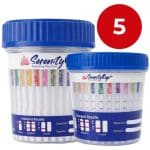
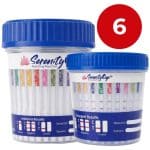
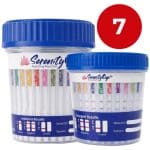
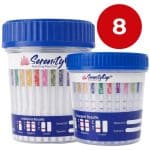
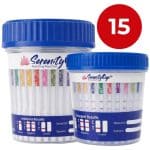
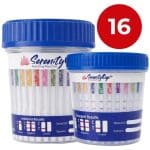
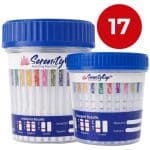
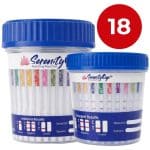
The Best 10-Panel Drug Test Kits for Workplace Testing (2026 Buyer’s Ranking)


If you run workplace screening and you’ve landed on a 10-panel cup, you’ve already made the harder decision. The 10-panel catches the five substances a standard 5-panel covers — THC, cocaine, opiates, amphetamines, PCP — and adds the five that trip up real workplaces: benzodiazepines, barbiturates, methadone, propoxyphene, and methaqualone.
The question that actually matters now isn’t whether to use a 10-panel. It’s which 10-panel cup holds up when you’re testing 40 people a month and can’t afford a re-test.
Most guides send workplace buyers toward a 7- or 8-panel to “save money.” Our own multi-panel selection guide leans that way too, and for some low-risk offices it’s the right call.
But if your workforce operates machinery, drives, or handles controlled substances, the two panels you’d drop — benzodiazepines and barbiturates — are exactly the ones that cause impairment lawsuits. Here’s how the 10-panel cups in our 10-panel category actually rank for workplace use, at 1.29–1.39 per cup.
What Is the Best 10-Panel Drug Test Kit to Buy for Workplace Testing?
For most workplaces, the best 10-panel drug test kit is an integrated 10-panel urine cup with a temperature strip. It ships CLIA-waived so you can test on-site, reads in about five minutes, and screens the standard SAMHSA-5 (THC, cocaine, opiates, amphetamines, PCP) plus benzodiazepines and barbiturates at 300 ng/mL cutoffs, which are the impairment-risk substances a 7- or 8-panel leaves out.
At $1.29 to $1.39 per cup, it’s the configuration that generates the fewest re-tests and questions. From there, match the cup to your risk. A CLIA-waived cup suits safety-sensitive teams, an adulteration-strip cup fits high-cheat-risk testing like return-to-duty and reasonable suspicion, a standard cup works for lean budgets with observed collections, and single kits cover occasional small-team testing.
The full ranking, cutoffs, and how to choose are below, but the short version is simple: match the cup to your risk level, not your headcount.
What we ranked on
Every cup below is a real integrated urine cup we stock, not a mail-away lab kit. We ranked on four things a workplace buyer feels within the first month: read time and clarity of lines, whether it ships CLIA-waived (so you can legally test on-site without a lab license), whether adulteration strips are built in, and cost per cup at reorder volume. Cutoff levels matter more than brand names here, so we’ve listed them.
1. Best overall: Integrated 10-Panel Cup with Temperature Strip
This is the cup we hand to a new workplace account by default. It reads in five minutes, the temperature strip flags a specimen that’s out of the 90–100°F range (the single most common way people cheat a supervised-lite collection), and the panel configuration hits the standard SAMHSA-5 plus benzodiazepines at a 300 ng/mL cutoff and barbiturates at 300 ng/mL. At 1.29–1.39 a cup it’s not the cheapest thing in the catalogue, but it’s the one that generates the fewest “what does this faint line mean” phone calls. For most employers reading this, stop here.
2. Best for regulated or safety-sensitive teams: CLIA-Waived 10-Panel Cup
If you’re testing forklift operators, drivers who fall outside DOT rules, or anyone whose impairment is a genuine safety event, buy the CLIA-waived version. CLIA-waived status means a positive result from this cup carries more evidentiary weight and you can run it in-house without a moderate-complexity lab certificate. Same 10 analytes, same five-minute read, but the documentation trail is cleaner when an HR decision gets challenged.
3. Best for high-cheat-risk environments: 10-Panel Cup with Adulteration Strip
Some workforces try harder to beat the test. This configuration adds a six-parameter adulteration strip — creatinine, pH, specific gravity, oxidants, nitrites, glutaraldehyde — so a diluted or spiked sample is caught on the same cup instead of after you’ve already recorded a “negative.” It’s the cup to standardize on for return-to-duty and reasonable-suspicion testing, where the person being tested has a strong motive to cheat.
4. Best for lean budgets: Standard 10-Panel Cup (no temperature strip)
If your collections are directly observed and dilution isn’t a concern, you can drop the temperature strip and land at the bottom of the 1.29–1.39 band. Same 10 analytes and cutoffs. This is the reorder SKU for established accounts that have their collection process locked down and just want the ten-panel coverage at the lowest per-unit cost.
5. Best for occasional or small-team testing: 10-Panel Single Kits
For an office testing a handful of people a quarter, buying a full case is overkill. The single-unit 10-panel cup gives you the same clinical performance without committing to bulk. When your volume grows, move to a bulk 10-panel order and the per-cup price drops.
How to actually choose
Match the cup to your risk, not to your headcount. A 15-person accounting firm doing annual random screens is fine on the standard cup at #4. A 200-person logistics operation running post-incident tests needs the adulteration-strip cup at #3 as its baseline. The temperature strip is worth the few cents for anyone doing unobserved collections, which is most employers.
One thing we won’t tell you: that a 10-panel is always the right panel count. If none of your controlled-substance risks live in the benzo/barbiturate/methadone group, you’re paying for coverage you’ll never use — read our 5-panel vs 10-panel breakdown before you commit a year of reorders. But if any of them do, the 10-panel is the floor, not the ceiling, and the cups above are where we’d start.
FAQ
Is a 10-panel cup legal for employers to use on-site?
Yes. Employers can run instant urine cups in-house. Buy the CLIA-waived version (#2) if you want results that hold up to challenge without sending specimens to a lab.
What’s the detection window on a 10-panel urine cup?
Most substances show for roughly 1–4 days after use; chronic THC use can be detected far longer. The cup detects recent use, not impairment at the moment of the test.
Do I need to confirm positives at a lab?
Instant cups are presumptive. For any adverse employment action, send non-negative specimens for GC/MS or LC/MS confirmation. Budget for confirmation on the small percentage of non-negatives, not the whole batch.
How much do 10-panel cups cost in bulk?
Individually 1.29–1.39; per-unit cost drops at case and pallet quantities — see bulk drug test cups.