How to Read a Drug Test: A Step-by-Step Guide for Faint, Positive, and Invalid Results

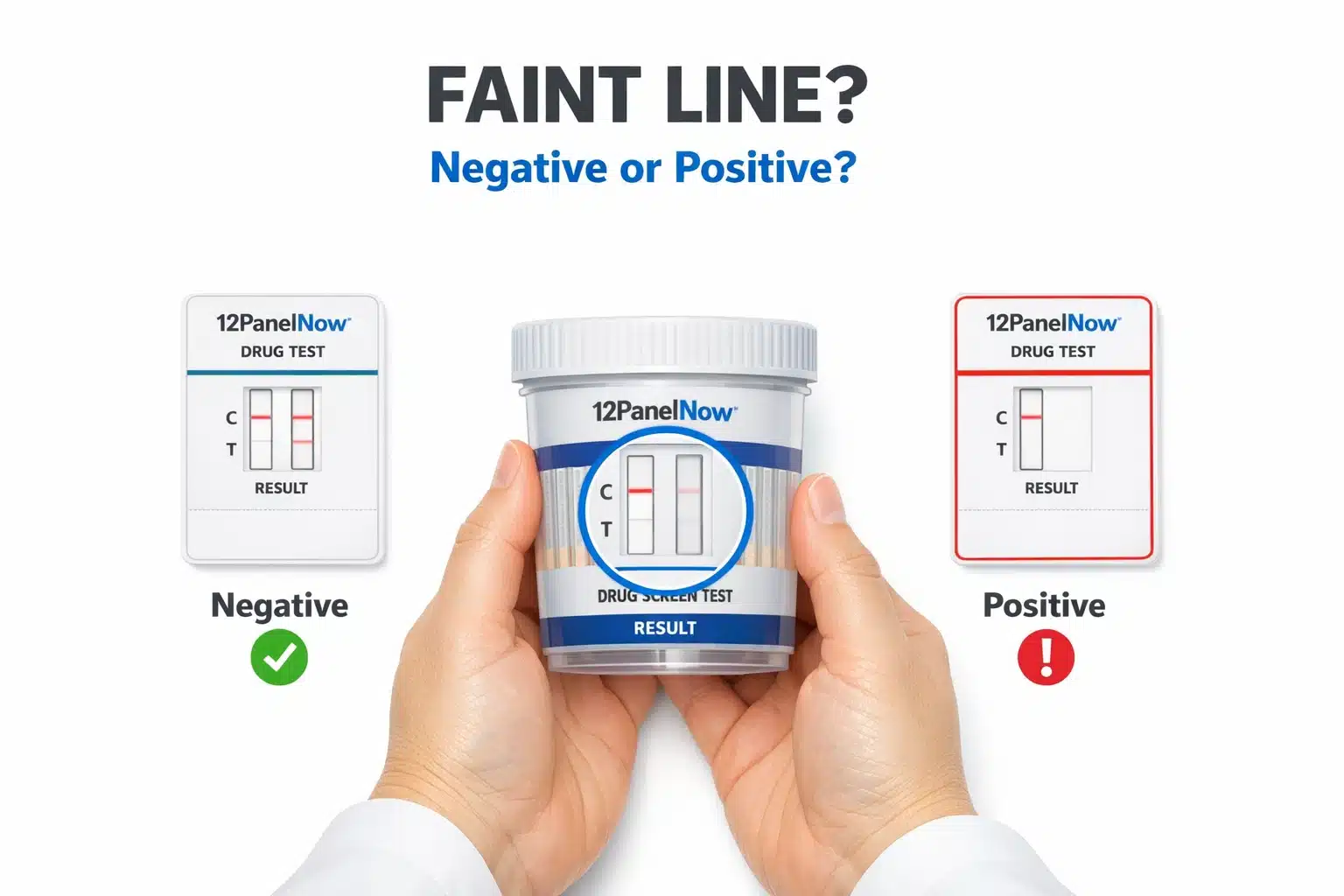
The moment after taking an at-home drug test is often filled with anxiety. You’re holding a small plastic device that could have a major impact on your job, your family, or your personal well-being. But interpreting the results isn’t always as simple as it looks. Faint lines, missing lines, and unexpected positives create confusion when you need clarity the most.
This guide moves beyond generic definitions to provide a clear framework for action. We’ll show you exactly how to read your test, what each result truly means, and the precise next steps to take to protect yourself and make an informed decision.
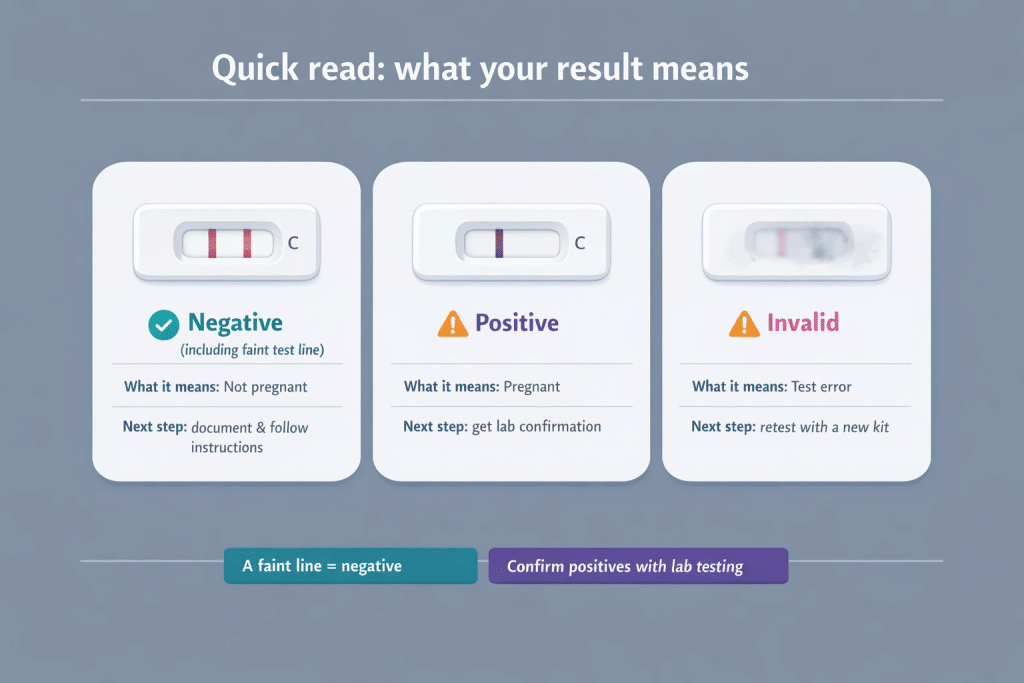
A fast visual key: identify negative, positive, or invalid results at a glance, then follow the recommended next step to reduce mistakes and anxiety.
Decoding your results: the three possible outcomes
Every at-home drug screen will produce one of three results. Understanding the difference is the first step in taking control of the situation.
The most common result: negative (even with a faint line)
A negative result occurs when a line appears in both the control region (C) and the test region (T). The control line confirms the test worked correctly, while the test line indicates the target drug was not detected above the cut-off level.
This is where most of the confusion happens. Many people worry when the test line is faint, assuming it means a small amount of the drug is present. This is incorrect.
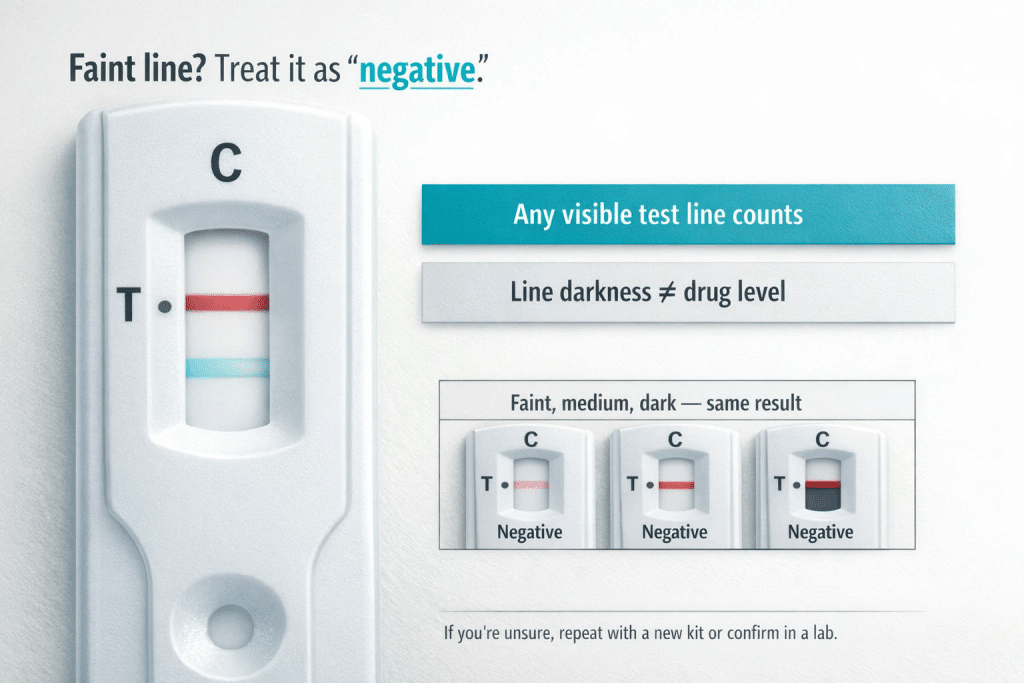
Faint lines cause the most confusion. This visual reinforces the rule: any visible test line is negative, and darkness does not indicate drug concentration.
Unlike a pregnancy test, the intensity or darkness of the test line in a drug screen is irrelevant. Any visible line, no matter how faint, is a negative result. The test is binary; it either detects the substance at a specific concentration or it doesn’t. A faint line simply means you are below that threshold.
The concerning result: positive
A preliminary positive result occurs when a line appears in the control region (C) but no line appears in the test region (T). This indicates the test has presumptively detected the presence of a specific drug metabolite at or above the test’s cut-off level.
It’s crucial to remember that a positive result from an at-home test is not a final verdict. It is a screening result. The FDA strongly recommends that any preliminary positive from a home test be sent to a laboratory for confirmation. We will cover the exact steps for this process later.
The frustrating result: invalid

If the control line is missing, the test is invalid. Use this checklist to spot the cause (dilution, timing, temperature, kit issues) and retest correctly.
An invalid result occurs when the control line (C) does not appear. A missing control line means the test itself has failed and the result, whether positive or negative, cannot be trusted.
There are several common reasons for an invalid test:
- Insufficient Sample: Not enough urine was added to the test.
- Procedural Error: The test was not administered according to the instructions.
- Expired Test: The test kit was used past its expiration date.
- Sample Tampering or Dilution: According to SAMHSA guidelines, an invalid result can be triggered if a sample is too diluted, often indicated by a specific gravity below 1.002. Many modern drug test cups have built-in checks for temperature and adulterants to prevent this.
If your test is invalid, the only solution is to repeat the process with a new test kit, following the instructions carefully.
Your next steps: a crisis management framework
Your result is in. Now what? The actions you take next are critical, especially if you’re facing employment or legal consequences.

A positive home screen is not the final word. This framework shows how to request confirmation testing, document prescriptions, and work with an MRO to protect yourself.
Next steps for a positive result
A preliminary positive requires a calm, methodical response. Do not panic. Instead, use this as a trigger to begin a formal verification process.
- Request Laboratory Confirmation: The gold standard for confirming a drug test is a lab-based method called Gas Chromatography/Mass Spectrometry (GC/MS). This test is far more specific than an at-home screen and can identify the exact substance in the sample. If the test is for employment, your employer is required to offer this confirmatory testing.
- Document Your Prescriptions: Many common prescription medications can trigger a false positive on a screening test. This is known as cross-reactivity. For example, clinical data from the National Institutes of Health shows that up to 41% of unconfirmed amphetamine positives in certain settings were associated with Bupropion (Wellbutrin) use. Other common culprits include certain antidepressants, antihistamines, and pain relievers. Gather all your prescription information, including the medication name, dosage, and prescribing doctor.
- Understand the Role of the Medical Review Officer (MRO): For workplace testing, an MRO is a licensed physician who is responsible for reviewing and verifying drug test results. The MRO is your “secret weapon.” They are required to contact you to determine if there is a legitimate medical explanation for the positive result. This is your opportunity to provide your documented prescription information. The MRO will then verify the prescription with your pharmacy or doctor and may report your result as negative to your employer if a valid explanation is found.
Next steps for a negative or invalid result
If your result was negative, you have the reassurance you were looking for. No further action is required. If you need to perform routine testing, consider keeping reliable drug testing supplies on hand.
If your result was invalid, the process is simple: obtain a new 12-panel drug test cup or another testing device and retest, making sure to follow all instructions precisely.
From uncertainty to action
Reading an at-home drug test can feel overwhelming, but understanding the science behind the lines demystifies the process. Remember that a faint line is a negative, an invalid test requires a do-over, and a positive screen is the beginning of a verification process, not the end of the story. By knowing the rules and preparing your documentation, you can navigate the outcome with confidence and clarity.