Building a Defensible Drug Free Workplace Policy: The 2026 Blueprint

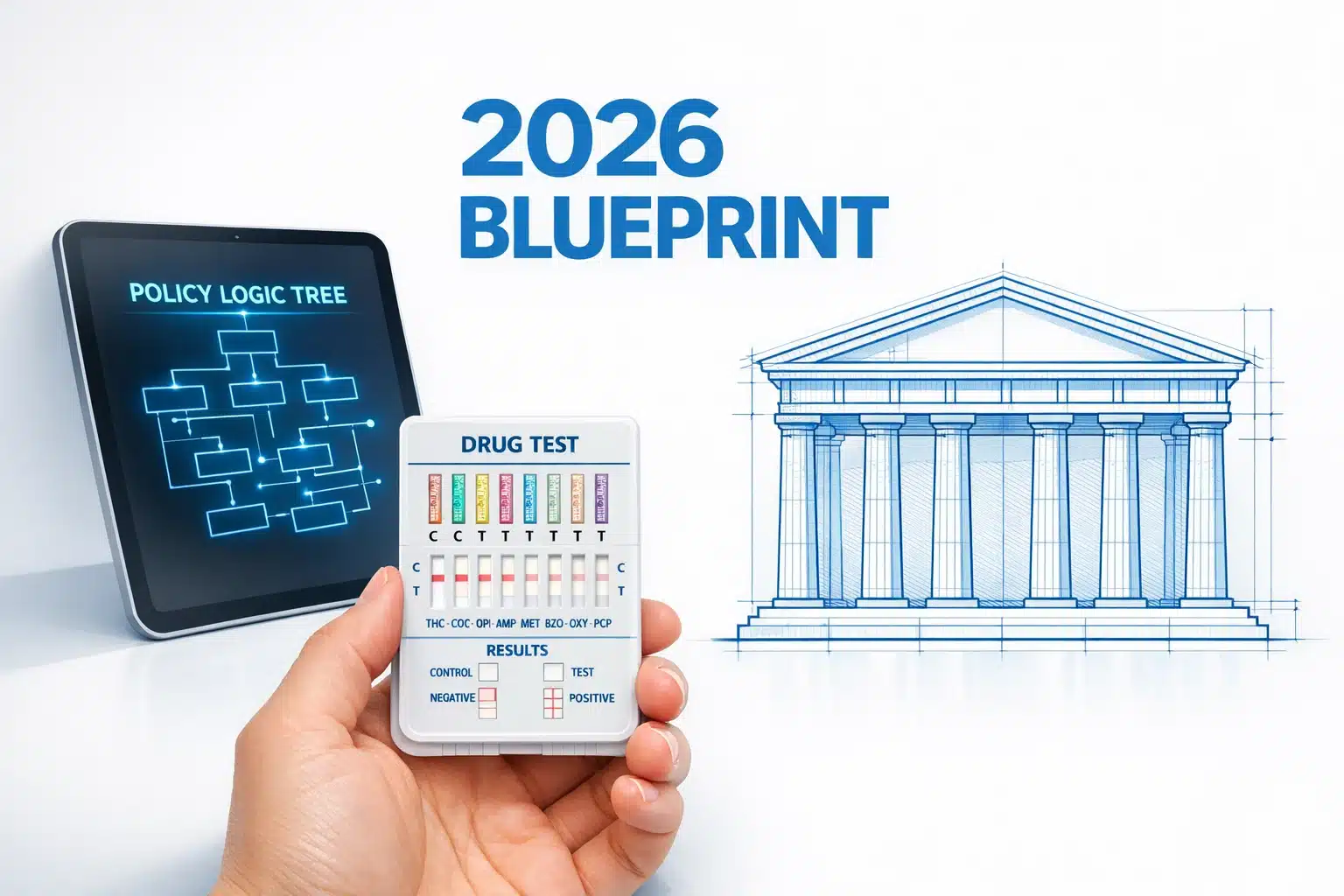
The rate of post-accident marijuana positivity has hit a staggering 7.3%. According to the 2025 Quest Diagnostics Drug Testing Index, this near-record high shows that despite changing laws, the risk of impairment on the job is not just present; it’s increasing. For safety and HR leaders, this isn’t just a statistic. It’s a direct threat to workplace safety, productivity, and legal defensibility.
A “copy-paste” policy from a decade-old template won’t protect your company anymore. Modern policies must address the complex realities of a distributed workforce and the divergence between state and federal cannabis laws. They need a solid architecture, not just a set of rules.
What Is a Drug Free Workplace Policy?
A drug free workplace policy is a formal document that explains an organisation’s approach to preventing workplace impairment, protecting employee safety, and managing workplace drug testing. It establishes clear expectations regarding prohibited conduct, testing procedures, employee responsibilities, confidentiality, and the consequences of policy violations.
An effective policy also protects employers by providing consistent procedures for responding to workplace incidents, documenting testing decisions, and applying disciplinary or supportive measures fairly across the workforce. Rather than focusing solely on enforcement, modern workplace policies increasingly combine education, prevention, employee assistance, and testing within a comprehensive workplace safety programme.
Regular policy reviews help ensure procedures remain aligned with current legislation, industry standards, and emerging workplace risks.
Who Needs a Drug Free Workplace Policy?
Although safety-sensitive industries often receive the greatest attention, virtually every organisation can benefit from maintaining a well-defined drug free workplace policy. Manufacturing, transportation, logistics, construction, healthcare, education, warehousing, energy, government agencies, and retail businesses all face operational risks associated with workplace impairment.
Even organisations with predominantly office-based or remote employees benefit from establishing clear expectations regarding workplace conduct, fitness for duty, prescription medications, cannabis use, and reporting responsibilities. A consistent policy provides managers and employees with a shared understanding of workplace expectations regardless of where work is performed.
The 5 pillars of an audit-proof policy
A strong drug-free workplace program is built on five core pillars. This framework, adapted from federal compliance standards, provides a comprehensive structure that moves beyond simple prohibition to active risk management. It ensures every aspect of your program is documented, communicated, and consistently enforced.

A clear 5-pillar blueprint helps safety and HR teams see what must be written, trained, tested, and documented—plus where to add remote-work and cannabis language.
- Written Policy: The foundational document that clearly outlines expectations, prohibited conduct, testing procedures, and consequences for violations.
- Employee Education: Proactively communicating the policy to all employees, explaining its purpose, their responsibilities, and the dangers of substance use.
- Supervisor Training: Equipping managers to identify and address potential impairment, document observations, and enforce the policy fairly and consistently.
- Drug Testing: The mechanism for verifying compliance, deterring use, and identifying employees who may need assistance. This includes pre-employment, random, post-accident, and reasonable suspicion testing.
- Employee Assistance Program (EAP): Providing a confidential resource for employees to seek help with substance use or other personal issues that could affect their job performance.
Understanding Workplace Drug Testing Within Your Policy
A comprehensive drug free workplace policy should clearly explain when drug testing may occur and why each testing circumstance exists. Employees are more likely to understand and support workplace testing when procedures are transparent, consistently applied, and communicated in advance.
Pre-employment testing helps organisations make informed hiring decisions, while random testing acts as an ongoing deterrent by identifying substance use that may develop after employment begins. Post-accident testing supports incident investigations, reasonable suspicion testing addresses observable impairment, and return-to-duty or follow-up testing assists employees returning to work after treatment or disciplinary action.
Clearly defining these testing categories within the written policy helps reduce uncertainty while supporting fair and consistent implementation across the organisation.
Which path is right for you? A policy logic tree
Before you write a single word, you need to determine your governing framework. Are you a DOT-regulated entity with specific federal mandates, or are you a non-regulated company creating a corporate policy? The answer dictates your policy’s structure, testing requirements, and legal obligations. Misclassifying your business can lead to compliance failures or unnecessary operational burdens.

Use this logic tree to pick the right policy structure fast—then layer in remote-work and cannabis rules so your program stays defensible across locations.
For companies falling under Department of Transportation rules, like those governed by the FMCSA, the policy components are strictly defined by federal regulations like 49 CFR Part 382. For everyone else, you have more flexibility, but that flexibility requires careful thought to ensure your policy is fair, effective, and legally sound.
Benchmarking the best: Nucor’s safety-first vs. Nestlé’s global standard
Many organizations look to industry leaders to see what a “gold standard” policy looks like. Two distinct approaches come from Nucor, the steel manufacturer, and Nestlé, the global food and beverage giant. They highlight the difference between a policy driven by acute safety-critical needs and one designed for global corporate consistency.

Benchmarking works best when you copy the components—not the wording. This comparison isolates the policy choices that drive safety, consistency, and audit readiness.
- The Nucor Model (Safety-First): In high-risk environments like manufacturing, where the workforce positivity rate is 14.6%, policies are often stricter. Nucor is known for its rigorous safety culture, and its drug policy reflects that. This approach typically involves hair testing for its longer detection window and a zero-tolerance stance for safety-sensitive roles. The primary goal is accident prevention.
- The Nestlé Model (Global Standard): For a multinational corporation, the focus shifts to creating a consistent, defensible policy that respects diverse regional laws while upholding a global standard of safety and wellness. This model often emphasizes employee education, robust EAP support, and clear communication to foster a culture of well-being.
The lesson isn’t to copy Nucor or Nestlé. It’s to understand the “why” behind their choices and adopt the principles that align with your company’s specific risks, culture, and operational realities.
The Drug-Free Workplace Act and Employer Compliance
Many employers confuse internal workplace policies with legal compliance obligations. While not every organisation is subject to the Drug-Free Workplace Act, federal contractors and certain grant recipients may be required to maintain formal drug-free workplace programmes that meet specific federal standards.
Employers should also consider guidance issued by agencies such as the Department of Transportation (DOT), Occupational Safety and Health Administration (OSHA), the Department of Health and Human Services (HHS), and the Substance Abuse and Mental Health Services Administration (SAMHSA). These agencies influence workplace drug testing practices, employee safety expectations, and testing procedures across many industries.
For organisations operating across multiple states, employment laws relating to drug testing, privacy, cannabis use, and employee protections may differ significantly. Periodic legal reviews help ensure workplace policies remain compliant while reducing organisational risk.
Navigating the 2026 legal gray zone: Remote work and cannabis
The most significant challenge for modern policies is the intersection of remote work and evolving marijuana laws. Simply stating that “the same rules apply” to remote workers is no longer a sufficient or legally defensible position. How do you handle an employee in a state with legal recreational cannabis when your company is based in a state where it’s illegal?
The answer lies in shifting from a location-based policy to a role-based one. By classifying positions based on their safety sensitivity, you can create clear, enforceable guidelines regardless of where the employee works.

This matrix turns cannabis and remote-work uncertainty into a role-based policy decision—backed by recent positivity and post-accident trend data for stronger legal defensibility.
For safety-sensitive roles, like operating machinery or driving company vehicles, a zero-tolerance policy for substances that cause impairment, including marijuana, is defensible and necessary. For general roles, the focus can be on performance and ensuring employees are not impaired during work hours. Choosing the right drug testing supplies that align with these role-based requirements is critical for consistent policy enforcement.
Implementing a Drug Free Workplace Policy
Developing a comprehensive workplace policy is only the beginning. Successful implementation requires careful planning, clear communication, and ongoing management to ensure policies become part of everyday workplace culture rather than remaining documents stored within employee handbooks.
Employers should introduce policy updates through formal communication, employee acknowledgement procedures, and supervisor training sessions. Explaining why changes are being made—including evolving workplace risks, updated testing panels, and regulatory developments—helps improve understanding and acceptance throughout the organisation.
Annual refresher training provides another opportunity to reinforce policy expectations, educate new employees, review reporting procedures, and address emerging workplace issues such as synthetic opioids, cannabis legislation, or changes in drug testing technology.
Policy implementation should also include periodic internal audits to confirm documentation remains current, supervisors are following established procedures, and workplace drug testing programmes continue aligning with organisational objectives and legal requirements.
The hidden threat: Addressing fentanyl and polysubstance use
While cannabis dominates headlines, a more dangerous threat is quietly growing. According to 2025 data from Psychemedics, fentanyl detection in random drug tests is 700% higher than in pre-employment screens. This alarming statistic reveals a critical vulnerability: some applicants can pass a pre-hire test but begin or resume use once employed.
This makes a robust random testing program more important than ever. It acts as a powerful deterrent and an essential tool for identifying active substance use before it leads to an incident. A pre-employment test is a snapshot in time; a random testing program protects your workplace every day. Implementing this requires access to reliable multi-panel urine cups that can screen for a wide array of substances, including synthetic opioids like fentanyl.
Putting your policy into practice
A well-architected drug-free workplace policy is not a static document you file away. It is a living risk management system that protects your people, your assets, and your reputation. By building it on a solid five-pillar foundation, choosing the right regulatory path, and adapting it to the modern challenges of remote work and polysubstance use, you create a framework that is both fair and defensible.
Now that your policy architecture is clear, the next step is implementation. Explore our range of CLIA-waived and FDA-approved drug testing kits to equip your team with the accurate and affordable tools needed for a safe and compliant workplace.
Common Mistakes Employers Make When Developing a Drug Free Workplace Policy
Many workplace drug policies become outdated because they are only reviewed following a serious workplace incident or regulatory change. Regular policy reviews help employers identify weaknesses before they become organisational risks.
One of the most common mistakes is relying exclusively on pre-employment drug testing. While pre-employment screening remains valuable, ongoing workplace safety often depends on random, reasonable suspicion, post-accident, return-to-duty, and follow-up testing programmes that address substance use throughout employment.
Another frequent issue is failing to update testing panels as drug trends evolve. Traditional workplace drug testing panels may not include fentanyl or other emerging synthetic opioids unless employers specifically request expanded testing options. Reviewing testing panels periodically helps ensure workplace programmes remain relevant.
Employers also sometimes overlook supervisor training, resulting in inconsistent documentation or uncertainty when applying reasonable suspicion procedures. Similarly, failing to educate employees about policy updates may reduce understanding and increase the likelihood of disputes following workplace testing.
Finally, organisations should avoid treating workplace drug testing as a stand-alone programme. Integrating employee education, Employee Assistance Programmes (EAPs), supervisor training, documented procedures, and periodic policy audits creates a more effective and defensible drug free workplace policy.
Maintaining an Effective Drug Free Workplace Policy
The workplace substance use landscape continues to evolve as new synthetic drugs emerge, legislation changes, and testing technologies improve. Organisations that review their policies regularly are generally better positioned to respond to these developments without requiring significant operational changes.
Annual policy reviews provide opportunities to assess whether testing panels remain appropriate, regulatory requirements have changed, employee training materials require updating, and documentation procedures continue supporting organisational objectives. Employers should also evaluate whether remote work arrangements, safety-sensitive positions, or operational changes require revisions to existing policies.
Maintaining open communication between human resources, safety professionals, occupational health providers, legal advisors, and senior leadership helps ensure workplace drug policies remain practical, legally defensible, and aligned with broader organisational risk management strategies.