Does Caffeine Show Up on a Drug Test?

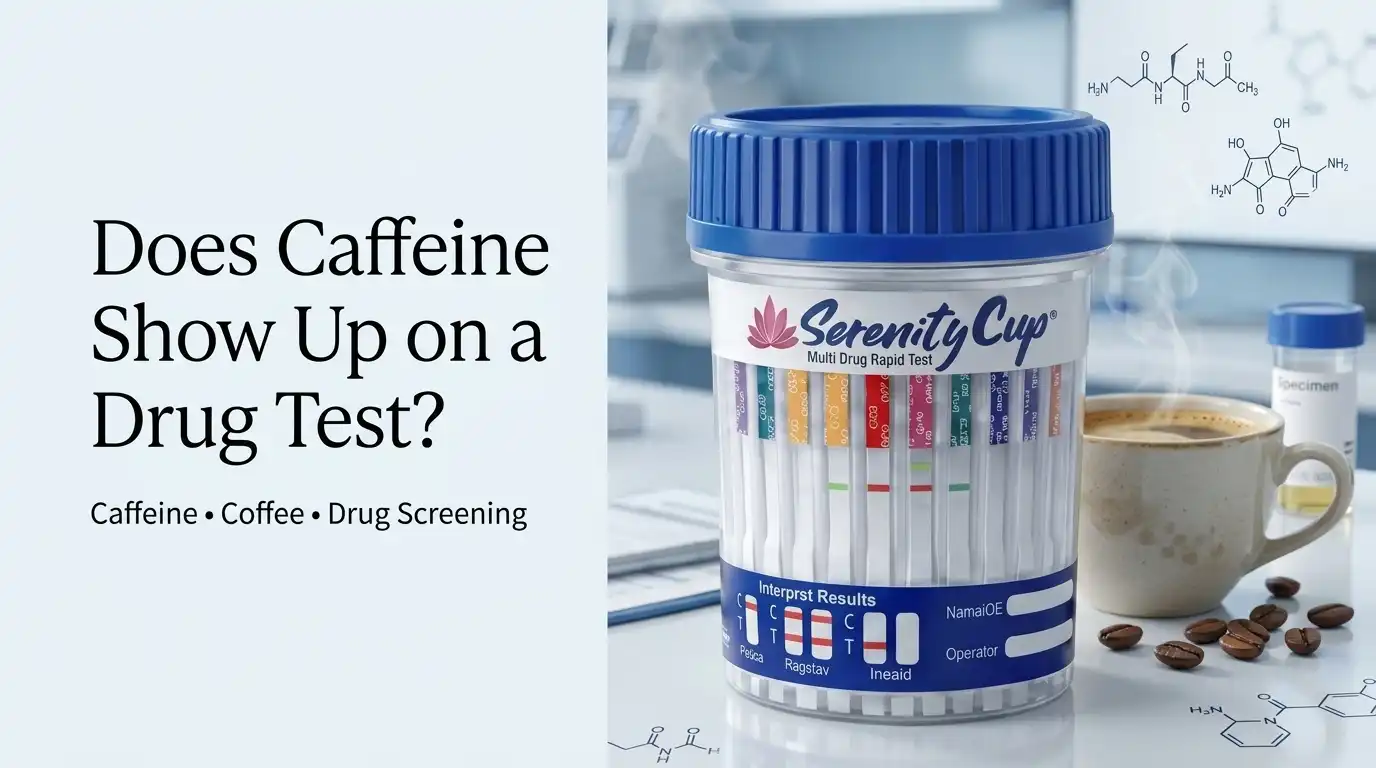
If you drink coffee, tea, energy drinks, or other caffeinated products regularly, you may wonder whether caffeine can affect an upcoming drug test. The good news is that caffeine is not normally included in standard drug-testing panels and does not typically cause a positive result on a routine drug screen.
Standard drug tests are designed to detect specific drugs or their metabolites, such as THC, cocaine, amphetamines, opioids, PCP, and other substances depending on the panel being used. Caffeine is a legal and widely consumed stimulant, so it is generally outside the scope of routine workplace drug screening.
There is an important distinction, however: caffeine can be measured with specialized laboratory testing when specifically requested. That is different from a standard employment or multi-panel drug test.
Understanding that difference can help explain why coffee can be detected by certain laboratory methods but still have no effect on the result of a routine drug screen.
What Does a Standard Drug Test Look For?
A drug test does not analyze every chemical present in your body. Instead, the laboratory looks for specific substances or metabolites included in the testing panel.
Depending on the test, common targets can include:
- THC or marijuana metabolites
- Cocaine metabolites
- Amphetamines
- Methamphetamine
- Opioids or opiates
- PCP
- Benzodiazepines
- Barbiturates
- Methadone
- Buprenorphine
- Oxycodone
- MDMA
The exact substances depend on the test panel, laboratory, employer, healthcare provider, or other organization ordering the test.
For example, a 5-panel, 10-panel, and 12-panel test do not necessarily contain exactly the same substances. The number of panels refers to the particular group of analytes being tested rather than every possible chemical a person may have consumed.
Why Isn’t Caffeine Included in Most Drug Tests?
Caffeine is not normally included because routine drug testing is designed around specific substances of interest rather than commonly consumed dietary compounds.
Coffee, tea, energy drinks, and other caffeinated products are widely used by the general population. A routine workplace drug screen therefore generally has no reason to report ordinary caffeine consumption.
The important point is that being a stimulant does not automatically make a substance part of a drug-testing panel.
Caffeine and amphetamines, for example, can both have stimulant effects, but they are chemically different compounds and are analyzed differently.
Can You Drink Coffee Before a Drug Test?
For a standard drug test, an ordinary amount of coffee is not expected to produce a positive result.
If you normally drink coffee in the morning, the caffeine itself is not a reason to assume that your drug test will become positive.
There is one separate issue to understand with urine testing: excessive fluid consumption can dilute a urine specimen.
Laboratories may evaluate urine characteristics such as:
- Creatinine
- Specific gravity
- pH
These measurements can help determine whether a specimen is unusually dilute or otherwise unsuitable for interpretation.
That means the concern is not that coffee “masks” drugs or that caffeine changes a drug into another substance. Rather, consuming unusually large amounts of liquid before providing a urine sample can affect specimen concentration.
Does Coffee Cause a False Positive?
Normal coffee consumption is not expected to cause a confirmed positive result for the drugs targeted by a standard drug screen.
Initial drug screening can sometimes produce presumptive positive results because immunoassay methods are designed to screen for particular drug classes and may occasionally cross-react with certain compounds.
That is why an unexpected screening result may require more specific laboratory testing.
Confirmatory methods can include:
- Gas chromatography-mass spectrometry (GC-MS)
- Liquid chromatography-tandem mass spectrometry (LC-MS/MS)
These methods can provide much greater analytical specificity than an initial screening assay.
Therefore, if an unexpected result occurs, caffeine should not automatically be assumed to be the explanation.
Can Caffeine Cause an Amphetamine False Positive?
Caffeine is not normally responsible for a confirmed amphetamine or methamphetamine positive.
The fact that both caffeine and amphetamines have stimulant effects does not mean that a drug screen treats them as the same substance.
Drug-testing assays are designed around specific chemical targets. If an initial screen produces an unexpected result, confirmatory testing can help determine which compound is actually present.
This distinction is particularly important when discussing false positives: a presumptive screening result is not necessarily the same thing as a confirmed laboratory identification.
Does Caffeine Show Up in Urine?
Caffeine and its metabolites can be present in urine after consumption and can be measured using appropriate laboratory methods.
That does not mean caffeine will appear as a positive result on a routine urine drug screen.
After consumption, caffeine is metabolized primarily in the liver. Major metabolites include:
- Paraxanthine
- Theobromine
- Theophylline
Some caffeine and its metabolites are eventually eliminated through urine.
A specialized laboratory can specifically look for these compounds. A routine drug screen, however, generally has a predefined list of target substances and does not normally include caffeine.
This creates an important distinction:
Caffeine can be detectable in urine without being part of a routine urine drug test.
How Long Does Caffeine Stay in Your System?
Caffeine is absorbed relatively quickly after consumption and is then metabolized and eliminated over time.
Its half-life is commonly measured in hours, but the exact rate differs between individuals.
Factors that can influence caffeine metabolism include:
- Age
- Pregnancy
- Liver function
- Certain medications
- Smoking
- Individual metabolic differences
- Amount consumed
Because of this variability, there is no single exact number of hours that applies to everyone.
It is also important not to confuse caffeine’s elimination with the detection window of a routine drug test. A standard drug screen generally isn’t looking for caffeine in the first place.
How Is Caffeine Metabolized?
Most caffeine metabolism occurs in the liver, with the enzyme CYP1A2 playing an important role.
The body converts caffeine into several metabolites, with paraxanthine being the major metabolite.
Paraxanthine
Paraxanthine is the primary caffeine metabolite produced in humans.
Theobromine
Theobromine is another caffeine metabolite and is also naturally found in foods such as cocoa.
Theophylline
Theophylline is produced in smaller amounts during caffeine metabolism and has its own pharmacological effects.
These compounds are different from the target drugs commonly included in workplace drug-testing panels.
Does Caffeine Show Up on a 5-Panel Drug Test?
A standard 5-panel drug test does not normally include caffeine.
Traditional five-panel testing commonly focuses on major drug categories such as:
- Marijuana/THC
- Cocaine
- Amphetamines
- Opioids/opiates
- PCP
Exact test configurations can vary, but caffeine is generally outside the standard panel.
Does Caffeine Show Up on a 10-Panel Drug Test?
Caffeine is also generally not included in standard 10-panel drug-testing configurations.
A 10-panel test expands the number of substances being screened, but it still only tests for the analytes included in that particular panel.
Depending on the test, additional drug classes may include substances such as benzodiazepines, barbiturates, methadone, or other specified drugs.
The exact contents should always be confirmed with the laboratory or testing provider.
Does Caffeine Show Up on a 12-Panel Drug Test?
A standard 12-panel drug test generally does not target caffeine.
A 12-panel test can include a broader selection of substances than a basic panel. Depending on the product or testing program, targets can include drugs such as:
- THC
- Amphetamines
- Cocaine
- Opiates
- Benzodiazepines
- Barbiturates
- Methadone
- Buprenorphine
- Oxycodone
- PCP
- MDMA
- Tricyclic antidepressants
The exact combination varies between test products and laboratories.
The important point is that a 12-panel test is not a test for every substance in someone’s body.
Do Energy Drinks Affect Drug Tests?
The caffeine contained in ordinary energy drinks is not normally targeted by standard drug screens.
Energy drinks can contain several other ingredients, however, including:
- Taurine
- Guarana
- B vitamins
- Herbal extracts
- Sweeteners
- Other stimulant ingredients
For routine drug testing, caffeine itself is generally not the issue.
If you regularly use energy drinks, pre-workout products, or stimulant supplements, checking the complete ingredient list can be useful because formulations vary considerably.
What About Pre-Workout Supplements?
Pre-workout products often contain caffeine along with several other ingredients.
A typical formulation may contain:
- Caffeine
- Creatine
- Beta-alanine
- Amino acids
- Herbal ingredients
- Other stimulants
Caffeine itself is not normally included in a routine workplace drug panel.
However, specialized athletic testing can follow different rules from ordinary employment screening. Athletes who are subject to anti-doping regulations should therefore consider the rules of their specific organization and the ingredients in any supplement they use.
Can a Specialized Test Detect Caffeine?
Yes.
A laboratory can specifically measure caffeine or caffeine metabolites using analytical methods designed for that purpose.
Specialized caffeine testing may be used in situations such as:
- Research
- Clinical investigations
- Forensic toxicology
- Poisoning investigations
- Pharmacokinetic studies
- Specialized laboratory analysis
This is very different from a routine workplace drug screen.
A useful way to understand the difference is:
Standard drug screen: tests for selected drugs or metabolites.
Caffeine-specific analysis: specifically looks for caffeine or caffeine-related compounds.
The fact that a laboratory can detect caffeine does not mean that caffeine is part of a routine drug-testing panel.
Caffeine Detection vs. Drug-Test Detection
This is one of the most important distinctions when discussing this topic.
A substance can be chemically detectable without being included in a particular drug test.
For example, a laboratory may have the equipment and methodology to measure caffeine in urine or blood. But if the ordered test is designed to detect THC, cocaine, amphetamines, opioids, and PCP, the laboratory is not necessarily testing that specimen for caffeine.
In other words:
Detectable does not automatically mean tested.
This explains why caffeine can exist in the body and even be measurable through specialized laboratory analysis while still having no impact on the result of a routine drug screen.
Can Caffeine Affect a Urine Drug Test?
Caffeine itself does not normally interfere with the target analytes of a standard urine drug screen.
The more relevant issue is excessive fluid intake.
Drinking very large amounts of liquid shortly before a urine test can result in a specimen with unusually low concentrations of certain urine components. Specimen validity testing can identify characteristics associated with dilution.
This is why drinking excessive amounts of coffee, water, energy drinks, or other liquids should not be viewed as a way to alter a drug test.
The testing process can evaluate specimen characteristics independently of the drug screen.
Does Coffee Flush Drugs Out of Your System?
No.
Coffee should not be considered a detoxification method for drug metabolites.
Caffeine does not selectively remove THC metabolites, cocaine metabolites, amphetamines, opioids, or other substances from the body.
Drug detection depends on multiple factors, including:
- Substance used
- Dose
- Frequency of use
- Time since exposure
- Metabolism
- Specimen type
- Laboratory method
- Cutoff concentration
- Individual biological variation
Caffeine does not override these factors.
Does Stopping Caffeine Help With a Drug Test?
There is generally no reason to stop drinking caffeine simply because you are concerned about caffeine being detected on a routine drug screen.
Caffeine is not normally one of the target analytes in standard workplace drug testing.
Stopping coffee also does not eliminate unrelated drug metabolites from the body.
If you take prescription medication, you should not stop or change prescribed treatment solely because you have an upcoming drug test unless your healthcare professional advises you to do so.
What About Caffeine Pills?
Caffeine tablets contain concentrated caffeine, but caffeine itself is still not normally included in standard drug panels.
However, concentrated caffeine products can deliver much more caffeine than ordinary beverages. Following the product’s directions is important.
Excessive caffeine consumption can cause symptoms such as:
- Jitteriness
- Restlessness
- Anxiety
- Headache
- Rapid heartbeat
- Sleep problems
- Nausea
These effects are separate from whether caffeine is included in a drug-testing panel.
Does Decaf Coffee Contain Caffeine?
Yes.
Decaffeinated coffee is not completely caffeine-free. It generally contains substantially less caffeine than regular coffee, but small amounts can remain.
That does not normally matter for a standard drug test because caffeine itself is not usually one of the substances being screened.
What If You Take Prescription Medication?
Caffeine itself generally does not cause a positive drug-test result simply because it is consumed alongside prescription medication.
Some medications, however, can affect certain drug-screening assays or produce presumptive positive results depending on the test method.
If you receive an unexpected result, provide the testing program or Medical Review Officer with accurate information about prescriptions and other relevant medications.
Do not discontinue a prescribed medication simply because you are concerned about a drug test.
What Can Actually Affect a Drug Test Result?
Several factors can influence how a drug test is interpreted.
The substance being tested
Different drugs have different metabolic pathways and detection characteristics.
The specimen type
Drug testing may use:
- Urine
- Oral fluid
- Blood
- Hair
Each specimen has different properties and detection characteristics.
The testing panel
Different panels test for different substances.
Cutoff concentrations
Laboratories use defined analytical thresholds when interpreting test results.
Time since exposure
Drug and metabolite concentrations change over time.
Individual metabolism
Metabolic rates differ between people.
Medications and supplements
Some substances can interfere with certain screening assays or produce presumptive positive results.
Specimen validity
For urine testing, measurements such as creatinine, specific gravity, and pH can help evaluate specimen characteristics.
Common Myths About Caffeine and Drug Tests
Myth: Caffeine is a stimulant, so it will test as an amphetamine.
Caffeine and amphetamines are chemically different substances. Drug tests are designed to identify specific target compounds rather than simply detecting whether something has stimulant effects.
Myth: Coffee can make you fail a drug test.
Normal coffee consumption is not expected to produce a positive result on a standard drug screen.
Myth: You need to stop drinking coffee several days before testing.
There is generally no need to stop caffeine solely because of concern about a routine drug screen detecting it.
Myth: Caffeine flushes drugs from urine.
Caffeine is not a reliable method for removing drugs or drug metabolites from the body.
Myth: If caffeine can be detected in urine, it must be part of a urine drug test.
A laboratory can detect a compound without that compound being included in the ordered drug-testing panel.
Myth: A 12-panel test checks everything.
A multi-panel test checks the specific substances included in that particular panel. It does not automatically test every chemical present in a specimen.
Caffeine vs. Common Drug-Test Targets
| Substance | Normally included in routine drug testing? | Can specialized testing detect it? |
|---|---|---|
| Caffeine | Generally no | Yes |
| THC/metabolites | Depending on panel | Yes |
| Cocaine/metabolites | Depending on panel | Yes |
| Amphetamines | Depending on panel | Yes |
| Opioids/opiates | Depending on panel | Yes |
| PCP | Depending on panel | Yes |
| Benzodiazepines | Depending on panel | Yes |
| Methadone | Depending on panel | Yes |
| Buprenorphine | Depending on panel | Yes |
The key difference is between what a laboratory can detect and what the ordered drug panel is designed to detect.
Frequently Asked Questions
Does caffeine show up on a standard drug test?
No. Caffeine is generally not included in standard workplace drug-testing panels, so ordinary caffeine consumption does not normally produce a positive result.
Does coffee show up on a urine drug test?
No. Coffee and its caffeine content are not normally reported by a standard urine drug screen.
Can I drink coffee before a drug test?
An ordinary amount of coffee is not expected to cause a positive result on a standard drug test. Avoid excessive fluid consumption before providing a urine specimen because unusually dilute urine can affect specimen validity.
Can caffeine cause a false positive for amphetamines?
Normal caffeine consumption is not expected to cause a confirmed amphetamine positive. Unexpected screening results may require more specific confirmatory testing.
Does caffeine show up on a 5-panel drug test?
Caffeine is generally not included in a standard 5-panel drug test.
Does caffeine show up on a 10-panel drug test?
Caffeine is generally not included in standard 10-panel configurations.
Does caffeine show up on a 12-panel drug test?
Caffeine is generally not included in standard 12-panel drug tests, although exact panel contents vary.
Do energy drinks affect drug tests?
The caffeine in energy drinks does not normally cause a positive result on a standard drug screen. Other ingredients may vary between products.
Can caffeine be detected in urine?
Yes. Specialized laboratory methods can measure caffeine or its metabolites in urine, but this is different from a routine urine drug screen.
How long does caffeine stay in your system?
Caffeine’s half-life is generally measured in hours, but elimination varies based on factors such as age, pregnancy, liver function, medications, smoking, and individual metabolism.
Does decaf coffee contain caffeine?
Yes. Decaffeinated coffee can still contain small amounts of caffeine.
Can caffeine make you fail a drug test?
Normal caffeine consumption is not expected to make you fail a standard drug test.
Can a laboratory specifically test for caffeine?
Yes. Specialized laboratory testing can measure caffeine and its metabolites when caffeine analysis is specifically requested.
Final Takeaway
Caffeine does not normally show up on a standard drug test. Routine drug screens are designed to identify specific drugs and metabolites included in the selected testing panel, rather than every substance a person has consumed.
Coffee, tea, energy drinks, and ordinary caffeine products therefore do not typically cause a positive result simply because they contain caffeine.
The important distinction is that caffeine can be detected through specialized laboratory testing, but a caffeine-specific analysis is not the same as a routine workplace drug screen.
If you are concerned about a particular test, the most accurate information comes from the organization or laboratory administering it because panel contents, specimen types, and testing procedures can vary.