Does Citalopram Show Up on a Drug Test?

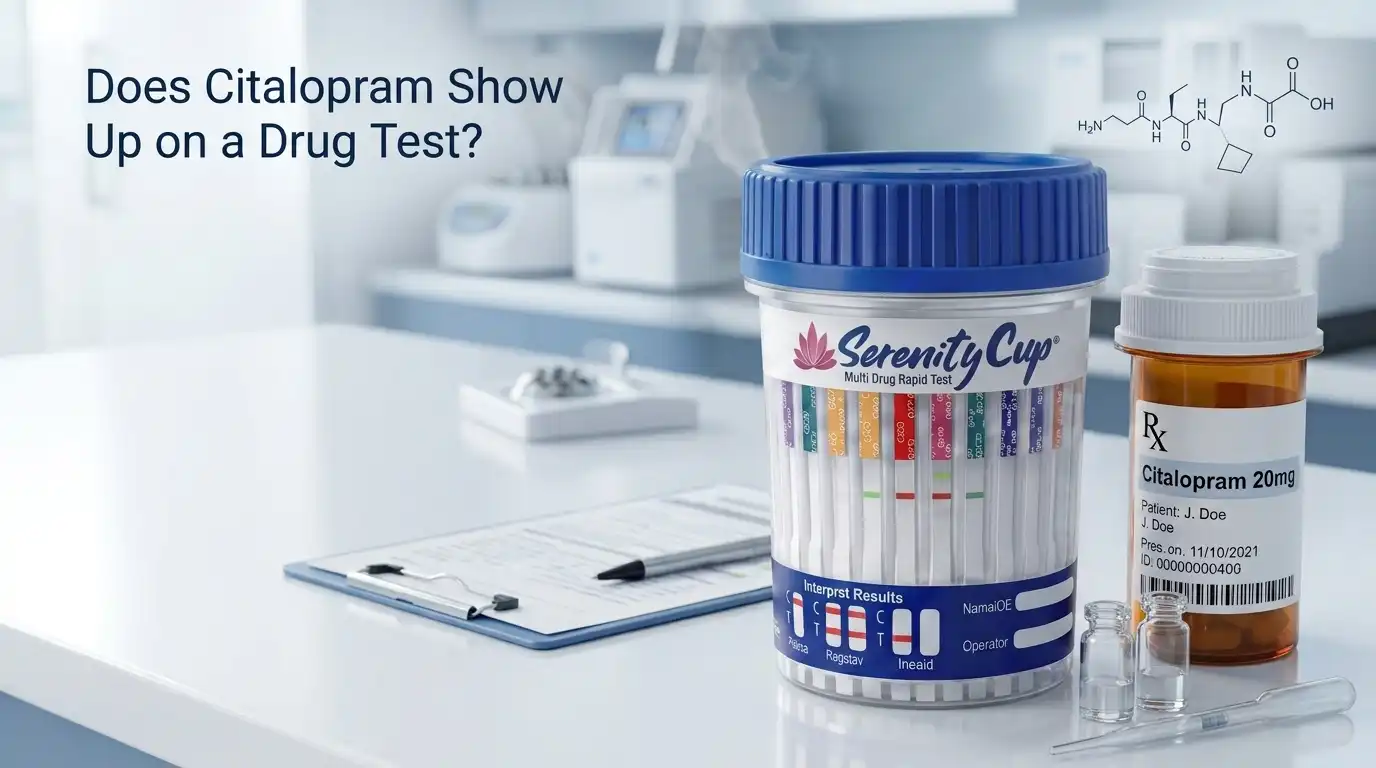
If you take citalopram (Celexa) and have an upcoming drug test, it is reasonable to wonder whether the medication will appear on the results. Citalopram is generally not one of the substances targeted by standard workplace drug-screening panels. However, a drug test can be designed specifically to detect citalopram, and the possibility of an unexpected screening result depends on the particular test and laboratory method being used.
The key distinction is between a standard drug screen and a laboratory test specifically looking for citalopram. Standard workplace testing focuses on defined drug categories rather than testing for every prescription medication. For example, current federal workplace testing programs include categories such as amphetamines, cocaine, marijuana, opioids/opiates, and PCP. Citalopram is not one of those routine federal target categories.
If you take citalopram as prescribed, you should not stop or change your medication simply because you have a drug test. If you are concerned about a test result, tell the appropriate testing professional or your healthcare provider about your prescription.
Does Citalopram Show Up on a Drug Test?
Usually, no—not on a standard drug test.
Citalopram is a selective serotonin reuptake inhibitor (SSRI) antidepressant. Standard drug-screening panels are designed to look for particular drugs or drug metabolites, and citalopram is generally not included among the routine targets.
However, this does not mean that citalopram is impossible to detect.
A laboratory can perform specialized testing designed to identify particular prescription medications. The result therefore depends on what substances the laboratory was instructed to test for and which analytical method it uses.
What Is Citalopram?
Citalopram is a prescription antidepressant belonging to the selective serotonin reuptake inhibitor (SSRI) class. It is commonly sold under the brand name Celexa.
Like other SSRIs, citalopram works primarily by affecting serotonin signaling in the brain. It is prescribed for conditions such as depression and may be used in other circumstances according to a healthcare professional’s judgment.
Citalopram is different from the substances that routine workplace drug panels are primarily designed to identify.
That difference is important when interpreting a drug-test result.
Why Doesn’t Citalopram Usually Show Up on a Standard Drug Test?
A drug test does not automatically search for every chemical present in someone’s body.
Instead, a laboratory normally uses a defined testing panel. The panel specifies which drugs, metabolites, or drug classes are being evaluated.
Current federal workplace testing information from the Substance Abuse and Mental Health Services Administration (SAMHSA) describes five major federal drug categories: amphetamines, cocaine, marijuana, opioids/opiates, and PCP. Federal programs can also authorize additional testing under specified circumstances.
Citalopram is not part of those routine federal target categories.
Therefore:
Taking citalopram does not normally produce a positive result for one of the standard drugs simply because citalopram is present in the body.
This is different from saying that no laboratory test could ever detect citalopram.
Does Citalopram Show Up on a Urine Drug Test?
A routine urine drug screen generally does not test for citalopram.
Urine is commonly used for drug testing because it can contain drugs or their metabolites after the body has processed them. But the laboratory still has to select the substances being tested.
SAMHSA notes that drug-testing programs vary according to the substances being tested and the specimen collected. Federal programs currently authorize urine and oral-fluid testing, while other testing contexts can use different specimen types.
So if a routine urine drug screen is checking its usual target categories, citalopram generally isn’t one of the analytes being sought.
Important distinction
A urine specimen can contain citalopram or its metabolites without the test reporting a positive result for citalopram.
Why?
Because presence in a specimen and inclusion in the testing panel are two different things.
Is Citalopram Included in a 5-Panel Drug Test?
A typical 5-panel drug test is designed around a specified group of commonly screened drug categories.
For example, federal workplace testing currently includes:
- Amphetamines
- Cocaine
- Marijuana
- Opioids/opiates
- PCP
The exact composition of a commercially marketed “5-panel” test can vary by provider and testing program, so it is important to check the actual panel rather than assuming that every test with the same label is identical.
Citalopram is not one of the routine federal five drug categories.
Is Citalopram Included in a 10-Panel Drug Test?
Generally, citalopram is not a routine target simply because a test is called a 10-panel test.
A 10-panel test usually expands the number of drug categories being examined, but there is no universal rule that every “10-panel” test contains exactly the same substances.
The testing provider, employer, healthcare facility, laboratory, or other organization determines what the particular panel includes.
Therefore, if someone needs to know whether citalopram is included, the most reliable approach is to check the actual test panel or laboratory order.
Can Citalopram Cause a False Positive on a Drug Test?
This question requires more nuance than simply answering yes or no.
Citalopram is not normally targeted by standard drug-screening panels, but immunoassay results can depend on the particular assay and substances involved.
Initial drug screens commonly use screening methods that are designed to recognize particular drug classes. These tests are useful for screening, but an unexpected result may require more specific laboratory testing.
A false-positive or unexpected screening result can occur when a substance interferes with an assay or produces cross-reactivity.
That is why an initial screening result should not always be interpreted as definitive evidence of exposure to a particular drug.
What Is Cross-Reactivity?
Cross-reactivity occurs when a substance other than the intended target interacts with the antibodies or detection system used in an immunoassay.
In simple terms, the screening test is looking for a particular chemical pattern. Another substance may sometimes interact with that test enough to produce an unexpected signal.
Importantly, cross-reactivity is assay-specific.
That means a result obtained using one manufacturer’s test system cannot automatically be assumed to occur with every other drug test.
This is one reason that statements such as “citalopram can never cause a false positive” are unnecessarily absolute.
Can Citalopram Show Up as an Amphetamine?
Citalopram is not an amphetamine and is not normally reported as an amphetamine simply because someone takes citalopram.
Amphetamine screening is intended to identify particular amphetamine-related substances or their metabolites.
If an unexpected amphetamine screening result occurs, the result can require further laboratory evaluation. The testing method, cutoff, specimen and confirmation procedure all matter.
A screening result should therefore not automatically be interpreted as proof that citalopram caused the result.
Can Citalopram Show Up as a Benzodiazepine?
Citalopram is not a benzodiazepine.
Standard benzodiazepine testing is designed to detect specific benzodiazepine drugs or related metabolites.
If a screening test produces an unexpected benzodiazepine result, the appropriate interpretation depends on the specific assay and subsequent laboratory testing.
Citalopram should not simply be assumed to be the explanation for an unexpected result.
Can Citalopram Show Up as an Opioid?
Citalopram is not an opioid.
Routine opioid testing targets specific opioid drugs or metabolites. Federal workplace testing includes several opioid-related analytes, but citalopram is not part of that category.
If an unexpected opioid screening result occurs, confirmatory laboratory testing can help establish what substance is actually present.
How Long Does Citalopram Stay in Your System?
Citalopram has an elimination half-life of approximately 35 hours according to FDA labeling. Its metabolism produces compounds including desmethylcitalopram and didesmethylcitalopram.
However, half-life should not be confused with a guaranteed drug-test detection window.
A drug’s half-life describes how its concentration decreases over time. It does not tell you exactly when a particular drug test will become negative.
Detection can depend on factors such as:
- The substance being measured
- The testing method
- The laboratory’s cutoff
- The specimen type
- Dose and dosing history
- Individual metabolism
- Kidney and liver function
- Whether the test is looking for the parent drug or a metabolite
For this reason, it would be misleading to give everyone a single guaranteed number of days during which citalopram can or cannot be detected.
Citalopram Metabolism
Citalopram is metabolized in the body into several compounds.
FDA labeling identifies:
- Desmethylcitalopram
- Didesmethylcitalopram
- Citalopram-N-oxide
- A deaminated propionic-acid derivative
The FDA labeling also identifies CYP3A4 and CYP2C19 as important enzymes involved in citalopram metabolism.
This pharmacology is relevant when discussing specialized laboratory testing, but it should not be used to predict an individual’s exact drug-test result.
Can a Drug Test Specifically Detect Citalopram?
Yes.
A laboratory can use a targeted or expanded toxicology test when citalopram itself or its metabolites are specifically being investigated.
This is different from a routine workplace screening panel.
For example, specialized laboratory testing can use highly specific analytical techniques to identify particular compounds. Depending on the laboratory and purpose of testing, these may include techniques such as:
- Liquid chromatography
- Mass spectrometry
- LC-MS/MS
- Other validated toxicology methods
The important point is:
Citalopram not being part of a routine drug panel does not mean that citalopram is chemically undetectable.
It means the routine panel generally isn’t looking for it.
Standard Drug Screen vs. Specialized Citalopram Testing
| Testing situation | Is citalopram normally targeted? |
|---|---|
| Routine workplace drug screen | Generally no |
| Standard urine drug panel | Generally no |
| Standard federal workplace panel | No, not among the routine target categories |
| Expanded toxicology testing | Potentially |
| Targeted medication testing | Yes, if specifically ordered |
| Therapeutic drug monitoring | Yes, when clinically indicated |
| Forensic toxicology | Potentially, depending on the investigation |
Federal workplace testing programs specify which substances are authorized for routine testing, while specialized clinical and forensic testing can have different purposes.
What Is the Difference Between a Screening Test and a Confirmatory Test?
This distinction is important.
Initial screening
An initial drug screen is designed to quickly identify specimens that may contain a target substance or related compound.
Immunoassays are commonly used for screening because they can process specimens efficiently.
But screening results can sometimes be affected by cross-reactivity.
Confirmatory testing
A more specific analytical method can then be used to determine what compound is actually present.
Techniques based on chromatography and mass spectrometry can provide much greater chemical specificity.
SAMHSA’s federal testing framework distinguishes initial testing from subsequent testing and establishes laboratory procedures for specimens requiring further analysis.
Why this matters
An unexpected initial result should not automatically be treated as definitive proof that someone took the drug named by the screening assay.
The testing process and any required confirmation matter.
What Should You Do If Your Drug Test Is Unexpectedly Positive?
If a drug screen produces an unexpected result while you are taking a prescription medication such as citalopram:
1. Tell the appropriate testing professional about your prescription
Provide accurate information about medications you are taking when asked.
2. Do not stop your medication on your own
A drug test is not a reason to abruptly discontinue a prescribed antidepressant. Medication changes should be discussed with the prescribing healthcare professional.
3. Ask whether confirmatory testing is performed
If an initial screening result is unexpected, ask the testing provider what confirmation process applies.
4. Keep relevant prescription information available
The testing organization or medical review process may need medication information to properly interpret a result.
5. Follow the rules of the specific testing program
Workplace, clinical, legal and forensic testing can have different procedures.
SAMHSA notes that federal workplace programs use medical review and established laboratory procedures for drug-test results.
Does Citalopram Affect Drug Test Results?
For a routine drug screen, citalopram generally isn’t a target analyte, so taking the medication does not ordinarily cause the test to report citalopram as one of the standard drugs being screened.
However, the possibility of assay interference cannot be discussed as though every drug test behaves identically.
Different laboratories may use different:
- Assays
- Antibodies
- Cutoffs
- Testing platforms
- Confirmation methods
Therefore, an unexpected result needs to be interpreted in the context of the actual test used.
Does Celexa Show Up on a Drug Test?
Celexa is the brand name for citalopram, so the answer is essentially the same.
Celexa/citalopram is generally not included among the routine drugs targeted by standard workplace drug screens.
A specialized laboratory test can nevertheless be designed to measure citalopram.
Does Citalopram Show Up on a Drug Test for Employment?
For a typical employment drug screen, citalopram is generally not one of the routine substances being tested for.
However, employment drug-testing programs are not all identical.
The employer, laboratory and applicable regulations determine:
- Which drugs are tested
- Which specimen is collected
- Which cutoff levels apply
- How unexpected results are reviewed
- Whether additional testing is performed
SAMHSA specifically notes that workplace testing programs should establish what substances are tested and how results are handled.
Does Citalopram Show Up on a Drug Test for a Doctor or Hospital?
Clinical testing is different from employment testing.
A physician may order a test for a specific medication for a particular medical reason. In that situation, the laboratory may deliberately look for citalopram or its metabolites.
This is sometimes referred to as therapeutic drug monitoring (TDM) when drug concentrations are being measured for clinical purposes.
Therefore, the answer depends heavily on why the test was ordered.
Why the Purpose of the Test Matters
There is no single test called simply “a drug test.”
Different tests can have very different purposes.
Workplace screening
Usually focused on specified drugs relevant to the employer’s testing program.
Clinical testing
May investigate medication levels, adherence, toxicity or other medical questions.
Forensic toxicology
May investigate drugs or medications in circumstances such as poisoning, overdose or other legal investigations.
Research testing
May measure drug concentrations or metabolites as part of a scientific study.
A person could therefore have the same urine sample analyzed in completely different ways depending on the purpose of the test.
Citalopram and Drug Testing: What Matters Most?
When trying to understand whether citalopram will appear on a particular test, consider these five questions:
1. What type of test is being performed?
Urine, oral fluid, blood and other specimens can be used in different testing contexts.
2. What drugs are included in the panel?
The name of the panel alone may not tell you everything.
3. Is citalopram specifically listed?
A targeted test can be different from a routine screening panel.
4. Was the result an initial screen or a confirmed result?
A preliminary screening result can require additional testing.
5. What laboratory method was used?
The analytical method can affect specificity and interpretation.
Frequently Asked Questions
Does citalopram show up on a drug test?
Citalopram generally does not appear as a target on standard workplace drug-screening panels. Specialized testing can specifically measure citalopram when it is ordered for that purpose.
Does citalopram show up on a urine drug test?
Usually not on a routine urine drug screen because citalopram is generally not one of the standard target substances. A specialized urine analysis can be designed to detect it.
Can citalopram cause a false positive?
An unexpected screening result can depend on the particular immunoassay and testing method. It is better not to make an absolute claim that citalopram can never interfere with any assay.
Does citalopram show up as an amphetamine?
Citalopram is not an amphetamine. An unexpected amphetamine screening result should be evaluated using the testing laboratory’s confirmation procedures rather than automatically attributing it to citalopram.
Does citalopram show up as a benzodiazepine?
Citalopram is not a benzodiazepine and is not normally reported as one on a standard drug screen.
Does citalopram show up as an opioid?
Citalopram is not an opioid and is not one of the routine opioid targets in federal workplace testing.
Is citalopram included in a 5-panel drug test?
Generally no. Current federal workplace testing targets amphetamines, cocaine, marijuana, opioids/opiates and PCP rather than citalopram.
Is citalopram included in a 10-panel drug test?
Citalopram is not normally included simply because a test is labeled “10-panel.” Panel contents can vary, so the actual laboratory test should be checked.
How long does citalopram stay in your system?
Citalopram has an elimination half-life of approximately 35 hours, but this does not provide a guaranteed drug-test detection window.
Can a laboratory specifically test for citalopram?
Yes. A laboratory can use specialized analytical testing when citalopram or its metabolites are specifically being investigated.
Should I stop taking citalopram before a drug test?
No. A person should not stop or change a prescribed antidepressant solely because of an upcoming drug test. Medication changes should be discussed with the prescribing healthcare professional.
Final Takeaway
Does citalopram show up on a drug test? Usually, not on a standard drug screen.
Citalopram (Celexa) is an SSRI antidepressant rather than one of the routine target categories in federal workplace drug testing. Current federal workplace programs focus on specified drug categories such as amphetamines, cocaine, marijuana, opioids/opiates and PCP.
However, there is an important distinction between not being part of a routine panel and being impossible to detect. A laboratory can specifically test for citalopram using targeted analytical methods when there is a clinical, forensic or other reason to do so.
If an unexpected drug-screen result occurs, the specific assay, testing panel and confirmation procedure should be considered rather than assuming that citalopram caused the result.
In short: citalopram generally isn’t included in standard drug screens, but specialized testing can detect it, and unexpected screening results should be interpreted through the appropriate laboratory confirmation process.