Does Fioricet Show Up on a Drug Test?

If you are wondering “does Fioricet show up on a drug test?”, the answer is yes, Fioricet can be detected by certain drug tests because it contains butalbital, a barbiturate. However, whether Fioricet appears on a particular drug test depends on the drug panel, specimen type, testing method, and whether the test specifically includes barbiturates.
Fioricet is commonly formulated with three active ingredients: butalbital, acetaminophen, and caffeine. Butalbital is the ingredient that matters most when discussing drug testing because specialized or expanded testing can specifically look for barbiturates. The current U.S. prescribing information identifies Fioricet as containing 50 mg butalbital, 300 mg acetaminophen, and 40 mg caffeine per capsule.
A standard employment drug test does not automatically test for every prescription medication. For example, current federal workplace testing programs focus on specified drug categories, including amphetamines, cocaine, marijuana, opioids, and PCP; barbiturates such as butalbital are not part of that routine federal panel. Federal programs can also conduct additional testing for certain substances under specified circumstances.
The important distinction is therefore:
Fioricet can be detected in urine, but it will not necessarily be included in every urine drug screen.
What Is Fioricet?
Fioricet is a prescription combination medication used for the treatment of tension headaches. The traditional Fioricet formulation contains:
- Butalbital — a barbiturate
- Acetaminophen — a non-opioid pain reliever
- Caffeine — a central nervous system stimulant
The current DailyMed labeling identifies butalbital as a short- to intermediate-acting barbiturate. It also warns that the medication can be habit-forming and that extended or repeated use is not recommended because of the potential for physical dependence.
When someone takes Fioricet and later has a drug test, butalbital is the component that can produce a barbiturate-related result.
Acetaminophen and caffeine are not normally the reason Fioricet is identified on a drug screen.
It is also important not to confuse standard Fioricet with Fioricet formulations that contain codeine. Those are different formulations and can introduce an additional opioid-related testing consideration.
Does Fioricet Show Up on a Standard Drug Test?
It depends on what the test is designed to detect.
A drug test is not a universal analysis of every medication or chemical in someone’s body. Instead, the laboratory tests a specimen for a predefined group of drugs, metabolites, or drug classes.
For example, a typical federal workplace panel includes specific targets involving:
- Amphetamines
- Cocaine
- Marijuana
- Opioids
- PCP
Barbiturates are not part of that routine federal panel.
Therefore, a routine federal-style 5-panel test would generally not be expected to detect Fioricet simply because someone takes Fioricet.
However, a different employer, laboratory, healthcare provider, court program, or testing service may order an expanded panel that includes barbiturates.
In that situation, the butalbital component of Fioricet can be relevant.
Which Ingredient in Fioricet Shows Up on a Drug Test?
The primary ingredient of concern is butalbital.
Butalbital belongs to the barbiturate class. If a urine drug screen contains a barbiturate assay, butalbital may be detected.
The other ingredients in standard Fioricet are different:
| Fioricet ingredient | Drug class | Usually the target of a routine drug screen? |
|---|---|---|
| Butalbital | Barbiturate | May be detected when barbiturates are included |
| Acetaminophen | Analgesic | Generally no |
| Caffeine | Stimulant | Generally no |
This is why saying simply “Fioricet shows up on every drug test” is inaccurate.
The more precise statement is:
Butalbital in Fioricet can be detected when the drug test includes an appropriate barbiturate target or specialized testing for butalbital.
Does Fioricet Show Up on a 5-Panel Drug Test?
A traditional 5-panel urine drug test generally does not include barbiturates.
The common federal-style categories are:
- Marijuana
- Cocaine
- Amphetamines
- Opioids
- PCP
Because butalbital is a barbiturate, it is outside those routine five categories.
Current federal workplace drug-testing information from SAMHSA identifies these five major drug categories for federal agency testing, while also noting that additional Schedule I or II substances can be tested under specified circumstances.
Therefore, Fioricet would generally not be expected to produce a positive result on a standard federal 5-panel solely because of its butalbital content.
That does not mean every employer’s “5-panel” test is identical. Testing providers can use different panels and terminology, so the actual test order matters.
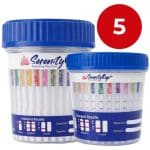
Does Fioricet Show Up on a 10-Panel Drug Test?
A 10-panel test may or may not include barbiturates.
The term “10-panel” describes the number of drug categories or targets included in a particular test, but different testing providers can configure their panels differently.
Some expanded panels include barbiturates, while others may use that testing slot for another drug class.
Therefore, you should not determine whether Fioricet is included based solely on the words 10-panel drug test.
The actual list of analytes is what matters.
If BAR, barbiturates, or butalbital appears among the test’s targets, Fioricet’s butalbital component may be relevant.
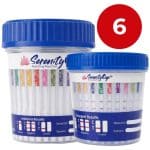
Does Fioricet Show Up on a 12-Panel Drug Test?
It can, depending on the specific 12-panel test.
Some 12-panel urine drug tests include a BAR category, while others do not.
This is an important distinction because two products can both be called “12-panel drug tests” while testing different combinations of substances.
For example, a panel might contain:
- THC
- AMP
- BZO
- COC
- BAR
- BUP
- MDMA
- MET
- MTD
- OPI
- OXY
- PCP
If BAR is included, butalbital becomes a relevant target.
If BAR is not included, a routine 12-panel screen may not test for butalbital.
This is also why consumers should check the actual analyte list rather than assuming every 12-panel test contains the same substances.
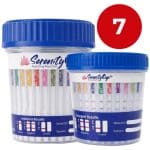
Does Fioricet Show Up on a 14-Panel Drug Test?
A 14-panel test can include barbiturates, but the answer depends on the specific panel configuration.
Expanded tests often add drug classes that are not present in smaller panels. Barbiturates may be among those additional categories.
If a 14-panel urine test includes BAR, Fioricet may be detected because of its butalbital component.
If the panel does not include barbiturates, the test may not identify Fioricet through routine screening.
The panel number alone is therefore not enough to answer the question.
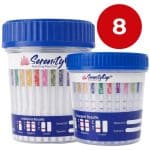
Does Fioricet Show Up on a 16-Panel Drug Test?
A 16-panel drug test may include barbiturates, but again, the exact contents vary between products and laboratories.
A larger panel generally means more testing targets, but it does not mean the test automatically checks for every prescription medication.
If the 16-panel test includes BAR, butalbital may be detected.
If barbiturates are not included, a routine screen may not identify Fioricet.
For this reason, the most useful information on a drug-test report or test kit is the list of analytes, not just the panel number.
Can a Urine Test Detect Fioricet?
Yes.
A urine test can detect butalbital, particularly when the test is designed to screen for barbiturates or specifically analyze butalbital.
The official Fioricet labeling indicates that butalbital is eliminated primarily through the kidneys and that approximately 85% of an oral dose appears in urine within 24 hours, largely as metabolites and conjugated products, with smaller amounts of unchanged drug. The label reports a plasma half-life of approximately 35 hours.
However, the fact that a substance is excreted in urine does not automatically mean a routine drug screen will detect it.
The test must have an appropriate analytical target.
How Long Does Fioricet Stay in Your Urine?
Online sources commonly give a 2- to 7-day or 3- to 7-day urine detection estimate for butalbital.
That range can be useful as a general reference, but it should not be treated as a guaranteed detection window for every person or every test.
There is no single number of days that applies universally because laboratory detection depends on factors such as:
- Dose
- Frequency of use
- Time since the last dose
- Individual metabolism
- Liver function
- Kidney function
- Test sensitivity
- Cutoff concentration
- Whether the test detects the parent drug, metabolites, or both
- Whether testing is performed with an immunoassay or a more specific analytical method
The approximately 35-hour plasma half-life reported in the Fioricet labeling is particularly important because butalbital is not eliminated as quickly as some short-acting medications.
A half-life also should not be confused with a drug-test detection window.
Half-life describes how quickly the concentration falls in the body. Detection time describes how long a particular testing method can identify the substance or its metabolites.
Fioricet Detection Windows by Test Type
The following ranges are commonly reported as general estimates rather than guaranteed results:
| Test type | General Fioricet/butalbital detection consideration |
|---|---|
| Urine | Often several days; commonly cited estimates are about 2–7 days |
| Blood | Shorter window than urine in most testing situations |
| Saliva/oral fluid | Generally intended for more recent exposure |
| Hair | Can provide a longer retrospective window, but interpretation is more complex |
| Specialized laboratory testing | Depends on the analyte, method, cutoff, and specimen |
These should not be interpreted as exact expiration times.
A person should not assume that a negative result is guaranteed after a particular number of hours or days.
Why Does Butalbital Have a Relatively Long Detection Period?
Butalbital has a relatively long half-life compared with many commonly tested substances.
The current prescribing information reports a plasma half-life of approximately 35 hours. The drug is metabolized and eliminated through the kidneys, with both unchanged drug and metabolites appearing in urine. This pharmacokinetic profile helps explain why butalbital can remain relevant to urine testing for several days.
Repeated use can also change the overall exposure pattern because additional doses are taken before previous doses have been completely eliminated.
What Factors Affect How Long Fioricet Can Be Detected?
Several factors can influence the period during which butalbital remains measurable.
Dose
Higher or repeated doses can produce greater overall exposure and may affect how long the drug remains detectable.
Frequency of use
Someone who takes Fioricet repeatedly may have a different elimination pattern from someone who takes a single dose.
Repeated exposure can maintain drug concentrations for longer.
Metabolism
Individual metabolic differences can influence how quickly butalbital is processed.
Age
Age-related changes in liver and kidney function can affect the elimination of some medications.
Liver function
Because the body metabolizes medications through hepatic pathways, significant liver impairment can affect drug disposition.
Kidney function
The Fioricet labeling indicates substantial renal elimination of butalbital and its metabolites. Changes in kidney function can therefore influence elimination.
Testing method
A rapid immunoassay and a specialized laboratory method are not necessarily equivalent.
The sensitivity, specificity, cutoff, and analyte being measured can all affect the result.
Can Fioricet Cause a False Positive?
This question requires an important distinction.
If a test is specifically designed to detect barbiturates, a true detection of butalbital is not a false positive simply because the person has a legitimate prescription.
Butalbital is actually present in Fioricet.
False-positive screening results are possible with immunoassays because some compounds can cross-react with antibodies used by the screening method.
However, claims that ordinary Fioricet routinely causes false positives for unrelated drug classes should be treated cautiously.
Research has demonstrated that some NSAIDs, including ibuprofen and naproxen, have occasionally produced false-positive results in certain immunoassay urine tests, including rare barbiturate results. The study found the likelihood was small.
This is different from saying that Fioricet itself routinely produces a false positive.
If a screening result is unexpected or disputed, confirmatory laboratory testing is the appropriate way to clarify the finding.
What Is the Difference Between Screening and Confirmatory Testing?
Drug testing often involves two different analytical stages.
Initial screening
The first test is frequently an immunoassay designed to rapidly screen for a particular drug class.
For example, a barbiturate immunoassay may identify specimens that require further examination.
Confirmatory testing
More specific laboratory techniques can then be used to identify the actual compound.
Depending on the testing program, confirmatory analysis can involve techniques such as:
- Gas chromatography-mass spectrometry
- Liquid chromatography-mass spectrometry
- Tandem mass spectrometry
These methods can provide greater specificity than an initial immunoassay.
This distinction is especially important when a screening result could have employment, medical, legal, or other consequences.
Can a Prescription for Fioricet Explain a Positive Drug Test?
Yes, if the test detects butalbital and the person has legitimately been prescribed Fioricet.
A positive result for a prescription medication is not automatically equivalent to illicit drug use.
The interpretation depends on the testing program and its policies.
In regulated workplace testing, a Medical Review Officer (MRO) may review laboratory results and relevant medical information as part of the verification process.
SAMHSA’s federal workplace testing framework includes MRO procedures and provides specific requirements for how regulated test results are handled.
If someone is taking a prescribed medication, keeping accurate prescription information available can help the appropriate medical or testing professional interpret the result.
Should You Tell the Testing Provider About Fioricet?
If you are taking Fioricet as prescribed, follow the instructions provided by the testing program regarding medication disclosure.
Some testing programs ask donors to provide prescription information during the testing or medical-review process, while others have specific procedures for handling prescription medications.
A prescription should not be assumed to change the laboratory result itself.
Instead, it can provide important context when a qualified reviewer evaluates a result.
Can You Stop Fioricet Before a Drug Test?
Stopping a prescription medication solely to change a drug-test result is not a good approach.
Butalbital-containing medications can lead to physical dependence with repeated use, and the current prescribing information specifically warns about dependence and recommends against extended or repeated use.
If Fioricet has been prescribed to you, do not abruptly change or discontinue regular use without discussing it with your healthcare professional.
The safest approach is to follow the prescription instructions and handle any drug-testing questions through the appropriate testing or medical-review process.
Can Drinking Water Remove Fioricet From Your System?
No reliable method can simply flush butalbital from the body on demand.
Drinking excessive amounts of water does not speed up the underlying metabolism of butalbital in a predictable way.
Excessive water consumption can also cause dangerous electrolyte disturbances, including hyponatremia.
Urine dilution may alter specimen concentration, but it does not reliably eliminate a drug or guarantee a particular test result.
Can Detox Products Remove Fioricet Before a Drug Test?
There is no scientifically reliable detox product that can guarantee removal of butalbital before a drug test.
Drug elimination primarily depends on normal pharmacokinetic processes involving metabolism and excretion.
Products marketed as instant cleanses, masking agents, or guaranteed drug-test solutions should not be treated as medically established methods for eliminating butalbital.
Attempting to manipulate a specimen can also create additional problems because some testing programs perform specimen validity testing.
SAMHSA notes that regulated urine testing can include checks for abnormal specimen characteristics and substances that interfere with testing.
Does Fioricet Show Up on a Federal Workplace Drug Test?
Under the current federal workplace framework, routine federal testing covers specified drug categories rather than all prescription medications.
SAMHSA identifies federal workplace testing categories including amphetamines, cocaine, marijuana, opioids, and PCP. Barbiturates such as butalbital are not included in that routine five-category panel.
However, federal agencies can request expanded testing under specified circumstances, including case-by-case testing for certain Schedule I or II substances or an approved expanded testing program.
Therefore, the statement “Fioricet is never tested for at work” would be too broad.
The more accurate statement is:
Fioricet is not part of the routine federal five-category panel, but an employer or testing program can use a different panel or testing arrangement.
Does Fioricet Show Up on a DOT Drug Test?
DOT-regulated testing has specific federal requirements and should not be confused with every commercial “5-panel,” “10-panel,” or “12-panel” test sold on the market.
The DOT-regulated panel is based on federal requirements and focuses on specified drug categories.
Because butalbital is a barbiturate and is outside the routine DOT drug categories, Fioricet is not automatically included simply because someone undergoes a DOT-regulated urine drug test.
However, workplace policies and separate testing arrangements can differ from the federally regulated panel.
Does Fioricet Show Up on a Probation Drug Test?
Probation testing can be different from ordinary employment testing.
A court, probation department, treatment program, or testing laboratory may order:
- A standard urine panel
- An expanded urine panel
- A barbiturate-specific test
- Additional prescription-drug testing
- Confirmatory laboratory testing
If the ordered panel specifically includes barbiturates, butalbital can be relevant.
Therefore, someone should not assume that a probation urine test is identical to a standard employment 5-panel.
Does Fioricet Show Up on a Military Drug Test?
Military testing programs can have their own requirements and policies.
A routine panel should not automatically be interpreted as testing for every prescription medication.
If a particular military testing program specifically includes barbiturates or expanded prescription-drug testing, butalbital may be detected.
For military personnel, the applicable testing policy and actual test order are more important than the generic term “drug test.”
Can Fioricet Show Up on a Hair Drug Test?
Hair testing can provide a longer retrospective window than urine for some substances, but hair analysis has important limitations.
Whether butalbital is detected depends on:
- Whether the laboratory tests for it
- Hair specimen characteristics
- Laboratory methodology
- Amount of exposure
- Time represented by the hair segment
- Potential external contamination
- Laboratory cutoff
Therefore, it is not accurate to say that every hair drug test automatically detects Fioricet for exactly 90 days.
The phrase “90 days” is commonly associated with hair testing because laboratories may analyze a segment of scalp hair representing approximately several months of growth. It is not a universal guarantee that butalbital will be detectable throughout that entire period.
Can Fioricet Show Up in a Saliva Test?
Butalbital can potentially be analyzed in oral fluid when an appropriate test is used.
However, oral-fluid testing is generally focused on specific analytes and recent exposure.
The presence of Fioricet in the body does not mean every saliva drug test will detect it.
As with urine testing, the relevant questions are:
What drug panel was ordered?
Does it include barbiturates?
What analytical method is being used?
SAMHSA recognizes urine and oral fluid as specimen types used in federal workplace drug-testing programs, with specific authorized panels and procedures.
What Does BAR Mean on a Drug Test?
If you see BAR on a multi-panel urine drug test, it commonly refers to barbiturates.
Because butalbital is a barbiturate, BAR is the panel abbreviation that is particularly relevant to Fioricet.
For example:
BAR → Barbiturates → Butalbital → Fioricet
This does not mean that every BAR test has exactly the same cutoff or analytical characteristics.
The specific manufacturer and laboratory determine the test’s performance characteristics.
What Is the Difference Between Butalbital and Barbiturates?
Butalbital is itself a barbiturate.
Barbiturates are a class of central nervous system depressants.
Butalbital is the barbiturate component in standard Fioricet.
Therefore, if a urine test is designed to detect barbiturates, butalbital can be one of the substances that produces a relevant result.
This is different from medications such as acetaminophen, which belongs to a different pharmacological category.
How Accurate Is a Drug Test for Butalbital?
The accuracy of a butalbital-related drug test depends on the test method.
An initial immunoassay is designed primarily as a screening test.
A more specific confirmatory analytical method can distinguish individual compounds with greater specificity.
Factors that can influence interpretation include:
- Assay sensitivity
- Specificity
- Cutoff concentration
- Specimen quality
- Timing
- Cross-reactivity
- Laboratory procedures
- Confirmatory methodology
An unexpected screening result should therefore be interpreted within the context of the testing program rather than treated as definitive proof of a particular medication or behavior.
Can Fioricet Make You Fail a Drug Test?
If the test includes barbiturates and detects butalbital above the applicable reporting threshold, Fioricet can produce a barbiturate-positive result.
If the test does not include barbiturates, standard screening may not identify the butalbital component.
Therefore, the phrase “Fioricet will make you fail every drug test” is inaccurate.
The actual outcome depends on the test.
A better way to think about it is:
Fioricet contains butalbital → butalbital is a barbiturate → barbiturate testing can detect it.
Does Acetaminophen in Fioricet Show Up on a Drug Test?
Acetaminophen is not normally the component responsible for a Fioricet-related drug-test result.
It is a commonly used pain-relieving medication and is not generally one of the drugs targeted by routine workplace drug panels.
Therefore, when discussing Fioricet and drug testing, the focus is primarily on butalbital, not acetaminophen.
Does Caffeine in Fioricet Show Up on a Drug Test?
Caffeine is also not normally included in standard employment drug panels.
Although caffeine is a stimulant, that does not mean it is classified or tested like amphetamine-type drugs in routine workplace screening.
Therefore, the caffeine in Fioricet is generally not what causes a drug-test concern.
What If a Drug Test Result Is Positive for Barbiturates?
If a test reports a barbiturate-positive result, the next step depends on the testing program.
If the person has a legitimate Fioricet prescription, the medication history can be relevant to interpretation.
A medical review process may determine whether the result is consistent with a legitimate prescription.
If an initial screening result is disputed or unexpected, confirmatory testing can provide greater analytical specificity.
The important point is that a screening result and a final verified result are not always the same thing.
Why the Exact Drug Panel Matters
One of the biggest misconceptions about drug testing is assuming that every urine drug test looks for the same substances.
They do not.
A 5-panel test, 10-panel test, 12-panel test, 14-panel test, and 16-panel test can all have different configurations.
For Fioricet, look specifically for:
- BAR
- Barbiturates
- Butalbital
- Expanded prescription-drug testing
- Specialized toxicology testing
If none of these are included, a routine panel may not be designed to identify Fioricet.
Fioricet and Drug Testing at a Glance
| Question | Answer |
|---|---|
| Does Fioricet contain butalbital? | Yes |
| Is butalbital a barbiturate? | Yes |
| Can butalbital be detected in urine? | Yes |
| Will every urine drug test detect Fioricet? | No |
| Is Fioricet normally part of a federal 5-panel? | No |
| Can a barbiturate panel detect butalbital? | Yes, potentially |
| Does a 12-panel automatically include Fioricet? | No |
| Does a 14-panel automatically include Fioricet? | No |
| Does a 16-panel automatically include Fioricet? | No |
| Can specialized testing identify butalbital? | Yes |
| Is there one guaranteed urine detection period? | No |
| Does the prescription matter when interpreting a result? | Yes |
| Can stopping a prescribed medication suddenly be risky? | Yes |
Common Misconceptions About Fioricet and Drug Tests
“Fioricet is a prescription, so no drug test can detect it.”
Not correct.
A prescription does not make a drug chemically invisible. If a test is designed to detect butalbital, it can potentially identify the medication’s barbiturate component.
“Every 12-panel test detects Fioricet.”
Not correct.
Panel contents differ between manufacturers and testing programs.
“A 5-panel tests every common prescription medication.”
Not correct.
A standard federal-style five-category panel is designed around specific drug categories, not every prescription medication.
“A positive barbiturate result automatically means illegal drug use.”
Not necessarily.
A legitimate prescription containing butalbital can explain a barbiturate result.
“A negative result is guaranteed after seven days.”
Not necessarily.
Detection windows vary according to the individual and the test.
“Drinking lots of water will remove butalbital.”
There is no reliable scientific basis for using excessive hydration to rapidly eliminate butalbital.
“Detox drinks guarantee a negative result.”
No detox product can reliably guarantee a particular laboratory result.
The Bottom Line
Does Fioricet show up on a drug test? Yes, it can—but it depends on what the test is designed to detect.
Fioricet contains butalbital, acetaminophen, and caffeine, with butalbital being the component most relevant to drug testing. Butalbital is a barbiturate and can be detected when a urine or other specimen is tested for barbiturates or when specialized testing specifically targets the compound.
A standard federal-style workplace drug panel does not routinely include barbiturates, so Fioricet is not automatically detected by every employment drug test.
For urine testing, butalbital can remain relevant for several days, but there is no guaranteed universal detection window. The reported approximately 35-hour plasma half-life, renal elimination, dose, frequency of use, individual metabolism, and laboratory testing method all affect interpretation.
If a test specifically includes BAR/barbiturates, Fioricet can potentially produce a positive result because of its butalbital content. If you have a legitimate prescription, that medical information may be important when the result is reviewed.
The safest way to understand a particular drug test is to look at the actual panel and analytes being tested, rather than relying only on terms such as “5-panel,” “10-panel,” “12-panel,” or “16-panel.”
Medical note: This information is educational and does not replace advice from a physician, pharmacist, Medical Review Officer, laboratory, employer, or qualified legal professional. If Fioricet has been prescribed to you, do not abruptly stop regular use solely because of an upcoming drug test without discussing the medication with your healthcare professional.