Does GLP-1 Show Up on a Drug Test?

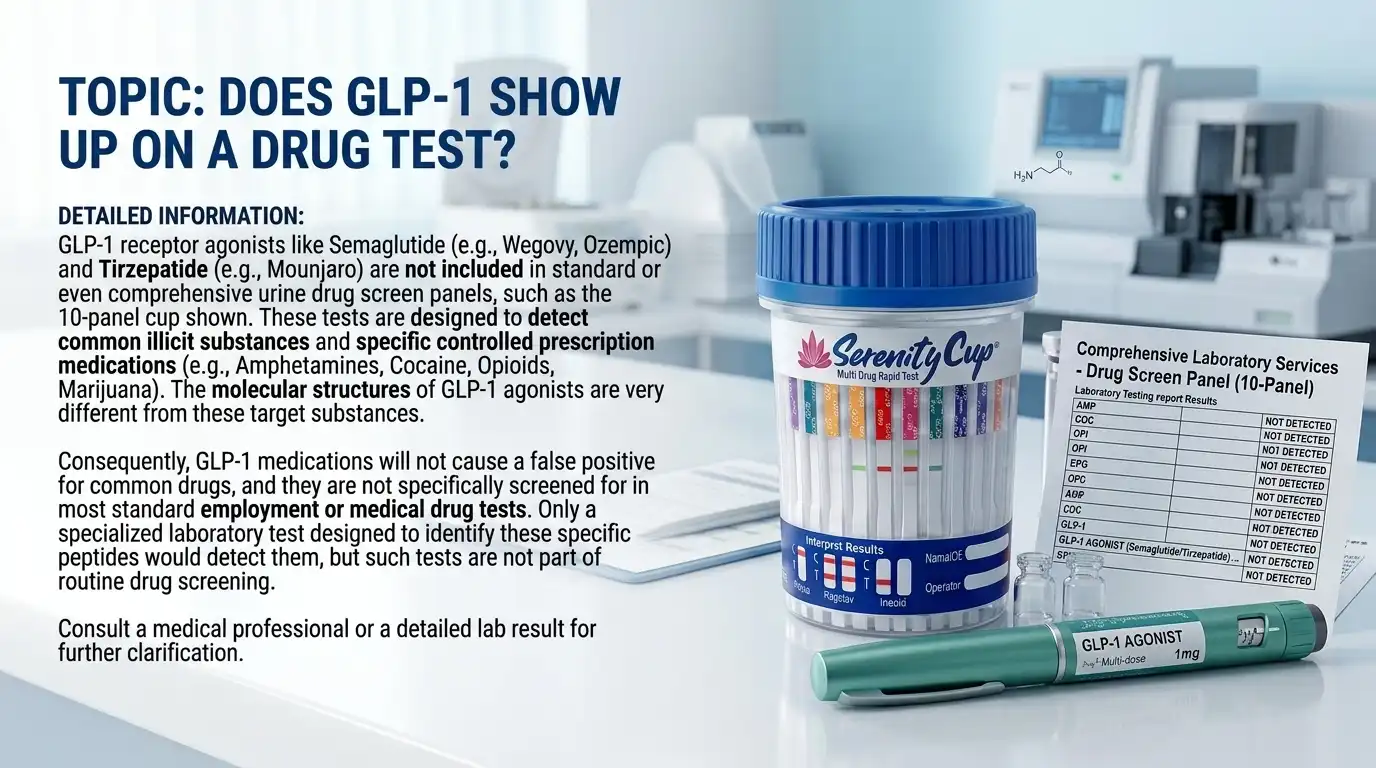
If you take a GLP-1 medication and have an upcoming drug test, you may wonder: Does GLP-1 show up on a drug test?
In most standard drug-screening situations, GLP-1 medications such as semaglutide and tirzepatide are not the substances being screened for. Standard workplace drug tests are designed around specific drug classes and analytes rather than testing for every prescription medication a person may be taking. For example, current federal workplace testing programs include specified categories such as marijuana, cocaine, amphetamines, opioids, and phencyclidine (PCP).
However, it is important to distinguish a routine drug screen from a laboratory test specifically designed to detect a particular medication.
This article explains what GLP-1 medications are, whether semaglutide or tirzepatide can appear on common drug tests, how urine and oral-fluid testing differ, and what to know about false-positive results.
Does GLP-1 Show Up on a Drug Test?
Generally, no. GLP-1 medications are not included in standard drug-testing panels simply because they are prescription medications.
Common GLP-1-related medicines include:
- Semaglutide
- Ozempic
- Wegovy
- Rybelsus
- Tirzepatide
- Mounjaro
- Zepbound
- Dulaglutide
- Trulicity
- Liraglutide
- Victoza
- Saxenda
The important point is that a drug test only detects substances that the particular test is designed to analyze. A routine workplace drug screen is not a universal test for every medication in someone’s body.
Federal workplace drug-testing programs, for example, use authorized testing panels with specific drugs and metabolites rather than screening for all prescription medicines.
What Is a GLP-1 Medication?
GLP-1 stands for glucagon-like peptide-1.
GLP-1 receptor agonists are prescription medications that act on GLP-1 receptors and are used for conditions including type 2 diabetes and, depending on the specific medication, chronic weight management.
Semaglutide is the active ingredient in medications including Ozempic, Wegovy, and Rybelsus. FDA information identifies semaglutide as a GLP-1 receptor agonist.
Tirzepatide is slightly different. It acts on both GIP and GLP-1 receptors and is marketed in the United States as Mounjaro and Zepbound for different approved uses.
These medications are not simply interchangeable, but they are frequently grouped together in searches about GLP-1 drugs.
Which Medications Are Considered GLP-1 Drugs?
Here’s a useful overview:
| Medication | Common brand name(s) | Drug class |
|---|---|---|
| Semaglutide | Ozempic, Wegovy, Rybelsus | GLP-1 receptor agonist |
| Tirzepatide | Mounjaro, Zepbound | GIP/GLP-1 receptor agonist |
| Dulaglutide | Trulicity | GLP-1 receptor agonist |
| Liraglutide | Victoza, Saxenda | GLP-1 receptor agonist |
| Exenatide | Byetta, Bydureon | GLP-1 receptor agonist |
| Lixisenatide | Adlyxin | GLP-1 receptor agonist |
FDA materials identify several of these medicines as GLP-1 receptor agonists and list their corresponding brand names.
What Does a Standard Drug Test Actually Look For?
One of the biggest misconceptions about drug testing is that a drug screen checks for every drug or medication in the body.
It doesn’t.
A drug-testing panel is designed to look for particular substances or their metabolites.
For example, current federal workplace testing resources list five major categories:
- Marijuana
- Cocaine
- Amphetamines
- Opioids
- Phencyclidine (PCP)
The specific analytes and testing requirements are established by the applicable testing program.
Therefore, a routine drug screen should not be interpreted as a general-purpose test for every prescription medication.
This distinction is important:
Medication is present in the body
does not automatically mean
the medication will be detected by a standard drug screen.
The test has to be designed to detect that particular substance or an appropriate target related to it.
Does Semaglutide Show Up on a Drug Test?
Semaglutide is not a routine target of standard workplace drug-testing panels.
Semaglutide is the active ingredient in medications such as:
- Ozempic
- Wegovy
- Rybelsus
FDA documentation identifies semaglutide as a GLP-1 receptor agonist.
So if someone is taking semaglutide and receives a standard drug screen, the important question is not simply whether semaglutide is present in the body.
The question is:
Is semaglutide included in the specific testing panel?
For standard federal workplace drug-testing panels, semaglutide is not one of the listed target drug categories.
Does Ozempic Show Up on a Drug Test?
Ozempic contains semaglutide, and semaglutide is not a standard target in routine federal workplace drug-testing panels.
This means questions such as:
- “Will Ozempic show up on a urine drug test?”
- “Can Ozempic cause a positive drug test?”
- “Does Ozempic show up on a 5-panel drug test?”
all depend first on what substances that particular test is designed to detect.
Ozempic and Rybelsus contain semaglutide, while Wegovy is also a semaglutide product.
Does Wegovy Show Up on a Drug Test?
Wegovy contains semaglutide and is not part of standard federal workplace drug-testing targets.
Wegovy is a GLP-1 receptor agonist. The FDA identifies semaglutide as its active ingredient.
A routine drug screen is therefore different from a specialized analytical test specifically designed to look for semaglutide.
Does Tirzepatide Show Up on a Drug Test?
Tirzepatide is the active ingredient in Mounjaro and Zepbound.
It is a dual GIP/GLP-1 receptor agonist, rather than a conventional drug of abuse targeted by routine workplace drug panels. FDA documentation describes tirzepatide as a peptide-based dual GIP/GLP-1 receptor agonist.
Therefore, the same basic principle applies:
A routine drug screen is not automatically a tirzepatide test.
Does Mounjaro Show Up on a Drug Test?
Mounjaro contains tirzepatide.
A standard drug test does not simply scan a person’s sample for every prescription medication. It uses a defined testing panel.
Current DOT rules, for example, specify marijuana, cocaine, amphetamines, opioids and PCP as the drugs tested under Part 40.
Tirzepatide is not one of those standard DOT drug categories.
Does Zepbound Show Up on a Drug Test?
Zepbound contains tirzepatide.
The FDA describes Zepbound as a tirzepatide product that acts on GIP and GLP-1 receptors.
Because standard drug panels are designed around particular target substances, taking Zepbound does not mean that a routine drug screen is testing specifically for tirzepatide.
Does GLP-1 Show Up on a Urine Drug Test?
This is one of the most common questions.
The answer depends on what kind of urine test is being performed.
A routine urine drug screen is designed to detect the drugs included in its particular panel.
Federal workplace programs use urine testing as one authorized specimen type and specify the substances and analytes that laboratories are authorized to test for.
Therefore:
A urine specimen can be used to test for drugs without the urine test being a test for every medication present in the specimen.
That’s why “urine test” by itself doesn’t tell you whether a GLP-1 medication will be detected.
Does GLP-1 Show Up on a Blood Test?
This question requires another important distinction.
A routine blood test and a blood drug test are not the same thing.
Routine medical bloodwork may measure things such as:
- Blood glucose
- Hemoglobin A1c
- Cholesterol
- Kidney function
- Liver-related markers
- Other health measurements
A drug test, on the other hand, is designed around particular substances or analytes.
A specialized laboratory method could potentially be designed to measure a particular medication, but that is fundamentally different from saying that the medication is part of a routine drug-screening panel.
So:
The ability to detect a medication with a specialized laboratory method does not mean that the medication is automatically detected by a standard drug test.
Can GLP-1 Medications Cause a False Positive on a Drug Test?
This is another area where online articles sometimes make overly broad statements.
A false positive generally refers to a screening result that indicates the presence of a target substance when that target has not actually been confirmed.
Drug-testing programs can involve initial screening followed by additional laboratory testing or review procedures when required.
SAMHSA explains that federal workplace testing uses defined drug analytes and cutoff levels, and that laboratories conduct testing according to the applicable federal requirements.
There is no reason to assume that simply taking a GLP-1 medication means a routine drug test will report that medication as an opioid, amphetamine, cocaine, marijuana or PCP.
However, if someone receives an unexpected non-negative result, the appropriate response is to follow the testing program’s review and confirmation process rather than assuming the cause.
Why Doesn’t a Standard Drug Test Detect Every Prescription Medication?
The answer comes down to test design.
Drug-testing laboratories use analytical methods intended to identify particular drugs, drug classes, metabolites or biomarkers.
The test is not asking:
“What medications exist in this person’s body?”
It is asking something closer to:
“Are the specific target analytes included in this testing panel present at or above the applicable testing threshold?”
SAMHSA’s federal testing resources specifically describe authorized panels, analytes and cutoffs.
This is why a person can take a legitimate prescription medication without that medication appearing on a routine workplace drug screen.
What About a 5-Panel Drug Test?
A 5-panel drug test generally refers to a panel covering five broad drug categories.
For current DOT testing, the required categories are:
- Marijuana
- Cocaine
- Amphetamines
- Opioids
- PCP
The U.S. Department of Transportation’s current Part 40 definition identifies these drug categories for DOT testing.
GLP-1 medications are not one of those five categories.
However, “5-panel” can be used differently by different testing providers, so the exact test ordered should always be checked.
What About a 10-Panel Drug Test?
A 10-panel test covers more substances than a basic five-panel test, but the number of panels alone does not mean every prescription medication is included.
The exact substances depend on the laboratory or testing provider’s panel.
Therefore, someone asking:
“Will Ozempic show up on a 10-panel drug test?”
should check the actual list of analytes included in that particular 10-panel test.
The same principle applies to:
- 12-panel tests
- expanded panels
- custom panels
- comprehensive toxicology screens
A larger panel is not automatically an “everything in the body” test.
Does GLP-1 Show Up on a DOT Drug Test?
For DOT-regulated testing, the required drug categories are specified by federal regulation.
DOT identifies marijuana, cocaine, amphetamines, opioids and PCP as the drugs for which testing is required under Part 40 and applicable DOT agency regulations.
DOT also states that specimens used for DOT drug testing are analyzed at HHS-certified laboratories.
Therefore, taking a GLP-1 medication such as semaglutide or tirzepatide is a different issue from being tested for the substances in the DOT drug-testing panel.
A DOT physical is also not identical to a DOT drug test. Medical examinations can involve separate health and fitness-for-duty considerations.
What If Your Employer Uses a Different Drug-Test Panel?
This is important.
Not every employer uses exactly the same test.
A workplace may use:
- A standard panel
- An expanded panel
- A customized panel
- Urine testing
- Oral-fluid testing
- Another legally applicable testing method
SAMHSA notes that drug-testing programs vary according to the drugs being tested and the specimen collected.
Therefore, the most accurate answer for a specific situation comes from the actual test panel or testing provider.
Can a Specialized Test Detect Semaglutide or Tirzepatide?
This is where many articles confuse readers.
There is a major difference between:
Standard drug screening
and
Specialized analytical testing
A laboratory can use specialized analytical techniques to look for particular compounds when the test has been designed for that purpose.
But that does not mean that a routine employment drug screen automatically includes that compound.
Think of it this way:
A test can be capable of detecting something without routinely testing for it.
This distinction is one of the most important concepts to understand when researching GLP-1 medications and drug testing.
GLP-1 Drug Test vs. Routine Medical Testing
| Type of test | Main purpose |
|---|---|
| Routine bloodwork | Monitor health and treatment-related markers |
| Urine drug screen | Detect specified drugs/drug metabolites |
| Oral-fluid drug test | Detect specified drugs/drug metabolites |
| Specialized medication assay | Detect a specifically targeted medication or compound |
| Toxicology testing | Analyze selected substances according to the test’s scope |
SAMHSA currently recognizes urine and oral fluid as authorized specimen types in federal workplace drug-testing programs.
Does Taking a GLP-1 Mean You Will Fail a Drug Test?
Taking a GLP-1 medication does not by itself mean that you will receive a positive result for one of the drugs targeted by a standard drug panel.
The result depends on:
- What test was ordered
- Which analytes are included
- The specimen type
- The laboratory’s testing methodology
- Applicable testing rules
- Whether another substance is present
A drug test should therefore be interpreted according to the specific panel rather than simply the fact that someone takes prescription medication.
What Should You Do If You Take a Prescription GLP-1 Medication?
For legitimate medical use, keep your medication information available and answer medical or testing questions truthfully when required.
If a testing program produces an unexpected result, don’t assume that the GLP-1 medication caused it.
Instead, ask the relevant testing provider, healthcare professional, or Medical Review Officer about the result and the applicable review process.
Federal workplace testing programs include Medical Review Officer procedures for reviewing certain laboratory results.
Frequently Asked Questions
Does GLP-1 show up on a drug test?
Generally, GLP-1 medications are not targets of standard drug-testing panels. The exact answer depends on the specific testing panel.
Does semaglutide show up on a drug test?
Semaglutide is not included among the standard drug categories used in current federal workplace testing panels.
Does Ozempic show up on a drug test?
Ozempic contains semaglutide. A standard drug screen is not designed simply to test for every prescription medication, and semaglutide is not a standard federal workplace drug-panel target.
Does Wegovy show up on a drug test?
Wegovy contains semaglutide. It is not a standard target in federal workplace drug-testing panels.
Does Mounjaro show up on a drug test?
Mounjaro contains tirzepatide. Tirzepatide is not one of the standard DOT drug categories.
Does Zepbound show up on a drug test?
Zepbound contains tirzepatide. Standard workplace drug testing does not automatically test for tirzepatide.
Can GLP-1 cause a false positive?
A GLP-1 medication should not simply be assumed to be the cause of an unexpected positive result. Drug-testing results should be evaluated according to the specific panel, laboratory process and applicable confirmation/review procedures.
Does GLP-1 show up on a urine drug test?
A routine urine drug test looks for the substances included in its particular panel. A urine test is not automatically a test for every medication in the body.
Does GLP-1 show up on a blood test?
Routine bloodwork and drug testing are different. A specialized assay can be designed to detect a particular medication, but that is different from routine bloodwork or a standard drug screen.
Does GLP-1 show up on a 5-panel drug test?
Current DOT five-category testing covers marijuana, cocaine, amphetamines, opioids and PCP. GLP-1 medications are not one of those categories.
Does GLP-1 show up on a 10-panel drug test?
It depends on the exact panel. A 10-panel test is not necessarily a test for every prescription medication, so check the substances included by the testing provider.
Can an employer test specifically for a GLP-1 medication?
A specialized laboratory test can be designed around particular analytes, but that is different from a routine workplace drug screen. Employer testing policies and applicable laws can also vary.
Final Answer: Does GLP-1 Show Up on a Drug Test?
For most standard drug-screening situations, GLP-1 medications such as semaglutide, Ozempic, Wegovy, tirzepatide, Mounjaro and Zepbound are not the substances being targeted by the standard drug-testing panel.
The key is understanding that drug tests are targeted tests, not universal searches for every medication in a person’s body. Current federal workplace testing programs specify particular drug categories and analytes, while DOT testing separately specifies its required panel.
If a specific test is being used, the most reliable way to know what it detects is to review the test’s panel or ask the testing provider.