Does Hemp-Derived THC Show Up on a Drug Test?

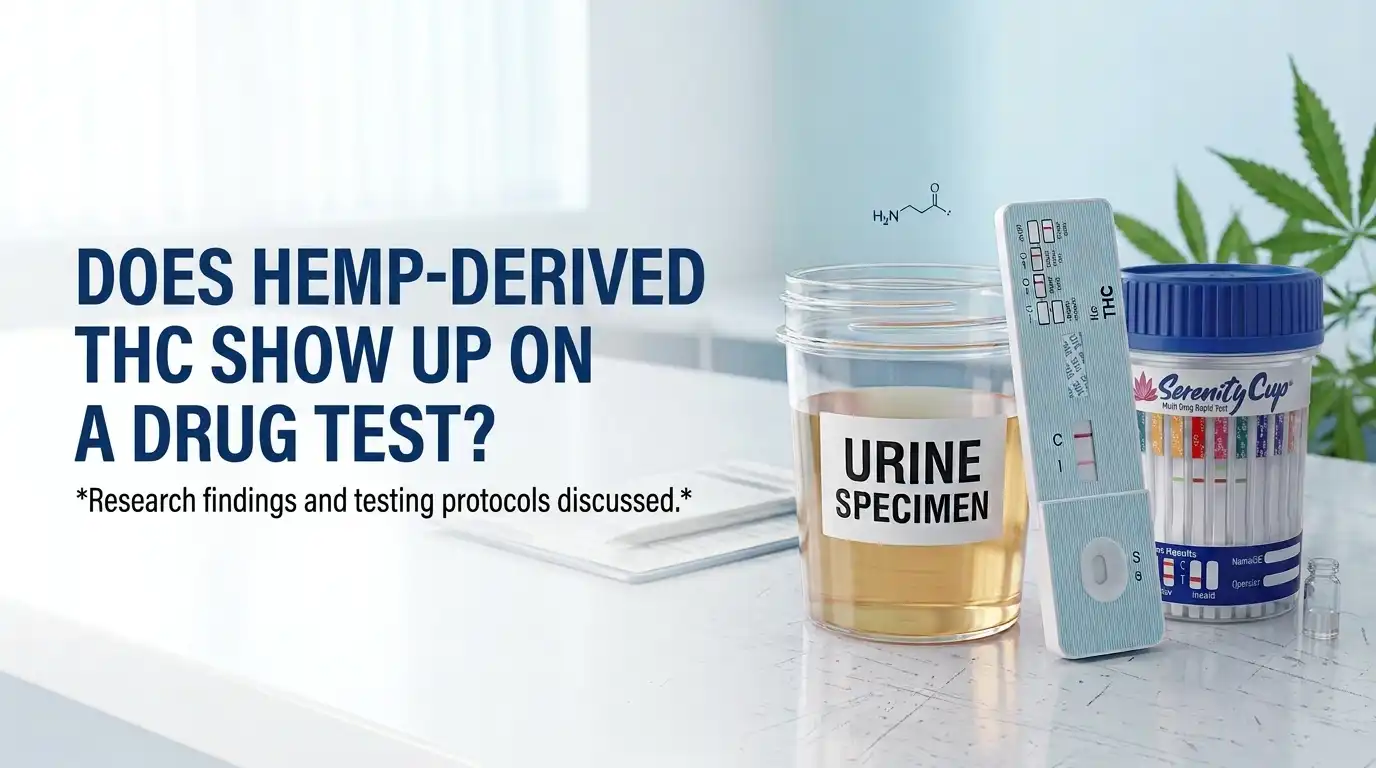
Yes, hemp-derived THC can show up on a drug test. A drug test generally does not determine whether THC came from hemp or marijuana. Instead, depending on the testing method, it looks for THC or THC-related metabolites in a biological specimen. Therefore, using a hemp-derived THC product can potentially result in a positive cannabinoid drug test.
This distinction is important because the terms hemp-derived, legal hemp, and THC-free do not all mean the same thing. A product’s source or legal classification does not automatically determine how it will affect a drug test.
What Is Hemp-Derived THC?
Hemp-derived THC refers to THC obtained from cannabis plants classified as hemp or produced from cannabinoids derived from hemp.
One of the most important cannabinoids is delta-9-tetrahydrocannabinol (delta-9 THC), commonly called THC. THC is the cannabinoid associated with the intoxicating effects of cannabis.
Other hemp-derived products may contain cannabinoids such as:
- Delta-9 THC
- Delta-8 THC
- Delta-10 THC
- THCA
- CBD
- Other minor cannabinoids
The word hemp by itself does not mean that a product contains no THC. Some hemp products are specifically formulated to contain THC.
Delta-8 THC is a useful example. The FDA explains that concentrated delta-8 THC is commonly manufactured from hemp-derived CBD because naturally occurring delta-8 THC is present in hemp at relatively low levels. The FDA also notes that delta-8 products can vary in formulation, labeling, and cannabinoid concentration.
Can Hemp-Derived THC Show Up on a Drug Test?
Yes.
The key issue is what the test is designed to detect, rather than whether the THC was obtained from hemp or marijuana.
Many cannabinoid drug tests are designed to identify THC-related metabolites. For urine testing, one important metabolite is commonly referred to as THC-COOH, or 11-nor-9-carboxy-THC.
SAMHSA educational material describes workplace cannabinoid testing using an initial urine cutoff of 50 ng/mL and a confirmatory cutoff of 15 ng/mL for the delta-9 THC carboxy metabolite.
That means a product being marketed as a hemp product does not automatically make its use irrelevant to a THC drug screen.
The basic process can be simplified as:
Hemp-derived THC → THC exposure → metabolism → THC-related metabolites → specimen testing
The exact process varies according to the cannabinoid, dose, route of exposure, individual factors, specimen type, and laboratory method.
How Do Drug Tests Detect THC?
Drug tests can use different biological specimens and testing technologies.
Common specimen types include:
- Urine
- Oral fluid
- Blood
- Hair
The most appropriate interpretation depends on the specific test being used.
The FDA maintains a category for regulated drugs-of-abuse tests that includes tests for cannabinoids.
Screening tests
A screening test is generally designed to identify whether a target drug class or metabolite may be present above a specified cutoff.
For example, an immunoassay may be used as an initial screen.
Confirmatory testing
When a screening result requires confirmation, a laboratory may use a more specific analytical method to identify and measure the relevant compound or metabolite.
This distinction matters because an initial screening result is not always the final laboratory determination.
What Is THC-COOH?
THC-COOH is a major metabolite associated with THC exposure.
When the body processes THC, it produces several metabolites. THC-COOH is particularly important in urine drug testing because cannabinoid testing commonly targets this metabolite rather than simply looking for the original THC molecule.
SAMHSA’s clinical drug-testing guidance describes urine marijuana testing as targeting THC-COOH and notes that detection depends on factors such as use patterns, metabolism, hydration, and the laboratory cutoff.
This is why the question:
“Was the THC from hemp or marijuana?”
is not necessarily the same as:
“Will the drug test detect evidence of THC exposure?”
The testing method and target analyte are what matter.
Does Hemp-Derived Delta-9 THC Show Up on a Drug Test?
Yes, it can.
Delta-9 THC is still delta-9 THC regardless of whether it originated from hemp or another cannabis source.
If a hemp-derived product contains delta-9 THC and enough exposure occurs to produce detectable levels of the relevant metabolite, a cannabinoid drug test may detect it.
Therefore, the phrase “hemp-derived delta-9 THC” should not automatically be interpreted as “drug-test safe.”
The legal status of a product and the analytical result of a drug test are separate questions.
Does Delta-8 THC Show Up on a Drug Test?
Delta-8 THC deserves special attention because it is chemically related to delta-9 THC and is frequently sold in products described as hemp-derived.
The FDA states that delta-8 THC is a psychoactive cannabinoid and that concentrated delta-8 THC is commonly produced from hemp-derived CBD. The agency has also raised concerns about variability in delta-8 product formulations and labeling.
Whether a particular delta-8 product produces a positive result depends on the testing method and what the test is designed to detect.
For that reason, someone should not assume that a product labeled “hemp-derived delta-8” will necessarily be ignored by a cannabinoid drug test.
Does Delta-10 THC Show Up on a Drug Test?
Delta-10 THC is another THC isomer found in some cannabinoid products.
Drug-test results involving delta-10 can depend on the specific analytical method and the compounds the test is designed to identify.
Because cannabinoid products can contain mixtures of cannabinoids rather than one perfectly isolated compound, product labeling alone may not tell you exactly what a laboratory will encounter in a specimen.
For this reason, delta-10 should not automatically be treated as equivalent to a THC-free product.
Does THCA Show Up on a Drug Test?
THCA, or tetrahydrocannabinolic acid, is a cannabinoid precursor associated with THC.
THCA and delta-9 THC are not chemically identical. However, THCA can be converted into THC under conditions such as heating.
That makes THCA-containing products relevant when discussing drug testing, especially when the product is used in a way that can convert THCA into THC.
It is therefore inaccurate to assume that the presence of the word “THCA” on a product label automatically means the product has no relevance to THC drug testing.
Can CBD Cause a Positive Drug Test?
CBD and THC are different cannabinoids.
A test specifically designed to detect THC-related metabolites is not simply testing for “all cannabinoids.” However, some CBD and hemp products can contain THC depending on their formulation.
This is particularly important with:
- Full-spectrum CBD
- Hemp extracts
- Hemp-derived cannabinoid products
- Products containing multiple cannabinoids
The FDA has also raised concerns about variability in some cannabinoid products, including differences between labeling and actual product composition.
Therefore, CBD itself should not automatically be equated with THC, but a person should not assume that every product marketed as CBD is completely free of THC.
Full-Spectrum CBD vs. Broad-Spectrum CBD vs. CBD Isolate
Understanding these terms can help explain why different products may have different drug-testing implications.
Full-spectrum CBD
Full-spectrum products are generally formulated to contain multiple naturally occurring cannabis compounds and may contain THC.
Because of that, the presence of THC may be relevant to cannabinoid drug testing.
Broad-spectrum CBD
Broad-spectrum products are generally formulated to contain multiple cannabinoids while attempting to remove THC.
However, product composition can vary, so the label alone should not be treated as an absolute guarantee about laboratory testing.
CBD isolate
CBD isolate is intended to contain primarily cannabidiol rather than a broad mixture of cannabinoids.
That is different from a THC-containing hemp product.
The important distinction is:
CBD ≠ THC
but also:
a product marketed as CBD ≠ automatically guaranteed THC-free.
Which Drug Tests Can Detect THC?
Different tests use different specimens and analytical methods.
Urine Drug Tests
Urine testing is widely used for workplace and other drug-screening purposes.
Urine cannabinoid testing commonly focuses on THC-related metabolites rather than simply looking for the original THC molecule.
Federal workplace guidance has historically used specific cutoff concentrations for cannabinoid metabolite testing.
Oral Fluid Tests
Oral-fluid testing uses saliva or another oral-fluid specimen.
The detection characteristics are different from urine testing because the specimen type and analytical targets differ.
Blood Testing
Blood testing can measure compounds present in the bloodstream and is interpreted differently from urine testing.
A blood test is therefore not simply a shorter version of a urine test.
Hair Testing
Hair testing examines compounds incorporated into hair over time.
Its detection characteristics and interpretation differ from urine and oral-fluid testing.
The important point is that there is no single universal “THC detection window” that applies to every drug test.
How Long Can Hemp-Derived THC Be Detected?
There is no single number that accurately applies to everyone.
Detection depends on factors including:
- The cannabinoid involved
- Amount of THC exposure
- Frequency of use
- Pattern of use
- Individual metabolism
- Specimen type
- Laboratory method
- Test cutoff
- Product composition
- Time since exposure
SAMHSA guidance specifically notes that cannabinoid detection is influenced by factors including use patterns, metabolism, hydration at the time of urine collection, and the laboratory cutoff.
Therefore, articles claiming that hemp-derived THC will always disappear from a urine test after a specific number of hours or days are oversimplifying a variable biological process.
Can a Legal Hemp Product Still Result in a Positive Drug Test?
Yes.
This is one of the most important distinctions to understand.
Legal status and drug-test status are not the same thing.
A product may be marketed as hemp-derived while still containing THC.
If the body processes THC and produces detectable metabolites, a drug test designed to detect those metabolites may identify them.
In other words:
“Legal hemp product” does not automatically mean “negative drug test.”
The applicable laws also vary by jurisdiction and testing program, so the legal classification of a product should not be used as a prediction of an individual laboratory result.
Why Hemp Product Labels Can Be Important
Hemp-derived products can vary substantially in their cannabinoid composition.
A label might identify:
- Delta-9 THC
- Delta-8 THC
- CBD
- THCA
- Total cannabinoids
- Other hemp-derived cannabinoids
Some products may also provide a Certificate of Analysis (COA) from a laboratory.
A COA can provide information about the cannabinoid profile of a particular tested batch.
However, a COA is not the same thing as a guarantee about the result of a person’s drug test. Laboratory testing programs use their own specimens, analytical methods, and cutoff concentrations.
What Is a Certificate of Analysis?
A Certificate of Analysis, commonly called a COA, is a laboratory document associated with testing a product or batch.
Depending on the laboratory and product, it may report:
- Cannabinoid concentrations
- THC concentration
- CBD concentration
- Other cannabinoids
- Testing date
- Batch or lot information
- Laboratory information
A COA can help describe what was measured in a particular product sample.
It does not, however, establish that every future batch has exactly the same composition or guarantee how an individual’s biological specimen will test.
Hemp-Derived THC and Workplace Drug Testing
Workplace drug-testing programs can have specific testing rules.
The exact policy depends on the employer, jurisdiction, occupation, and testing program.
In regulated U.S. transportation testing, for example, DOT regulations include marijuana metabolites among the substances tested under its drug-testing program.
The federal DOT urine-testing framework specifies a 50 ng/mL initial test cutoff for marijuana metabolites and a 15 ng/mL confirmatory cutoff for the relevant cannabinoid metabolite.
This illustrates an important concept:
A drug test is based on defined analytical targets and cutoff concentrations—not simply on whether a product was sold as hemp.
What About DOT Drug Testing?
DOT testing is a particularly important example because it operates under federal regulations.
For regulated DOT drug testing, marijuana metabolites are part of the testing panel.
The current federal framework specifies:
- Initial urine test: 50 ng/mL for marijuana metabolites
- Confirmatory test: 15 ng/mL for the specified cannabinoid metabolite
These values apply to the regulated testing framework and should not be assumed to describe every drug test performed by every employer or laboratory.
If someone is subject to a particular workplace testing program, the applicable policy and regulatory requirements should be checked directly.
Can a THC Test Tell Whether THC Came From Hemp or Marijuana?
Generally, a standard cannabinoid drug test is concerned with its specified target analyte rather than determining the agricultural source of the THC.
In practical terms, the laboratory is asking whether the relevant drug or metabolite is present according to the test’s analytical criteria.
It is not necessarily answering:
“Did this THC come from hemp?”
That is why the distinction between hemp-derived THC and marijuana-derived THC does not automatically translate into a distinction between a positive and negative drug-test result.
Does “Hemp-Derived” Mean “THC-Free”?
No.
These terms should not be treated as synonyms.
Hemp-derived describes the source or category of the material.
THC-free describes the claimed absence of THC.
A hemp product can contain THC, depending on its formulation.
Likewise, a product marketed as CBD may contain different cannabinoid components depending on whether it is full-spectrum, broad-spectrum, isolate, or another formulation.
The FDA has specifically warned that some cannabinoid products have variable formulations and labeling.
Why Product Composition Matters
Two products carrying similar marketing language may not necessarily have identical cannabinoid profiles.
Factors can include:
- Manufacturing process
- Cannabinoid source
- Product formulation
- Batch variation
- Label accuracy
- Testing methodology
- Storage conditions
- Presence of additional cannabinoids
This is especially relevant for products containing delta-8 THC and other cannabinoids.
The FDA has expressed concerns about variable delta-8 THC concentrations and other cannabinoid content in products sold on the market.
Can a Drug Test Result Be Confirmed?
Some testing programs use an initial screening stage followed by more specific confirmatory analysis when required.
This is an important distinction because a preliminary screening result and a confirmed laboratory result are not necessarily the same analytical step.
SAMHSA guidance recommends confirmatory testing when a positive screening result has significant legal or other consequences.
The exact procedures depend on the testing program and laboratory.
Does Hemp-Derived THC Always Cause a Positive Drug Test?
No.
The scientifically accurate answer is it can, not that every exposure will necessarily produce a positive result.
A result depends on multiple variables, including:
- What the product actually contains
- How much THC exposure occurred
- How frequently it was used
- Which specimen is tested
- Which analyte the laboratory targets
- The laboratory’s cutoff
- The time between exposure and testing
- Individual biological factors
This is why it is not responsible to promise that a particular hemp product will or will not produce a positive result in every person.
Common Misconceptions About Hemp and Drug Testing
Myth 1: “If it’s hemp-derived, a drug test can’t detect it.”
Not necessarily.
Hemp-derived products can contain THC, and THC exposure can produce metabolites relevant to cannabinoid testing.
Myth 2: “Legal THC cannot cause a positive test.”
Legal status does not automatically determine laboratory results.
A drug test evaluates its specified analytes according to its testing criteria.
Myth 3: “CBD and THC are the same.”
They are different cannabinoids.
However, some products marketed as CBD or hemp products can contain THC.
Myth 4: “All hemp products are THC-free.”
False.
Some hemp-derived products are intentionally formulated with THC.
Myth 5: “Every drug test uses the same cutoff.”
False.
Cutoffs vary according to the testing program, specimen, analyte, and laboratory method.
Does Hemp-Derived THC Show Up on a Urine Drug Test?
It can.
Urine cannabinoid testing commonly looks for THC-related metabolites.
Because hemp-derived THC can result in THC exposure, it can potentially lead to detectable metabolites in urine.
The exact outcome depends on the product, exposure, individual factors, and testing criteria.
Federal workplace guidance provides specific cutoff concentrations for marijuana metabolite testing, but those federal values should not be assumed to apply to every private or clinical test.
Does Hemp-Derived THC Show Up on a Saliva Drug Test?
It can potentially be relevant to oral-fluid testing as well.
However, oral-fluid tests differ from urine tests in their specimen characteristics, analytical targets, and detection patterns.
Therefore, information about a urine test should not automatically be applied to a saliva test.
Does Hemp-Derived THC Show Up on a Blood Test?
THC and its metabolites can be measured in blood using appropriate analytical methods.
Blood testing has different pharmacokinetic and detection characteristics from urine testing.
Therefore, a statement such as “THC stays detectable for X number of days” is incomplete unless the specimen type and testing method are specified.
Does Hemp-Derived THC Show Up on a Hair Test?
Hair testing is another type of drug-testing method, but it operates differently from urine, blood, and oral-fluid testing.
Because hair testing involves a different biological matrix and analytical process, its interpretation and detection characteristics cannot simply be copied from urine-testing information.
What Factors Affect THC Drug-Test Results?
Several variables can influence whether a cannabinoid test detects its target.
1. Product composition
The actual cannabinoid content of a product matters.
2. Amount of THC exposure
Greater exposure can affect the amount of metabolite produced.
3. Frequency of exposure
Repeated exposure can affect the persistence of metabolites.
4. Individual metabolism
People process cannabinoids differently.
5. Specimen type
Urine, oral fluid, blood, and hair provide different testing matrices.
6. Laboratory method
Different analytical techniques can have different characteristics.
7. Cutoff concentration
A laboratory result is interpreted according to the applicable cutoff.
8. Time since exposure
The concentration of a substance or metabolite can change over time.
Because of these variables, there is no universal result that can be predicted solely from the phrase “hemp-derived THC.”
Hemp-Derived THC vs. Marijuana-Derived THC
| Feature | Hemp-derived THC | Marijuana-derived THC |
|---|---|---|
| Source | Hemp or hemp-derived material | Marijuana/cannabis classified as marijuana |
| Can contain THC? | Yes | Yes |
| Can produce THC metabolites? | Yes, when THC is present and absorbed | Yes |
| Can be relevant to cannabinoid drug testing? | Yes | Yes |
| Automatically guaranteed negative? | No | No |
| Does legal classification alone determine test result? | No | No |
The central point is that source and drug-test detection are different questions.
What Should You Know Before a Drug Test?
If you are subject to a drug test, the most useful information is the testing program’s actual requirements.
Important questions include:
- What specimen is being tested?
- Which substances or metabolites are included?
- What cutoff applies?
- Is the test an initial screen, confirmatory test, or both?
- Is the testing program governed by a specific regulation?
- What does the product label actually list?
- Is there a laboratory report or COA for the product?
For regulated testing, the applicable employer or agency rules should be consulted rather than relying on general internet claims.
Frequently Asked Questions
Does hemp-derived THC show up on a drug test?
Yes, it can. If a hemp-derived product contains THC, the resulting THC exposure can produce metabolites that are relevant to cannabinoid drug testing.
Can hemp-derived Delta-9 THC cause a positive drug test?
Yes. Hemp-derived delta-9 THC is still delta-9 THC, and its metabolites can be relevant to cannabinoid testing.
Does Delta-8 THC show up on a drug test?
Delta-8 THC can be relevant to drug testing, but the result depends on the specific testing method and analytical targets.
Does THCA show up on a drug test?
THCA is different from delta-9 THC, but THCA can convert to THC under certain conditions. Therefore, THCA-containing products should not automatically be considered irrelevant to THC drug testing.
Can CBD cause a positive drug test?
CBD itself is different from THC, but some CBD and hemp products can contain THC. Product formulation therefore matters.
Does hemp mean THC-free?
No. Hemp products can contain THC.
Does legal hemp mean a drug test will be negative?
No. Legal classification and laboratory drug-test results are separate issues.
How long does hemp-derived THC stay detectable?
There is no single detection period that applies to everyone. Detection varies according to the cannabinoid, exposure pattern, specimen type, test method, cutoff, and individual factors.
Does a urine drug test detect THC itself?
Many urine cannabinoid tests are designed to detect a THC-related metabolite rather than the original THC molecule.
What is THC-COOH?
THC-COOH is a major metabolite associated with THC exposure and is an important target in urine cannabinoid testing.
What is the difference between a screening test and a confirmatory test?
A screening test is generally an initial analytical test. Confirmatory testing uses a more specific analytical approach when confirmation is required.
Can a drug test tell whether THC came from hemp?
A standard cannabinoid test is generally concerned with its specified target analyte rather than determining the agricultural source of the THC.
Final Takeaway
Yes, hemp-derived THC can show up on a drug test.
The most important point is that “hemp-derived” does not automatically mean “undetectable.” If a product contains THC, the body can metabolize that THC into compounds that are relevant to cannabinoid drug testing.
The result depends on several factors, including:
- The type and amount of THC involved
- Product composition
- Frequency of exposure
- Time since exposure
- Specimen type
- Testing method
- Laboratory cutoff
- Individual biological factors
Delta-9 THC, delta-8 THC, THCA-containing products, and some hemp/CBD formulations therefore deserve careful consideration when discussing cannabinoid drug testing.
For regulated testing programs, the applicable rules and laboratory procedures should be checked directly. Federal workplace guidance, for example, uses defined cutoff concentrations for marijuana metabolite testing rather than relying on whether a product is marketed as hemp.
Medical and testing disclaimer: This article is for general educational purposes and is not a guarantee of any individual’s drug-test result. Drug-testing requirements vary by employer, laboratory, jurisdiction, and testing program. For a specific testing situation, consult the applicable testing policy or a qualified healthcare or laboratory professional.