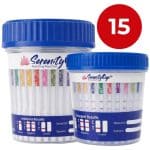
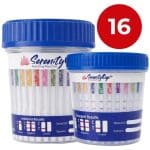
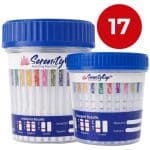
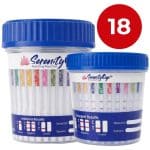
The Best Drug Testing Kits for Employers (2026 Ranking for Staff Screening)


Most employers searching for the “best drug testing kit” land on a category page with 80-plus products and no guidance, then either overbuy a 12-panel they don’t need or grab the cheapest cup and discover it can’t handle their actual testing situations. The best kit for your staff isn’t a single product, it’s the right configuration matched to how and why you test. This ranking cuts through the catalogue and names the kit to standardize on for each kind of employer.
Our workplace testing category is the broad catch-all; this article is the curated version, the specific picks an employer should actually put on a purchase order.
What Is the Best Drug Testing Kit for Employers to Use on Staff?
For most employers, the best drug testing kit for staff is a CLIA-waived 10-panel urine cup with a temperature strip. It covers the standard five substances plus the sedatives and controlled substances that create workplace impairment risk, reads on-site in about five minutes, and the temperature strip catches substituted specimens. From there, match the kit to how you test: a 5-panel cup with a temperature strip for pre-employment-heavy hiring, a 12-panel or DOT-configured cup for safety-sensitive staff, a cup with an adulteration strip for high-cheat-risk post-incident and reasonable-suspicion testing, and a standard cup bought in bulk for cost control at scale. The rule that decides everything is to match the cup to your highest-stakes test and your actual risk, not to your headcount, and to confirm any non-negative at a lab before taking employment action.
The one decision that comes before the kit
Before you pick a cup, decide what you’re testing for and when. That drives everything: pre-employment screening, random testing of current staff, post-incident testing after an accident, and reasonable-suspicion testing all have different requirements. A pre-employment program can standardize on a simple cup; a post-incident program needs tamper resistance and clean documentation. Get the program right and the kit choice becomes obvious. (More on program types in the sub-pillars below.)
What we ranked on
Every pick is an integrated instant urine cup you can run on-site — not a mail-away lab kit. We weighted: panel coverage matched to typical staff-testing needs, CLIA-waived status (so you can legally test in-house), tamper features (temperature and adulteration strips), read clarity, and cost per cup at reorder volume.
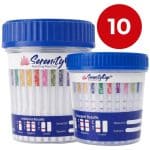
1. Best overall for most employers: CLIA-Waived 10-Panel Cup with Temperature Strip
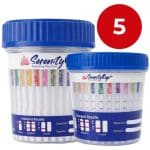
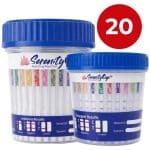
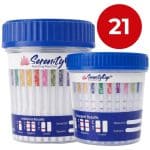
For the typical employer testing current and prospective staff, the 10-panel is the sweet spot. It covers the standard five substances plus the sedatives and controlled substances that create workplace impairment risk, the temperature strip catches substituted specimens, and CLIA-waived status lets HR run it on-site. It reads in five minutes with clear lines, which keeps your testing volume moving. This is the cup to standardize on unless you have a specific reason to go simpler or broader — browse configurations in the 10-panel cups range.
2. Best for pre-employment-heavy hiring: 5-Panel Cup with Temperature Strip
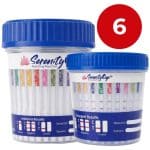
If most of your testing is screening new hires for non-safety-sensitive roles, you don’t need ten panels. A 5-panel cup covers the substances relevant to a hiring decision at a lower per-cup cost, and standardizing on it keeps a high-volume hiring pipeline efficient. Add the temperature strip for unobserved collections.
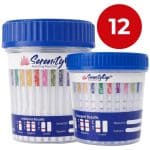
3. Best for safety-sensitive or regulated staff: 12-Panel or DOT-configured Cup
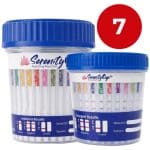
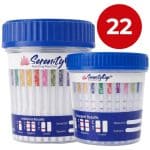
Employers whose staff operate vehicles, machinery, or handle controlled substances need broader coverage. A 12-panel cup adds oxycodone and buprenorphine — the prescription-opioid analytes a 10-panel can miss. If any of your drivers fall under federal rules, note that the regulated test must be lab-based; see our DOT drug testing overview before building that part of your program.
4. Best for high-cheat-risk testing: Cup with Adulteration Strip
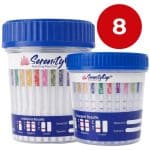
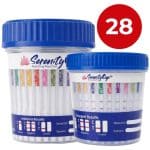
For post-incident and reasonable-suspicion testing — where the employee has a strong motive to beat the test — add the adulteration strip. It checks creatinine, pH, specific gravity, oxidants, nitrites, and glutaraldehyde on the same cup, catching dilution and substitution before you record a false negative. Make this the standard cup for your event-driven testing even if your routine screening uses a simpler one.
5. Best for cost control at scale: Standard Cup bought in bulk
Once your program is running and your collections are consistent, the standard cup (your chosen panel count) in bulk is your reorder SKU. The per-cup price drops meaningfully at case and pallet volume, and for an employer running steady monthly testing that’s real budget. Buy against realistic 6–12 month usage so cups don’t expire on the shelf.
How to actually choose for your staff
Match the cup to your highest-stakes test, then buy simpler versions for routine screening. A general office: standardize on the 10-panel at #1, or the 5-panel at #2 if you’re mostly pre-employment. A logistics or manufacturing employer: 12-panel base (#3) with the adulteration-strip version (#4) for post-incident testing. Whatever you choose, keep the panel and cutoffs consistent across the program so results are comparable and defensible, and confirm non-negatives at a lab before any employment action — an instant cup is presumptive, not final. And don’t default to the widest panel “to be safe”; paying for analytes your workforce never encounters is the most common way employers overspend.
FAQ
What’s the best all-around drug test kit for an employer?
A CLIA-waived 10-panel cup with a temperature strip suits most employers — broad enough for workplace risks, simple enough to run on-site.
Can employers legally drug test staff on-site?
Yes, with a written, consistently applied policy. Use CLIA-waived cups for on-site testing and confirm non-negatives at a lab before acting.
Do I need different kits for pre-employment vs post-incident testing?
Often yes — pre-employment can use a simpler cup, while post-incident and reasonable-suspicion testing benefit from an adulteration strip. Many employers stock two configurations.
How many panels should an employer test for?
5-panel for standard non-safety-sensitive roles, 10-panel for broader coverage, 12-panel for safety-sensitive or prescription-opioid concerns.