Can You Pass a Drug Test With Someone Else’s Urine?

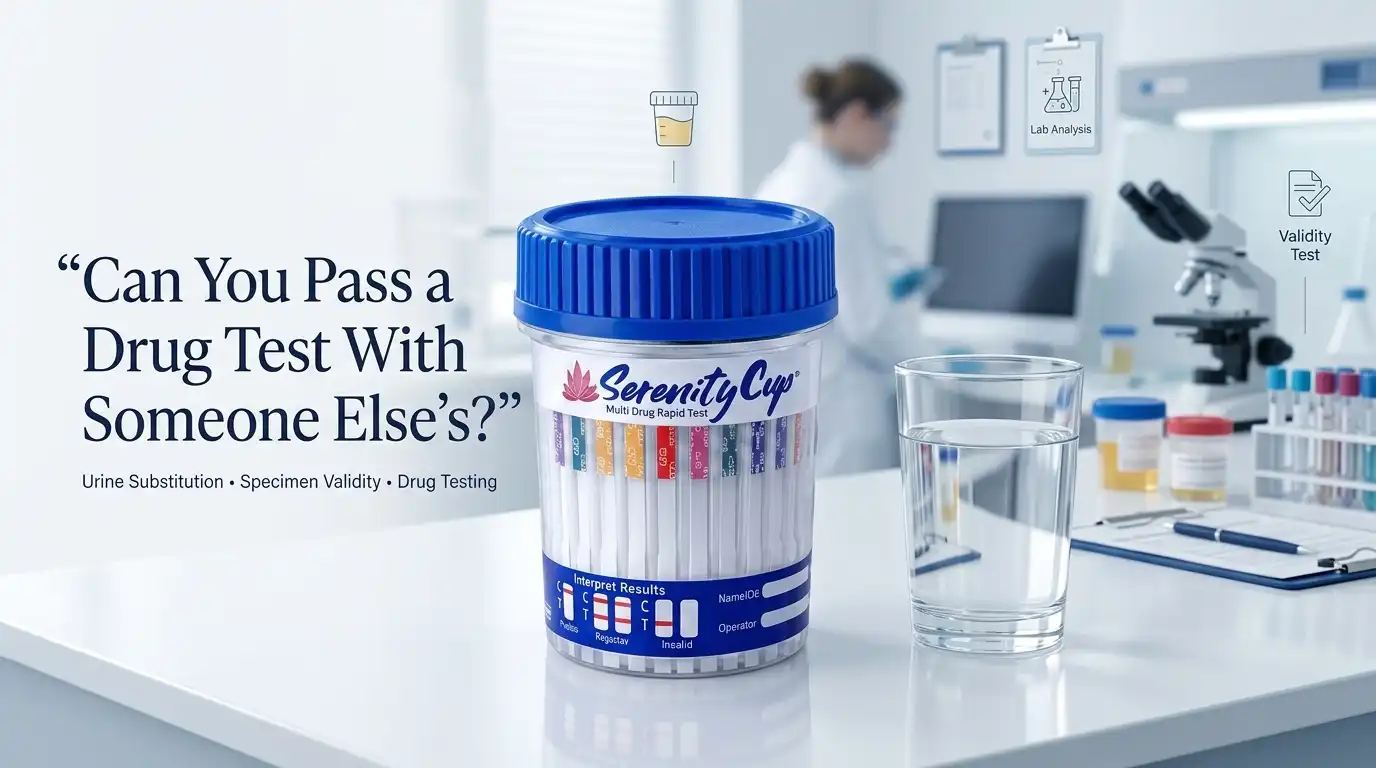
Generally, you should not expect someone else’s urine to provide a reliable negative drug-test result.
A urine drug test is designed to analyze the specimen submitted for testing for particular drugs and/or their metabolites. In professional testing programs, however, the process can also include measures designed to evaluate the validity and integrity of the specimen.
This means that simply finding another person’s drug-free urine does not guarantee that the specimen will be accepted as a normal sample.
Several factors can be relevant, including:
- Specimen collection procedures
- Specimen identification
- Chain of custody
- Specimen temperature checks where applicable
- Creatinine
- Specific gravity
- pH
- Evidence of adulteration
- Evidence of substitution
- Laboratory screening
- Confirmatory testing when required
The exact procedures vary according to the testing program, laboratory, jurisdiction, and purpose of the test.
Why Would Someone Consider Using Someone Else’s Pee?
People searching this topic are often concerned about receiving a positive drug-test result.
For example, someone might be facing:
- A pre-employment drug test
- Workplace testing
- A random drug test
- A probation-related test
- A court-related test
- A safety-sensitive employment test
- A medical or toxicology screening
- A personal or home drug test
This can lead to questions about whether a drug-free urine sample from another person could be used instead.
However, substituting a specimen creates a separate specimen-validity issue. Instead of simply asking whether drugs are present, the testing process may also need to determine whether the submitted sample is a valid specimen from the donor.
How Does a Urine Drug Test Work?
A urine drug test looks for specific substances or drug metabolites in urine.
After a drug is taken, the body processes it. Some of the resulting substances can eventually be eliminated through urine.
Depending on the test, a urine specimen may be screened for substances such as:
- Marijuana/THC metabolites
- Cocaine metabolites
- Amphetamines
- Opioids
- Phencyclidine (PCP)
- Other drug classes included in the particular test panel
The exact drugs included depend on the test.
A screening test is generally designed to identify whether the specimen may contain a target substance at or above a specified cutoff. In appropriate circumstances, additional laboratory testing may be used to investigate or confirm an initial result.
This is why drug testing isn’t simply a matter of looking at the color or appearance of urine.
What Is Specimen Validity Testing?
Specimen validity testing (SVT) refers to testing or evaluation used to determine whether a urine specimen meets applicable criteria for a valid sample.
The purpose is different from simply asking:
“Are drugs present?”
Instead, specimen-validity procedures can help answer:
“Does this specimen appear consistent with a valid urine sample for this testing program?”
Depending on the testing program, laboratories may evaluate characteristics such as:
- Creatinine concentration
- Specific gravity
- pH
- Other indicators of specimen integrity
- Evidence of adulteration or substitution
This distinction is important because a specimen can have a different testing outcome from a straightforward negative or positive result if it does not meet applicable validity criteria.
What Is a Substituted Specimen?
A substituted specimen generally refers to a specimen that is determined, under the applicable testing criteria, not to be consistent with the donor’s urine.
This is different from a drug-positive specimen.
For example, a laboratory may evaluate whether a submitted urine specimen has characteristics expected of a valid human urine specimen from the person being tested.
If the specimen does not meet the applicable requirements, the testing program may treat the issue as a specimen-validity problem rather than simply reporting the sample as a normal negative drug test.
The specific classification and follow-up depend on the testing program.
Can a Lab Tell If Someone Else’s Urine Was Used?
A laboratory does not necessarily need to identify exactly whose urine was submitted.
The important question is whether the specimen meets the applicable criteria for a valid specimen.
Professional testing procedures can use multiple safeguards, including:
- Donor identification
- Controlled collection procedures
- Specimen labeling
- Chain-of-custody documentation
- Collection-site procedures
- Specimen integrity checks
- Laboratory analysis
In some programs, specimen temperature is also checked shortly after collection because urine has a characteristic temperature range when freshly produced.
These procedures make urine substitution considerably less straightforward than simply providing a drug-free urine sample.
Why Does Urine Temperature Matter?
Freshly collected urine has a temperature that is generally close to body temperature.
For certain regulated or professional testing procedures, the specimen may be checked shortly after collection to determine whether its temperature falls within the applicable range.
The important point is not that temperature alone proves who produced the urine.
Instead, it is one potential specimen-integrity check used within a larger collection and testing process.
A laboratory or collection site may also have additional procedures for evaluating a specimen.
What Are Creatinine and Specific Gravity?
Two terms that frequently appear when discussing urine specimen validity are creatinine and specific gravity.
Creatinine
Creatinine is a naturally occurring waste product that is commonly present in urine.
Its concentration can provide information about the concentration of a urine specimen.
Very unusual creatinine results can be relevant to determining whether a specimen meets applicable validity criteria.
Specific Gravity
Specific gravity describes the density of urine compared with water.
It provides another way of assessing urine concentration.
Together with other measurements, creatinine and specific gravity can help laboratories evaluate whether a specimen appears consistent with a normal urine sample.
What Does pH Have to Do With a Drug Test?
Urine has a naturally occurring pH range.
Testing laboratories can evaluate urine pH as part of specimen validity procedures.
An unusual pH does not automatically answer every question about a specimen, but it can be one of several measurements considered when assessing specimen integrity.
This is why attempting to alter a urine specimen can create additional testing concerns rather than simply changing the drug result.
What Is the Difference Between Dilute, Invalid, Adulterated, and Substituted Urine?
These terms are sometimes used interchangeably online, but they describe different specimen issues.
Dilute specimen
A specimen may be considered dilute when its concentration characteristics meet the applicable criteria for dilution.
Dilution can affect the concentration of substances in urine, but a dilute result is not necessarily the same thing as a negative result.
Invalid specimen
An invalid specimen is one that does not meet applicable criteria for testing or validity.
The reason can depend on the testing program and laboratory findings.
Adulterated specimen
An adulterated specimen generally means that evidence indicates the specimen has been altered in a way that is inconsistent with an authentic urine sample.
Substituted specimen
A substituted specimen is a sample determined under applicable criteria to be inconsistent with the donor’s urine.
These categories are important because a problematic specimen does not necessarily become a routine negative drug test.
Does Drinking Water Solve the Problem?
Drinking water is another common topic associated with attempts to influence urine drug-test results.
Water can affect urine concentration, but drinking excessive amounts of water is not a dependable way to eliminate drugs or metabolites from the body.
It can instead produce unusually dilute urine.
Laboratory testing can evaluate characteristics of the specimen, and a dilute specimen may lead to additional procedures depending on the testing program.
There is also a health concern with consuming excessive quantities of water in a short period because it can disrupt the body’s electrolyte balance.
For that reason, drinking excessive water should not be considered a safe or reliable drug-testing strategy.
What About Synthetic Urine?
Synthetic urine is frequently marketed online as a way to imitate a normal urine specimen.
However, professional laboratories can use specimen-validity procedures and other collection safeguards that make synthetic or otherwise non-authentic specimens unreliable for legitimate testing.
A product claiming to “guarantee” a negative drug test should therefore be treated with considerable skepticism.
The result of a drug test depends on the testing procedure, specimen, analytes, laboratory methods, and applicable requirements—not on marketing claims printed on a product.
What Happens If a Specimen Has a Validity Problem?
The outcome depends on the type of test and the organization conducting it.
Possible follow-up actions can include:
- Additional laboratory evaluation
- A recollection
- A repeat test
- Review by an appropriate testing professional
- Further investigation under the applicable testing policy
A specimen-validity issue should not automatically be interpreted as equivalent to a drug-positive result.
The terminology and consequences depend on the applicable testing program.
What Is Chain of Custody in Drug Testing?
Chain of custody refers to documentation and procedures used to track a specimen from collection through handling and testing.
It can help establish:
- Who provided the specimen
- When it was collected
- How it was identified
- How it was handled
- Where it was transferred
- How it was tested
Chain-of-custody procedures are particularly important when drug testing is being performed for employment, legal, regulatory, or other official purposes.
The exact requirements vary depending on the testing program.
Workplace Drug Testing and Someone Else’s Urine
Employment drug testing can have different procedures depending on the employer, laboratory, jurisdiction, and applicable regulations.
A workplace drug test may involve:
- Identification of the donor
- Collection of a specimen
- Specimen labeling
- Initial testing or laboratory screening
- Specimen-validity evaluation where applicable
- Additional testing when required
- Reporting of the final result according to the applicable program
This means that a drug-free urine sample from another person is not equivalent to simply taking a normal negative drug test.
What About DOT Drug Testing?
Drug testing conducted under U.S. Department of Transportation (DOT) regulations has specific requirements governing the collection and handling of specimens.
DOT-regulated testing is therefore different from an informal home drug test.
Where a person is subject to a regulated testing program, the applicable rules and procedures determine how specimens are collected, evaluated, and reported.
If your test is connected to a regulated or safety-sensitive position, follow the instructions provided by the testing program rather than relying on internet claims about urine substitution.
Can Someone Else’s Drug-Free Urine Remove Drugs From Your Body?
No.
This is an important distinction.
If another person’s urine does not contain drug metabolites, those metabolites still remain in your body if they are present there.
Substituting a specimen does not:
- Remove drugs from your body
- Change your metabolism
- Shorten a drug’s biological detection window
- Eliminate drug metabolites from your system
- Guarantee a negative result
Instead, it attempts to replace the specimen being tested.
That creates a separate specimen-validity issue.
What Determines How Long Drugs Remain Detectable?
Drug detection depends on multiple factors.
These can include:
- The specific substance
- Dose
- Frequency of use
- Pattern of use
- Time since use
- Individual metabolism
- Body factors
- Test sensitivity
- Laboratory cutoff
- Specimen type
- Testing method
There is therefore no universal number of hours or days that applies to every person and every drug.
Urine, oral fluid, hair, and other specimen types can also have different detection characteristics.
Urine vs. Other Drug-Testing Methods
Urine is only one type of specimen used for drug testing.
Urine testing
Urine is widely used for drug screening and can detect many drugs and their metabolites.
Oral-fluid testing
Oral-fluid testing uses saliva or oral fluid and has a different detection profile from urine.
Hair testing
Hair testing can provide a substantially longer historical window for certain types of drug-use assessment.
Blood testing
Blood testing can provide information about substances circulating in the body and is used in specific clinical, forensic, or other contexts.
The appropriate testing method depends on the purpose of the test.
What If You Are Worried About a Drug Test?
If you are concerned about an upcoming test, the safest approach is to understand what type of test you are taking and what it actually measures.
Useful questions include:
- Is it a urine, oral-fluid, hair, or blood test?
- Is it a home screening test or laboratory test?
- What substances are included in the panel?
- What are the applicable testing procedures?
- Is confirmatory testing performed when necessary?
- Are you taking prescription medications that should be disclosed?
- Is the test for employment, medical, legal, or personal purposes?
If you take prescription or over-the-counter medication, provide accurate information when the testing program asks for it.
Do not stop a prescribed medication simply because you are worried about a drug test unless your healthcare professional tells you to do so.
Home Drug Tests vs. Laboratory Drug Tests
Home drug tests can be useful for preliminary screening, but they are not necessarily equivalent to laboratory testing.
A home test may use a rapid immunoassay to screen urine for particular substances.
Laboratory testing can provide more extensive analysis and may be used for confirmation or official testing.
If a home test produces an unexpected result, follow the test manufacturer’s instructions and consider appropriate laboratory confirmation when the result has important medical, employment, legal, or other consequences.
Does a Negative Home Test Guarantee a Negative Laboratory Test?
No.
A home screening test and a laboratory test may differ in:
- Test methodology
- Cutoff levels
- Panel composition
- Specimen handling
- Timing
- Analytical sensitivity
- Confirmation procedures
A home result should therefore be interpreted according to the specific test’s instructions rather than treated as an absolute guarantee of what another testing program will report.
Common Myths About Using Someone Else’s Pee
Myth 1: Drug-free urine automatically means a negative test
Not necessarily.
A testing program may evaluate the specimen itself, not merely whether target drugs are detected.
Myth 2: A different person’s urine cannot be detected
This is not a safe assumption.
Specimen collection and validity procedures can identify problems with a submitted specimen.
Myth 3: Temperature is the only thing laboratories check
No.
Temperature can be one collection-site check, while laboratory testing can evaluate additional specimen characteristics.
Myth 4: Drinking huge amounts of water guarantees a negative result
No.
Excessive fluid intake can dilute urine and may create a specimen-validity issue rather than reliably eliminating drug metabolites.
Myth 5: Synthetic urine is guaranteed to work
No.
Marketing claims do not override laboratory testing procedures or specimen-validity requirements.
Myth 6: A specimen problem is automatically the same as a positive drug test
Not necessarily.
A specimen can have a validity classification such as dilute, invalid, adulterated, or substituted. The consequences depend on the applicable testing program.
What Should You Do Instead of Trying to Substitute Urine?
If you are taking a legitimate drug test, focus on understanding the testing process rather than attempting to manipulate the specimen.
You can:
- Find out what type of test you are taking.
- Review which substances the test panel includes.
- Follow the collection instructions.
- Tell the appropriate medical or testing professional about legitimate medications when required.
- Ask how unexpected or non-negative results are handled.
- Request clarification if you don’t understand the testing procedure.
- Seek medical advice when a medication or medical condition could affect your testing situation.
For an official test, follow the requirements of the organization conducting the test.
Frequently Asked Questions
Can you pass a drug test with someone else’s pee?
Using someone else’s urine is not a reliable way to obtain a negative drug-test result. Professional testing programs may use collection procedures and specimen-validity testing to identify problems with a submitted specimen.
Can a drug test detect someone else’s urine?
Testing programs can evaluate specimen characteristics and collection procedures that may identify a specimen as inconsistent with the donor. The exact process depends on the testing program.
What is specimen validity testing?
Specimen validity testing evaluates characteristics of a urine specimen to determine whether it meets applicable criteria for a valid sample. Measurements can include creatinine, specific gravity, and pH, depending on the program.
What happens if a urine sample is substituted?
A specimen identified as substituted may receive a specimen-validity classification rather than simply being reported as a routine negative drug test. The next steps depend on the applicable testing rules.
Can drinking water help pass a urine drug test?
Drinking water can dilute urine but does not reliably remove drugs or metabolites from the body. Excessive water consumption can also create a dilute specimen and can be medically dangerous.
Does synthetic urine work for drug testing?
Synthetic urine should not be considered a reliable way to obtain a negative result from a legitimate drug-testing program. Professional testing may include procedures designed to evaluate specimen validity.
What is a dilute urine specimen?
A dilute specimen is urine whose concentration characteristics meet applicable criteria for dilution. A dilute result is not necessarily the same thing as a negative drug test.
What is an adulterated specimen?
An adulterated specimen is one that shows evidence of alteration inconsistent with an authentic urine specimen, according to the applicable testing criteria.
What is the difference between a screening test and a confirmatory test?
A screening test is generally used to identify whether a specimen may contain a target substance. When appropriate, additional laboratory testing can be used to confirm or investigate an initial finding.
How long do drugs stay detectable in urine?
There is no single detection period for every drug or person. Detection depends on the substance, use pattern, time since use, metabolism, specimen type, testing method, and cutoff.
Final Takeaway
If you searched “how to pass a drug test with someone else’s pee,” the most important thing to understand is that using another person’s urine is not a dependable shortcut to a negative drug-test result.
Modern drug-testing programs can involve much more than simply checking whether drug metabolites are present. Depending on the testing program, specimen collection, chain of custody, temperature checks, specimen validity measurements, and laboratory analysis can all play a role.
A urine specimen may be evaluated for characteristics including creatinine, specific gravity, pH, dilution, adulteration, and substitution, depending on the applicable testing requirements.
Most importantly, substituting urine does not change what is happening inside your body. It does not remove drugs or metabolites or shorten their biological detection period.
If you have an upcoming drug test, the most useful approach is to understand the type of test, what substances it screens for, how specimens are evaluated, and how results are handled. That gives you accurate information without relying on risky or unreliable internet “tricks.”