Drug Test Chain of Custody: A Complete Guide to Legally Defensible Testing

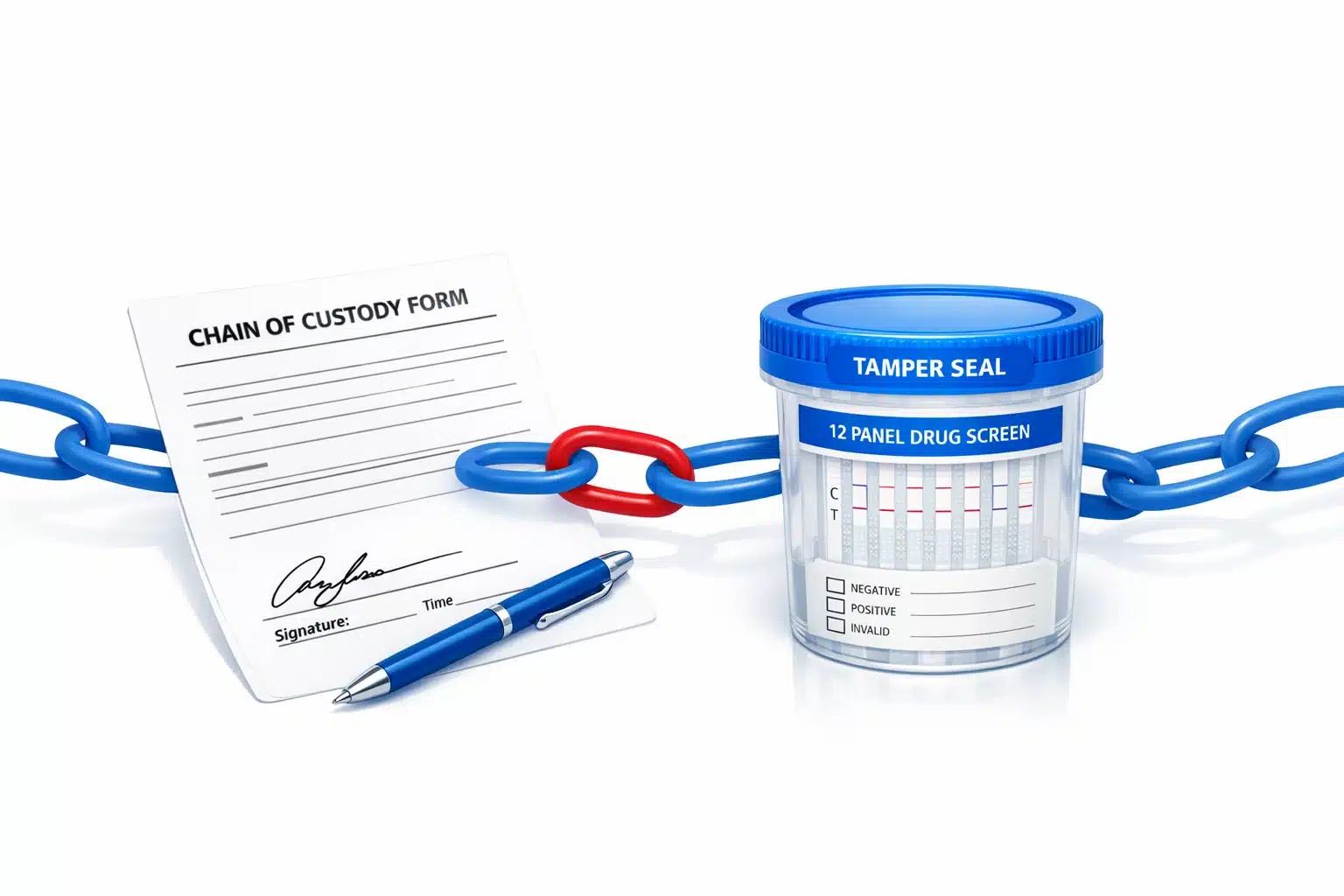
In 2023, attempts to cheat drug tests by substituting urine specimens skyrocketed by 633%, while invalid specimens surged by over 45%, according to a major analysis by Quest Diagnostics. This isn’t just a statistical anomaly; it’s a direct challenge to the integrity of every drug testing program. A positive or negative result means nothing if it can be dismantled in a courtroom or during an HR dispute because of a procedural error.
Most guides focus on filling out a form. We focus on what makes that form legally defensible. A proper chain of custody (COC) is more than a paper trail; it’s a chronological and legal narrative that proves a specimen was handled correctly from the moment of collection to the final report. Understanding the difference between a minor typo and a critical failure is the key to ensuring your results are beyond reproach.
What Is Drug Test Chain of Custody?
Drug test chain of custody is the documented process of recording every stage of a specimen’s journey from collection through laboratory analysis and final reporting. The purpose is to establish a continuous record showing who collected, handled, transported, received, and analyzed the specimen while preserving specimen integrity throughout the testing process.
The chain of custody combines physical specimen security with detailed documentation. Each transfer is recorded using a Chain of Custody Form (CCF), specimen identification numbers, tamper-evident seals, signatures, dates, and transfer records. Together, these elements create an auditable history that supports legal defensibility and regulatory compliance.
Whether testing is performed for workplace drug testing, Department of Transportation (DOT) compliance, post-accident investigations, or court proceedings, maintaining an unbroken chain of custody strengthens the credibility of every laboratory result.
Why Chain of Custody Matters
Drug testing programs rely on more than laboratory accuracy. Every analytical result depends upon confidence that the specimen reaching the laboratory truly belongs to the donor and remained protected against tampering, contamination, substitution, or unauthorized access throughout collection and transport.
Strong chain of custody procedures reduce administrative errors, improve specimen integrity, strengthen workplace compliance, and provide defensible documentation if a drug test result is questioned during employment disputes, regulatory reviews, or legal proceedings.
Why most chains of custody fail: Fatal vs. correctable flaws
A drug test result is only as strong as its weakest link. The U.S. Department of Transportation (DOT) provides a clear framework in 49 CFR Part 40 that distinguishes between procedural mistakes. Some errors can be fixed with a formal correction, while others are “fatal flaws” that force a laboratory to cancel the test. Knowing the difference is critical for both enforcing a policy and challenging an incorrect result.
Fatal Flaws are errors so significant they permanently invalidate the test. There is no recovery from a fatal flaw. Examples include:
- The specimen ID numbers on the bottle and the form do not match.
- The specimen bottle seal is broken or shows evidence of tampering upon arrival at the lab.
- There is no collector signature on the chain of custody form.
Correctable Defects are procedural omissions that can be “cured,” usually within a specific timeframe, by submitting a signed statement detailing the corrective action. Examples include:
- The collector’s signature is missing, but they are available to provide a correction statement.
- A date or address is transcribed incorrectly.
Understanding this distinction allows you to audit any test procedure, whether it’s your own or one presented by an opposing party.

A quick audit view of which documentation or handling errors can invalidate a result versus issues that may be corrected with proper documentation.
Understanding the Chain of Custody Form (CCF)
The Chain of Custody Form (CCF) serves as the central document connecting every stage of specimen collection, transport, laboratory receipt, and reporting. It records donor identification, specimen identification numbers, collection details, collector certifications, transfer documentation, and laboratory processing information.
Because the CCF provides the official record supporting specimen integrity, every field should be completed accurately and consistently. Missing signatures, mismatched specimen identifiers, incomplete transfer records, or inaccurate documentation may delay testing or increase scrutiny during regulatory reviews or legal proceedings.
Standardized CCF completion procedures help collection personnel maintain consistency while reducing preventable documentation errors across multiple testing locations.
Mastering the core protocols for a tamper-proof process
Building a legally sound chain of custody begins with high-quality supplies and unwavering adherence to protocol. Each step is a link in the chain, designed to prevent tampering and eliminate doubt.
1. Proper identification and specimen collection
The process starts before the sample is even collected. The collector must verify the donor’s identity using a valid photo ID. During collection, measures should be in place to prevent substitution or adulteration, such as securing water sources and removing personal items from the collection area.
2. Secure sealing and labeling
Immediately after collection, the specimen bottle must be sealed with a tamper-evident seal. The donor should initial and date the seal. This act is the donor’s certification that the specimen in the bottle is theirs and that it was sealed in their presence. Using reliable, high-quality collection tools like our CLIA-waived 12-panel drug test cups ensures the initial container is secure.
3. Documenting every handoff
The Chain of Custody Form (CCF) tracks the specimen from the collection site to the laboratory. Every person who handles the specimen must sign, date, and note the time of the transfer. This unbroken record ensures accountability. Secure transport in a sealed bag or locked container is the final step before the laboratory takes custody.

Use this 10-point audit visual to confirm the form, seal, labels, and handoffs are complete before a result is relied on in court or HR action.
Navigating jurisdictional minefields: Workplace vs. family court
The standard for a defensible test isn’t universal. The purpose of the test and the legal venue dictate the level of scrutiny and the specific rules that apply.
Comparing Workplace and Forensic Drug Testing
Workplace drug testing primarily focuses on regulatory compliance, employee safety, organizational policy enforcement, and risk management. In these settings, chain of custody procedures ensure specimens remain secure while protecting employers from challenges related to specimen handling or documentation.
Forensic and court-ordered drug testing often receives greater legal scrutiny because laboratory findings may influence criminal proceedings, civil litigation, child custody determinations, or other judicial decisions. These cases typically require comprehensive documentation demonstrating that specimen identity, specimen integrity, and laboratory handling remained intact throughout every stage of testing.
Understanding the intended use of a drug test helps organizations establish chain of custody procedures appropriate for the level of legal review the results may ultimately receive.
For the workplace: The DOT standard
In the United States, DOT regulations are the gold standard for workplace testing. A key component is the Medical Review Officer (MRO), a licensed physician who reviews all test results from the lab. The MRO’s role is to verify the chain of custody and contact the donor to determine if there is a legitimate medical explanation for a positive result before reporting it to the employer. This adds a crucial layer of verification and legal protection.
DOT & SAMHSA Chain of Custody Standards
Many regulated workplace drug testing programs follow guidance established by the Department of Transportation (DOT) and laboratory standards supported by the Substance Abuse and Mental Health Services Administration (SAMHSA). These standards emphasize standardized specimen collection, documented chain of custody, secure specimen transportation, laboratory quality assurance, and Medical Review Officer oversight.
Following recognized standards helps employers establish consistent procedures while reducing documentation errors, protecting specimen integrity, and improving confidence in laboratory findings across regulated testing environments.
For family law: Proving behavioral change
In child custody cases, the court is often less concerned with a single event and more interested in a pattern of behavior. This is where different testing methods become strategically important. While a urine test shows recent use (typically within 4 days), a hair follicle test can provide a 90-day history of substance use. Since head hair grows approximately 1cm per month, segmented analysis can even demonstrate a change in behavior over time, which can be powerful evidence in court.

A jurisdiction-first view helps you match documentation and oversight to the venue—reducing the risk that a valid test is attacked on technical grounds.
Modern challenges to test integrity
As testing becomes more common, so do sophisticated attempts to defeat it. A strong chain of custody is your primary defense against these modern challenges.
The dramatic rise in specimen tampering highlights a critical vulnerability. An unobserved collection or a poorly documented handoff creates an opportunity for substitution. This is why strict adherence to protocol and using professional-grade supplies like tamper-evident multi-panel urine cups are non-negotiable.
Another growing issue is the “CBD defense,” where a donor claims a positive THC result is due to legal CBD products. In DOT cases, this defense rarely succeeds because the MRO’s verification process is strict. However, in family law or other non-regulated settings, this claim can introduce doubt. The best defense is a well-documented chain of custody paired with clear company policies. For individuals mounting this defense, providing a product’s Certificate of Analysis (COA) to prove it contains undisclosed THC is becoming essential evidence.

Rising tampering makes documentation a defense strategy—not paperwork. Pair strong chain-of-custody controls with an evidence file when CBD or exposure claims are likely.
Common Chain of Custody Mistakes
Many challenges to drug test results stem from preventable documentation or handling errors rather than laboratory analysis itself. Common mistakes include incomplete Chain of Custody Forms (CCFs), mismatched specimen identification numbers, missing collector or donor signatures, damaged tamper-evident seals, incomplete transfer documentation, and improperly secured specimen transport.
Administrative inconsistencies can also create unnecessary legal scrutiny. Recording incorrect dates or times, using inconsistent donor identifiers, delaying documentation, or failing to document specimen transfers may weaken confidence in an otherwise valid testing process.
Standardized collection procedures, ongoing collector training, and routine quality audits significantly reduce these risks while strengthening specimen integrity and overall program reliability.
Your first line of defense is a reliable test
A legally defensible drug test result is not an accident. It is the outcome of a deliberate process that begins with reliable supplies, follows strict protocols, and maintains an unbroken chain of documentation. Whether you are an employer protecting your workplace or a legal professional advocating for a client, understanding these principles is your greatest asset.
The integrity of your entire testing program rests on the quality of the tools you use. At 12 Panel Now, we provide FDA-approved and CLIA-waived drug testing supplies with a 99% reliability rate, ensuring the first link in your chain of custody is strong.
Explore our full range of urine analysis cups, dip cards, and oral swabs to build your drug testing program on a foundation of confidence and legal defensibility.
Preparing Collection Personnel
Even the most detailed chain of custody procedures depend upon properly trained collection personnel. Collectors serve as the first guardians of specimen integrity by verifying donor identification, supervising collection procedures, completing documentation accurately, and maintaining secure specimen handling throughout the collection process.
Training programs should emphasize standardized workflows, proper completion of Chain of Custody Forms (CCFs), specimen labeling, tamper-evident sealing procedures, documentation requirements, and secure specimen transfers. Consistent training reduces procedural variation while improving the overall defensibility of workplace drug testing programs.
Routine competency evaluations and periodic refresher training help ensure collection personnel remain current with evolving regulatory guidance, organizational policies, and best practices for specimen collection.
Choosing Chain of Custody Supplies
Reliable collection supplies support every stage of the drug test chain of custody. Tamper-evident specimen containers, secure transport bags, Chain of Custody Forms (CCFs), integrated temperature verification, specimen validity testing products, and durable labeling systems all contribute to preserving specimen integrity throughout collection and laboratory transport.
Organizations should evaluate whether testing products meet applicable FDA clearance, CLIA-waived requirements where appropriate, and compatibility with laboratory workflows. Selecting professional-grade collection supplies helps reduce preventable documentation errors while supporting standardized specimen handling procedures.
High-quality collection systems improve efficiency by simplifying specimen labeling, reducing handling errors, and strengthening confidence in every documented specimen transfer.
Common Chain of Custody Myths
Several misconceptions continue to create unnecessary risk during workplace drug testing. Understanding these myths helps organizations strengthen chain of custody procedures while improving specimen integrity.
One common misconception is that accurate laboratory testing alone guarantees legally defensible results. In reality, even highly accurate laboratory analysis may be challenged if documentation, specimen identification, or chain of custody procedures are incomplete.
Another myth is that paperwork can always be corrected after collection. While certain documentation deficiencies may qualify as correctable defects under specific regulatory frameworks, fatal flaws involving specimen identity or seal integrity generally cannot be remedied after the fact.
Some organizations believe digital recordkeeping automatically replaces traditional chain of custody requirements. Electronic documentation can improve efficiency, but it must still accurately document specimen collection, transfers, signatures, and secure handling throughout the testing process.
It is also incorrect to assume that collection supplies alone prevent specimen tampering. Effective chain of custody depends upon standardized procedures, trained personnel, complete documentation, secure specimen handling, and ongoing quality assurance working together.
Choosing the Right Chain of Custody Process
An effective drug test chain of custody process should reflect an organization’s regulatory obligations, testing environment, operational workflows, and legal responsibilities. Employers, healthcare providers, laboratories, government agencies, and legal professionals may require different collection procedures while maintaining the same core objective of protecting specimen integrity.
Organizations should periodically review chain of custody protocols to ensure documentation requirements, collection procedures, personnel training, and specimen handling practices remain aligned with current regulations and evolving industry standards. Continuous process improvement reduces preventable errors while strengthening the overall reliability of workplace drug testing programs.