How Long Does Gabapentin Stay in Your Urine? Detection Time, Urine Tests & Complete Guide

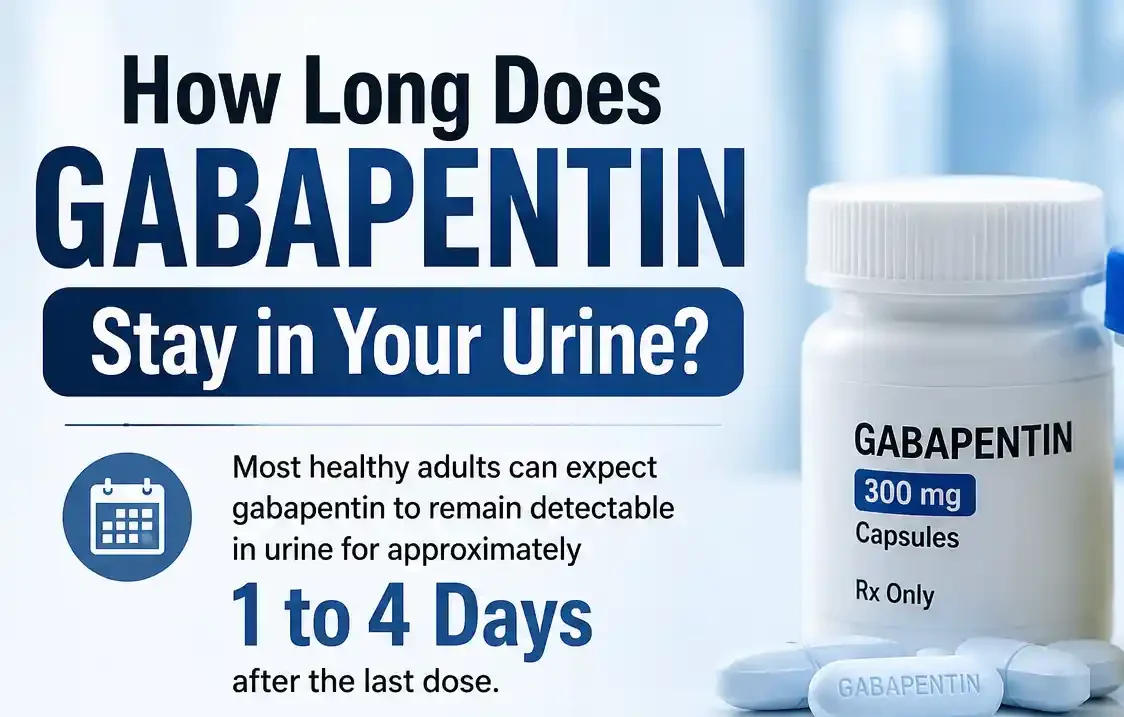
Quick Answer: Gabapentin is usually detectable in urine for 1 to 4 days after your last dose. People with reduced kidney function, long-term use, or higher daily doses may remain positive for several days longer. Standard workplace drug tests generally do not test for gabapentin unless a specific test is requested.
If you’re wondering how long gabapentin stays in your urine, the short answer is that most healthy adults can expect gabapentin to remain detectable in urine for approximately 1 to 4 days after the last dose. However, this detection window isn’t the same for everyone. Factors such as kidney function, dosage, age, frequency of use, hydration, and overall health can significantly affect how quickly the medication leaves your body.
Unlike many prescription medications, gabapentin is not metabolized by the liver. Instead, it is excreted almost entirely unchanged through the kidneys, making kidney function the single most important factor influencing how long gabapentin remains detectable in urine.
Another common misconception is that if gabapentin leaves the bloodstream quickly, it also disappears from urine immediately. In reality, drug elimination and urine detection are two different processes. Although gabapentin has a relatively short half-life of 5 to 7 hours, sensitive urine tests can still detect the medication for several days after the last dose.
Whether you’re preparing for a workplace drug test, managing a prescription, or simply curious about the medication, understanding gabapentin’s detection window can help you know what to expect.
Gabapentin Detection Window at a Glance
| Test Type | Typical Detection Window |
| Urine Test | 1–4 days |
| Blood Test | Approximately 5–24 hours |
| Hair Follicle Test | Up to 90 days (specialized testing) |
| Saliva Test | Limited evidence; not routinely used |
These are average detection times. Individual results vary depending on health conditions and testing methods.
What Is Gabapentin?
Gabapentin is a prescription medication sold under brand names such as Neurontin®, Gralise®, and Horizant®. It belongs to a class of medications known as gabapentinoids and is commonly prescribed to treat several neurological conditions.
Healthcare providers may prescribe gabapentin for:
- Partial seizures
- Postherpetic neuralgia (nerve pain after shingles)
- Neuropathic pain
- Restless legs syndrome (extended-release formulations)
- Certain chronic pain conditions
- Off-label treatment for anxiety disorders or alcohol withdrawal in some patients
Although its name resembles the neurotransmitter GABA (gamma-aminobutyric acid), gabapentin does not directly activate GABA receptors. Instead, it works by affecting calcium channels in the nervous system, helping reduce abnormal nerve activity responsible for seizures and nerve pain.
Because gabapentin has a relatively low potential for abuse compared with opioids, it is widely prescribed. However, some states classify it as a monitored or controlled medication because of increasing reports of misuse.
How Long Does Gabapentin Stay in Your Urine?
For most healthy adults, gabapentin stays detectable in urine for approximately 1 to 4 days after the final dose.
This means if someone asks:
- How long does gabapentin stay in your urine?
- How long does gabapentin stay in your urine for?
- How long does gabapentin stay in your urine system?
the answer is generally between one and four days, assuming normal kidney function and occasional use.
People with chronic kidney disease or severe renal impairment may eliminate gabapentin much more slowly because the kidneys are responsible for clearing nearly all of the medication.
Why Does Gabapentin Stay in Urine?
Unlike most prescription medications, gabapentin undergoes very little metabolism.
Most drugs are processed by the liver before being eliminated through urine or stool. Gabapentin is different.
After absorption:
- Gabapentin enters the bloodstream.
- It circulates throughout the body.
- The kidneys filter the medication.
- Most of the drug is excreted unchanged in urine.
Because the medication leaves the body without significant chemical changes, urine becomes the most reliable sample for detecting recent gabapentin use.
Gabapentin Half-Life Explained
To understand urine detection, it’s helpful to understand a medication’s half-life.
A drug’s half-life is the amount of time required for half of the medication in your bloodstream to be eliminated.
For gabapentin:
- Average half-life: 5 to 7 hours
- People with healthy kidneys generally eliminate most of the medication within 35 to 48 hours (about five to seven half-lives).
However, being largely eliminated from the bloodstream does not necessarily mean the drug is immediately undetectable in urine.
Small amounts can continue passing through the kidneys for several more hours or days depending on the individual.
Gabapentin Elimination Timeline
The following timeline illustrates how gabapentin typically leaves the body in adults with normal kidney function.
| Time After Last Dose | Approximate Amount Remaining |
| 5–7 hours | About 50% remains |
| 10–14 hours | About 25% remains |
| 15–21 hours | About 12.5% remains |
| 20–28 hours | About 6% remains |
| 35–48 hours | Nearly all eliminated |
Although the drug is largely cleared within two days, urine testing may still detect residual amounts for up to four days, particularly after repeated dosing.
How Long Does Gabapentin Stay in Your System for a Urine Test?
Typical Urine Detection Window
| Type of Use | Detection Time |
| Single dose | Approximately 1–2 days |
| Occasional use | About 1–4 days |
| Long-term use | Several days, depending on kidney function |
| Kidney disease | May remain detectable significantly longer |
What Factors Affect How Long Gabapentin Stays in Your Urine?
Although the average detection window is relatively short, several important factors can influence how quickly gabapentin leaves your body.
1. Kidney Function
Kidney function is the single biggest factor affecting gabapentin elimination.
Unlike many medications that rely on liver metabolism, gabapentin depends almost entirely on the kidneys for clearance.
People with:
- Chronic kidney disease
- Reduced kidney function
- Kidney failure
- Dialysis
may retain gabapentin much longer than healthy adults.
In severe kidney impairment, the drug’s half-life can increase dramatically, extending urine detection well beyond the normal 1–4 day range.
2. Dosage
Higher daily doses increase the amount of medication your kidneys must eliminate.
Someone taking:
- 300 mg occasionally
will usually eliminate gabapentin faster than someone taking:
- 600 mg three times daily
- 800 mg four times daily
- Long-term high-dose therapy
Although dosage does not dramatically change the drug’s half-life, larger amounts take longer to clear completely.
3. Frequency of Use
People taking gabapentin for months or years often maintain steady drug levels in their bodies.
Repeated dosing allows small amounts of the medication to accumulate between doses.
As a result, chronic users may remain positive on specialized urine tests longer than someone who has taken only a single dose.
4. Age
Kidney function naturally declines with age.
Older adults often eliminate medications more slowly, particularly if they also have reduced kidney filtration or other chronic medical conditions.
For this reason, healthcare providers frequently adjust gabapentin doses for elderly patients.
5. Hydration
Hydration affects urine concentration but does not significantly speed up gabapentin elimination.
Drinking water supports healthy kidney function, but it cannot rapidly remove the medication from your body.
Attempting to dilute urine before a drug test may instead result in an invalid or rejected sample.
6. Overall Health
Several medical conditions may influence gabapentin clearance, including:
- Diabetes affecting kidney function
- Heart disease reducing kidney blood flow
- Chronic kidney disease
- Acute kidney injury
The healthier your kidneys are, the more efficiently gabapentin is removed from your system.
Does Gabapentin Stay Longer in Chronic Users?
Yes.
People taking gabapentin every day for weeks or months may remain detectable longer than someone taking a single dose.
Daily dosing creates a more consistent concentration of the medication in the body. Although gabapentin does not accumulate as extensively as some long-acting medications, regular use can still extend urine detection, especially when combined with higher doses or impaired kidney function.
This is why two people taking the same medication may receive different drug test results even if they stopped on the same day.
Immediate-Release vs. Extended-Release Gabapentin
Gabapentin is available in different formulations, and many patients wonder whether they affect urine detection.
Immediate-Release Gabapentin
- Standard capsules and tablets
- Usually taken three times daily
- Reaches peak blood levels within a few hours
- Typical half-life: 5–7 hours
Extended-Release Gabapentin
Examples include Gralise® and Horizant®.
These formulations release gabapentin gradually throughout the day, helping maintain steadier blood concentrations. While they may delay absorption, the elimination process remains primarily dependent on kidney function, and overall urine detection windows are generally similar.
Understanding which formulation you take can help explain differences in symptom relief, but it usually has less impact on urine detection than kidney health or long-term use.
Does Gabapentin Show Up on a Urine Drug Test?
One of the biggest concerns people have is whether gabapentin will appear on a routine drug screen.
The answer is usually no.
Gabapentin is not included in most standard workplace drug tests, including the commonly used 5-panel and many 10-panel drug tests. However, the medication can be detected if a laboratory performs a specific gabapentin test or includes it in an expanded drug testing panel.
Whether gabapentin is detected depends on:
- The type of drug test being used
- The laboratory’s testing methods
- Whether gabapentin is specifically ordered
- Your kidney function
- How recently you took the medication
If you’re taking gabapentin exactly as prescribed, it’s important to inform the testing facility or Medical Review Officer (MRO) if requested. A valid prescription helps explain a positive result on a specialized test.
Is Gabapentin Included in a Standard 5-Panel Drug Test?
In most cases, no.
A standard 5-panel urine drug test typically screens for:
| Drug Category | Usually Included |
| Marijuana (THC) | ✓ |
| Cocaine | ✓ |
| Amphetamines | ✓ |
| Opiates | ✓ |
| PCP | ✓ |
| Gabapentin | ✗ |
Since gabapentin is not part of routine workplace screening, most people taking the medication will not test positive on a standard 5-panel test.
Is Gabapentin Included in a 10-Panel Drug Test?
Generally, no.
Most 10-panel drug tests add medications such as:
- Benzodiazepines
- Barbiturates
- Methadone
- Propoxyphene
- Methaqualone (or similar substances depending on the panel)
Gabapentin still isn’t routinely included unless an employer, physician, treatment program, or legal authority specifically requests it.
Is Gabapentin on a 12-Panel Drug Test?
This is one of the most frequently searched questions.
Usually, no—but it depends on the testing panel.
Many commercial 12-panel drug tests do not include gabapentin as a standard target drug.
However, some:
- Pain management clinics
- Addiction treatment programs
- Probation departments
- Hospital laboratories
may order expandedurine drug testing that specifically includes gabapentin.
Always check the exact testing panel rather than assuming every 12-panel test detects the same substances.
Why Would Someone Be Tested for Gabapentin?
Although gabapentin isn’t routinely screened, healthcare providers or laboratories may order testing for several reasons.
Common situations include:
- Monitoring medication compliance
- Pain management programs
- Substance use treatment
- Suspected medication misuse
- Probation or court monitoring
- Forensic investigations
- Medical emergencies
Because gabapentin misuse has increased in recent years, specialized testing has become more common in certain healthcare settings.
Other Ways Gabapentin Can Be Detected
Although urine testing is the most common method, gabapentin may also be detected in other biological samples.
Blood Test
Blood testing is mainly used in hospitals or emergency settings.
Typical detection window:
Approximately 5 to 24 hours
Blood tests measure recent use rather than long-term exposure.
Hair Follicle Test
Hair testing provides the longest detection window.
Typical detection:
Up to 90 days
Hair testing for gabapentin is relatively uncommon and usually reserved for forensic or specialized investigations.
Saliva Test
Current evidence suggests gabapentin is not routinely tested using saliva.
Because oral fluid testing offers little advantage for this medication, saliva tests are rarely used outside research settings.
Can You Flush Gabapentin Out of Your Urine Faster?
Many websites promote detox drinks, supplements, or home remedies claiming they can remove gabapentin from your urine quickly.
There is no scientific evidence that any product can rapidly eliminate gabapentin once it has been absorbed.
Your kidneys naturally clear the medication over time.
Myth vs. Fact
Myth: Drinking large amounts of water removes gabapentin.
Fact: Water supports normal kidney function but does not dramatically speed drug elimination.
Myth: Exercise helps clear gabapentin.
Fact: Physical activity benefits overall health but has little effect on how quickly your kidneys eliminate gabapentin.
Myth: Detox drinks guarantee a negative drug test.
Fact: No detox product has been proven to reliably remove gabapentin from the body or guarantee a negative laboratory result.
Myth: Cranberry juice flushes gabapentin.
Fact: Cranberry juice may support hydration but does not significantly affect gabapentin metabolism or urine detection.
Drug Interactions That May Affect Gabapentin
Unlike many medications, gabapentin has relatively few drug interactions because it is not metabolized by liver enzymes.
However, some medications may influence absorption or increase side effects.
Examples include:
- Morphine
- Hydrocodone
- Oxycodone
- Naproxen
- Cimetidine
- Magnesium- or aluminum-containing antacids
For example, antacids containing magnesium or aluminum can reduce gabapentin absorption if taken too close together. Many healthcare providers recommend taking gabapentin at least two hours after these antacids.
Can Kidney Disease Increase Urine Detection Time?
Yes.
Kidney function is the single biggest predictor of how long gabapentin stays in your urine.
Healthy Kidneys
- Typical half-life: 5–7 hours
- Urine detection: 1–4 days
Mild Kidney Impairment
- Slower elimination
- Detection window may increase
Moderate to Severe Kidney Disease
- Significantly prolonged half-life
- Urine detection may extend well beyond several days
Dialysis Patients
Gabapentin elimination depends heavily on dialysis schedules because the kidneys can no longer remove the medication efficiently.
Healthcare providers usually adjust gabapentin doses based on kidney function to avoid excessive drug accumulation.
Gabapentin Withdrawal Timeline
People searching about urine detection are often preparing to stop taking gabapentin.
Unlike opioids or benzodiazepines, gabapentin withdrawal is generally less severe, but it can still occur after long-term use.
Common symptoms include:
- Anxiety
- Restlessness
- Insomnia
- Sweating
- Nausea
- Headaches
- Irritability
- Increased heart rate
Approximate Withdrawal Timeline
| Time After Last Dose | Possible Symptoms |
| 12–24 hours | Mild symptoms may begin |
| 24–72 hours | Symptoms often become more noticeable |
| 3–7 days | Peak withdrawal for many people |
| 1–2 weeks | Gradual improvement |
Never stop gabapentin abruptly without discussing it with your healthcare provider, especially if you take it for epilepsy or seizure disorders.
Frequently Asked Questions
How long does gabapentin stay in your urine?
For most healthy adults, gabapentin remains detectable in urine for approximately 1 to 4 days after the last dose. The exact detection window depends on several factors, including your kidney function, age, dosage, frequency of use, hydration status, and overall health. Because gabapentin is eliminated almost entirely through the kidneys rather than being metabolized by the liver, people with reduced kidney function may continue to test positive for several days longer than healthy individuals.
How long does gabapentin stay in your system for a urine test?
Most specialized laboratory urine tests can detect gabapentin for 1 to 4 days after the final dose in healthy adults. However, this timeframe can be extended in individuals with chronic kidney disease (CKD), older adults, or those taking high doses for an extended period. Routine workplace drug screens generally do not include gabapentin unless the test specifically requests it.
How long does gabapentin stay detectable in your urine?
Gabapentin usually remains detectable in urine for up to 4 days after the last dose, although the exact duration varies from person to person. The medication has a relatively short elimination half-life of about 5 to 7 hours, but complete clearance depends on how efficiently your kidneys remove it from the body. Individuals with impaired kidney function may have significantly longer detection times because the drug is excreted unchanged in the urine.
Does gabapentin show up on a urine drug screen?
Not usually. Standard workplace urine drug screens, including most 5-panel, 10-panel, and 12-panel drug tests, do not routinely test for gabapentin. Detection generally requires a specialized laboratory assay or an expanded prescription drug panel. Healthcare providers, pain management clinics, probation programs, and addiction treatment centers may specifically order gabapentin testing when clinically necessary.
Does gabapentin show up on a 12-panel drug test?
In most cases, no. A standard 12-panel drug test is designed to detect commonly abused substances such as opioids, cocaine, amphetamines, methamphetamine, THC, PCP, and benzodiazepines, but gabapentin is typically not included. However, some employers, healthcare facilities, or court-ordered testing programs may use customized or expanded 12-panel drug tests that specifically include gabapentin as an additional analyte.
Is gabapentin an opioid?
No. Gabapentin is not an opioid. It belongs to a class of medications known as gabapentinoids and works by reducing abnormal nerve activity in the brain and spinal cord. Unlike opioid medications such as oxycodone, morphine, or hydrocodone, gabapentin does not bind directly to opioid receptors. It is commonly prescribed to treat neuropathic pain, postherpetic neuralgia, restless legs syndrome, and certain seizure disorders.
Is gabapentin a controlled substance?
At the federal level in the United States, gabapentin is not classified as a controlled substance. However, due to increasing reports of misuse, dependence, and diversion, several states—including Kentucky, Virginia, Tennessee, West Virginia, Alabama, Michigan, and others—have implemented their own regulations by classifying gabapentin as a controlled substance or requiring prescription monitoring. Always check your state’s current laws, as regulations continue to evolve.
Can drinking water help you pass a gabapentin urine test?
No. Drinking extra water will not rapidly eliminate gabapentin or guarantee a negative urine drug test. While proper hydration supports normal kidney function, it does not significantly change the body’s natural elimination process. Attempting to dilute your urine excessively may even result in an invalid or diluted specimen, requiring another test. The only reliable way to test negative is to allow enough time for the medication to naturally clear from your system.
Does kidney disease affect how long gabapentin stays in urine?
Yes. Kidney function is the single most important factor affecting gabapentin elimination. Since gabapentin is excreted almost entirely unchanged through the kidneys, people with chronic kidney disease (CKD), reduced renal function, or those receiving dialysis eliminate the drug much more slowly. As a result, gabapentin may remain detectable in urine well beyond the typical 1 to 4 days, and healthcare providers often prescribe lower doses or longer dosing intervals for these patients.
Can gabapentin be detected in hair?
Yes, although hair testing for gabapentin is uncommon. Specialized hair follicle drug tests may detect previous gabapentin use for up to 90 days, depending on hair length and laboratory methods. Hair testing is rarely used for routine employment screening but may be performed in certain forensic investigations, legal cases, or specialized toxicology testing when long-term drug exposure needs to be evaluated.
Can I stop taking gabapentin suddenly?
No. You should not stop gabapentin abruptly without consulting your healthcare provider. Suddenly discontinuing gabapentin may cause withdrawal symptoms, including anxiety, insomnia, nausea, sweating, agitation, headaches, and, in some individuals, an increased risk of rebound seizures. This risk is especially important for people taking gabapentin to manage epilepsy. Your healthcare provider will usually recommend a gradual tapering schedule based on your dosage, treatment duration, and underlying medical condition to reduce the risk of withdrawal and other complications.