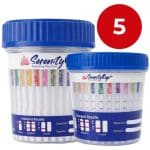
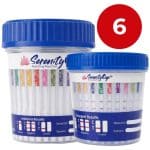
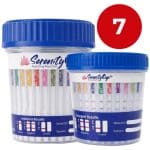
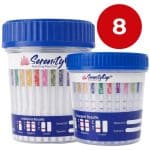
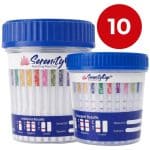
What Does a 10-Panel Drug Test Detect? Cutoff Levels That Actually Matter


Two workplaces can run the “same” 10-panel drug test and get different results from identical specimens — because the panel name tells you how many substances are screened, not the cutoff level at which each one reads positive. The cutoff is the number that decides who passes, and it’s the spec most buyers never check. Here’s exactly what a 10-panel detects and the cutoffs that shape every result.
What Does a 10-Panel Drug Test Detect?
A 10-panel drug test detects ten substances: the SAMHSA-standard five (THC, cocaine, amphetamines and methamphetamine, opiates, and PCP) plus benzodiazepines, barbiturates, methadone, propoxyphene, and (depending on configuration) methaqualone or an added opioid. But what a “positive” actually means depends on the cutoff level for each substance, not the panel count, which is the spec most buyers never check. Common cutoffs include THC at 50 ng/mL, cocaine at 150 ng/mL, opiates at 2000 ng/mL, and benzodiazepines and barbiturates at 300 ng/mL. This article breaks down all ten substances, the cutoffs that decide each result, what a 10-panel does not catch (like oxycodone and alcohol), and the detection windows behind every reading.
The ten substances, and why these ten
A 10-panel cup screens the SAMHSA-standard five — THC (marijuana), cocaine, amphetamines/methamphetamine, opiates, and phencyclidine (PCP) — plus five more that matter to workplaces with controlled-substance exposure: benzodiazepines, barbiturates, methadone, propoxyphene, and (in some configurations) methaqualone or an additional opioid. The reason these particular five get added is impairment risk: benzodiazepines and barbiturates are sedatives that affect alertness and reaction time, exactly the risks a safety-sensitive employer needs to see. If those substances aren’t a risk in your workforce, you may not need a 10-panel at all — but if they are, this is the coverage floor.
Cutoff levels: the number that decides the result
Each substance on the panel has an immunoassay cutoff — the concentration at or above which the test reads positive. THC is commonly set at 50 ng/mL, cocaine at 150 ng/mL, amphetamines around 500–1000 ng/mL, opiates at 2000 ng/mL (the SAMHSA level, raised years ago to reduce false positives from poppy-seed foods), and benzodiazepines and barbiturates commonly at 300 ng/mL. These aren’t arbitrary — they’re set to distinguish genuine use from trace or incidental exposure. A cup with a lower opiate cutoff, for instance, will flag more people, including some who ate the wrong bagel. Confirm the cutoffs on the 10-panel cups you’re buying so you know what “positive” means for your program.
What a 10-panel does not detect
This is where workplaces get surprised. A standard 10-panel typically does not include oxycodone or buprenorphine at their own dedicated cutoffs — the general “opiates” line can miss semi-synthetic opioids like oxycodone entirely. If prescription-opioid misuse is a concern in your population, you need a cup that lists oxycodone specifically, which usually means stepping to a 12-panel. A 10-panel also won’t catch alcohol (use an EtG or breath test), nicotine, or many newer synthetic substances. Knowing the gaps is as important as knowing the coverage.
Detection windows: what the test can see, and for how long
A cutoff decides whether a substance shows; the detection window decides when. For urine, most substances on a 10-panel are detectable for roughly 1–4 days after use. The big exception is THC, which for chronic heavy users can register for weeks because it stores in body fat. This is why a urine 10-panel answers “recent-ish use,” not “used today” — for the latter you’d want a saliva test’s shorter window.
Presumptive vs confirmed: don’t skip this step
An instant 10-panel cup gives a presumptive result. It’s accurate enough to screen, but for any employment decision, non-negative results should go to a certified lab for GC/MS or LC/MS confirmation. Confirmation testing also quantifies the level and can distinguish, say, a prescribed medication from misuse — which is exactly the nuance an instant line can’t provide. Budget for confirmation on the small percentage of non-negatives, not the whole batch.
How this shapes your cup choice
Once you understand cutoffs and gaps, the buying decision gets simpler. If your risks live in the ten standard analytes, a 10-panel with clearly documented cutoffs is your tool — add a temperature strip for unobserved collections. If oxycodone or buprenorphine are real concerns, the 10-panel’s gap pushes you to a 12-panel. And whichever you choose, read at the specified time and confirm non-negatives. The panel count is the headline; the cutoffs and windows are the story.
FAQ
What are the 10 substances on a 10-panel drug test?
THC, cocaine, amphetamines/meth, opiates, PCP, benzodiazepines, barbiturates, methadone, propoxyphene, and (configuration-dependent) methaqualone or an added opioid.
What’s the standard cutoff for THC on a 10-panel?
Commonly 50 ng/mL. A 20 ng/mL configuration is more sensitive and used for zero-tolerance settings.
Does a 10-panel detect oxycodone?
Often not reliably — the general opiates line can miss it. Choose a cup that lists oxycodone specifically, typically a 12-panel, if that’s a concern.
How long do substances stay detectable on a urine 10-panel?
Roughly 1–4 days for most; chronic THC use can be detected for weeks.