Fentanyl Drug Test Guide: Why Your Workplace Drug Test Panel Is Outdated

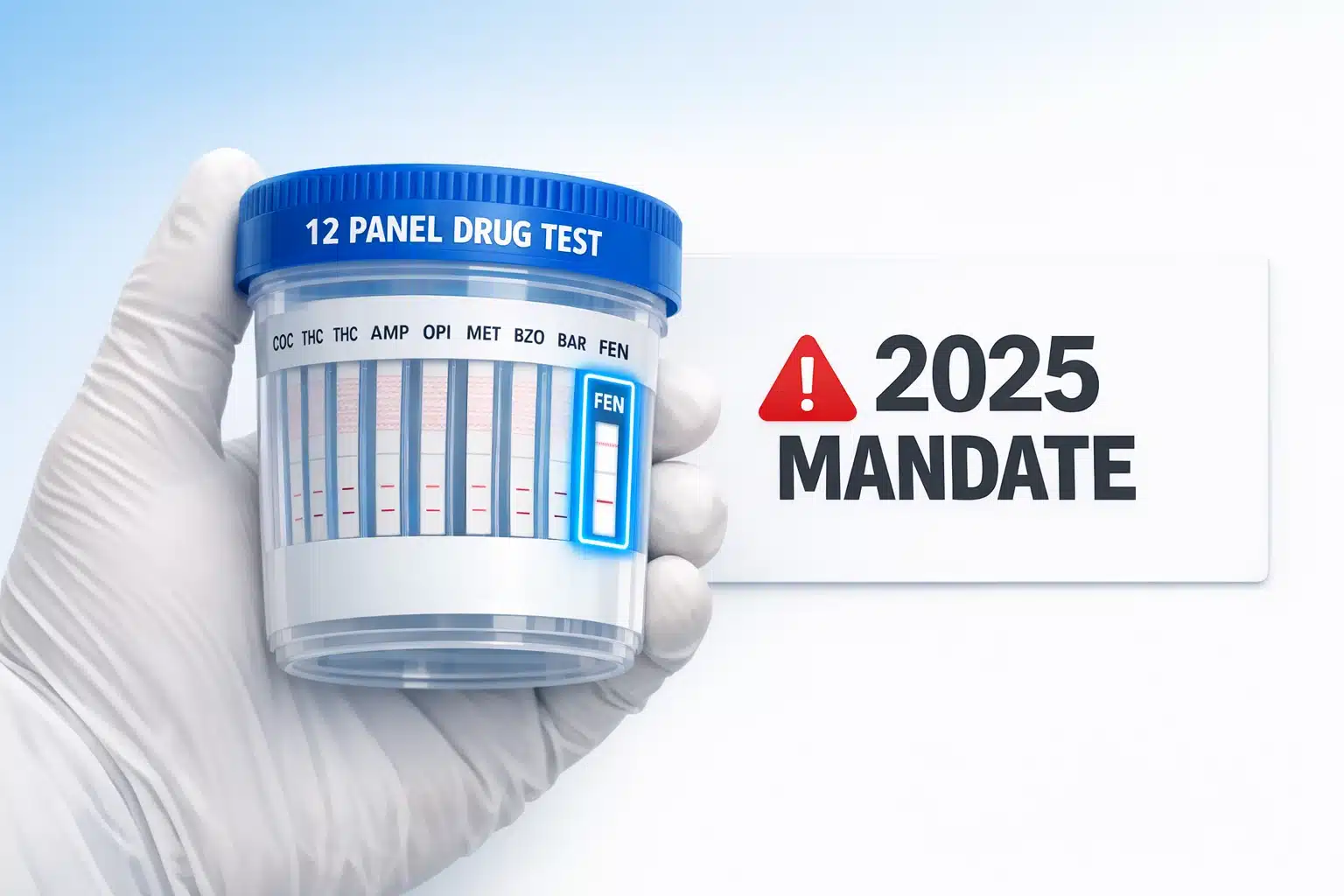
A common belief among employers and clinicians is that a standard drug test panel provides a comprehensive safety net. The reality is starkly different. As of 2026, many widely-used panels have a critical blind spot for fentanyl and its analogs, creating a significant gap between perceived security and actual risk.
This isn’t a minor oversight. According to a landmark 2025 study from Quest Diagnostics, fentanyl positivity is a staggering 707% higher in random drug tests than in pre-employment screenings. This suggests that while pre-employment tests filter out some candidates, a substantial risk remains hidden within the current workforce, undetected by outdated testing protocols.
If your organization hasn’t explicitly updated its drug screening program to target synthetic opioids, you are likely operating with incomplete data. This guide explains the rapid evolution of testing technology and provides a clear framework for closing this dangerous liability gap.
What Is a Fentanyl Drug Test?
A fentanyl drug test is designed to detect fentanyl and, depending on the testing methodology, certain fentanyl analogues or metabolites that traditional opiate drug tests may miss. Unlike older workplace drug testing panels that focused primarily on naturally occurring opiates such as morphine and heroin, dedicated fentanyl testing specifically targets synthetic opioids that require separate analytical methods.
Fentanyl drug tests are commonly available as rapid immunoassay screening devices, laboratory confirmation tests, or expanded multi-panel drug testing cups. Many employers now incorporate fentanyl into pre-employment, random, post-accident, and reasonable suspicion testing programmes to improve workplace safety and align with evolving regulatory expectations.
While instant drug tests provide rapid preliminary results, non-negative findings should be confirmed through accredited laboratory testing before employment decisions are made. This combination of rapid screening and laboratory confirmation provides both efficiency and accuracy within workplace drug testing programmes.
Who Should Include Fentanyl Drug Testing?
Although fentanyl testing has historically been associated with healthcare and law enforcement, many industries now recognise the importance of including synthetic opioid detection within routine workplace drug testing programmes. Manufacturing facilities, transportation companies, construction firms, energy providers, logistics organisations, educational institutions, public agencies, and healthcare employers all face operational risks associated with workplace impairment.
Employers operating safety-sensitive environments often have additional responsibilities to minimise hazards for employees, contractors, customers, and the wider public. Incorporating fentanyl drug testing into workplace policies helps organisations identify emerging risks while supporting broader health and safety objectives.
The Crisis of the ‘Invisible’ Opioid
For years, standard 5-panel and 10-panel drug tests were the industry benchmark. They were designed to detect common substances like marijuana, cocaine, amphetamines, opiates (from poppy plants, like heroin and morphine), and PCP. The opioid crisis, however, wasn’t driven by these traditional substances. It was fueled by synthetics.
Fentanyl, carfentanil, and other lab-created analogs have a different chemical structure than plant-based opiates. Consequently, the antibodies used in older immunoassay tests simply couldn’t recognize them. An employee could test negative on a standard 10-panel cup while actively using one of the most potent drugs available.
This created the “invisible opioid” problem: organizations believed they had robust drug-free workplace programs, yet they were completely missing the primary driver of the modern substance abuse crisis.

The industry has been racing to catch up, leading to a critical evolution in the science of detection.
The Technology Ladder: From Basic Screening to Forensic Certainty
Addressing the fentanyl blind spot required a two-pronged technological advance: creating better initial screens and refining the methods for confirming results. Not all tests are created equal, and understanding the differences is key to building a defensible program.
Step 1: The Immunoassay Revolution
The first line of defense in drug testing is the immunoassay, the technology behind rapid urine test cups and dip cards. To solve the “invisible opioid” problem, scientists developed new assays with antibodies engineered specifically to bind to fentanyl molecules.
This allowed manufacturers to produce reliable multi-panel urine cups that include a dedicated strip for fentanyl (FEN). These modern screens provide the fast, cost-effective, and accurate results needed for on-site testing programs.
Step 2: The ‘Gold Standard’ Confirmation
While a quality immunoassay screen is over 99% accurate, certain situations require forensic-level certainty. This is where Liquid Chromatography with Tandem Mass Spectrometry (LC-MS/MS) comes in. It’s considered the gold standard for confirmation.
Instead of using antibodies, this lab-based method separates molecules by their mass and charge, allowing it to identify a substance with absolute precision. Research from PubMed Central shows that LC-MS/MS methods can have a quantification limit 4 to 50 times lower than standard immunoassays. This means it can detect tiny, residual amounts of a drug, catching use cases that a less sensitive screen might miss.

This sensitivity isn’t just an academic detail. It has profound real-world consequences, driving policy and legal standards across the country.
Understanding Different Types of Workplace Drug Testing
Adding a fentanyl drug test to an existing workplace programme is only one part of an effective risk management strategy. Employers should also consider when testing is performed and which testing method is most appropriate for different workplace situations. A well-designed programme combines multiple testing events to improve workplace safety while maintaining consistency and fairness.
Pre-employment testing helps organisations identify substance use before hiring decisions are finalised, while random drug testing provides an ongoing deterrent by testing employees without advance notice. Post-accident testing assists with incident investigations, reasonable suspicion testing addresses observable signs of impairment, and return-to-duty or follow-up testing supports employees who are re-entering the workplace after completing treatment or disciplinary programmes.
Each testing category serves a different purpose, but all benefit from using an updated drug testing panel that explicitly includes fentanyl when appropriate.
Choosing the Right Drug Testing Method
Employers also have several specimen options when implementing a fentanyl drug testing programme. Each testing method offers different detection windows, operational advantages, and practical considerations depending on workplace requirements.
Urine drug testing remains the most widely used option because it offers an effective balance between accuracy, affordability, and ease of administration. Modern urine drug test cups are commonly available with dedicated fentanyl panels, making them suitable for both laboratory confirmation and rapid workplace screening.
Oral fluid testing has grown in popularity because collections can be directly observed, reducing opportunities for specimen tampering while providing insight into more recent drug use. Hair testing offers a significantly longer detection window and may be appropriate for certain investigative or pre-employment applications, although it is generally less suitable for identifying very recent substance use.
Selecting the most appropriate testing methodology depends on organisational objectives, workplace risks, regulatory requirements, and operational considerations rather than relying on a single testing method for every situation.
When Technology Drives Policy: The New Mexico Precedent
To see how high the stakes are, look at New Mexico. In response to the crisis, the state implemented policies that link highly sensitive drug testing directly to child welfare. Under these protocols, universal prenatal screening is in effect, and the detection of certain substances in a newborn can trigger a mandatory 72-hour hold and involvement from child protective services.
This policy relies on the forensic certainty of advanced testing methods capable of analyzing umbilical cord tissue to identify specific drug markers. It’s a powerful example of how the evolution from basic screening to high-sensitivity confirmation is not just a technical upgrade; it’s a socio-legal catalyst that directly impacts lives and institutional liability.
The 2025 Regulatory Catalyst: Preparing for the HHS Mandate
For years, the federal government’s regulated drug testing programs, like those governed by the Department of Transportation (DOT), did not include fentanyl. This created a dangerous inconsistency where the most prevalent opioid was excluded from mandatory testing.
That is changing. The U.S. Department of Health and Human Services (HHS) has issued a ruling that adds fentanyl to the federal workplace drug testing panel, effective July 7, 2025.
While this directly impacts DOT-regulated employers, its ripple effect will be felt everywhere. The federal panel is often seen as the minimum standard for best practices. As of July 2025, any non-regulated employer still using a testing panel that excludes fentanyl will be operating below the accepted federal benchmark, potentially increasing their legal exposure in the event of a workplace accident.

Compliance is no longer a matter of choice; it’s a strategic necessity. The first step is auditing your current supplies and protocols to ensure they explicitly include fentanyl screening.
Implementing an Effective Workplace Drug Testing Policy
Updating a fentanyl drug test panel should be accompanied by corresponding policy revisions. Testing technology alone cannot reduce workplace risk if organisational procedures continue reflecting outdated standards or fail to explain when fentanyl testing will occur.
Effective workplace policies clearly define testing circumstances, employee responsibilities, specimen collection procedures, laboratory confirmation requirements, confidentiality expectations, and the process for reviewing confirmed results. Policies should also explain how reasonable suspicion decisions are documented and identify who is responsible for authorising different types of workplace testing.
Supervisor education is equally important. Managers responsible for recognising possible impairment should receive training on identifying behavioural indicators, documenting observations objectively, and applying workplace drug testing procedures consistently across all employees. Clear communication with staff helps improve understanding of policy updates while reducing confusion regarding expanded fentanyl testing.
Managing Real-World Risk: The Pre-Employment vs. Random Testing Gap
Many organizations anchor their drug testing program to the pre-employment screen. While essential, this approach can create a false sense of security. The 2025 Quest Diagnostics data reveals why.
The finding that fentanyl use is 707% more prevalent in random tests (1.13% positivity) than in pre-employment tests (0.14% positivity) points to a critical insight: the biggest threat isn’t just who you hire, but the hidden behaviors that can develop post-hire.

This data strongly supports a two-part strategy for effective risk management:
- Modernize Your Panel: Ensure every test, whether pre-employment or random, includes a fentanyl strip.
- Rethink Your Mix: Increase the frequency of random testing to get a more accurate picture of workforce risk and deter on-the-job substance use.
Future-Proofing Your Drug Testing Program
The evolution of drug testing technology is accelerating. Innovations like physics-based strip optimization are enhancing sensitivity, while the prospect of portable mass spectrometers could one day bring lab-grade confirmation testing on-site.
However, you don’t need to wait for future technology to protect your organization today. The tools to close the fentanyl detection gap are already here. The crucial step is to act.
Choosing a Fentanyl Drug Test
Not every fentanyl drug test offers the same level of performance or suitability for workplace testing. Employers should evaluate products based on testing methodology, regulatory compliance, ease of administration, manufacturer quality, and compatibility with their existing workplace policies.
Rapid urine drug test cups remain one of the most practical solutions for many employers because they provide fast preliminary screening while allowing non-negative results to be confirmed through accredited laboratories. Organisations should also consider whether testing products are CLIA-waived where appropriate, manufactured under recognised quality standards, and supported by clear instructions for specimen collection and interpretation.
Reliable suppliers can also assist employers by providing consistent product availability, technical support, and updated information as workplace drug testing requirements continue to evolve. Selecting high-quality drug testing supplies strengthens both operational efficiency and confidence in workplace testing results.
Common Mistakes Employers Make When Updating Drug Testing Programs
Many organisations recognise the need to strengthen workplace drug testing but unintentionally leave important gaps within their programmes. One of the most common mistakes is assuming that a traditional 5-panel or 10-panel drug test automatically includes fentanyl. In many cases, dedicated fentanyl testing must be specifically added to the testing panel.
Another common issue is updating laboratory testing without revising workplace policies. If organisational procedures, employee handbooks, supervisor guidance, and testing documentation continue referencing outdated drug panels, inconsistencies may create unnecessary legal and operational risks.
Some employers also rely exclusively on pre-employment drug testing while overlooking the value of random, reasonable suspicion, post-accident, return-to-duty, and follow-up testing. The data increasingly suggests that ongoing workplace testing provides a more accurate understanding of current workforce risk than hiring decisions alone.
Finally, organisations sometimes overlook laboratory confirmation procedures, Medical Review Officer (MRO) review, supervisor training, and employee education. Comprehensive workplace drug testing programmes combine accurate testing technology with clear policies, consistent implementation, and ongoing communication.
Review your current drug testing supplies and protocols immediately. If they don’t explicitly list fentanyl, they are no longer sufficient. Upgrading your program starts with choosing reliable, FDA-approved, and CLIA-waived supplies designed for the challenges of 2026.
Explore 12 Panel Now’s comprehensive drug test cups to see how easy and affordable it is to add fentanyl detection to your screening program. It’s the single most important step you can take to align your safety protocols with the reality of the modern opioid crisis.