Where to Buy Protein and Adulterant Test Strips Online

Quick Answer
If you’re looking to buy protein or adulterant test strips online, start by identifying the purpose of your testing. Protein urine test strips are commonly used to evaluate urine protein levels as part of general urinalysis, while adulterant test strips are designed to verify specimen integrity before interpreting urine drug test results.
Professional buyers—including employers, laboratories, occupational health clinics, rehabilitation centers, and drug testing programs—should purchase adulterant test strips from reputable medical and laboratory suppliers that provide clear product specifications, manufacturer instructions, and quality assurance. Before ordering, compare the number of testing parameters, packaging, storage requirements, expiration dates, and intended application to ensure the strips meet your testing needs.
Where to Buy Protein and Adulterant Test Strips Online
Purchasing laboratory testing supplies online has become easier than ever, but finding the right product requires more than comparing prices.
Many buyers search for protein test strips when they actually need adulterant test strips for urine drug screening. Others purchase specimen validity strips without understanding which parameters they measure or how those results help determine whether a urine sample appears authentic.
Choosing the wrong product can lead to unnecessary costs, incorrect testing procedures, or purchasing strips that do not meet your organization’s requirements.
This guide explains the differences between protein and adulterant test strips, how they work, what they detect, and the key factors to consider before purchasing online.
Whether you’re buying for a workplace drug testing program, healthcare facility, rehabilitation center, laboratory, or personal use, understanding these products helps you make a more informed purchasing decision.
Understanding Protein and Adulterant Test Strips
Although these products are often mentioned together, they serve very different purposes.
Protein Test Strips
Protein urine test strips are commonly used during routine urinalysis to measure the presence of protein in a urine sample.
Healthcare providers may include protein testing as part of broader urine analysis because abnormal protein levels can provide additional clinical information that may warrant further medical evaluation. Protein strips are designed for urinalysis—not for detecting specimen tampering during drug testing.
Adulterant Test Strips
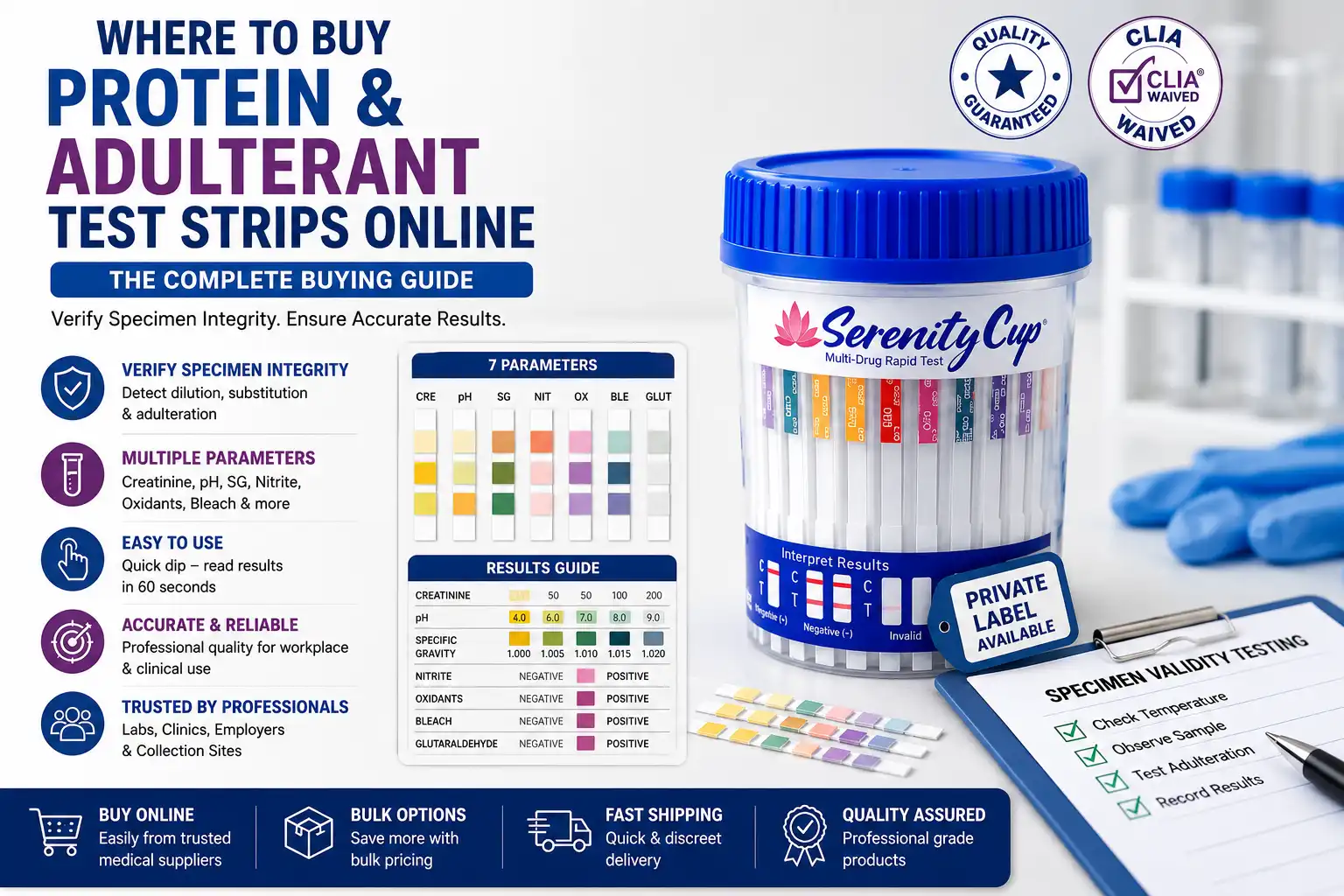
Adulterant test strips, also known as specimen validity test strips, evaluate whether a urine sample appears consistent with normal human urine before drug screening results are interpreted.
Rather than detecting drugs themselves, these strips measure physical and chemical characteristics that may indicate:
- Sample dilution
- Chemical adulteration
- Specimen substitution
- Oxidizing agents
- Abnormal urine chemistry
By identifying suspicious specimens early in the collection process, adulterant testing supports more reliable urine drug screening programs.
Protein Test Strips vs. Adulterant Test Strips
One of the biggest sources of confusion is assuming these products perform the same function.
They do not.
| Feature | Protein Test Strips | Adulterant Test Strips |
|---|---|---|
| Primary Purpose | Measure urine protein | Verify specimen integrity |
| Used During | Urinalysis | Urine drug testing |
| Detect Drugs | No | No |
| Detect Sample Tampering | No | Yes |
| Measures Protein | Yes | Some models may include protein, but not all |
| Measures Creatinine | Usually No | Yes (many models) |
| Measures Specific Gravity | Usually No | Yes |
| Measures Nitrite | Usually No | Yes |
| Measures Oxidants | No | Yes |
| Best For | Healthcare urinalysis | Workplace and clinical drug testing |
Understanding this distinction prevents buyers from ordering the wrong product for their testing program.
How Do Adulterant Test Strips Work?
Adulterant test strips evaluate urine by measuring several chemical and physical properties that normally fall within expected ranges for fresh human urine.
Each reagent pad on the strip reacts with a specific urine characteristic. After the strip is immersed in the specimen—or urine is applied according to the manufacturer’s instructions—the reagent pads change color. These colors are then compared with the reference chart supplied by the manufacturer.
Rather than determining whether drugs are present, adulterant strips help identify specimens that may have been intentionally altered before testing.
For example, a specimen may appear suspicious if testing indicates:
- Extremely low creatinine
- Abnormal specific gravity
- Unusual pH values
- Presence of oxidizing chemicals
- Evidence of bleach or other adulterants
When specimen validity indicators fall outside expected ranges, the collector may follow organizational procedures for handling questionable samples.
What Do Adulteration Test Strips Detect?
Different manufacturers offer different panel configurations, but many professional specimen validity strips evaluate several important urine characteristics.
These commonly include:
- Creatinine
- Specific Gravity
- pH
- Nitrite
- Glutaraldehyde
- Oxidants
- Bleach
- Pyridinium Chlorochromate (PCC)
Some products include six parameters, while others provide seven or more specimen validity markers depending on the intended application.
Selecting the appropriate configuration depends on your testing program and specimen validity requirements.
Understanding Each Specimen Validity Marker
Knowing what each marker measures helps buyers choose the right adulterant strip.
Creatinine
Creatinine is a natural waste product found in normal urine.
Extremely low creatinine levels may suggest that the specimen has been heavily diluted or substituted. While low creatinine alone does not prove tampering, it is an important specimen validity indicator when interpreted alongside other measurements.
Specific Gravity
Specific gravity measures the concentration of dissolved substances within urine.
Values outside expected physiological ranges may indicate excessive dilution or possible specimen substitution.
Because hydration levels naturally vary among individuals, specific gravity should always be interpreted within the broader specimen validity assessment.
pH
Urine normally falls within a predictable pH range.
Highly acidic or highly alkaline specimens may suggest that chemical substances have been introduced into the sample in an attempt to interfere with drug screening chemistry.
Monitoring pH helps identify specimens requiring additional review according to organizational protocols.
Nitrite
Nitrite is not typically present at unusually high levels in authentic urine collected for routine drug screening.
Elevated nitrite readings may indicate the addition of certain adulterants intended to interfere with immunoassay drug testing.
Glutaraldehyde
Glutaraldehyde is an industrial chemical that has historically been associated with some specimen adulteration products.
Its presence within a urine specimen may indicate possible chemical interference.
Oxidants
Oxidizing agents are chemicals capable of altering urine chemistry and potentially interfering with certain rapid drug screening methods.
Modern adulteration strips often include oxidant detection as part of comprehensive specimen validity testing.
Bleach
Bleach is one of the most recognized household chemicals associated with urine specimen adulteration.
Some individuals have attempted to add bleach or bleach-based products to urine samples in an effort to interfere with drug screening chemistry. Because bleach can alter the chemical composition of a specimen, many professional adulteration strips include a dedicated reagent pad to detect its presence.
A positive bleach indicator does not identify drug use—it simply suggests the specimen may have been chemically altered and should be evaluated according to your organization’s testing procedures.
Pyridinium Chlorochromate (PCC)
Pyridinium chlorochromate (PCC), sometimes referred to as a chromate adulterant, has historically been found in products marketed to interfere with urine drug testing.
Professional specimen validity strips may include a PCC detection pad because this oxidizing compound can affect certain screening methods.
Although PCC is less common today than in previous years, many laboratories and occupational testing programs continue to monitor for its presence as part of comprehensive specimen validity testing.
Why Specimen Validity Testing Matters
A rapid urine drug test is only as reliable as the specimen being tested.
If a urine sample has been diluted, substituted, contaminated, or chemically altered before testing, the screening result may no longer reflect the donor’s true specimen.
Specimen validity testing helps collectors identify samples that require additional attention before interpreting the drug test.
Rather than replacing drug screening, adulteration strips serve as an important quality control step that helps strengthen confidence in the testing process.
For organizations responsible for workplace safety, regulatory compliance, or clinical decision-making, specimen validity testing is an essential part of maintaining a consistent drug testing program.
Who Should Use Adulterant Test Strips?
Adulteration test strips are widely used across industries where urine drug screening is performed.
They are particularly valuable for organizations that need to verify specimen integrity before interpreting rapid drug test results.
Common users include:
- Occupational health clinics
- Employers conducting workplace drug testing
- Staffing agencies
- Rehabilitation centers
- Pain management clinics
- Hospitals and medical practices
- Probation and parole departments
- Correctional facilities
- Government agencies
- Toxicology laboratories
- Mobile drug testing providers
- Third-party collection sites
These organizations often incorporate specimen validity testing into established collection procedures to help reduce the likelihood of questionable specimens.
Where to Buy Protein and Adulterant Test Strips Online
Today, protein and adulterant test strips are available from a wide range of online suppliers. However, not every seller specializes in professional diagnostic products.
Choosing a reputable supplier helps ensure you receive authentic products with proper storage, manufacturer instructions, and current expiration dates.
When evaluating online retailers, consider suppliers that clearly provide:
- Product specifications
- Number of testing parameters
- Manufacturer information
- Package quantity
- Storage requirements
- Expiration details
- Customer support
- Bulk ordering options
Professional medical and laboratory suppliers generally offer more detailed technical information than general online marketplaces, making it easier to select the appropriate product for workplace or clinical use.
What to Compare Before Buying
Two adulteration strips may appear similar while offering very different testing capabilities.
Before placing an order, compare several important features.
Number of Parameters
Some strips test six specimen validity markers.
Others test seven or more.
Additional parameters may provide a more comprehensive assessment of specimen integrity depending on your testing requirements.
Intended Application
Not every strip is designed for the same environment.
Consider whether the product is intended for:
- Workplace drug testing
- Clinical laboratories
- Rehabilitation programs
- Occupational health
- Educational institutions
- Home use
Selecting a product designed for your intended application helps improve consistency and usability.
Package Size
Manufacturers commonly sell adulteration strips in quantities such as:
- 25 strips
- 50 strips
- 100 strips
- Bulk cases
Organizations conducting routine testing often reduce purchasing costs by ordering larger quantities.
Shelf Life
Always verify the product’s expiration date before purchasing.
Fresh inventory provides greater confidence that reagent pads will perform according to manufacturer specifications throughout their intended shelf life.
Storage Requirements
Proper storage helps preserve reagent performance.
Look for products that include clear storage instructions regarding:
- Recommended temperature
- Humidity protection
- Original packaging
- Expiration date
- Light exposure
Correct storage reduces unnecessary product waste and helps maintain consistent specimen validity testing.
Bulk Purchasing vs. Individual Packs
The best purchasing option depends on your testing volume.
Individual Packs
Best for:
- Small businesses
- Home users
- Occasional testing
- Pilot programs
Advantages include:
- Lower upfront investment
- Easier inventory management
- Reduced risk of unused products expiring
Bulk Purchasing
Better suited for:
- Large employers
- Collection sites
- Laboratories
- Hospitals
- Occupational health providers
- Third-party administrators
Benefits include:
- Lower cost per strip
- Consistent inventory
- Fewer supply interruptions
- Greater purchasing efficiency
Organizations performing regular testing often find bulk purchasing more economical over time.
Professional Products vs. Consumer Products
Although many urine testing products are sold online, professional-grade adulteration strips often provide features that consumer-oriented products may not.
Professional buyers typically look for:
- Multiple specimen validity parameters
- Easy-to-read color comparison charts
- Consistent manufacturing quality
- Clearly labeled instructions
- Reliable lot identification
- Technical documentation
- Responsive supplier support
Selecting products appropriate for your testing environment helps improve workflow and user confidence.
Common Buying Mistakes
Avoiding these mistakes can save both time and money.
Buying Protein Strips Instead of Adulteration Strips
Many online shoppers confuse these products because both are used with urine.
Remember:
Protein strips evaluate urine protein.
Adulteration strips evaluate specimen validity.
Choosing Price Over Features
The least expensive strip may not include all the specimen validity markers your organization requires.
Compare functionality before comparing price.
Ignoring Storage Conditions
Heat, humidity, and improper storage can reduce reagent performance.
Always review storage recommendations before ordering and after receiving your products.
Purchasing Without Checking Expiration Dates
Reagent-based products have a limited shelf life.
Ordering older inventory may shorten the usable life of your testing supplies.
Not Matching the Product to Your Testing Program
Different workplaces have different specimen validity requirements.
Choose products that align with your organization’s testing procedures rather than purchasing based solely on popularity.
Expert Buyer’s Checklist
Before ordering protein or adulteration test strips online, ask yourself:
- What type of testing am I performing?
- Do I need protein testing or specimen validity testing?
- How many parameters should the strip measure?
- Will testing occur occasionally or every day?
- How many strips will I use each month?
- Do I need bulk purchasing?
- Are storage conditions available?
- Are clear instructions included?
- Does the supplier provide technical support?
- Is the product appropriate for workplace or clinical use?
Answering these questions before purchasing helps ensure you select a product that supports reliable testing while minimizing unnecessary costs.
Which Test Strip Should You Buy?
Choosing the right urine testing strip depends on what you’re trying to measure, who will perform the test, and how the results will be used. While both protein test strips and adulterant test strips analyze urine, they serve entirely different purposes.
Use the decision guide below to select the most appropriate product.
| If Your Goal Is… | Recommended Product | Why |
|---|---|---|
| Verify urine specimen integrity before drug testing | Adulterant Test Strips | Detect dilution, substitution, and chemical adulteration |
| Measure urine protein during routine urinalysis | Protein Test Strips | Evaluates protein concentration in urine |
| Workplace drug testing | Adulterant Test Strips | Supports specimen validity procedures |
| Occupational health screening | Adulterant Test Strips | Helps identify questionable urine samples |
| Clinical urinalysis | Protein Test Strips | Part of routine urine chemistry evaluation |
| Rehabilitation centers | Adulterant Test Strips | Improves confidence in specimen authenticity |
| Toxicology laboratories | Adulterant Test Strips | Additional specimen validity assessment |
| Home health monitoring | Protein Test Strips | Convenient for routine urine monitoring |
| Drug collection sites | Adulterant Test Strips | Helps maintain specimen integrity |
| High-volume workplace testing | Adulterant Test Strips | Efficient quality control before interpretation |
Protein Test Strips vs. Adulterant Test Strips: Quick Comparison
| Feature | Protein Test Strips | Adulterant Test Strips |
|---|---|---|
| Primary Purpose | Measure urine protein | Verify urine specimen validity |
| Used For | Urinalysis | Drug testing programs |
| Detect Drugs | No | No |
| Detect Protein | Yes | Some models may include it, but it is not the primary purpose |
| Detect Creatinine | Usually No | Yes |
| Detect Specific Gravity | Usually No | Yes |
| Detect pH | Limited | Yes |
| Detect Nitrite | Usually No | Yes |
| Detect Oxidants | No | Yes |
| Detect Bleach | No | Yes |
| Detect Glutaraldehyde | No | Yes |
| Detect PCC/Chromates | No | Some professional models |
| Best Users | Healthcare providers | Employers, clinics, laboratories, collection sites |
Frequently Asked Questions
1. What are adulterant test strips used for?
Adulterant test strips are designed to evaluate the validity of a urine specimen before drug test results are interpreted. They measure chemical and physical characteristics such as creatinine, pH, specific gravity, nitrite, oxidants, and other markers that may indicate dilution, substitution, or chemical adulteration.
They do not detect drugs directly; instead, they help determine whether the urine sample appears suitable for reliable drug screening.
2. Are protein test strips the same as adulteration test strips?
No. Protein test strips and adulteration test strips serve different purposes.
Protein test strips measure the amount of protein in urine as part of routine urinalysis or clinical evaluation. Adulteration test strips assess specimen validity by checking for indicators that suggest a urine sample may have been altered before drug testing.
Although both products analyze urine, they are not interchangeable.
3. Where can I buy protein and adulterant test strips online?
You can purchase these products from reputable medical supply companies, laboratory distributors, occupational health suppliers, and specialized drug testing retailers. When comparing suppliers, review product specifications, parameter count, package size, expiration dates, storage recommendations, and customer support rather than choosing based solely on price.
4. What parameters do adulteration test strips measure?
Depending on the manufacturer and model, adulteration strips may measure:
- Creatinine
- Specific gravity
- pH
- Nitrite
- Oxidants
- Glutaraldehyde
- Bleach
- Pyridinium chlorochromate (PCC) or chromates
Some professional strips include six parameters, while others offer seven or more specimen validity markers.
5. Can adulterant test strips detect fake urine?
Adulteration strips cannot identify every type of synthetic or substituted urine on their own. However, they can detect abnormal chemical characteristics or specimen validity markers that may indicate the sample does not fall within expected physiological ranges.
When combined with proper collection procedures and organizational protocols, they help identify specimens that may require additional evaluation.
6. How accurate are adulteration test strips?
When manufactured according to quality standards and used as instructed, adulteration strips provide a reliable method for assessing specimen validity. Their accuracy depends on proper storage, correct testing procedures, and interpreting results using the manufacturer’s reference chart.
If a questionable specimen could affect legal, employment, or medical decisions, follow established policies regarding confirmatory testing or specimen recollection.
7. Should I buy six-parameter or seven-parameter adulteration strips?
The right choice depends on your testing requirements. Six-parameter strips may be sufficient for some programs, while seven-parameter or expanded panels provide additional specimen validity information. Review your workplace policy, laboratory procedures, or collection protocols before selecting a product.
8. How should adulteration test strips be stored?
Store test strips in their original container in a cool, dry place away from direct sunlight, excessive heat, and moisture. Keep the lid tightly closed after opening and avoid exposing reagent pads to humidity for prolonged periods. Always follow the storage instructions provided by the manufacturer.
9. Can home users purchase adulteration test strips?
Yes. Many suppliers offer adulteration test strips to individual consumers as well as organizations. Before purchasing, ensure the product matches your intended application and review the instructions carefully to understand how to perform and interpret the test.
10. What should I consider before buying online?
Before purchasing, compare:
- Number of specimen validity parameters
- Intended use
- Package quantity
- Shelf life
- Storage requirements
- Manufacturer instructions
- Technical support
- Bulk purchasing options
- Overall value rather than price alone
Selecting the appropriate product helps ensure reliable specimen validity testing and efficient inventory management.