What Are Benzodiazepines and How Are They Detected?


Benzodiazepines, such as Xanax, Valium, and Ativan, are commonly prescribed medications used to treat anxiety, insomnia, and seizures. However, their misuse is a growing concern, contributing to over 30% of opioid overdose cases and various legal and health issues. Detecting benzodiazepines is crucial for healthcare, workplace safety, and law enforcement.
Key Detection Methods:
- Urine Tests: Noninvasive, widely used, detects recent use.
- Blood Tests: Highly specific, identifies active substances, ideal for time-sensitive cases.
- Saliva Tests: Quick results, suitable for roadside or workplace checks.
- Hair Tests: Detects long-term use (up to 90 days), often used in legal cases.
Testing Accuracy:
- Initial screenings like immunoassays are 85–95% accurate but may have false positives.
- Advanced methods like GC-MS and LC-MS/MS provide over 99% accuracy.
Benzodiazepine testing plays a critical role in patient care, workplace policies, and law enforcement efforts to address misuse and ensure safety. Products like multi-panel test cups, oral swabs, and single drug test strips offer reliable and efficient solutions for various testing needs.
What Are Benzodiazepines?
Medical Uses and Definition
Benzodiazepines are medications that act as central nervous system (CNS) depressants, offering a range of effects such as sedation, anxiety relief, muscle relaxation, and seizure control. They are commonly prescribed to treat conditions like generalized anxiety, panic disorders, social phobias, insomnia, and seizures. Additionally, they are used as muscle relaxants and to prepare patients for anesthesia before medical procedures. Their wide-ranging applications highlight their importance in medical treatment and the necessity for precise detection methods.
What are Benzodiazepines and How Do You Drug Test For Them?
How to Detect Benzodiazepines
Benzodiazepines can be identified through tests that analyze urine, blood, saliva, or hair. Each method has a specific detection window, making it suited for different scenarios like clinical evaluations, workplace screenings, or law enforcement investigations. Here’s a closer look at how these tests work and their applications.
Urine Testing Methods
Urine testing is one of the most common methods for detecting benzodiazepines. It’s practical, reliable, and noninvasive, making it ideal for workplace and clinical settings. This test can provide both qualitative results (positive or negative) and quantitative data (showing concentration levels). This dual capability is particularly useful when recent benzodiazepine use needs to be assessed for patient care or safety monitoring.
Blood Testing Methods
Blood tests are highly specific and can pinpoint active benzodiazepines and their metabolites. This makes them valuable for diagnosing conditions like altered mental states, overdoses, or arrhythmias. They’re also commonly used in forensic investigations and traffic safety checks to determine if benzodiazepines contributed to an incident. Because blood testing focuses on detecting very recent use, it’s especially effective in time-sensitive situations.
Saliva and Hair Testing Methods
Saliva tests, approved by SAMHSA since 2011, offer a quick and noninvasive way to screen for benzodiazepines. These are often used in roadside checks or workplace environments where immediate results are needed.
Hair tests, on the other hand, can detect benzodiazepine use over a much longer period – up to 90 days. While they are more expensive and take longer to process, they are invaluable in legal cases, custody disputes, and comprehensive substance abuse evaluations.
Each of these methods plays a critical role in accurately identifying benzodiazepine use, allowing for tailored applications across various fields.
sbb-itb-99fc241
Testing Accuracy and Real-World Uses
Understanding the reliability of benzodiazepine tests and their applications sheds light on why these screening methods are so widely used across various industries. The accuracy of these tests depends on the method employed and several factors that can influence the results.
How Accurate Are the Tests
Immunoassays, often used as the first step in benzodiazepine screening, are popular because they’re quick and relatively affordable. These tests work by detecting benzodiazepine antibodies, but they’re not without flaws. Cross-reactivity can sometimes lead to false positives, which is a limitation to keep in mind.
Generally, immunoassays are 85% to 95% accurate for identifying benzodiazepines, making them reliable for initial screenings. They perform particularly well in detecting common medications like diazepam (Valium), lorazepam (Ativan), and alprazolam (Xanax). However, for more definitive results, confirmatory methods such as gas chromatography-mass spectrometry (GC-MS) and liquid chromatography-tandem mass spectrometry (LC-MS/MS) are used. These advanced techniques boast specificity rates above 99%, earning them the reputation as the gold standard for accuracy.
What Affects Test Results
The reliability of test results isn’t just about the method used – it’s also shaped by external and individual factors. The type of drug, a person’s metabolism, and how the sample is handled all play a role. For example, age, liver function, and proper sample storage can impact how long benzodiazepines remain detectable and how accurate the results are.
Another critical factor is the sensitivity and cutoff thresholds of the test. For workplace drug screenings, a cutoff level of 300 ng/mL is commonly used for urine samples, while medical settings often opt for a lower threshold of 200 ng/mL to catch smaller concentrations.
Uses in Healthcare, Workplaces, and Law Enforcement
The accuracy and flexibility of benzodiazepine testing have made it a key tool in a variety of fields.
In healthcare, these tests are essential for patient care and safety. Emergency departments use them to diagnose overdoses, spot drug interactions, and guide treatment decisions. Mental health facilities depend on testing to monitor medication compliance and ensure patients aren’t mixing benzodiazepines with other risky substances.
Workplace testing has also grown in importance as employers aim to reduce safety risks tied to benzodiazepine impairment. Industries like transportation, manufacturing, and healthcare often include benzodiazepines in their drug testing panels. For example, the Department of Transportation mandates testing for safety-sensitive positions, and many private companies have followed suit to safeguard their employees and the public.
In law enforcement, benzodiazepine testing serves multiple purposes. Traffic officers use these tests to identify impaired drivers since benzodiazepines can impair reaction times and decision-making. Forensic labs rely on advanced methods to analyze evidence for criminal cases, and probation departments use testing to monitor individuals with a history of substance abuse.
The adaptability and reliability of modern benzodiazepine testing make it an essential tool for ensuring safety, managing substance abuse, and addressing legal concerns. Different situations call for varying levels of accuracy and speed, which is why a range of testing methods continues to be employed across these diverse settings.
Drug Testing Products from 12PanelNow
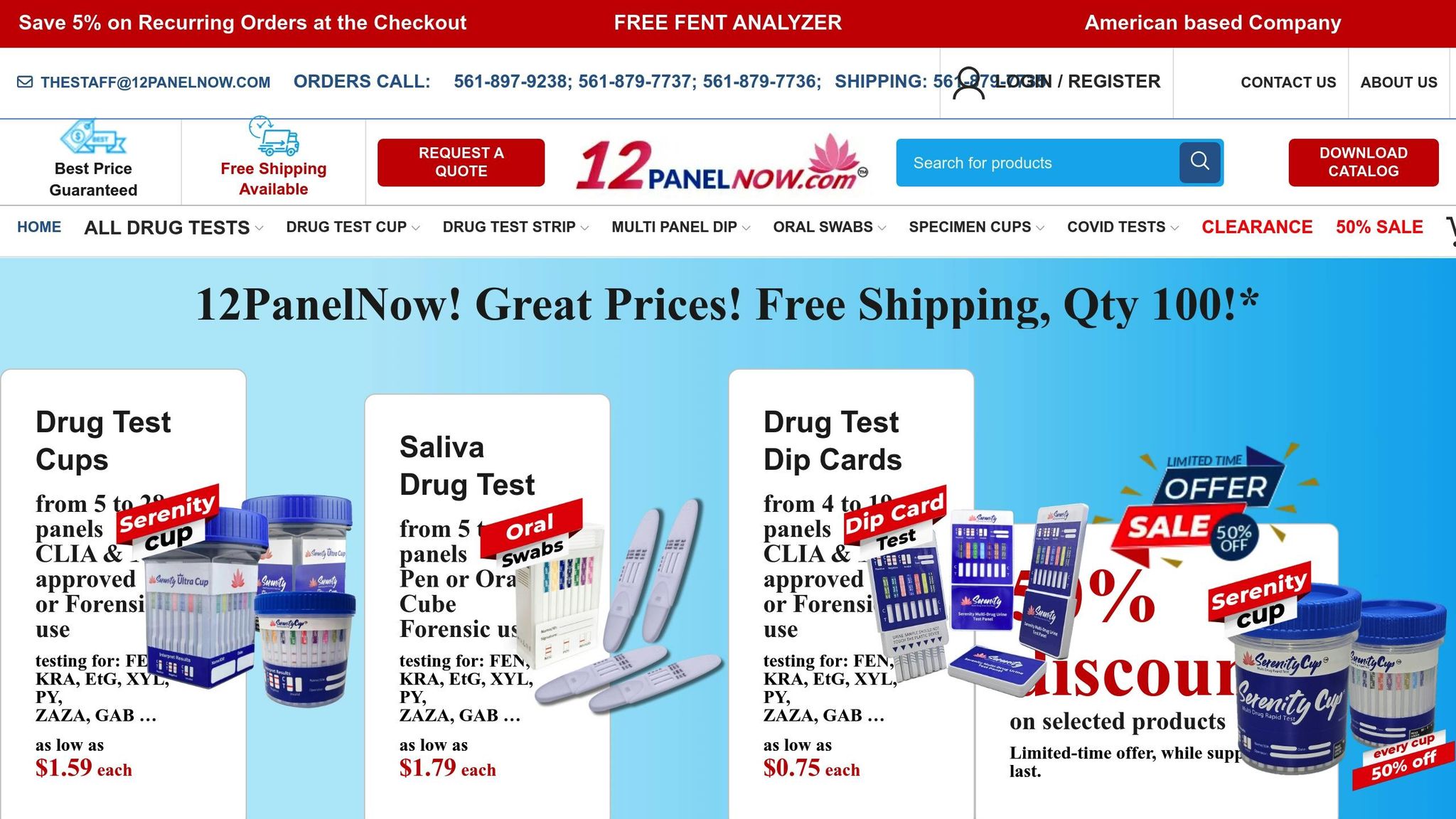
After exploring benzodiazepine detection methods, it’s clear how specialized products can enhance testing accuracy and reliability. 12PanelNow offers a variety of solutions that combine advanced testing technology with ease of use, catering to the needs of healthcare providers, workplaces, rehab centers, and law enforcement across the country.
12PanelNow Testing Product Options
12PanelNow offers four main categories of drug testing products, all designed to detect benzodiazepines and other controlled substances with precision:
- Multi-panel test cups: These come in configurations ranging from 5 to 28 panels and are both CLIA-waived and FDA-approved. They can detect substances like benzodiazepines, cocaine, marijuana, and opiates, making them a comprehensive option for broad-spectrum testing.
- Single drug test strips: Ideal for focused testing, these strips are a cost-effective choice for detecting benzodiazepines. Priced between $0.29 and $0.69 per strip, they offer 99% accuracy, making them well-suited for high-volume testing environments.
- Oral swabs: These provide a discreet and convenient option for sample collection, particularly in situations where urine collection is impractical. Oral swabs can detect benzodiazepines along with various other substances, making them a versatile tool for field testing.
- Harm reduction test kits: Ranging in price from $0.59 to $12.99, these kits include powder and solution-based options. They are designed for organizations focused on substance abuse prevention and harm reduction efforts.
Product Features and Benefits
12PanelNow products are packed with practical features that address real-world testing challenges. For instance, multi-panel drug test cups are equipped with built-in temperature strips to verify sample authenticity, a crucial measure to prevent tampering. Their leak-resistant design minimizes the risk of spills and contamination during handling and transport, ensuring both safety and reliability.
The company also supports bulk purchasing and offers custom pricing to meet the needs of various organizations. With same-day shipping available, 12PanelNow ensures testing supplies are delivered quickly, helping maintain the efficiency of ongoing testing programs.
How to Use 12PanelNow Products
The versatility of 12PanelNow’s products allows them to be seamlessly integrated into a wide range of professional settings where benzodiazepine detection is essential:
- Workplaces: These products help maintain safety standards by ensuring a drug-free environment.
- Healthcare settings: Used for monitoring patient care and medication compliance.
- Emergency departments: Rapid results assist in making timely treatment decisions.
- Rehabilitation centers: Tests are integrated into treatment programs to track progress and ensure accountability.
- Law enforcement: Oral swabs provide a simple, non-invasive solution for field testing scenarios where urine collection isn’t feasible.
With 99% accuracy, regulatory approvals, and user-friendly designs, 12PanelNow products have become a reliable choice for organizations seeking dependable solutions for benzodiazepine detection in various professional environments.
Conclusion
Detecting benzodiazepines accurately is essential for public safety in the U.S. The U.S. Drug Enforcement Administration classifies these drugs as schedule IV-controlled substances due to their potential for abuse, addiction, and misuse.
Statistics reveal that benzodiazepines are involved in over 50% of illicit overdose deaths and more than 30% of opioid overdoses. With no reversal agent available, the stakes for precise detection are incredibly high. This growing issue is further compounded by the emergence of powerful designer benzodiazepines. Between 2015 and 2020, 23 new variants were identified, many of which are more potent and longer-lasting than traditional prescriptions, increasing the risks for users.
Accurate testing plays a critical role in multiple areas, from ensuring patient safety and maintaining workplace standards to supporting law enforcement. The impact of benzodiazepine misuse even extends to legal matters, such as custody disputes where substance abuse can directly affect a child’s welfare. As misuse becomes more prevalent, the need for dependable detection methods grows.
12PanelNow offers advanced testing solutions with accuracy rates of up to 99%, providing reliable results for treatment decisions, workplace safety, and legal cases. As the misuse of non-prescribed benzodiazepines rises alongside the opioid epidemic, having access to effective testing and raising awareness are essential steps in addressing this crisis. Reliable testing, paired with proactive measures, remains one of the strongest tools in combating benzodiazepine misuse.
FAQs
What are the detection methods for benzodiazepines, and how do they differ in accuracy and detection windows?
Benzodiazepines can be identified using various testing methods, each tailored to specific needs and timeframes. Urine tests are the most widely used, as they can detect benzodiazepines for anywhere from several days to weeks after use, depending on the type of drug and how often it’s taken. In contrast, saliva tests are ideal for spotting recent use, usually within the last 24 hours.
To ensure accuracy, initial screenings often rely on immunoassays. These tests are quick and relatively inexpensive. However, for confirmation and more detailed results, liquid chromatography-tandem mass spectrometry (LC-MS/MS) is considered the most reliable option. This method provides high precision and specificity, making it the go-to choice in workplaces, healthcare environments, and law enforcement for addressing safety and substance use concerns.
What can cause false positives in benzodiazepine tests, and how can they be prevented?
Certain medications, including some antidepressants, antihistamines, and muscle relaxants, can lead to false positives in benzodiazepine drug tests. These substances might interfere with the test, mistakenly signaling the presence of benzodiazepines.
To minimize the risk of false positives, healthcare providers should carefully review all medications a person is taking before conducting the test. If a false positive is suspected, advanced confirmatory tests like gas chromatography-mass spectrometry (GC-MS) or liquid chromatography-mass spectrometry (LC-MS) can be used. These methods offer a higher level of accuracy, ensuring more dependable results and reducing the likelihood of misinterpretation.
Why is accurate benzodiazepine testing important in workplaces and legal cases?
Accurate testing for benzodiazepines plays a crucial role in both workplaces and legal contexts, ensuring safety, compliance, and fairness.
In workplaces, reliable testing helps safeguard employees, reduce the risk of accidents, and uphold a drug-free environment. For legal matters, dependable results ensure evidence holds up, supporting the resolution of cases involving substance use. Advanced methods like urine, blood, or hair analysis enable organizations and authorities to tackle substance abuse with precision and responsibility.