Chain of Custody: The 2026 Blueprint for Legally Defensible Drug Testing

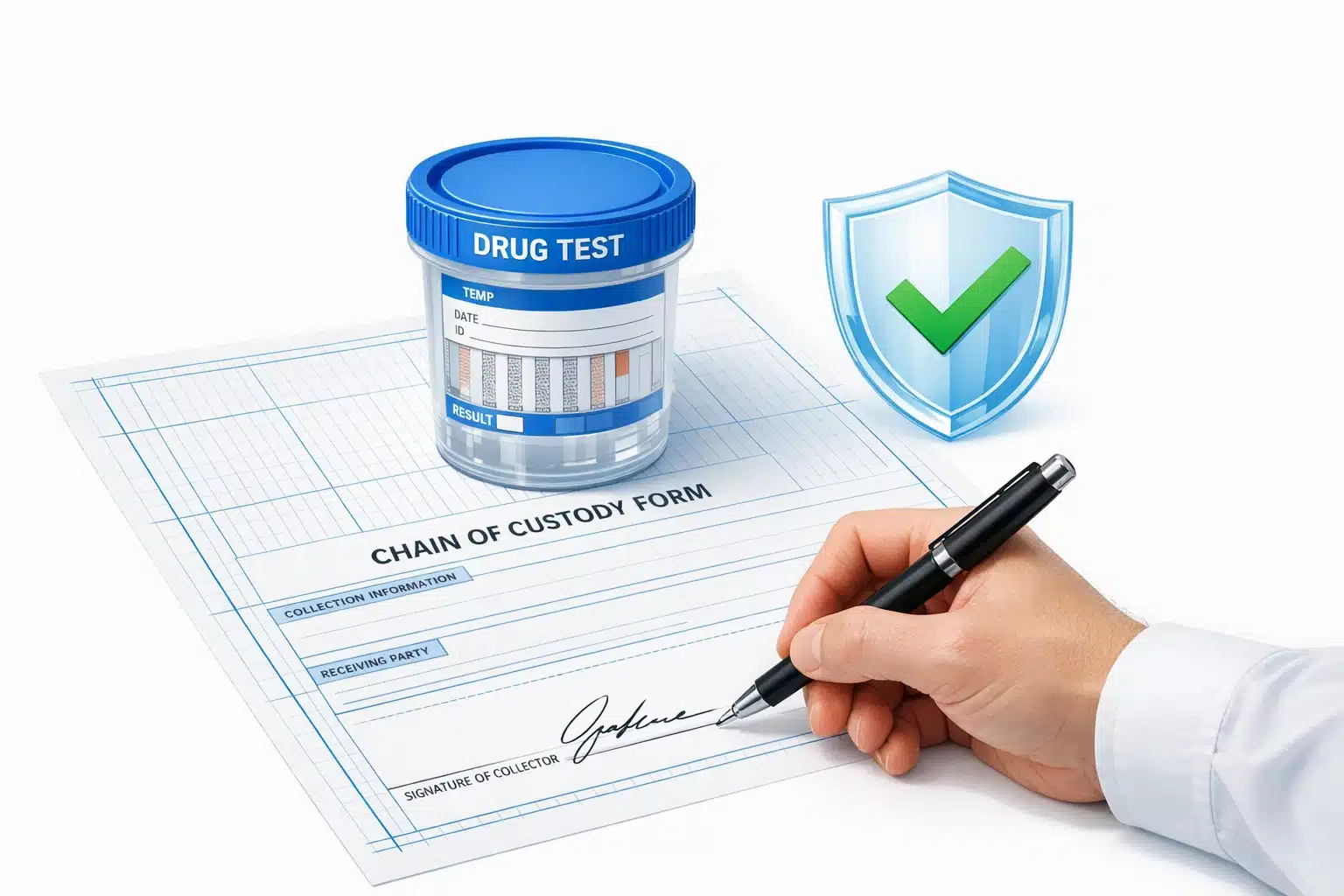
Chain-of-custody challenges remain the number one tactic used in drug testing litigation. According to legal case analyses from 2023-2024, a single missing signature or an undocumented gap in transfer records is often all it takes for a positive result to be excluded as evidence in court. This highlights a critical truth for any organization: a compliant drug testing program and a legally defensible one are not the same thing.
Compliance meets the minimum requirements. Defensibility means your program is built to withstand legal scrutiny from the moment of collection to the final report. This guide provides a blueprint for moving beyond basic compliance to build a litigation-ready program, focusing on the specific documentation and protocols that protect your organization when a result is challenged.

A litigation-ready program is documented, not assumed. Use this scorecard to spot chain-of-custody gaps, missing records, and weak MRO verification before a dispute escalates.
What Is Chain of Custody in Drug Testing?
Chain of custody is the documented process used to record every stage of a specimen’s collection, handling, transfer, storage, laboratory analysis, and final disposition. The purpose of chain of custody is to demonstrate that a specimen has remained secure, properly identified, and protected from tampering throughout the testing process.
In workplace drug testing, chain of custody extends far beyond simply transporting a specimen to the laboratory. It includes donor identification, specimen labeling, tamper-evident packaging, Custody and Control Forms (CCFs), documented transfers between authorised personnel, secure transportation, laboratory accessioning, Medical Review Officer review, and final record retention.
A complete chain of custody helps employers defend workplace drug testing decisions during audits, employment disputes, regulatory reviews, and litigation by demonstrating that every procedural safeguard was followed consistently.
Why Chain of Custody Matters
A compliant workplace drug testing program may satisfy regulatory requirements, but a legally defensible program depends on detailed documentation that can withstand legal scrutiny. Every signature, timestamp, transfer, and laboratory procedure contributes to preserving specimen integrity and maintaining confidence in testing results.
Strong chain of custody procedures protect employers against allegations of specimen mix-ups, contamination, selective enforcement, improper handling, or inaccurate reporting. They also support employee confidence by demonstrating that workplace drug testing is administered fairly, consistently, and according to documented procedures.
Why ‘compliant’ is no longer enough
For years, the primary concern for many businesses was operational compliance, driven by the “fear of an audit” from bodies like the DOT. But in 2026, the risk landscape has shifted. The focus is now on mitigating legal exposure from wrongful termination lawsuits, a far more complex and costly threat.
Two major factors are driving this change:
- The Clearinghouse II Effect: The full implementation of the FMCSA’s Clearinghouse II in 2024 tightened reporting requirements, increasing the visibility of violations and the administrative burden on employers. This has made procedural precision more important than ever.
- State-Level Marijuana Law Divergence: Recent laws in states like California and Washington prohibit employers from taking adverse action based on the presence of non-psychoactive cannabis metabolites for most jobs. This requires a fundamental shift in testing protocols for non-safety-sensitive roles, moving toward proving active impairment rather than just past use.
A program that only clears the bar for a DOT audit may not have the detailed documentation needed to survive a legal challenge centered on these new complexities.
Preparing for Workplace Drug Testing Audits
Regular internal audits help organisations verify that chain of custody procedures remain consistent across all testing locations and collection personnel. Employers should periodically review Custody and Control Forms, specimen handling procedures, laboratory reporting, record retention practices, and supervisor documentation to identify weaknesses before regulatory inspections or legal challenges occur.
Audit readiness also demonstrates an organisation’s commitment to continuous quality improvement, strengthening confidence among regulators, employees, and legal counsel alike.
The anatomy of a litigation-ready program
A truly defensible program is built on three pillars: an unbreakable chain of custody, an informed approach to new regulations, and a clear understanding of the Medical Review Officer’s role.
Fortress-level chain of custody
The chain of custody (CoC) is the chronological paper trail showing the seizure, custody, control, transfer, analysis, and disposition of a specimen. It’s where most legal challenges are won or lost. A minor procedural error can invalidate an entire test.

Most legal challenges attack the chain of custody. This map shows where programs break—and the evidence markers that keep results admissible when questioned.
A defensible CoC goes beyond the basics. It includes:
- Secure Specimen Collection: Using sealed, tamper-evident collection containers and ensuring the donor witnesses the sealing process.
- Meticulous Documentation: Every person who handles the specimen must sign and date the CoC form. There can be no unexplained gaps in time or custody.
- Controlled Transport and Storage: Documenting how the specimen is stored and transported to the laboratory to prevent any claims of tampering or contamination.
The foundation of a strong chain of custody begins with reliable tools. Using high-quality, FDA-approved, and CLIA-waived supplies ensures that the integrity of the specimen is maintained from the very first step.
Understanding Custody and Control Forms (CCFs)
The Custody and Control Form (CCF) serves as the primary document supporting chain of custody throughout the workplace drug testing process. It records donor information, specimen identification numbers, collection details, transfer documentation, laboratory receipt, Medical Review Officer review, and final reporting.
Incomplete Custody and Control Forms remain one of the most common administrative issues identified during workplace drug testing audits. Missing signatures, incorrect specimen identifiers, incomplete timestamps, or undocumented transfers may create opportunities for legal challenges even when laboratory testing itself is accurate.
Employers should ensure collection personnel receive regular training on proper CCF completion while conducting periodic audits to identify documentation errors before they become compliance concerns.
Protecting Specimen Integrity
Specimen integrity begins at the collection site. Tamper-evident collection containers, secure specimen sealing procedures, temperature verification where appropriate, and donor verification all contribute to maintaining confidence in specimen authenticity.
Many workplace drug testing programs also incorporate specimen validity testing to identify dilution, adulteration, substitution, or other attempts to compromise testing accuracy. Combining secure collection procedures with specimen validity testing provides additional assurance that laboratory results accurately reflect the collected specimen.
The MRO as your primary legal shield
Many employers view the Medical Review Officer (MRO) as a final checkpoint, but their role is far more significant. A verified result from a qualified MRO is one of the strongest defenses an employer has against claims of a “false positive.”
When a preliminary result is positive, the MRO process is not automatic. It involves a confidential investigation, including:
- The Donor Interview: The MRO contacts the donor to determine if there is a legitimate medical explanation for the result. This is where a donor might disclose a prescription for a substance that can cross-react with a drug panel, like pseudoephedrine appearing as an amphetamine.
- Prescription Verification: The MRO will verify any prescriptions with the pharmacy or prescribing physician.
- The Split Specimen Right: Federal regulations give donors the right to have their split specimen (the “B” bottle) tested at a different certified laboratory. An MRO manages this process, ensuring it follows strict protocols.

When a donor disputes a result, the fastest path to defensibility is an MRO-led process. This flow clarifies what to do, what to document, and how to de-escalate safely.
By allowing this independent medical expert to conduct their review, you create a defensible barrier between the raw lab result and any subsequent employment action.
Laboratory Confirmation and Testing Accuracy
Most workplace drug testing programs begin with an immunoassay screening designed to rapidly identify potential non-negative specimens. While highly effective as an initial screening method, immunoassay testing is not considered sufficient on its own for making final employment decisions involving non-negative results.
Laboratories typically perform confirmatory testing using advanced analytical methods such as Gas Chromatography-Mass Spectrometry (GC-MS) or Liquid Chromatography-Tandem Mass Spectrometry (LC-MS/MS). These highly specific confirmation methods reduce the risk of false positives while providing legally defensible laboratory results suitable for workplace drug testing programs.
Combining laboratory confirmation with Medical Review Officer evaluation creates multiple independent safeguards that strengthen the credibility and reliability of workplace drug testing results.
Electronic Chain of Custody (eCCF)
Many organisations are transitioning from paper-based Custody and Control Forms to Electronic Chain of Custody (eCCF) systems. Electronic documentation helps reduce transcription errors, incomplete forms, illegible handwriting, and missing signatures while creating secure digital audit trails throughout the specimen lifecycle.
Electronic chain of custody systems also improve operational efficiency by streamlining communication between collection sites, laboratories, Medical Review Officers, and employers. Automated recordkeeping supports faster reporting while strengthening documentation quality and long-term record retention.
Navigating the new marijuana testing landscape
The legal distinction between active THC and its non-psychoactive metabolites is now a central issue for legal defensibility, particularly in states like California and Washington. For any role that isn’t federally mandated or classified as safety-sensitive, taking action based on a test that only shows past use (metabolites) can expose an organization to significant legal risk.
To remain defensible, employers in these regions must:
- Review Job Classifications: Clearly define which roles are legally considered “safety-sensitive” and are exempt from these new protections.
- Adjust Testing Panels: Utilize testing methods that are better at indicating recent use or potential impairment, such as oral fluid tests, for non-safety-sensitive roles.
- Update Company Policies: Your drug-free workplace policy must explicitly reflect these state-specific nuances. Ambiguity is a legal vulnerability.

State divergence changed the risk equation. Use this matrix to align testing, role classifications, and adverse-action rules—especially where metabolite-only results are no longer defensible.
Common Chain of Custody Mistakes
Even well-established workplace drug testing programs can become vulnerable to legal challenges when chain of custody procedures are applied inconsistently. Small administrative mistakes often create the greatest legal risks because they may cast doubt on specimen integrity despite accurate laboratory testing.
One of the most common errors involves incomplete Custody and Control Forms. Missing signatures, incorrect specimen identification numbers, incomplete collection times, or undocumented specimen transfers may weaken an employer’s ability to defend testing results during litigation.
Improper specimen labeling and broken tamper-evident seals also represent significant risks. Every specimen should remain clearly identified and securely sealed throughout transportation and laboratory processing to eliminate questions regarding contamination or substitution.
Delayed transportation, inadequate storage conditions, incomplete record retention, and inconsistent collection procedures can further compromise chain of custody documentation. Employers should establish routine quality assurance reviews to identify these issues before regulatory inspections or employment disputes occur.
Regular training for collectors, supervisors, Human Resources personnel, and workplace drug testing administrators helps ensure every participant understands their role in maintaining an unbroken chain of custody.
Choosing Reliable Drug Testing Supplies
The strength of a chain of custody begins long before laboratory analysis. Professional collection supplies help protect specimen integrity while supporting consistent documentation throughout the workplace drug testing process.
Many employers utilise tamper-evident urine collection cups, oral fluid collection devices, specimen transport bags, security seals, temperature verification tools, and Custody and Control Forms designed specifically for workplace drug testing environments. Selecting reliable products reduces collection errors while supporting legally defensible specimen handling procedures.
Employers should also evaluate supplier reliability, FDA-cleared products where applicable, CLIA-waived rapid testing options, inventory availability, technical support, and quality assurance standards when selecting workplace drug testing supplies. Reliable equipment strengthens procedural consistency from specimen collection through laboratory confirmation.
Your program’s foundation: Quality and consistency
A defensible drug testing program cannot be built on an unreliable foundation. The accuracy and integrity of your testing supplies are the first link in your chain of custody. Using CLIA-waived and FDA-approved testing supplies with a proven 99% reliability rate is a non-negotiable first step.
At 12 Panel Now, we provide the tools that enable organizations to build programs they can trust. By offering affordable and reliable supplies, we empower you to implement consistent testing protocols across your entire workforce. This consistency is a key component of a fair and defensible program, helping you avoid claims of selective or discriminatory testing practices.
A legally defensible drug testing program is a proactive strategy, not a reactive measure. It requires a deep understanding of process, documentation, and the evolving legal landscape. By fortifying your chain of custody, leveraging the MRO process, and starting with supplies you can depend on, you can build a program that not only promotes a safe workplace but also protects your organization from costly legal challenges.