What Is MOP on a Drug Test? Meaning, Drugs Detected & Test Results

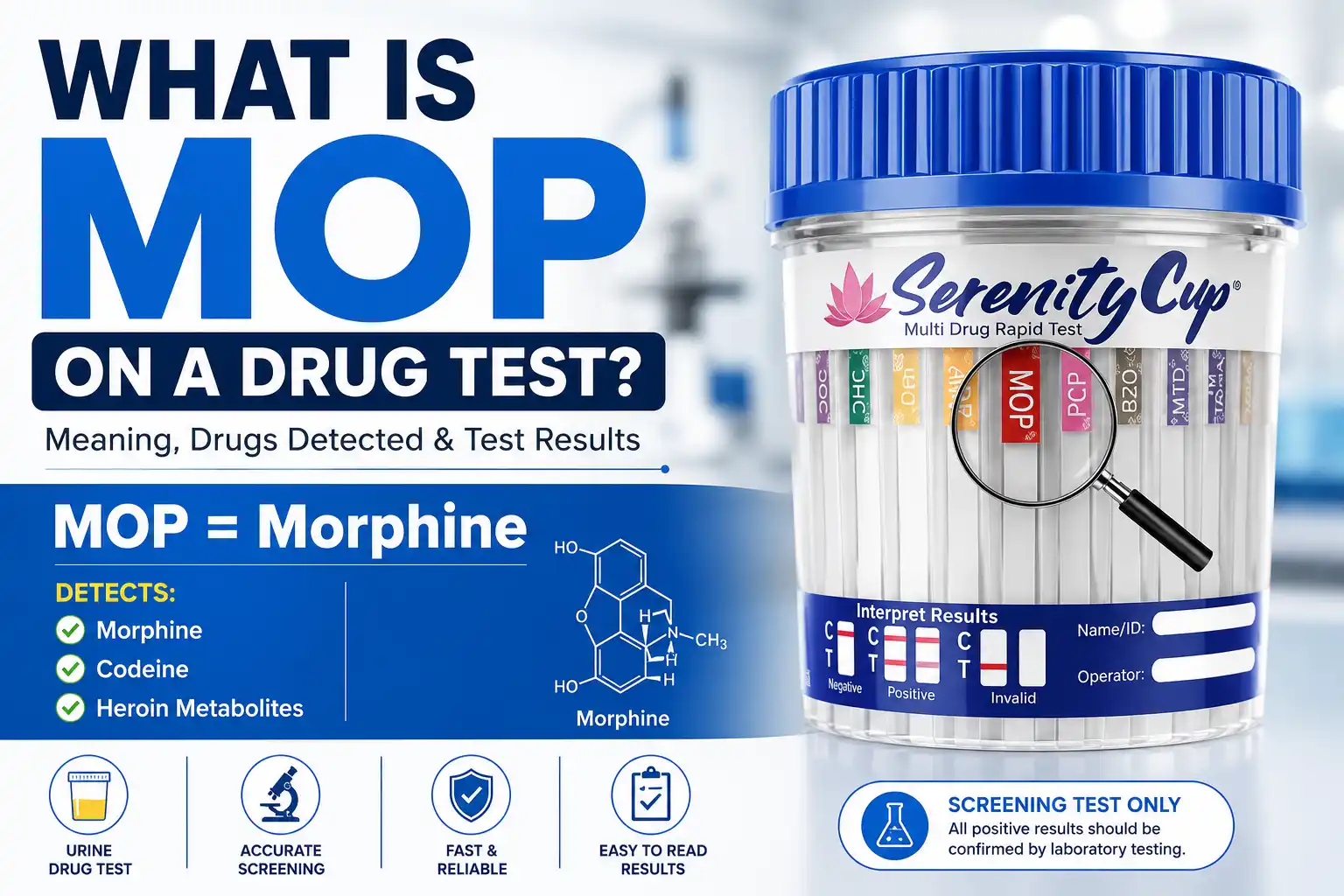
If you’ve recently taken a urine drug test or reviewed the results of a workplace, clinical, or probation screening, you may have noticed the abbreviation MOP on the test panel. Many people wonder, “What is MOP on a drug test?” or “Does MOP mean morphine or all opioids?”
The short answer is that MOP stands for morphine, an opiate commonly included on multi-panel urine drug tests. However, the MOP panel doesn’t only detect morphine itself. Because several drugs are metabolized into morphine, a positive MOP result may indicate exposure to morphine, codeine, heroin (through its metabolites), or other naturally occurring opiates, depending on the testing method and cutoff level.
Understanding what MOP means is important whether you’re interpreting a 12 panel drug test, reviewing employment screening results, monitoring prescription opioid therapy, or simply trying to understand the abbreviations printed on a drug test cup.
MOP Mean on a Drug Test?
MOP stands for Morphine, one of the primary natural opiates screened during a urine drug test. On many rapid drug test cups and dip cards, manufacturers use MOP to identify the testing strip that screens for morphine and related opiate metabolites.
Although the abbreviation refers to morphine, the panel is designed to detect a broader group of naturally occurring opiates because these substances share similar chemical structures and metabolic pathways.
A MOP panel is commonly included in:
- 5 panel drug tests
- 6 panel drug tests
- 10 panel drug tests
- 12 panel drug tests
- 14 panel and higher drug test cups
- Instant urine drug test strips
- Laboratory urine drug screening
Healthcare providers, employers, rehabilitation facilities, correctional institutions, pain management clinics, and workplace drug testing programs frequently use MOP screening as part of routine drug testing.
Why Is Morphine Used as the Marker?
Morphine serves as a key marker because several opioids eventually produce morphine metabolites after being processed by the body.
For example:
- Morphine remains detectable as morphine and morphine glucuronides.
- Codeine is partially metabolized into morphine.
- Heroin is rapidly converted into 6-monoacetylmorphine (6-MAM) and then into morphine before being excreted in urine.
Because of this metabolic relationship, screening specifically for morphine helps identify exposure to several naturally derived opiates.
What Drug Does MOP Detect?
One of the biggest misconceptions is that a MOP panel detects only morphine. In reality, it primarily detects morphine and compounds that metabolize into morphine or closely related opiate metabolites.
Drugs commonly detected by a MOP test
| Drug | Usually Detected by MOP? | Notes |
|---|---|---|
| Morphine | ✅ Yes | Primary target analyte |
| Codeine | ✅ Yes | Converts partially into morphine |
| Heroin | ✅ Yes | Metabolized into 6-MAM and morphine |
| Opium | ✅ Yes | Natural source of morphine and codeine |
| Morphine metabolites | ✅ Yes | Including morphine glucuronides |
Drugs that usually require separate panels
Many people assume all opioids trigger a MOP result, but that’s not always true.
These medications often require their own dedicated drug test panels:
- Oxycodone (OXY)
- Methadone (MTD)
- Buprenorphine (BUP)
- Fentanyl (FEN)
- Tramadol (TRA)
- Tapentadol
- Meperidine
Modern 12 panel drug tests frequently include these drugs as separate testing lines because their chemical structures differ enough that standard morphine immunoassays may not reliably detect them.
MOP vs OPI vs MOR: What’s the Difference?
Different drug test manufacturers use different abbreviations, which often causes confusion.
Fortunately, these labels usually refer to closely related concepts.
| Abbreviation | Meaning | Common Use |
|---|---|---|
| MOP | Morphine | Rapid urine drug tests |
| MOR | Morphine | Laboratory reports and some international test kits |
| OPI | Opiates | Broader opiate screening panel |
MOP
MOP specifically identifies the morphine screening panel. Because morphine is the primary metabolite of several natural opiates, many rapid urine drug tests use this abbreviation.
MOR
Some manufacturers and laboratories simply use MOR instead of MOP. Both generally refer to morphine testing rather than different drugs.
OPI
OPI stands for opiates, representing the broader drug class rather than a single compound.
Depending on the manufacturer, an OPI panel may detect:
- Morphine
- Codeine
- Heroin metabolites
- Other naturally occurring opiates
This is why some drug test cups label the panel as OPI, while others use MOP or MOR even though they screen for very similar substances.
How Does a MOP Drug Test Work?
Most instant MOP drug tests use competitive immunoassay technology, which relies on highly specific antibodies designed to recognize morphine or closely related opiate metabolites.
Here’s how the screening process works:
Step 1: Urine collection
The donor provides a fresh urine specimen in a drug test cup or collection container.
Step 2: Sample migration
The urine moves through the testing membrane by capillary action, carrying dissolved drug metabolites toward the reaction zone.
Step 3: Antibody interaction
Inside the test strip are antibodies that bind specifically to morphine-related compounds.
If morphine or related metabolites are below the cutoff concentration, the antibodies bind to the immobilized drug-protein complex, producing a visible test line.
If morphine concentrations exceed the cutoff, the antibodies bind to the drug present in the urine instead, preventing formation of the test line.
Step 4: Result interpretation
The control line confirms the test functioned correctly.
The presence or absence of the test line determines whether the sample is negative or presumptively positive.
Because immunoassays are screening tools, any non-negative MOP result should be confirmed using highly specific laboratory techniques such as gas chromatography-mass spectrometry (GC-MS) or liquid chromatography-tandem mass spectrometry (LC-MS/MS) before clinical, employment, or legal decisions are made.
Which Drugs Can Cause a Positive MOP Result?
A positive MOP result indicates that morphine or morphine-related metabolites were detected at or above the test’s cutoff concentration.
Common causes include:
Prescription medications
- Morphine sulfate
- Immediate-release morphine
- Extended-release morphine
- Codeine-containing medications
Illegal opioids
- Heroin
- Raw opium
Medical treatment
Patients receiving morphine for:
- Post-surgical pain
- Cancer pain
- Trauma
- Severe chronic pain
- Hospice or palliative care
Opiate-containing substances
Although uncommon with today’s testing standards, consuming foods made with poppy seeds may occasionally contribute to detectable morphine or codeine levels, especially shortly after ingestion and depending on the cutoff used.
Can Prescription Medications Trigger MOP?
Yes. Certain prescription opioid medications can trigger a positive MOP result because they either contain morphine directly or are metabolized into morphine after entering the body.
Whether a medication causes a positive result depends on several factors, including:
- The active ingredient
- Drug metabolism
- Dosage
- Time since the last dose
- The drug test’s cutoff concentration
- Individual metabolism and kidney function
Prescription medications that may produce a positive MOP result
| Medication | May Trigger MOP? | Why |
|---|---|---|
| Morphine | ✅ Yes | Contains morphine |
| Codeine | ✅ Yes | Metabolized into morphine |
| Heroin (illegal opioid) | ✅ Yes | Converts into 6-MAM and morphine |
| Opium-containing products | ✅ Yes | Natural source of morphine and codeine |
Medications that usually require separate drug test panels
Many prescription opioids do not reliably trigger the MOP panel because their chemical structures differ from morphine.
These commonly require dedicated panels:
| Medication | Separate Panel |
|---|---|
| Oxycodone | OXY |
| Methadone | MTD |
| Buprenorphine | BUP |
| Fentanyl | FEN |
| Tramadol | TRA |
| Tapentadol | Specialized panel |
This is why modern 12 panel drug test cups often include multiple opioid-related test strips rather than relying solely on the MOP panel.
If you’re taking prescription opioid medication, always disclose it to the employer, healthcare provider, or Medical Review Officer (MRO) if requested. A legitimate prescription may help explain a presumptive positive result during the review process.
Can Poppy Seeds Cause a Positive MOP Test?
This is one of the most frequently asked questions about morphine drug testing.
The answer is yes—but only under certain circumstances.
Poppy seeds naturally contain trace amounts of morphine and codeine because they come from the opium poppy (Papaver somniferum). Eating foods such as:
- Poppy seed bagels
- Muffins
- Pastries
- Cakes
- Bread
may temporarily introduce small amounts of these compounds into the body.
Why modern drug tests rarely flag poppy seeds
Years ago, lower cutoff concentrations occasionally resulted in positive opiate screens after consuming poppy seed foods.
Today, many workplace and federally regulated drug testing programs use higher screening cutoffs, which significantly reduce the likelihood that ordinary dietary consumption will produce a positive result.
However, consuming unusually large amounts of poppy seeds shortly before testing could still increase urinary morphine concentrations, particularly with tests using lower cutoff thresholds.
If there’s uncertainty, laboratories can perform confirmatory testing to distinguish dietary exposure from illicit opioid use by evaluating drug metabolites and concentration patterns.
How Long Does Morphine Stay Detectable in Urine?
The amount of time morphine remains detectable depends on:
- Dose
- Frequency of use
- Kidney function
- Hydration status
- Metabolism
- Body composition
- Overall health
For most individuals, morphine is detectable in urine for approximately 1 to 3 days after the last dose.
General urine detection window
| Drug | Approximate Detection Window |
|---|---|
| Morphine | 1–3 days |
| Codeine | 1–3 days |
| Heroin (via morphine metabolites) | 1–3 days after metabolism |
Heavy or prolonged opioid use may extend the detection period beyond these general estimates.
It’s important to remember that detection windows are estimates rather than guarantees. Individual metabolism varies, and laboratory interpretation should always consider clinical context.
What Is the Cutoff Level for MOP?
A cutoff level is the minimum drug concentration required for a screening test to report a presumptive positive result.
Drug tests use cutoff concentrations to reduce false positives caused by environmental exposure or trace contamination.
Common MOP screening cutoffs
| Cutoff | Typical Use |
|---|---|
| 300 ng/mL | Clinical testing, pain management, many instant urine drug tests |
| 2,000 ng/mL | Some workplace and federally regulated testing programs |
A lower cutoff increases sensitivity and may detect lower concentrations of morphine metabolites.
A higher cutoff reduces the likelihood of detecting insignificant exposure, including trace dietary sources such as poppy seeds.
The cutoff concentration does not measure impairment or indicate how much morphine a person consumed. It simply determines whether the sample meets the reporting threshold.
How to Read MOP Drug Test Results
Most rapid urine drug tests use a competitive immunoassay, which means the appearance of the test line differs from many other medical tests.
Negative Result
✅ Two lines appear.
- Control (C) line is visible.
- Test (T) line is visible.
Even a faint test line is generally interpreted as negative, provided the control line is present.
Presumptive Positive Result
✅ Only the Control (C) line appears.
The absence of the Test (T) line suggests morphine or related metabolites are present at or above the cutoff concentration.
Because this is only a screening result, additional laboratory confirmation is recommended before making employment, legal, or medical decisions.
Invalid Result
❌ No Control (C) line appears.
The test should be considered invalid regardless of whether a Test line is visible.
Common reasons include:
- Insufficient urine sample
- Improper testing procedure
- Damaged test device
- Expired test kit
- Manufacturing defect
A new test should be performed using a fresh device.
Can MOP Drug Tests Produce False Positives?
Like all rapid immunoassay drug tests, MOP screening is highly accurate but not perfect.
Because immunoassays rely on antibody binding, some substances with similar chemical structures may occasionally produce cross-reactivity.
Potential contributing factors include:
- Certain prescription medications
- Laboratory handling errors
- Improper specimen collection
- Sample contamination
- Rare antibody cross-reactivity
Modern FDA-cleared and CLIA-waived urine drug tests are designed to minimize these occurrences, but no screening test has 100% specificity.
It’s also possible to receive a false negative if drug concentrations remain below the test’s cutoff level or if the urine sample is collected after the detection window has passed.
How Are Positive MOP Results Confirmed?
A rapid urine drug test is considered a screening test, not a final diagnosis.
If a MOP panel produces a presumptive positive result, laboratories typically perform confirmatory testing using advanced analytical techniques.
The two most widely accepted methods are:
- Gas Chromatography–Mass Spectrometry (GC-MS)
- Liquid Chromatography–Tandem Mass Spectrometry (LC-MS/MS)
These methods provide:
- Extremely high specificity
- Precise identification of individual drugs
- Quantitative drug concentrations
- Improved distinction between different opioids
- Significantly reduced risk of false positives
Confirmatory testing is commonly required for:
- Workplace drug testing
- Department of Transportation (DOT) programs
- Court-ordered testing
- Probation and parole monitoring
- Pain management clinics
- Forensic investigations
Only after confirmatory laboratory analysis should a positive screening result be considered definitive.
Frequently Asked Questions
What is MOP on a drug test?
MOP stands for morphine, a testing panel that screens urine for morphine and related opiate metabolites. It is commonly included on 5-panel, 10-panel, 12-panel, and other multi-panel drug tests.
Does MOP mean opioids?
Not exactly. MOP refers specifically to morphine, while OPI generally refers to the broader opiate drug class. Because morphine is a primary opiate metabolite, the terms are sometimes used interchangeably on different test devices.
What drugs show up as MOP?
A MOP panel primarily detects:
- Morphine
- Codeine
- Heroin (through its metabolites)
- Morphine glucuronides
- Other closely related natural opiates
Is MOP the same as MOR?
In many rapid drug tests, MOP and MOR both refer to morphine. The abbreviation varies by manufacturer, but the testing purpose is generally the same.
Can codeine cause a positive MOP result?
Yes. Codeine is metabolized into morphine in the body, so it can produce a positive MOP result when urinary concentrations exceed the screening cutoff.
Does heroin show up on a MOP drug test?
Yes. Heroin is rapidly metabolized into 6-monoacetylmorphine (6-MAM) and then into morphine, which can trigger a positive MOP screening result.
Does oxycodone show up on a MOP test?
Not reliably. Most modern drug testing programs use a dedicated OXY panel because oxycodone is structurally different from morphine.
Can fentanyl trigger a MOP result?
No. Fentanyl generally requires its own FEN testing panel and is not reliably detected by standard morphine immunoassays.
What does a positive MOP test mean?
A positive MOP result means morphine or closely related opiate metabolites were detected at or above the test’s cutoff concentration. Because screening tests are presumptive, laboratory confirmation with GC-MS or LC-MS/MS is recommended before reaching a final conclusion.
How accurate are MOP drug tests?
Modern immunoassay-based MOP tests are highly accurate when used correctly. However, they are designed as screening tests, so any non-negative result should be confirmed using laboratory methods to ensure accuracy and identify the specific opioid present.