Does Amitriptyline Show Up in a Drug Test?

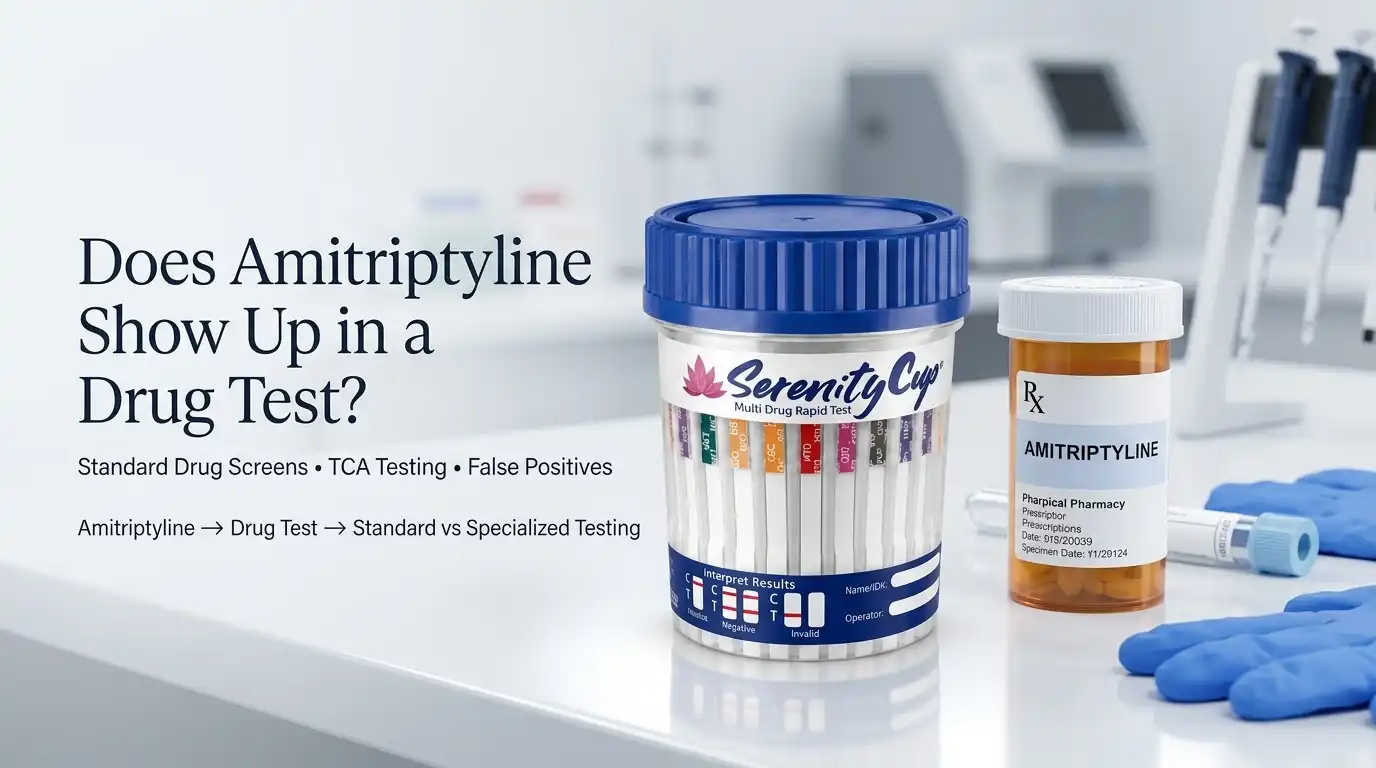
If you take amitriptyline and have an upcoming drug test, it is reasonable to wonder whether the medication will appear on your results.
In most routine workplace drug screens, amitriptyline is not one of the drug categories being tested. However, a laboratory can specifically test for amitriptyline and its metabolite, nortriptyline, when a TCA, antidepressant, therapeutic-drug-monitoring, or toxicology test is ordered.
So the important question isn’t simply “Does amitriptyline show up on a drug test?” It is:
What drugs does the particular test include?
A routine 5-panel or other standard workplace panel is different from a specialized test designed to identify tricyclic antidepressants.
Does Amitriptyline Show Up on a Drug Test?
Usually, not on a routine drug screen.
Amitriptyline is a tricyclic antidepressant (TCA). It is not part of the five drug categories required for U.S. Department of Transportation (DOT) testing: marijuana, cocaine, amphetamines, opioids, and PCP.
However, amitriptyline can absolutely be detected when a laboratory orders a test specifically designed to measure it. For example, Labcorp offers testing that measures amitriptyline and nortriptyline by LC/MS-MS, and Mayo Clinic Laboratories offers an amitriptyline/nortriptyline serum test using LC-MS/MS. At a glance
| Testing situation | Is amitriptyline specifically tested? |
|---|---|
| Routine drug screen | Usually no |
| DOT 5-panel drug test | No |
| Standard workplace panel | Depends on the ordered panel; usually no |
| 5-panel drug test | Usually no |
| 10-panel drug test | Depends on the laboratory’s exact panel |
| TCA-specific test | Yes |
| Antidepressant drug profile | Yes, if included |
| Dedicated amitriptyline test | Yes |
| Clinical toxicology testing | Can be tested specifically |
| Therapeutic drug monitoring | Yes |
The exact contents of a test should always be confirmed with the testing provider or laboratory because names such as “5-panel” and “10-panel” can refer to different configurations outside regulated programs.
What Is Amitriptyline?
Amitriptyline is a prescription medication belonging to the tricyclic antidepressant (TCA) class.
It has been used for depression and is also prescribed in some situations for other conditions, including certain types of chronic or neuropathic pain.
Amitriptyline is metabolized in the body into nortriptyline, which is also pharmacologically active. Laboratory testing may therefore measure both compounds. Mayo Clinic Laboratories specifically describes nortriptyline as a metabolite of amitriptyline, while Labcorp’s dedicated amitriptyline test also includes nortriptyline.
This distinction matters when interpreting a specialized test result.
Why Doesn’t Amitriptyline Usually Appear on a Standard Drug Test?
Routine drug screens are designed around a particular list of substances or drug classes.
A test does not automatically detect every medication present in a person’s body.
For example, under DOT regulations, required drug testing covers:
- Marijuana
- Cocaine
- Amphetamines
- Opioids
- Phencyclidine (PCP)
Amitriptyline is not among those required DOT drug categories.
Therefore, someone taking amitriptyline can have the medication in their body while still receiving a negative result on a routine drug panel that does not include amitriptyline.
Does Amitriptyline Show Up on a 5-Panel Drug Test?
Generally, no.
A standard five-category workplace drug test does not target amitriptyline.
For example, the DOT’s regulated testing program uses five drug categories:
- Marijuana
- Cocaine
- Amphetamines
- Opioids
- PCP
Amitriptyline is not included in that required panel.
However, it is important not to assume that every test marketed as a “5-panel” is identical in every setting. Always check the actual analytes included by the laboratory or employer.
Does Amitriptyline Show Up on a 10-Panel Drug Test?
Not necessarily.
A “10-panel drug test” is not automatically a test for every prescription medication.
The exact substances included in a 10-panel test can vary by provider and test configuration. Some panels may contain additional drug classes, but that does not mean amitriptyline is automatically included.
If you need to know whether a specific 10-panel test detects amitriptyline, check the laboratory’s test menu or ask the testing provider which analytes are included.
Don’t assume:
“10-panel” = “tests for all medications.”
Instead, look for TCA, tricyclic antidepressants, amitriptyline, nortriptyline, or an antidepressant profile in the test description.
Can a Drug Test Specifically Detect Amitriptyline?
Yes.
Laboratories can perform dedicated testing for amitriptyline.
For example, Labcorp’s amitriptyline test uses liquid chromatography/tandem mass spectrometry (LC/MS-MS) and includes both:
- Amitriptyline
- Nortriptyline
The laboratory lists the test for evaluating toxicity and monitoring therapeutic levels.
Mayo Clinic Laboratories similarly offers an Amitriptyline and Nortriptyline, Serum test using LC-MS/MS for therapeutic monitoring, potential toxicity evaluation, and assessment of compliance.
So the answer changes when the test is specifically designed to identify the medication.
What Is a TCA Drug Test?
A TCA drug test is a test designed to detect tricyclic antidepressants.
TCA testing may include amitriptyline and other medications in the same class.
Some laboratory profiles can include:
- Amitriptyline
- Nortriptyline
- Imipramine
- Desipramine
- Clomipramine
- Doxepin
- Protriptyline
- Trimipramine
The exact compounds depend on the laboratory’s test configuration.
For example, Labcorp’s urine antidepressant profile includes amitriptyline and nortriptyline along with multiple other antidepressants, using LC/MS-MS methodology.
MedTox/Labcorp also lists an antidepressant profile as a “TCA Screen” or “Tricyclic screen” and includes amitriptyline and nortriptyline.
Amitriptyline vs. Nortriptyline: What’s the Difference?
This is an important part of understanding specialized testing.
Amitriptyline is the medication you take.
Nortriptyline is one of its metabolites.
After amitriptyline is metabolized, nortriptyline can be produced. Because both compounds can be relevant clinically, specialized laboratory tests may measure them together.
Mayo Clinic Laboratories specifically identifies nortriptyline as a metabolite of amitriptyline, and Labcorp describes its nortriptyline test in the same way.
This means a laboratory report from specialized testing may contain both names.
Example
A report might identify:
Amitriptyline: measured concentration
Nortriptyline: measured concentration
That does not mean the person necessarily took nortriptyline separately. Nortriptyline can result from the body’s metabolism of amitriptyline.
Does Amitriptyline Show Up in a Urine Drug Test?
It depends on the type of urine test.
Routine urine drug screen
A standard urine drug screen generally does not include amitriptyline unless it is specifically part of the ordered panel.
Specialized urine testing
Amitriptyline can be specifically detected in urine.
For example, Labcorp offers an Antidepressant Drug Profile, quantitative, urine that includes amitriptyline and nortriptyline and uses LC/MS-MS.
Mayo Clinic Laboratories also offers a quantitative urine antidepressant screen that includes amitriptyline and nortriptyline.
Therefore:
Amitriptyline can be detected in urine, but whether it appears on your drug test depends on whether the ordered test is designed to look for it.
Does Amitriptyline Show Up in a Blood Test?
It can.
A blood test specifically designed to measure amitriptyline can identify the medication and its metabolite.
Mayo Clinic Laboratories offers an Amitriptyline and Nortriptyline, Serum test using LC-MS/MS. It is used for therapeutic drug monitoring and evaluation of possible toxicity.
Labcorp likewise offers dedicated amitriptyline testing using LC/MS-MS.
So it would be inaccurate to say that amitriptyline “doesn’t show up in blood.”
The more accurate statement is:
Amitriptyline generally isn’t part of a routine drug screen, but a dedicated blood test can measure it.
Does Amitriptyline Show Up in Saliva or Oral Fluid?
There is no single answer for every oral-fluid test because the result depends on what the laboratory’s assay is designed to detect.
A routine oral-fluid drug panel does not automatically test for every prescription medication.
If an oral-fluid test specifically includes amitriptyline or tricyclic antidepressants, specialized laboratory analysis may be used.
Therefore, the test menu and analytes matter more than simply knowing that the specimen is saliva.
Does Amitriptyline Show Up in a Hair Drug Test?
Again, the answer depends on the analytes included in the laboratory’s hair-testing method.
A hair test designed around common drugs of abuse does not automatically test for amitriptyline.
Specialized laboratory methods can be developed for particular compounds, but you should not assume that a standard hair panel includes prescription antidepressants.
If a hair test is being used for a specific medical, legal, or forensic purpose, ask which substances the laboratory has validated its method to detect.
How Long Does Amitriptyline Stay in Your System?
This question is more complicated than giving one universal number of days.
There is a difference between:
- how long a drug remains in the body,
- how long it remains pharmacologically active,
- how long a metabolite can be measured,
- and how long a particular laboratory method can detect it.
Amitriptyline is metabolized extensively, with nortriptyline being one important metabolite. The official prescribing information describes rapid absorption and metabolism, with most of the administered material ultimately excreted as metabolites.
Mayo Clinic Laboratories also notes that blood concentrations of amitriptyline and nortriptyline can vary substantially between patients.
Factors that can affect measured concentrations include:
- Dose
- Frequency of use
- Time since the last dose
- Individual metabolism
- Other medications
- Liver function
- Kidney function
- Specimen type
- Laboratory method
- Test sensitivity
- Whether the test measures the parent drug, metabolites, or both
Because of these variables, there is no reliable universal detection window that applies to every person and every test.
Amitriptyline Half-Life and Drug Testing
Half-life describes how quickly the concentration of a drug decreases in the body. It should not be confused with a guaranteed drug-test detection window.
A person may continue to have measurable drug or metabolites after the drug’s effects have changed.
Likewise, a substance can be present in the body but not be detected by a test that does not target it.
This is why these two questions are different:
“Is amitriptyline still in my body?”
and
“Will my drug test detect amitriptyline?”
The second question depends heavily on the test.
Can Amitriptyline Cause a False Positive on a Drug Test?
It can be relevant to unexpected screening results, but a suspected cross-reactivity should not automatically be treated as proof that a particular drug was present.
Some screening tests, especially immunoassays, are designed as initial screening methods rather than definitive identification of every compound.
When an unexpected screening result occurs, the testing program may use a more specific laboratory method to establish what substance is actually present.
For amitriptyline specifically, modern laboratory methods such as LC-MS/MS can directly identify and quantify amitriptyline and nortriptyline. Labcorp and Mayo both use mass-spectrometry-based methods for dedicated testing.
Why this matters
A screening result and a definitive identification are not necessarily the same thing.
If you receive an unexpected result, ask the testing provider what:
- screening method was used,
- substance was reported,
- confirmation method was used,
- laboratory performed the test,
- prescription documentation is needed.
Does Amitriptyline Cause a False Positive for Amphetamines?
A common concern is whether a prescription medication can make a person appear positive for an unrelated drug.
The answer should not be reduced to “yes” or “no” without knowing the assay.
Immunoassay cross-reactivity can occur with some medications and substances, but a presumptive screening result should be distinguished from definitive identification.
If a screening result is inconsistent with your medication history, ask whether confirmatory testing was performed.
Do not assume that an unexpected result proves illicit drug use.
Does Amitriptyline Cause a False Positive for Benzodiazepines?
The same principle applies.
A routine immunoassay is designed around particular drug targets and may have limitations. If a result is unexpected, the laboratory’s confirmation process and the specific assay used are important.
The most useful information is the actual reported analyte, not simply the name of the initial screening panel.
Does Amitriptyline Show Up on a Workplace Drug Test?
For many workplace testing programs, amitriptyline is not part of the standard drug categories being screened.
For federally regulated DOT testing, the required drug categories are marijuana, cocaine, amphetamines, opioids, and PCP. Amitriptyline isn’t among them.
However, non-DOT employers can use different testing panels.
An employer may contract with a laboratory for a particular panel that contains additional substances.
Therefore, “workplace drug test” does not always mean exactly the same test.
Before a workplace test
If you are prescribed amitriptyline:
- Continue to follow your healthcare professional’s instructions.
- Do not stop prescribed medication solely to try to alter a drug-test result.
- Review the testing instructions you receive.
- Provide medication information through the testing program’s required process.
- Keep prescription information available if the laboratory or Medical Review Officer requests it.
Does Amitriptyline Show Up on a DOT Drug Test?
For a standard DOT drug test, amitriptyline is not one of the required drug categories.
DOT regulations specify testing for:
- Marijuana
- Cocaine
- Amphetamines
- Opioids
- PCP
DOT also specifies that its regulated specimens are tested at HHS-certified laboratories, and its standard program does not authorize testing DOT specimens for unrelated drugs.
So if the question is specifically:
“Will amitriptyline itself be part of the standard DOT drug panel?”
The answer is no.
That is different from saying that amitriptyline can never be detected by any laboratory test.
What Happens If You Take Amitriptyline Before a Drug Test?
If you take amitriptyline as prescribed, you generally should not stop taking it on your own simply because you have an upcoming drug test.
Stopping a prescription medication can create medical problems and should be discussed with the prescribing clinician.
Instead, determine what testing program you are undergoing and follow its instructions regarding medication disclosure.
A specialized laboratory test can specifically identify amitriptyline and nortriptyline, so trying to alter medication use solely to change a test result is not a reliable approach.
Should You Tell the Testing Facility About Amitriptyline?
If the testing program asks you to provide prescription or medication information, provide accurate information according to its procedures.
For regulated testing programs, the Medical Review Officer process has specific rules for reviewing confirmed results and considering legitimate medical explanations for substances that are within the program’s testing categories.
For non-DOT testing, procedures can vary.
Keep useful documentation available
Depending on the testing situation, this might include:
- Prescription information
- Medication name
- Prescribing clinician
- Pharmacy information
- Current medication list
Don’t provide unnecessary medical information to an employer beyond what the applicable testing process requires.
Can You Test Yourself for Amitriptyline?
A standard multi-drug home test is not necessarily designed to detect amitriptyline.
For example, a multi-panel cup can contain several common drug targets without including antidepressants such as amitriptyline.
If the purpose is specifically to determine whether amitriptyline is present, the appropriate test needs to include amitriptyline as an analyte.
Clinical laboratories offer dedicated testing for that purpose. Labcorp lists dedicated amitriptyline testing and antidepressant profiles, while Mayo lists amitriptyline/nortriptyline testing.
Standard Drug Test vs. Amitriptyline-Specific Test
This distinction is the most important part of the subject.
| Feature | Routine Drug Screen | Amitriptyline-Specific Testing |
|---|---|---|
| Main purpose | Screen for specified drug classes | Measure amitriptyline and/or related compounds |
| Amitriptyline included? | Usually no | Yes |
| Nortriptyline included? | Usually no | Often |
| Common workplace use | Yes | Less common |
| Therapeutic monitoring | No | Yes |
| Toxicology evaluation | Sometimes | Yes |
| LC-MS/MS | Depends on program | Common for definitive testing |
| Urine available | Yes | Yes |
| Serum testing | Depends on program | Yes |
Laboratory offerings demonstrate that specialized urine and serum testing for amitriptyline and nortriptyline is available.
Why Test Type Matters More Than the Word “Drug Test”
“Drug test” is a broad term.
It can refer to:
- A workplace screening panel
- A DOT-regulated test
- A clinical toxicology screen
- A TCA screen
- An antidepressant profile
- Therapeutic drug monitoring
- A forensic toxicology analysis
- A dedicated amitriptyline test
Each can have different targets and analytical methods.
That’s why someone can truthfully say:
“Amitriptyline doesn’t show up on my drug test.”
while another person can truthfully say:
“My laboratory detected amitriptyline.”
They may simply have undergone different tests.
What Is LC-MS/MS and Why Is It Used?
LC-MS/MS stands for liquid chromatography-tandem mass spectrometry.
It is a laboratory analytical technique that can separate compounds and identify them based on their chemical characteristics.
It is used in dedicated amitriptyline testing by laboratories including Labcorp and Mayo Clinic Laboratories.
This is different from treating every drug screen as one generic test.
For example, Labcorp’s dedicated amitriptyline test uses LC/MS-MS and reports amitriptyline and nortriptyline.
Amitriptyline Detection: What Can Change the Result?
Even when a test specifically targets amitriptyline, the measured concentration can vary.
Factors include:
1. Dose
Different doses produce different drug concentrations.
2. Frequency
Regular use can produce a different concentration profile from occasional use.
3. Time since the last dose
Drug concentrations change over time.
4. Metabolism
People metabolize medications at different rates.
5. Other medications
Drug interactions can influence metabolism and concentrations.
6. Liver function
Amitriptyline undergoes extensive metabolism, so changes in metabolic function can affect concentrations.
7. Specimen type
Urine, serum/plasma, oral fluid, and other specimens have different analytical characteristics.
8. Laboratory method
Different assays have different analytical characteristics and targets.
9. Test cutoff or reporting threshold
A laboratory must establish how its method identifies or quantifies the analyte.
For these reasons, there is no single detection time that applies to everyone.
What Does a Positive Amitriptyline Test Mean?
A positive result on a test specifically designed to detect amitriptyline means the laboratory detected the target compound according to that test’s reporting criteria.
It does not automatically establish why the drug is present.
For example, the presence could be consistent with prescribed medication, depending on the test and context.
That is why medical testing requires interpretation alongside:
- Medication history
- Prescription information
- Timing
- Dose
- Laboratory method
- Clinical context
Mayo Clinic Laboratories specifically notes that amitriptyline and nortriptyline concentrations can vary among patients and that interpretation should include clinical evaluation.
What If Your Drug Test Result Is Unexpected?
If a screening result doesn’t match your medication history, don’t immediately assume the worst.
Ask the testing provider:
1. What substance was reported?
Find out the specific analyte.
2. Was the result a screening result?
Some screening methods are designed to identify specimens that need additional testing.
3. Was confirmatory testing performed?
Ask whether a more specific analytical method was used.
4. Was your medication list reviewed?
Provide the relevant prescription information through the appropriate process.
5. Was an MRO involved?
Medical Review Officers are part of certain regulated testing programs and have specific responsibilities for reviewing results.
Amitriptyline and Drug Testing: Common Misunderstandings
Myth 1: “If it is in my body, every drug test will detect it.”
False.
A test must be designed to detect the substance.
Myth 2: “A 10-panel test checks every medication.”
False.
Panel names do not necessarily mean that every prescription medication is included.
Myth 3: “Amitriptyline can never be detected in urine.”
False.
Specialized urine testing can specifically identify amitriptyline and nortriptyline.
Myth 4: “Amitriptyline can never be detected in blood.”
False.
Dedicated serum testing is available.
Myth 5: “A positive screening result automatically proves illegal drug use.”
False.
Screening and definitive testing are different processes, and results must be interpreted in context.
Myth 6: “I should stop my prescription before the test.”
Not a safe assumption.
Do not change or stop prescribed medication solely to alter a drug-test result without discussing it with the prescribing healthcare professional.
Amitriptyline vs. Common Drugs on Routine Panels
| Substance/Class | Commonly included in standard workplace testing? | Amitriptyline? |
|---|---|---|
| Marijuana/THC | Yes in many panels | No |
| Cocaine | Yes | No |
| Amphetamines | Yes | No |
| Opioids | Yes | No |
| PCP | In certain standard/federal panels | No |
| Amitriptyline | Usually not | — |
| Nortriptyline | Usually not | — |
| Other TCAs | Usually not | — |
For DOT testing specifically, the required categories are marijuana, cocaine, amphetamines, opioids and PCP.
Can a Standard Drug Test Detect Antidepressants?
Not necessarily.
“Antidepressant” is a broad medication category.
A standard drug screen isn’t automatically an antidepressant screen.
Some specialized laboratory panels are specifically designed to identify antidepressants. Labcorp’s antidepressant profile, for example, includes numerous antidepressants including amitriptyline and nortriptyline.
Therefore:
Antidepressants can be tested for, but they aren’t automatically included in every drug screen.
Is Amitriptyline a Controlled Substance?
In the United States, current DailyMed labeling for amitriptyline hydrochloride identifies it as a prescription drug and lists “DEA Schedule: None.”
That regulatory status is one reason it should not be confused with controlled substances commonly targeted in workplace drug-testing panels.
However, being a prescription medication does not mean it cannot be detected by laboratory testing.
A dedicated test can measure it.
Frequently Asked Questions
Does amitriptyline show up on a standard drug test?
Usually not. Amitriptyline is not one of the five drug categories required in standard DOT testing. Specialized laboratory tests can detect it when specifically ordered.
Does amitriptyline show up on a 5-panel drug test?
Generally no. A standard five-category test targets marijuana, cocaine, amphetamines, opioids and PCP rather than amitriptyline.
Does amitriptyline show up on a 10-panel drug test?
It depends on the exact panel. A “10-panel” label does not automatically mean that amitriptyline or TCAs are included.
Does amitriptyline show up in urine?
It can. Specialized urine testing can measure amitriptyline and nortriptyline.
Does amitriptyline show up in blood?
Yes, if the blood/serum test is designed to measure it. Mayo Clinic Laboratories offers an amitriptyline and nortriptyline serum test using LC-MS/MS.
Can amitriptyline cause a false positive?
Unexpected screening results can involve assay limitations or cross-reactivity, but the specific substance and testing method matter. Definitive laboratory testing can specifically identify amitriptyline and nortriptyline.
Does nortriptyline show up on a drug test?
Nortriptyline can be specifically measured in laboratory testing. It is also a metabolite of amitriptyline.
How long does amitriptyline stay in your system?
There is no single detection window that applies to everyone. Detectability depends on the medication, dose, timing, metabolism, specimen type and laboratory method.
How long does amitriptyline stay in urine?
A specific number of days cannot reliably be guaranteed for every person or test. Specialized urine tests can detect amitriptyline and nortriptyline, but detection depends on the assay and individual circumstances.
Is amitriptyline tested for in workplace drug tests?
It is generally not included in common workplace panels, but non-DOT employers can use different testing configurations. Check the actual panel.
Does amitriptyline show up on a DOT drug test?
Amitriptyline is not one of the drugs required by the standard DOT testing panel. DOT testing covers marijuana, cocaine, amphetamines, opioids and PCP.
Can a laboratory specifically test for amitriptyline?
Yes. Dedicated laboratory tests are available for amitriptyline and nortriptyline, including urine and serum testing.
Should I stop taking amitriptyline before a drug test?
Do not stop a prescribed medication just to try to change a drug-test result unless your healthcare professional tells you to do so. Follow the prescription and the testing program’s instructions.
Does Amitriptyline Show Up in a Drug Test?
Amitriptyline usually does not appear on a routine drug screen unless the testing panel specifically includes it.
For example, the standard DOT drug-testing categories are:
- Marijuana
- Cocaine
- Amphetamines
- Opioids
- PCP
Amitriptyline is not one of them.
But amitriptyline can definitely be detected by specialized laboratory testing. Dedicated tests can measure amitriptyline and its metabolite nortriptyline in specimens such as urine and serum, with laboratories using methods such as LC-MS/MS. The most important distinction is therefore:
Amitriptyline is not routinely included in many standard drug panels, but it can be specifically tested for when a TCA, antidepressant, therapeutic-monitoring, or toxicology test is ordered.
If you’re taking amitriptyline as prescribed and have an upcoming drug test, don’t change your medication solely because of the test. Instead, determine what type of test is being performed and follow the applicable medication-disclosure and testing instructions.
Medical note: This article is for educational purposes and does not replace advice from a physician, pharmacist, laboratory professional, or the organization administering your drug test. Testing panels and procedures can vary by laboratory, employer, jurisdiction, and testing program.