Does Ayahuasca Show Up on a Drug Test?

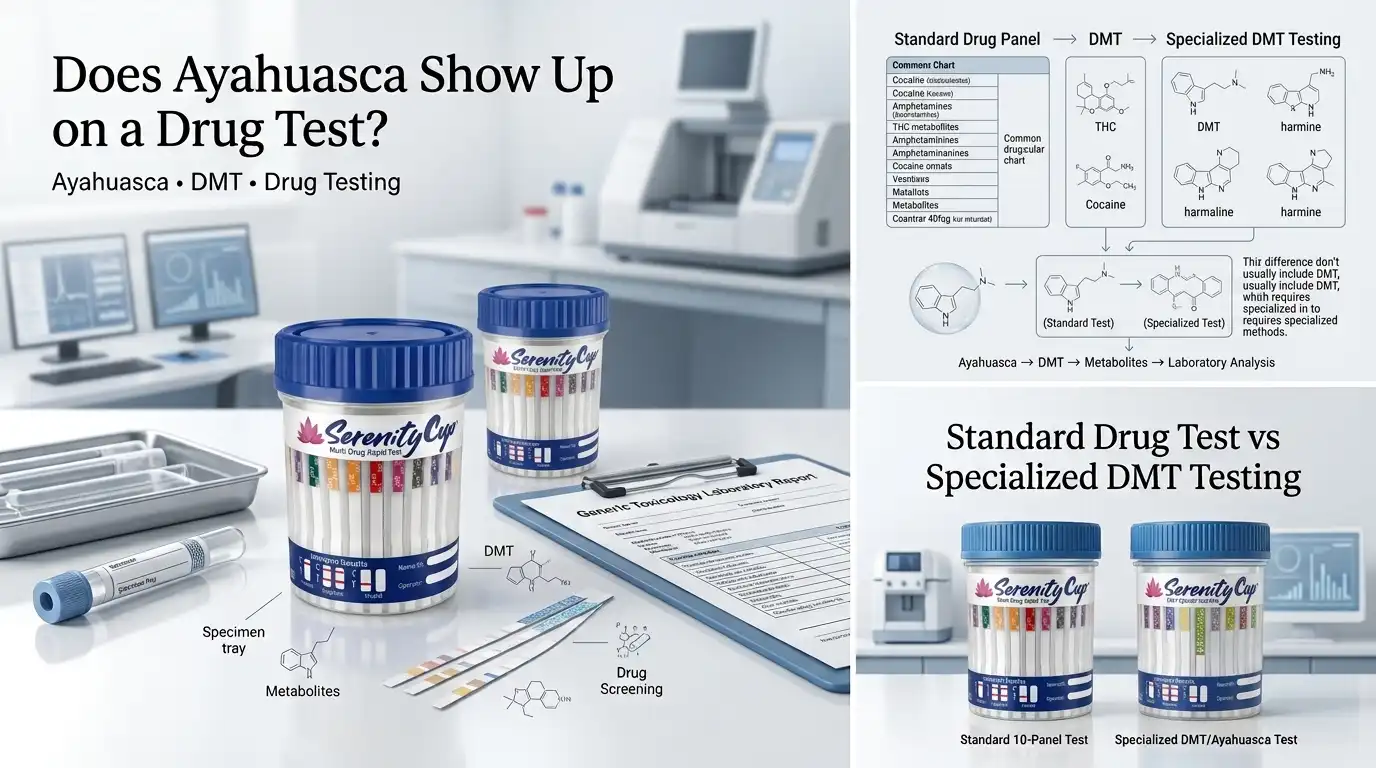
If you have searched “does ayahuasca show up on a drug test?”, the short answer is: usually not on a standard workplace drug test, but ayahuasca can be detected if a laboratory specifically tests for DMT or other ayahuasca-related compounds.
Ayahuasca is chemically different from many substances included in routine drug-screening panels. Its primary psychedelic compound is N,N-dimethyltryptamine (DMT), while the brew commonly contains beta-carboline alkaloids such as harmine, harmaline, and tetrahydroharmine (THH). These compounds affect how DMT is metabolized and can also serve as targets for specialized toxicology testing.
The important distinction is between what is present in the body and what a particular drug test is designed to detect. A routine urine drug screen can be negative for DMT simply because DMT is not one of the analytes being tested.
Quick Answer: Does Ayahuasca Show Up on a Drug Test?
Ayahuasca generally does not show up on a routine employment drug test unless the test specifically includes DMT or related compounds.
A standard federal workplace testing panel in the United States focuses on specific drug categories such as marijuana metabolites, cocaine metabolites, amphetamines, opioids, and PCP. DMT is not part of that routine five-category panel.
However, that does not mean ayahuasca is impossible to detect.
A laboratory can use specialized analytical methods to look for:
- DMT
- DMT metabolites
- DMT-N-oxide
- Harmine
- Harmaline
- Tetrahydroharmine (THH)
- Other ayahuasca-related metabolites
Specialized methods such as LC-MS/MS can identify compounds that are not included in an ordinary multi-drug screening panel.
So the most accurate answer is:
A routine drug test usually does not test for ayahuasca or DMT, but a targeted toxicology test can detect DMT or ayahuasca-related compounds.
What Is Ayahuasca?
Ayahuasca is a psychoactive botanical preparation traditionally associated with Amazonian ceremonial use.
Its chemistry is particularly important when discussing drug testing because ayahuasca generally combines two groups of compounds.
1. DMT
DMT stands for N,N-dimethyltryptamine.
It is the primary psychedelic compound responsible for many of ayahuasca’s psychoactive effects.
When DMT is taken orally by itself, it is extensively broken down by monoamine oxidase before it can produce the same systemic effects. Ayahuasca preparations commonly contain beta-carboline compounds that inhibit monoamine oxidase, allowing orally consumed DMT to reach systemic circulation.
2. Harmala alkaloids
The second important component is a group of beta-carboline alkaloids commonly associated with Banisteriopsis caapi.
These include:
- Harmine
- Harmaline
- Tetrahydroharmine (THH)
- Related metabolites
These compounds are important because they influence DMT metabolism and can themselves become targets of specialized laboratory testing.
Why Doesn’t Ayahuasca Usually Appear on a Standard Drug Test?
The simplest explanation is test design.
A drug test does not automatically look for every psychoactive substance that might be present in someone’s body.
Instead, the laboratory analyzes the specimen for a defined group of compounds.
For example, federal workplace testing in the United States includes specific categories such as:
- Marijuana
- Cocaine
- Amphetamines
- Opioids
- PCP
The exact authorized panel can change over time, and individual employers or testing programs can use different panels.
DMT is not routinely included in that standard federal panel.
Therefore, someone could have recently consumed ayahuasca and still receive a negative result on a routine panel because the laboratory was not looking for DMT.
This is an important concept:
A negative standard drug test does not necessarily mean that every substance in the body was absent.
It means the substances included in that particular test were not detected according to that test’s procedures and reporting criteria.
Does Ayahuasca Show Up on a 5-Panel Drug Test?
Generally, no.
A traditional five-panel workplace drug test is designed to identify specified drug categories rather than every possible psychoactive substance.
DMT is not one of the standard targets.
Therefore, ayahuasca consumption would not normally be expected to produce a positive result for:
- Marijuana
- Cocaine
- Amphetamines
- Opioids
- PCP
simply because ayahuasca contains DMT.
However, the exact test panel and laboratory methodology always matter.
A test provider can order additional testing when there is a specific reason to investigate substances outside the routine panel.
Does Ayahuasca Show Up on a 10-Panel or 12-Panel Drug Test?
This requires a little more nuance.
A 10-panel or 12-panel drug test is not a universal standardized list of exactly the same substances everywhere.
Different manufacturers and laboratories can offer different configurations.
Many commonly used expanded panels test substances such as:
- Marijuana/THC
- Cocaine
- Amphetamines
- Methamphetamine
- Opioids
- Benzodiazepines
- Barbiturates
- PCP
- Methadone
- Oxycodone
- Buprenorphine
- Other specified drug classes
But DMT is generally not a routine target of common multi-panel employment drug tests.
The number of panels does not automatically tell you whether DMT is included.
The analyte list is what matters.
A test labeled “12-panel” could contain a different combination of analytes from another company’s 12-panel test.
If DMT is not listed as an analyte, the test is not ordinarily designed to identify DMT.
Can a Urine Drug Test Detect Ayahuasca?
Yes, specialized urine testing can detect DMT or metabolites associated with ayahuasca, but this is different from an ordinary urine drug screen.
Urine is one of the most useful specimens for toxicology because drugs and metabolites are often eliminated through the kidneys.
Research on ayahuasca has demonstrated that DMT is extensively metabolized after ingestion.
In one human study, researchers analyzed 24-hour urine samples following oral ayahuasca administration. Less than 1% of the administered DMT was recovered unchanged. A substantial portion was recovered as metabolites, including indole-3-acetic acid and DMT-N-oxide.
Another study found that very little unchanged DMT may appear in urine, while DMT-N-oxide and other metabolites can provide more useful analytical targets.
This helps explain why detecting ayahuasca is more complicated than simply asking:
“Is DMT still in the urine?”
A sophisticated laboratory may instead look for a combination of DMT-related compounds and metabolites.
How Long Does Ayahuasca Stay in Your System?
There is no single detection time that applies to everyone.
The answer depends on:
- Dose
- Ayahuasca preparation
- DMT concentration
- Individual metabolism
- Route of administration
- Frequency of use
- Time since ingestion
- Specimen type
- Laboratory method
- Detection limits
- Which compound the laboratory is targeting
Research shows that DMT is rapidly absorbed and metabolized after ayahuasca administration. In a controlled human study, median DMT blood concentrations reached their peak at approximately 1.5 hours after administration, while subjective effects peaked around 1.5–2 hours.
But a peak concentration is not the same thing as a detection window.
A laboratory may detect a substance or metabolite after its peak concentration has passed.
Ayahuasca Detection by Specimen Type
| Test type | What may be detected | Important consideration |
|---|---|---|
| Urine | DMT metabolites and harmala-related compounds | Specialized testing can target ayahuasca compounds |
| Blood | DMT and related compounds | Generally useful around more recent exposure |
| Saliva/oral fluid | Potentially targeted compounds | Not a routine DMT screening method |
| Hair | DMT and some ayahuasca alkaloids | Requires specialized analytical testing |
| Standard multi-panel urine test | Usually not DMT | Depends on the specific panel |
These should be viewed as general toxicology principles, not guaranteed personal detection windows.
How Long Does DMT Stay in Urine?
DMT is rapidly metabolized, which makes urine detection more complicated than for substances with long-lived metabolites.
Research has demonstrated that after ayahuasca administration, most administered DMT is metabolized rather than eliminated as unchanged DMT.
One human study found:
- Less than 1% of administered DMT was excreted unchanged.
- Approximately 50% was recovered as indole-3-acetic acid.
- DMT-N-oxide represented another important metabolite.
- Total recovery of DMT plus measured metabolites reached approximately 68% in the study conditions.
Another human urine study found very little DMT itself and identified DMT-N-oxide as a major metabolite of the hallucinogenic component.
That means a specialized laboratory does not necessarily need to find a large amount of unchanged DMT to investigate ayahuasca exposure.
Can a Blood Test Detect Ayahuasca?
A blood test can detect DMT when an appropriate analytical method is used.
Blood testing is generally more focused on recent exposure because many substances leave the bloodstream relatively quickly.
Human pharmacology research found that DMT from ayahuasca reached measurable plasma concentrations, with median peak concentrations occurring around 1.5 hours after administration in the studied doses.
However, blood testing for DMT is not part of ordinary employment drug screening.
It would generally require a test specifically designed to identify the compound.
Can a Saliva Test Detect Ayahuasca?
Potentially, but specialized analysis would be required.
Oral-fluid testing is commonly used for certain workplace drug-testing programs, but the standard analytes are defined by the particular testing program.
DMT is not ordinarily part of the standard federal workplace drug panel.
A specialized toxicology laboratory could theoretically develop or use an analytical method capable of identifying DMT or related compounds in oral fluid.
Therefore:
Routine saliva drug test: generally not designed for DMT.
Specialized DMT analysis: technically possible.
Can Ayahuasca Show Up on a Hair Drug Test?
This is where the answer becomes more interesting.
Researchers have demonstrated that DMT can be measured in human hair using specialized LC-MS/MS analytical techniques.
A 2021 forensic study analyzed 28 hair samples from ayahuasca users and reported measurable DMT concentrations using a validated UPLC-MS/MS method.
Earlier research also demonstrated DMT detection in the hair of an ayahuasca user using UHPLC-MS/MS.
More recent analytical research has expanded methods for simultaneously measuring DMT and several harmala alkaloids in human hair.
But this does not mean that a normal employment hair test automatically detects ayahuasca.
The key distinction is:
Specialized hair analysis ≠ ordinary hair drug panel.
A laboratory has to specifically include the relevant analytes and use an appropriate analytical method.
What Are Harmala Alkaloids?
Harmala alkaloids are an important part of ayahuasca’s pharmacology.
The most commonly discussed compounds include:
Harmine
Harmine is a beta-carboline alkaloid associated with the MAO-inhibiting properties of many ayahuasca preparations.
Harmaline
Harmaline is another beta-carboline compound that can inhibit monoamine oxidase.
Tetrahydroharmine (THH)
THH is another important ayahuasca alkaloid and has been identified among the major compounds and metabolites associated with ayahuasca.
These compounds matter in drug testing because a specialized laboratory does not necessarily have to search exclusively for DMT.
Researchers have demonstrated analytical methods capable of identifying ayahuasca-related harmala alkaloids and metabolites in biological specimens.
Why DMT Testing Is Different From Ordinary Drug Testing
DMT presents several analytical challenges.
1. DMT is rapidly metabolized
After ayahuasca administration, DMT undergoes extensive metabolism.
That means the amount of unchanged DMT may become quite small.
2. Metabolites may be more useful
Instead of looking only for unchanged DMT, specialized toxicology testing can investigate metabolites such as DMT-N-oxide and other metabolic products.
3. Endogenous compounds complicate interpretation
Some DMT-related metabolic chemistry overlaps with compounds naturally present in the human body.
For example, indole-3-acetic acid is a major metabolite identified after DMT metabolism.
This means specialized forensic interpretation can be more complicated than simply detecting a single molecule.
4. The test has to be designed for the substance
A laboratory cannot report a DMT result from a panel that was never designed to measure DMT.
This is why the distinction between “drug testing” and “targeted toxicology testing” is so important.
Does Ayahuasca Cause a False Positive on a Drug Test?
There is an important difference between cross-reactivity and actually detecting ayahuasca.
A standard immunoassay is designed around specific drug classes and screening targets.
Ayahuasca’s DMT and harmala alkaloids are not ordinarily intended targets of common employment drug panels.
Therefore, consuming ayahuasca does not automatically mean a routine drug screen will report a positive result.
If an unexpected positive result occurs, laboratories may use confirmatory testing to determine which specific substance or metabolite is actually present.
The exact interpretation depends on the test method, cutoff, laboratory procedure, and analyte being measured.
Does DMT Show Up on a Standard Drug Test?
Usually, no.
This is one of the most important answers for the search query.
A standard drug test is not a universal test for every controlled or psychoactive substance.
For example, the federal workplace testing framework specifies particular drug categories rather than testing every possible psychoactive compound.
Because DMT is not normally included in that routine panel, a standard test is generally not designed to detect it.
However:
Standard test ≠ specialized toxicology test.
If a laboratory specifically orders DMT analysis, the situation is different.
Does a 12-Panel Drug Test Test for DMT?
Usually, a common 12-panel test does not include DMT.
However, the number “12” by itself does not guarantee the exact substances being tested.
Different manufacturers use different panel configurations.
The correct way to determine whether a test detects DMT is to check the actual analyte list.
If the list includes substances such as:
- THC
- Cocaine
- Amphetamines
- Methamphetamine
- Opioids
- Benzodiazepines
- Barbiturates
- PCP
- Methadone
- Oxycodone
- Buprenorphine
that does not automatically mean DMT is included.
DMT would need to be specifically listed or covered by a targeted analytical method.
Can a Home Multi-Panel Drug Test Detect Ayahuasca?
Most ordinary home multi-panel urine tests are designed to screen for the drug classes printed on their packaging.
If DMT is not one of the listed targets, the test is not designed to detect DMT.
This is particularly important with products described as 5-panel, 10-panel, or 12-panel drug tests.
The number of panels tells you how many categories or analytes are included in that particular configuration—not that the test detects every psychoactive substance.
So a home urine cup can be useful for the substances it is designed to screen for, while still providing no direct DMT result.
What Can Affect Ayahuasca Detection?
Several factors can influence whether a specialized test detects DMT or ayahuasca-related compounds.
Dose
Higher exposure can affect the amount of parent compound and metabolites available for detection.
Ayahuasca composition
Not every ayahuasca preparation has exactly the same chemical composition.
Different plants, preparation techniques, concentrations, and brewing methods can alter the relative amounts of DMT and harmala alkaloids.
Individual metabolism
People metabolize substances differently.
Genetic differences, liver enzyme activity, age, body characteristics, and other biological variables can influence pharmacokinetics.
Specimen type
Urine, blood, oral fluid, and hair have very different detection characteristics.
Laboratory sensitivity
A highly sensitive targeted analytical method can detect compounds at concentrations that an ordinary screening test was never designed to measure.
Time since exposure
The concentration of a drug or metabolite can change substantially over time.
This is one reason a result from a specialized test cannot be predicted solely from the fact that someone consumed ayahuasca.
Does Drinking Water or Detoxing Remove Ayahuasca From a Drug Test?
There is no scientifically established detox method that reliably eliminates DMT or guarantees a negative drug-test result.
Drinking excessive amounts of water does not cause the body to instantly eliminate DMT or its metabolites.
Similarly, products marketed as:
- Detox drinks
- Cleanses
- Herbal detoxes
- Sweating methods
- Special supplements
- “Flush” products
cannot reliably control what a laboratory will detect.
Urine testing also incorporates specimen-validity considerations in many testing programs, so attempting to manipulate a specimen can create additional testing issues. Federal workplace programs, for example, include specimen validity procedures for urine testing.
The scientifically relevant variables are the body’s metabolism, the time elapsed, the specimen collected, and the analytical method.
Is Ayahuasca the Same Thing as DMT?
Not exactly.
DMT is a specific chemical compound.
Ayahuasca is a botanical preparation containing DMT along with other compounds, particularly beta-carboline alkaloids in commonly described preparations.
This distinction matters.
Someone can refer to ayahuasca as a “DMT-containing brew,” but an ayahuasca preparation is chemically more complex than purified DMT alone.
The harmala alkaloids help explain why orally administered DMT can become systemically active when consumed as ayahuasca.
Is Ayahuasca Tested for in Employment Drug Tests?
In a typical workplace drug-testing program, DMT is not ordinarily one of the routine screening targets.
However, employers and organizations do not all use identical testing programs.
A workplace may use:
- A standard panel
- An expanded panel
- Laboratory-specific testing
- Reasonable-suspicion testing
- Post-incident testing
- Specialized toxicology analysis
The actual testing policy determines what is being tested.
For federally regulated workplace testing, the applicable testing panel and procedures are established by federal requirements.
Therefore, the phrase “drug test” by itself is not specific enough to determine whether DMT will be tested.
What About Court-Ordered or Forensic Drug Testing?
Court, probation, forensic, or specialized toxicology testing can differ from ordinary employment screening.
A standard probation urine panel may not include DMT, but a court-related or forensic investigation could potentially involve additional laboratory analysis when there is a specific reason to test for an unusual substance.
Specialized forensic laboratories have demonstrated the ability to analyze DMT and ayahuasca-related compounds using advanced mass-spectrometry techniques.
Therefore, it is better not to assume that a substance outside a routine employment panel is impossible to test for.
Can Specialized Laboratories Test Specifically for Ayahuasca?
Yes.
Researchers have developed analytical methods capable of identifying ayahuasca constituents in biological specimens.
These methods can involve:
- Liquid chromatography
- Tandem mass spectrometry
- LC-MS/MS
- UPLC-MS/MS
- Targeted toxicological analysis
Research has demonstrated detection of DMT in urine, hair, and other biological matrices under specialized laboratory conditions.
Researchers have also identified harmala alkaloids and their metabolites in human urine following ayahuasca exposure.
This is very different from saying that every ordinary drug test can detect ayahuasca.
Ayahuasca Detection Window: What the Science Actually Shows
A common mistake in online articles is to give everyone a single number such as “DMT stays in your system for X hours.”
That can be misleading.
A detection window is not determined by the drug alone.
It depends on the combination of:
Substance + dose + metabolism + specimen + laboratory method + cutoff + timing
For ayahuasca, this is especially important because DMT is rapidly metabolized and because laboratories may target metabolites or harmala alkaloids instead of unchanged DMT.
General picture
Blood: Primarily relevant to relatively recent exposure and requires specialized analysis for DMT.
Urine: DMT metabolites and harmala-related compounds can be investigated with specialized testing.
Saliva: Potentially testable with appropriate targeted methods, but not a routine DMT screen.
Hair: DMT has been demonstrated in hair using specialized LC-MS/MS methods, but ordinary hair panels do not necessarily include it.
There is therefore no universal “guaranteed negative after X hours” rule.
Why a Positive Ayahuasca Test Would Require Specialized Testing
Imagine two different laboratory orders.
Test A: Standard employment panel
The laboratory is instructed to test for a predefined group of drug classes.
DMT is not included.
Result: The test is not designed to report DMT.
Test B: Targeted toxicology panel
The laboratory is specifically instructed to investigate DMT and/or ayahuasca-related compounds.
The laboratory uses an analytical method capable of detecting those compounds.
Result: DMT or related metabolites may be identified if they are present at detectable concentrations.
The difference is not necessarily the person’s biology.
The difference is what the laboratory was asked to measure.
Ayahuasca and Drug-Test Results: The Most Important Distinction
There are three different questions people often mix together:
Question 1:
Did the person consume ayahuasca?
That is a question about exposure.
Question 2:
Is DMT or an ayahuasca-related metabolite still analytically detectable?
That is a toxicology question.
Question 3:
Will a particular drug test report a positive result?
That is a testing-panel and laboratory-method question.
These are not the same thing.
Someone could have consumed ayahuasca but receive a negative result on a standard drug panel because DMT was never one of the substances being tested.
Does Ayahuasca Stay Longer Because of MAO Inhibition?
Ayahuasca’s harmala alkaloids inhibit monoamine oxidase and change the pharmacokinetics of orally administered DMT.
This is one of the fundamental reasons ayahuasca works differently from oral DMT taken without an MAO-inhibiting component.
However, MAO inhibition does not mean that DMT remains detectable for an unlimited period.
DMT is still metabolized.
The resulting metabolites can be important for toxicological analysis, which is why specialized testing may investigate more than the parent compound.
Does Ayahuasca Have Medical or Medication Interaction Risks?
Drug-test questions are often focused entirely on detection, but ayahuasca also has important pharmacological considerations.
Because ayahuasca preparations can contain MAO-inhibiting harmala alkaloids, interactions with certain medications and psychoactive substances can be clinically important.
Particular caution is warranted with medications or substances that affect serotonin and other monoamine systems.
Research reviews have documented potential adverse psychological and physical effects and have highlighted interaction concerns.
Anyone taking prescription medication should discuss potential ayahuasca interactions with a qualified healthcare professional rather than relying on online drug-test information.
Frequently Asked Questions
Does ayahuasca show up on a urine drug test?
Usually not on a standard urine drug panel because DMT is generally not one of the routine targets. A specialized urine toxicology test can specifically analyze DMT, metabolites, or harmala alkaloids.
Does DMT show up on a 5-panel drug test?
Generally no. Standard five-panel testing focuses on specified drug categories such as marijuana, cocaine, amphetamines, opioids, and PCP.
Does DMT show up on a 10-panel drug test?
Usually not on common 10-panel configurations, but the exact analyte list varies. The number of panels alone does not establish whether DMT is included.
Does DMT show up on a 12-panel drug test?
Generally not on common 12-panel configurations. Always check the specific test’s analyte list because panel composition can vary.
Can a lab specifically test for DMT?
Yes. Specialized analytical methods, including mass-spectrometry-based methods, can detect DMT and related compounds.
Can ayahuasca be detected in urine?
Yes, specialized urine analysis can investigate DMT metabolites and harmala-related compounds.
Can ayahuasca be detected in hair?
Yes. Research has demonstrated specialized LC-MS/MS detection of DMT in human hair from ayahuasca users.
Does ayahuasca cause a positive marijuana result?
Ayahuasca itself does not contain THC simply because it contains DMT. A marijuana test is designed to detect cannabinoids or their metabolites, not DMT.
Does ayahuasca cause a positive opioid result?
DMT is not an opioid. A standard opioid assay is designed to identify specified opioid compounds or metabolites rather than DMT.
Can drinking lots of water guarantee a negative result?
No. There is no reliable method of manipulating hydration that guarantees a negative result, and excessive water intake can itself be dangerous.
Is DMT included in every drug test?
No. Drug tests are targeted to particular analytes. A test cannot be assumed to detect DMT merely because it is called a “drug test.”
Is ayahuasca the same as DMT?
No. Ayahuasca is a botanical preparation that commonly contains DMT together with other compounds, including harmala alkaloids.
Does Ayahuasca Show Up on a Drug Test?
Usually, ayahuasca does not show up on a standard employment drug test because DMT and the primary ayahuasca alkaloids are generally not part of routine drug-screening panels.
But that answer has an important qualification.
Specialized toxicology testing can detect DMT, DMT metabolites, and ayahuasca-related harmala alkaloids. Researchers have demonstrated detection in urine and hair using advanced laboratory techniques, including LC-MS/MS.
The most important factors are therefore:
- What substance the test is designed to detect
- Which specimen is collected
- How long has passed since exposure
- Which DMT or ayahuasca-related analytes are being targeted
- The laboratory’s analytical method
- The test’s detection limits and reporting criteria
So, rather than asking only “Does ayahuasca show up on a drug test?”, the more scientifically accurate question is:
“Does this specific drug test include DMT or ayahuasca-related compounds among its testing targets?”
That distinction explains why ayahuasca can be detectable with specialized toxicology methods while remaining outside the scope of many routine workplace drug screens.