Does Promethazine Show Up on a 12 Panel Drug Test? False Positives Explained (2026)

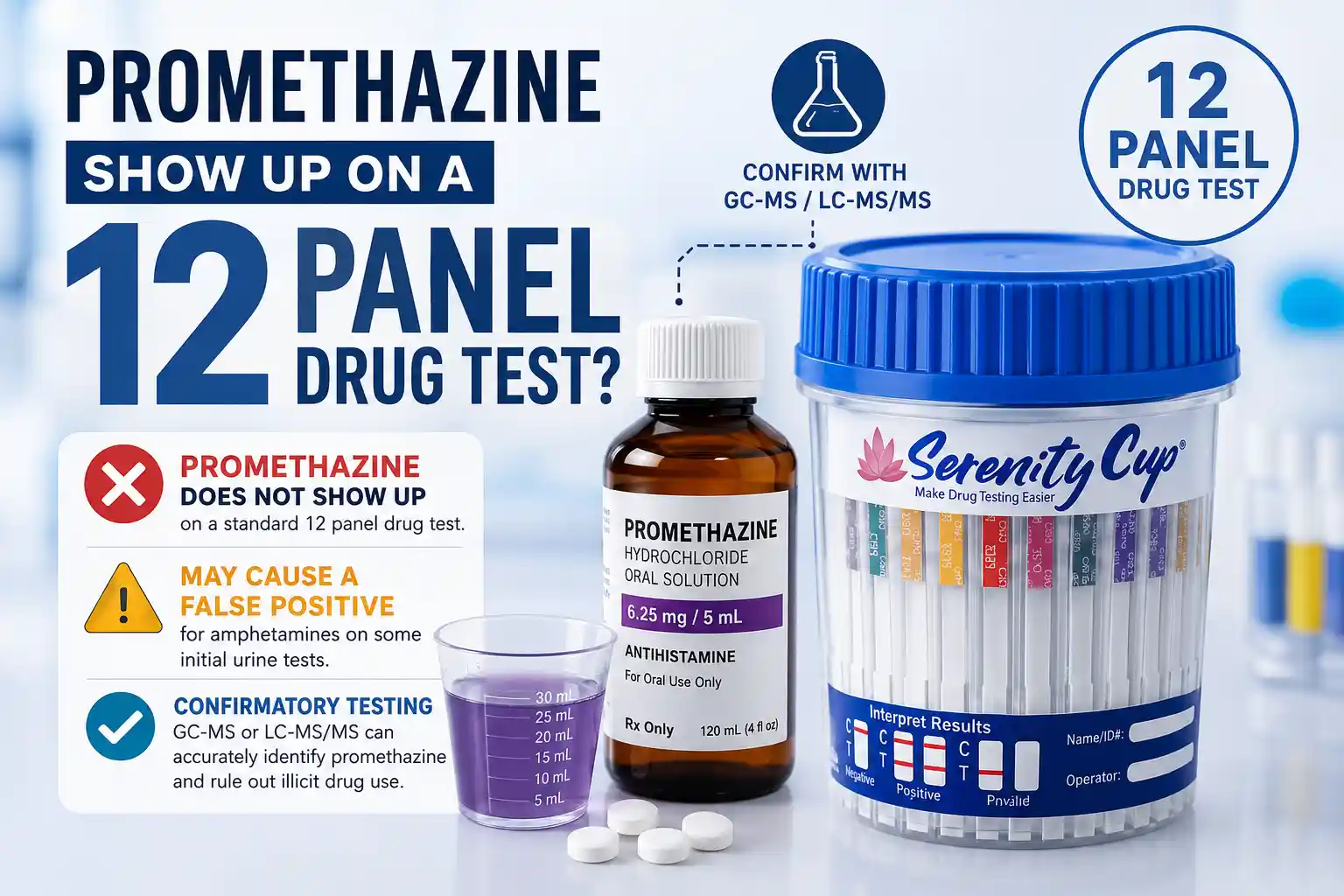
No, promethazine does not typically show up on a standard 12 panel drug test because it is not one of the drugs these screening panels are designed to detect. However, promethazine has been reported to cause a false positive for amphetamines on some initial urine immunoassay tests. If this happens, a confirmatory laboratory test such as gas chromatography-mass spectrometry (GC-MS) or liquid chromatography-tandem mass spectrometry (LC-MS/MS) can accurately identify promethazine and rule out illicit drug use.
What Is Promethazine?
Promethazine is a prescription antihistamine belonging to a group of medications called phenothiazines. Although it shares a chemical family with certain antipsychotic medications, promethazine is primarily prescribed to treat allergies, nausea, vomiting, motion sickness, and short-term insomnia caused by illness or medical procedures.
Healthcare providers may prescribe promethazine to help with:
- Seasonal allergies
- Motion sickness
- Nausea and vomiting
- Postoperative nausea
- Short-term sedation before medical procedures
- Severe itching caused by allergic reactions
The medication is available as tablets, oral syrup, suppositories, and injectable formulations. While the brand name Phenergan® was once widely recognized, generic promethazine is now the most common form prescribed.
Unlike opioids or stimulants, promethazine is not classified as a controlled substance in the United States when used alone. This distinction is important because standard workplace drug tests are generally designed to detect drugs with a higher potential for misuse rather than medications like promethazine.
Does Promethazine Show Up on a 12 Panel Drug Test?
For most people, the answer is no.
A standard 12 panel drug test not screen specifically for promethazine. Whether the test is performed for employment, pre-employment screening, healthcare, or workplace compliance, the laboratory is generally looking for common drugs of abuse—not prescription antihistamines.
That means taking promethazine exactly as prescribed will not normally produce a positive result because the medication itself is not included in the testing panel.
However, there is one important exception.
Some initial urine screening tests rely on a technology called an immunoassay, which identifies substances based on how certain antibodies react with drug metabolites. Because some promethazine metabolites share chemical similarities with amphetamine-related compounds, the medication can occasionally trigger a false positive amphetamine result during the preliminary screening.
Fortunately, laboratories rarely make final decisions based solely on an initial screening result. If a specimen produces a non-negative result, it is typically sent for confirmatory testing using highly specific analytical methods that distinguish promethazine from illegal substances.
In other words:
- Promethazine itself is not part of a standard 12-panel drug screen.
- A false positive is possible on some preliminary urine tests.
- Confirmatory laboratory testing can accurately identify the medication.
What Drugs Does a Standard 12 Panel Drug Test Detect?
Although testing panels can vary slightly between laboratories and employers, a typical 12 panel urine drug test screens for the following substances:
| Substance | Included in a Standard 12-Panel Test? |
| Amphetamines | Yes |
| Barbiturates | Yes |
| Benzodiazepines | Yes |
| Cocaine | Yes |
| Marijuana (THC) | Yes |
| Methadone | Yes |
| Opiates | Yes |
| Oxycodone | Yes |
| Phencyclidine (PCP) | Yes |
| Buprenorphine* | Often Included |
| Propoxyphene or Methaqualone* | May Be Included |
| MDMA or another expanded panel drug* | Depends on the laboratory |
| Promethazine | No |
*The exact drugs included in the final few positions may vary depending on the testing provider, employer requirements, or laboratory protocol.
The key takeaway is simple: promethazine is not a routine target of a standard 12-panel drug screen.
Why Doesn’t Promethazine Usually Show Up on a 12 Panel Drug Test?
The purpose of a 12-panel drug test is to identify substances that employers, healthcare providers, government agencies, or legal programs commonly monitor for safety or compliance reasons.
These tests are designed to detect drugs such as:
- Illegal stimulants
- Cocaine
- Marijuana
- Opioids
- Benzodiazepines
- Certain prescription medications with abuse potential
Promethazine does not belong to these categories.
Instead, it is an antihistamine with anti-nausea and sedative properties. While it can cause drowsiness, it does not produce the same laboratory markers that standard drug panels are built to detect.
Unless a physician, toxicologist, or investigator specifically requests a specialized toxicology analysis, most routine drug screens simply ignore promethazine.
This is why many people who take promethazine exactly as prescribed complete workplace or pre-employment drug testing without the medication appearing on their results.
Can Promethazine Cause a False Positive for Amphetamines?
Yes—but it is important to understand what that actually means.
A false positive occurs when an initial screening test incorrectly suggests that a prohibited drug is present even though the individual has not used that substance.
In the case of promethazine, research has shown that some urine immunoassay tests may mistakenly react to promethazine metabolites because they share certain structural characteristics with amphetamine-related compounds.
This does not mean that promethazine is an amphetamine or that your body converts it into amphetamine.
Instead, it reflects a limitation of certain rapid screening methods, which are intentionally designed to be highly sensitive. These tests quickly separate negative samples from specimens that require further laboratory analysis, but they are not intended to provide a final diagnosis.
Several factors can influence whether a false positive occurs, including:
- The specific immunoassay used by the laboratory
- The manufacturer’s testing technology
- Individual metabolism
- Recent medication use
- The concentration of promethazine metabolites in the urine
Most people taking promethazine never experience a false positive, but because the possibility exists, healthcare providers generally recommend informing the testing facility about any prescription medications before testing.
Immunoassay vs. GC-MS: Why Confirmatory Testing Matters
Understanding how drug testing works can help explain why a false positive doesn’t automatically mean someone has failed a drug test.
Step 1: Initial Immunoassay Screening
Most workplace urine drug tests begin with an immunoassay.
This rapid screening method uses antibodies to detect chemical patterns associated with specific drug classes. It is fast, cost-effective, and capable of screening large numbers of samples.
However, because it looks for similar chemical structures rather than identifying the exact compound, medications such as promethazine can occasionally trigger unexpected results.
Think of the immunoassay as a security checkpoint. If something appears suspicious, it doesn’t immediately conclude that a prohibited substance is present—it simply flags the sample for additional review.
Step 2: Confirmatory Laboratory Testing
If the initial screening produces a non-negative result, the specimen typically undergoes confirmatory testing using advanced laboratory methods such as:
- Gas Chromatography-Mass Spectrometry (GC-MS)
- Liquid Chromatography-Tandem Mass Spectrometry (LC-MS/MS)
Unlike immunoassays, these technologies identify the exact chemical compounds present in the sample.
This allows the laboratory to distinguish promethazine from amphetamines, methamphetamine, and other controlled substances with a very high degree of accuracy.
Simple Testing Process
Urine Sample Collected
Initial Immunoassay Screen
Negative Result → Testing Complete
OR
Non-Negative Result
GC-MS or LC-MS/MS Confirmation
Final Verified Laboratory Result
Because of this two-step process, a preliminary false positive does not automatically mean you have failed a drug test. Confirmatory testing is specifically designed to eliminate cross-reactivity and identify the actual substance present.
What Should You Do Before Taking a Drug Test?
If you’re taking promethazine under a valid prescription, there are a few simple steps you can take before your drug test to help prevent unnecessary confusion.
1. Tell the Testing Facility About Your Prescription
Before providing your urine sample, inform the collector or testing administrator that you’re taking promethazine. While the medication is not normally included in a standard 12-panel drug test, disclosing prescription medications gives the laboratory important context if an unexpected screening result occurs.
2. Bring Documentation if Available
Although it isn’t always required, it’s helpful to bring:
- Your current prescription bottle
- A copy of your prescription
- A note from your healthcare provider, if requested
This information can make the review process smoother if additional verification becomes necessary.
3. Understand the Role of the Medical Review Officer (MRO)
Many workplace and federally regulated drug testing programs use a Medical Review Officer (MRO)—a licensed physician trained to interpret drug test results.
If your initial screening is non-negative, the MRO may contact you to discuss any prescription medications you’re taking before reporting a verified result to your employer. This process helps distinguish legitimate prescription drug use from illicit substance use and reduces the likelihood of an incorrect final report.
Does Promethazine With Codeine Show Up on a Drug Test?
This is one of the most common points of confusion.
Promethazine by itself and promethazine with codeine are not the same medication from a drug-testing perspective.
Promethazine Alone
Promethazine is an antihistamine. It is not typically included in a standard 12-panel drug test, although it may occasionally contribute to a false positive for amphetamines during an initial immunoassay screen.
Promethazine With Codeine
When promethazine is combined with codeine, the situation changes.
Codeine is an opioid, and opioids are commonly included in workplace, clinical, and legal drug testing panels. Depending on the type of test used, the dosage, and how recently the medication was taken, codeine may produce a positive opioid result.
In other words:
| Medication | Standard 12-Panel Result |
| Promethazine only | Usually No |
| Promethazine with Codeine | Codeine may test positive as an opioid |
If you’re prescribed a cough syrup containing both ingredients, inform the testing facility beforehand so the laboratory can interpret the results correctly.
How Long Does Promethazine Stay in Your System?
Although a standard 12-panel drug test does not normally screen for promethazine, the medication can still remain in your body for several days.
The average elimination half-life of promethazine is approximately 10 to 19 hours. Since it generally takes several half-lives for a medication to be cleared from the body, small amounts may remain for a few days after your last dose.
If a healthcare provider orders specialized toxicology testing, approximate detection windows are:
| Test Type | Approximate Detection Window* |
| Urine | 2–4 days |
| Blood | Up to 24 hours |
| Saliva | 1–2 days |
| Hair | Up to 90 days (specialized testing only) |
*Detection times are estimates and vary depending on the testing method, dosage, frequency of use, metabolism, and individual health factors.
It’s important to understand that these detection windows do not mean a standard 12-panel drug test is looking for promethazine. They simply describe how long the medication may remain detectable if a laboratory specifically tests for it.
Factors That Affect How Long Promethazine Stays in Your Body
No two people eliminate medications at exactly the same rate. Several factors can influence how quickly promethazine leaves your system.
Dosage
Higher doses generally take longer for the body to eliminate than lower doses.
Frequency of Use
Someone taking promethazine regularly may retain detectable levels longer than someone who takes a single dose.
Metabolism
People with faster metabolic rates often process medications more quickly, while slower metabolism can extend elimination time.
Liver Function
Promethazine is primarily metabolized by the liver. Reduced liver function may slow the breakdown of the medication.
Age
Older adults may process certain medications more slowly because of normal age-related changes in liver and kidney function.
Overall Health
Hydration, body composition, and underlying medical conditions can all influence how medications are absorbed, metabolized, and eliminated.
Other Medications That Can Cause False Positives on Drug Tests
Promethazine isn’t the only medication that can occasionally interfere with an initial urine drug screen.
Certain prescription and over-the-counter medications have been reported to cause false positives because some immunoassays react to similar chemical structures.
| Medication | Possible False Positive* |
| Promethazine | Amphetamines |
| Pseudoephedrine | Amphetamines |
| Bupropion | Amphetamines |
| Diphenhydramine (Benadryl) | PCP (rare) |
| Dextromethorphan | PCP |
| Sertraline | Benzodiazepines (rare) |
*False positives are uncommon and depend on the testing method used. Confirmatory testing with GC-MS or LC-MS/MS can accurately identify the actual medication.
Key Takeaways
If you’re taking promethazine and have an upcoming drug test, remember these important points:
- Promethazine is not normally included in a standard 12-panel drug test.
- Some initial urine immunoassay screens may produce a false positive for amphetamines, but this is relatively uncommon.
- Confirmatory laboratory testing using GC-MS or LC-MS/MS can accurately distinguish promethazine from controlled substances.
- If you’re taking promethazine with codeine, the codeine component may be detected as an opioid, depending on the testing panel and detection window.
- Always disclose prescription medications before a drug test if requested by the testing program or Medical Review Officer.
Understanding how modern drug testing works can help reduce unnecessary stress and ensure that prescription medications are interpreted correctly.
Frequently Asked Questions
What does promethazine show up as on a drug test?
Promethazine itself is not usually included in a standard 12-panel drug test. However, on some preliminary urine immunoassay screenings, it may occasionally trigger a false positive for amphetamines. Confirmatory laboratory testing can identify the medication correctly.
Does promethazine show up on a 10-panel drug test?
No. Like a standard 12-panel test, a typical 10-panel drug test does not routinely screen for promethazine. Specialized toxicology testing is required to detect the medication directly.
Does promethazine show up on a 14-panel drug test?
Most 14-panel drug tests also do not specifically include promethazine. However, panel contents vary by laboratory, employer, and testing provider, so expanded panels may differ.
Can promethazine make you fail a urine drug test?
Not by itself. While promethazine is not one of the drugs a standard urine drug test is designed to detect, it may rarely cause a false positive during the initial screening. Confirmatory testing typically resolves the issue.
Does a DOT drug test screen for promethazine?
No. Standard U.S. Department of Transportation (DOT) drug testing does not include promethazine as one of its target substances. If you’re taking promethazine under a prescription, it’s still a good idea to disclose your medications if asked during the testing process.
Will GC-MS detect promethazine?
Yes. If a laboratory specifically analyzes a sample using GC-MS or LC-MS/MS, promethazine can be accurately identified. These methods are highly specific and are commonly used to confirm or rule out preliminary screening results.
Final Thoughts
For most people, the answer to “Does promethazine show up on a 12 panel drug test?” is reassuring: No, not under normal circumstances.
Because promethazine is not one of the substances included in standard 12-panel drug screening, taking the medication as prescribed is unlikely to produce a positive result. The primary exception is the possibility of a false positive for amphetamines during an initial immunoassay screen. Fortunately, today’s confirmatory laboratory methods are designed to distinguish promethazine from illicit drugs with a high degree of accuracy.
If you have an upcoming workplace, healthcare, or legal drug test, informing the testing provider about your prescription medications and keeping documentation available can help ensure your results are interpreted correctly.
Medical Disclaimer: This article is for educational purposes only and should not be considered medical or legal advice. Drug testing protocols vary by laboratory, employer, and jurisdiction. If you have questions about your prescription medications or drug test results, consult your healthcare provider, pharmacist, or the Medical Review Officer (MRO) responsible for reviewing your test.