Does Trazodone Show Up on a 12 Panel Drug Test?

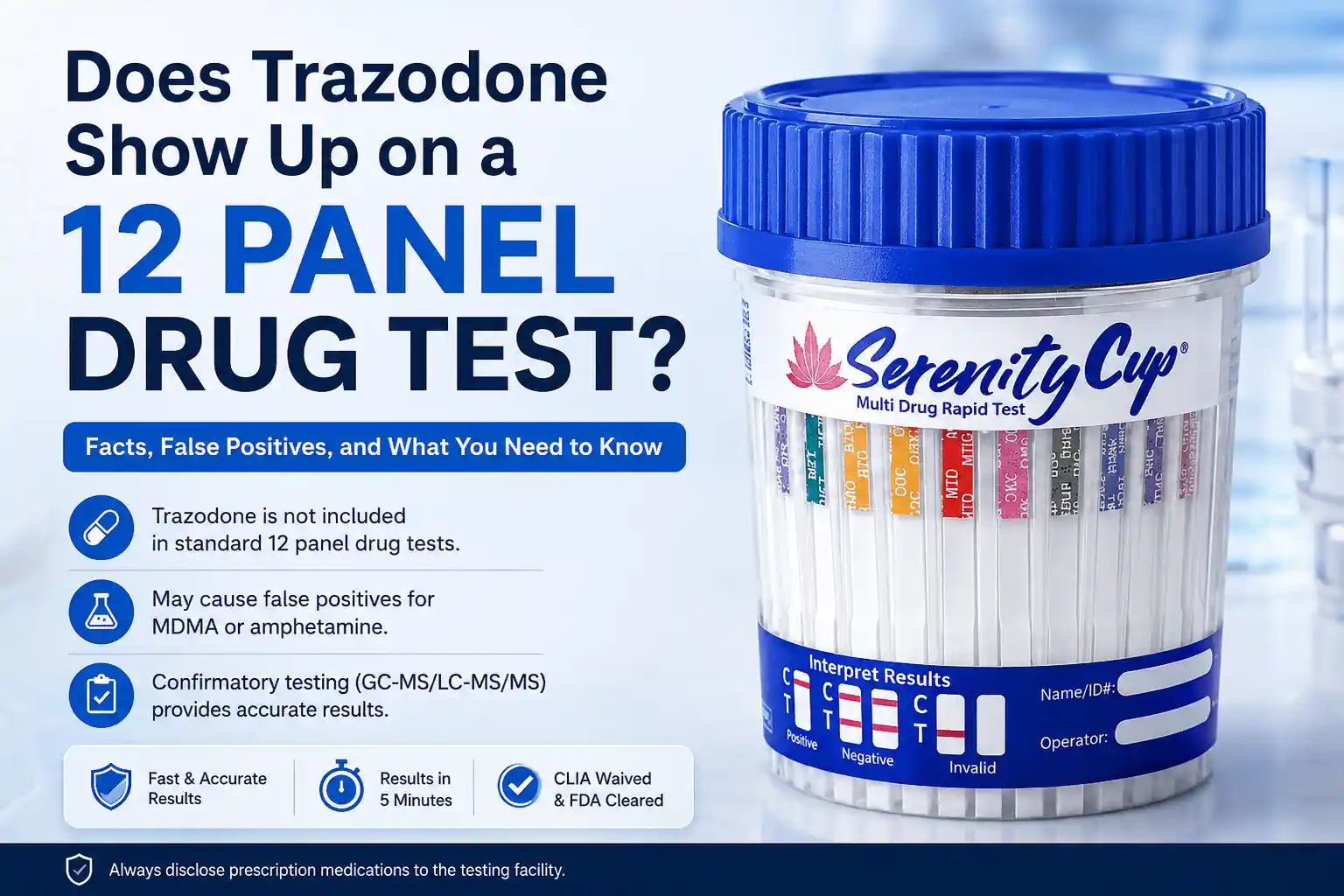
If you’re taking trazodone and have an upcoming workplace, DOT, probation, healthcare, or pre-employment drug test, it’s normal to wonder whether the medication will appear on a standard 12 panel drug test—or whether it could cause a false positive.
The short answer is no. A standard 12 panel urine drug test does not test for trazodone because it is a prescription antidepressant, not a drug of abuse typically included in routine screening panels. However, trazodone’s primary metabolite, meta-chlorophenylpiperazine (mCPP), has been reported to occasionally cross-react with certain immunoassay drug tests, which may lead to a false positive for amphetamine or MDMA (ecstasy). When this happens, a laboratory confirmation test using GC-MS or LC-MS/MS can accurately identify the substance and rule out a false positive.
This guide explains exactly how trazodone interacts with drug testing, why false positives can happen, which drugs a 12 panel test actually detects, and what to do if you’re taking trazodone before a drug screen.
Quick Answer
No, trazodone does not normally show up on a standard 12 panel drug test.
Most 12 panel drug tests are designed to detect commonly abused substances such as THC, cocaine, amphetamines, methamphetamine, opiates, PCP, benzodiazepines, barbiturates, oxycodone, methadone, buprenorphine, or MDMA depending on the panel configuration. Trazodone is not one of the drugs these panels are intended to detect.
However, there’s an important exception.
Some rapid urine immunoassay drug tests may mistakenly identify trazodone’s metabolite (mCPP) as MDMA or, less commonly, an amphetamine because of cross-reactivity. If an initial screening result is unexpectedly positive, laboratories routinely perform confirmatory testing using Gas Chromatography-Mass Spectrometry (GC-MS) or Liquid Chromatography-Tandem Mass Spectrometry (LC-MS/MS). These highly specific methods distinguish trazodone metabolites from illegal drugs and determine the correct result.
Key takeaway: Taking trazodone as prescribed should not cause you to fail a properly confirmed 12 panel drug test.
How a Standard 12 Panel Drug Test Works
A 12 panel drug test is a rapid screening tool used to detect the presence of selected drugs or their metabolites in urine. Employers, healthcare providers, rehabilitation centers, pain management clinics, correctional facilities, schools, and occupational health programs commonly use these tests because they provide results within minutes.
Most instant drug tests use an immunoassay. Instead of identifying the exact chemical compound, immunoassays use antibodies that recognize specific drug structures. This makes them fast and cost-effective, but it also explains why certain prescription medications can occasionally trigger false-positive screening results.
If a screening test is positive, especially in workplace or federally regulated testing, the specimen is typically sent to a certified laboratory for confirmatory analysis. Unlike immunoassays, confirmatory methods identify the exact molecular structure of a substance, virtually eliminating cross-reactivity.
What Drugs Does a Standard 12 Panel Drug Test Detect?
The exact drug menu varies slightly by manufacturer, laboratory, and intended use. Some panels replace one drug class with another or include fentanyl, buprenorphine, or MDMA.
A typical 12 panel urine drug test may screen for:
| Drug Class | Common Target |
|---|---|
| THC | Marijuana (Cannabis) |
| COC | Cocaine metabolites |
| AMP | Amphetamines |
| MET | Methamphetamine |
| OPI | Opiates (Morphine, Codeine, Heroin metabolites) |
| PCP | Phencyclidine |
| BZO | Benzodiazepines |
| BAR | Barbiturates |
| OXY | Oxycodone |
| MTD | Methadone |
| BUP | Buprenorphine |
| MDMA or another configured analyte | Ecstasy or manufacturer-specific drug |
Notice what’s missing: Trazodone is not included in standard 12 panel drug testing.
Because trazodone is prescribed to treat depression and insomnia rather than being classified as a controlled substance of abuse, routine employment and pre-employment drug tests generally do not look for it.
What Is Trazodone?
Trazodone is a prescription antidepressant that belongs to a class of medications known as serotonin antagonist and reuptake inhibitors (SARIs). It was originally approved to treat major depressive disorder, but healthcare providers also prescribe it frequently for insomnia, anxiety, and certain sleep disorders because of its sedating effects.
Common brand names include:
- Desyrel®
- Oleptro®
Unlike opioids, benzodiazepines, or stimulant medications, trazodone is not classified as a controlled substance in the United States. It has a relatively low potential for misuse compared with many medications used for sleep.
This is one of the primary reasons standard workplace drug tests are not designed to detect trazodone.
Why Trazodone Is Not Normally Included in Standard Drug Panels
Drug testing programs focus on substances that present workplace safety risks, have high misuse potential, or are required under federal or organizational policies.
Standard testing panels prioritize drugs such as:
- Marijuana (THC)
- Cocaine
- Opiates
- Amphetamines
- Methamphetamine
- PCP
- Benzodiazepines
- Barbiturates
- Methadone
- Oxycodone
- Buprenorphine
- MDMA (on some panels)
Since trazodone is prescribed as a therapeutic medication and is not routinely abused in the same way as these substances, laboratories generally do not include it in standard screening panels.
A healthcare provider or toxicologist could specifically order a laboratory assay for trazodone if clinically necessary, but this is different from a routine 12 panel drug screen.
Can Trazodone Cause a False Positive on a Drug Test?
Yes—but it’s much less common than many people think.
The concern isn’t that a 12 panel drug test detects trazodone directly. Instead, the issue involves cross-reactivity during the initial immunoassay screening.
When your body processes trazodone, it produces a metabolite called meta-chlorophenylpiperazine (mCPP).
Some older or highly sensitive immunoassay tests may recognize parts of the mCPP molecule as chemically similar to certain illicit drugs.
As a result, the screening device may incorrectly report:
- MDMA (Ecstasy)
- Amphetamines (less commonly)
- Rare reports involving LSD on certain assay platforms
These are called false positives, meaning the screening test reacts even though the person has not taken the illegal drug.
Fortunately, this is exactly why laboratories perform confirmatory testing before reporting verified positive results in regulated drug-testing programs.
Why the mCPP Metabolite Can Cross-React With Some Immunoassays
This is the science behind the confusion.
After you take trazodone, your liver—primarily through the CYP3A4 enzyme—breaks it down into several metabolites. One of these is meta-chlorophenylpiperazine (mCPP).
Immunoassays work by recognizing molecular patterns rather than identifying the exact chemical.
If two compounds share similar structural features, the antibody used in the screening test may bind to both.
That’s known as cross-reactivity.
Think of it like facial recognition software mistaking two people who have similar features. The software detects enough similarities to make an incorrect match.
The same principle explains why some prescription medications occasionally produce false-positive screening results.
This limitation affects screening tests only—not confirmatory laboratory testing.
Can Trazodone Cause False Positives for Amphetamine or MDMA?
Research and clinical reports have shown that MDMA (Ecstasy) is the drug most commonly associated with trazodone-related false positives.
Some immunoassays have also reported occasional false-positive results for:
- Amphetamines
- LSD (rarely on certain testing platforms)
The likelihood depends on several factors, including:
- The specific immunoassay manufacturer
- The assay antibodies used
- Individual metabolism
- Trazodone dosage
- Concentration of mCPP in the urine
- Laboratory cutoff levels
Importantly, not every urine drug test behaves the same way. Different manufacturers use different antibodies and detection technologies, so one test may show cross-reactivity while another does not.
This is one reason healthcare professionals never rely solely on an initial screening result when important legal, employment, or medical decisions are involved.
How GC-MS or LC-MS/MS Confirms the Correct Result
If an immunoassay produces an unexpected positive result, the specimen doesn’t automatically mean someone used an illegal drug.
Instead, certified laboratories perform confirmatory testing using highly specific analytical instruments such as:
- Gas Chromatography-Mass Spectrometry (GC-MS)
- Liquid Chromatography-Tandem Mass Spectrometry (LC-MS/MS)
Unlike screening tests, these methods identify the exact chemical compounds present in the urine.
That means they can distinguish:
- Trazodone
- mCPP
- Amphetamine
- Methamphetamine
- MDMA
- Other prescription medications
- Illicit substances
Because these technologies measure unique molecular fingerprints, they virtually eliminate false positives caused by cross-reactivity.
For workplace, federal, and many clinical drug-testing programs, confirmed laboratory results—not the initial screening result—are considered the final determination.