Drug Testing Program: A Practical Guide to Administration and Compliance

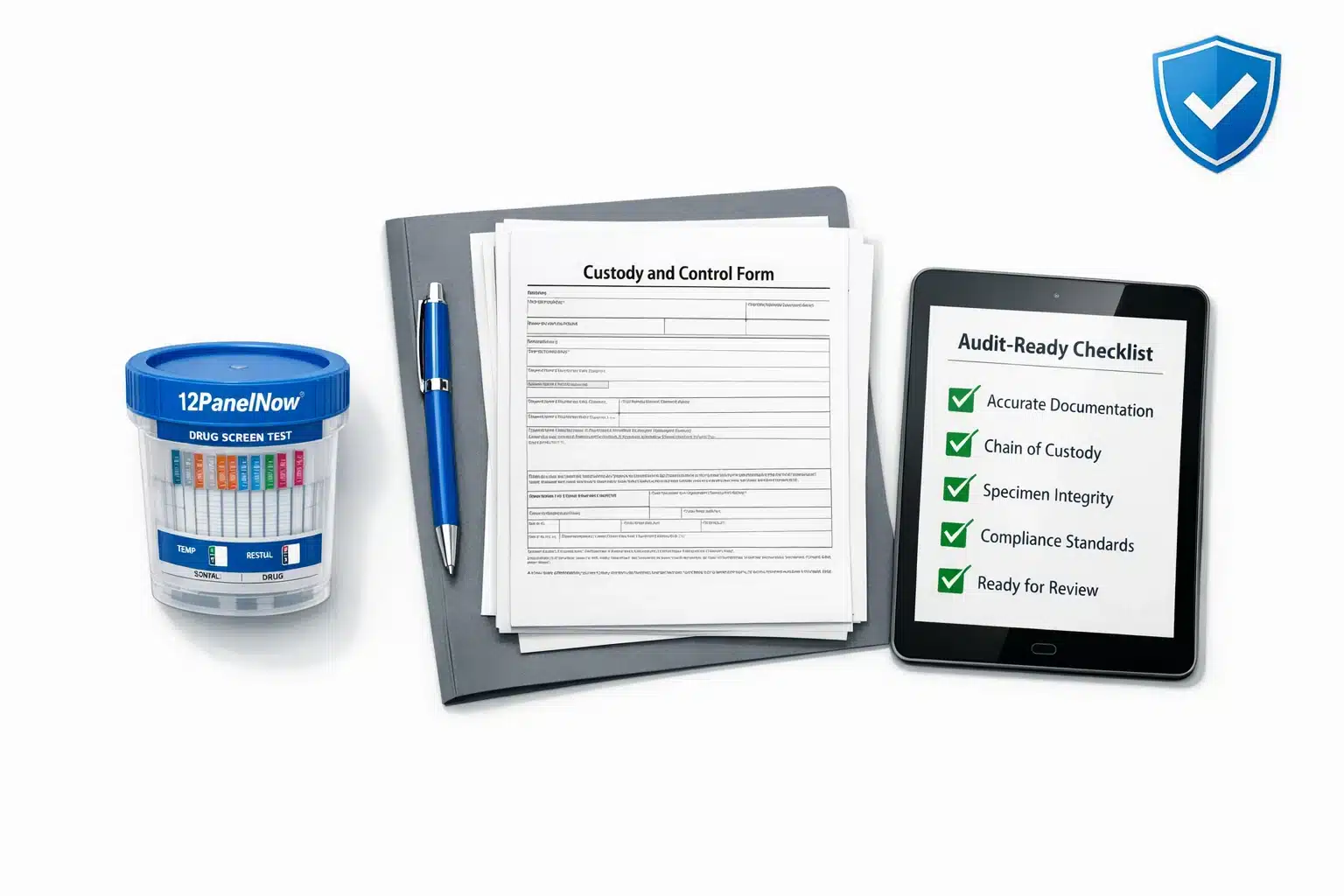
The most common FMCSA violation isn’t a failed drug test. It’s a missing document. Simple recordkeeping gaps, like an expired random pool list or a misplaced Custody and Control Form (CCF), can trigger fines exceeding $16,000 per violation. This reveals a critical truth: the success of a drug testing program has less to do with the test itself and more to do with the system you build around it.
This guide moves past the basics of what a drug test is. Instead, it provides a framework for program administration that withstands audits, minimizes hidden costs, and functions efficiently. We’ll cover the core pillars of a defensible program: vendor selection, specimen choice, and recordkeeping.
What Is a Drug Testing Program?
A drug testing program is a structured process used by employers to administer workplace drug testing consistently throughout the employee lifecycle. Depending on organisational policies and regulatory requirements, a program may include pre-employment screening, random testing, post-accident testing, reasonable suspicion testing, return-to-duty testing, and follow-up testing.
An effective drug testing program establishes standard operating procedures for specimen collection, laboratory analysis, Medical Review Officer (MRO) review, record retention, policy enforcement, and regulatory compliance. Rather than treating each drug test as an isolated event, successful organisations manage testing through documented workflows that improve efficiency while supporting legally defensible employment decisions.
Why Drug Testing Program Administration Matters
Many organisations focus primarily on the cost of drug testing supplies while overlooking the administrative processes that determine long-term program success. Delayed collections, incomplete documentation, inconsistent procedures, and inadequate recordkeeping often create greater operational costs than the tests themselves.
Well-managed drug testing programs reduce workplace risk, improve audit readiness, strengthen regulatory compliance, minimise administrative delays, and create a more consistent experience for applicants, employees, supervisors, and human resources teams. Investing in program administration often delivers greater operational value than focusing solely on the cost of individual tests.
The real cost is in logistics, not supplies
When budgeting for a drug testing program, it’s easy to focus on the price per test. But the most significant expenses are often hidden in logistical friction and administrative downtime.
Consider the “shy bladder” tax. Industry analysis shows that up to 10% of all urine collections encounter a “shy bladder” protocol. This isn’t just an inconvenience; it triggers a mandatory observation period that results in an average three-hour delay before the employee can return to work. For a single employee, that’s half a day of lost productivity. Across a large workforce, these delays create a substantial financial drag.
Effective program management is about identifying and mitigating these operational costs. It starts with choosing the right partners who can streamline your process, not complicate it.
Understanding the Total Cost of a Drug Testing Program
A comprehensive drug testing program should be evaluated using both direct and indirect costs. Direct costs include testing supplies, laboratory services, Medical Review Officer review, and collection fees. Indirect costs often include employee downtime, supervisor time, travel expenses, administrative labour, onboarding delays, and compliance risks associated with incomplete documentation.
Organisations that continuously monitor these performance indicators often discover opportunities to improve efficiency through better vendor management, electronic reporting, centralised administration, and optimised collection site networks.
Selecting vendors: building your compliance shield
Your drug testing program is only as strong as its weakest link. Your key vendors, the Medical Review Officer (MRO) and collection site network, are your first line of defense. Making the right choice here often comes down to evaluating a local clinic against a more structured Consortium/Third-Party Administrator (C/TPA).
How to select a qualified Medical Review Officer (MRO)
An MRO is a licensed physician who acts as an independent and impartial gatekeeper. They are responsible for reviewing laboratory results and evaluating whether a legitimate medical explanation exists for a non-negative finding.
Their independence is non-negotiable. A major compliance red flag is an MRO who has a financial relationship with your testing laboratory. You must also verify their process for handling sensitive employee health information under HIPAA and their understanding of DOT 49 CFR Part 40 procedures.

Working with a Consortium/Third-Party Administrator (C/TPA)
Many employers rely on a Consortium/Third-Party Administrator (C/TPA) to coordinate their drug testing program. A C/TPA can manage random testing selections, collection site scheduling, regulatory reporting, vendor coordination, laboratory communication, and documentation while helping employers maintain compliance with applicable testing requirements.
For organisations with multiple locations or distributed workforces, centralising administration through a qualified C/TPA often improves consistency, reduces administrative workload, and simplifies audit preparation.
Optimizing your drug test collection site network
For companies with employees in multiple states or rural areas, a patchwork of local clinics can create logistical nightmares. One site may be fast and efficient, while another has long wait times and inconsistent protocols. This lack of standardization introduces risk and inefficiency.
When evaluating a collection partner or network, look beyond a pin on a map. Demand clear service-level agreements (SLAs) for wait times, collector certification, and protocol consistency. A strong network ensures every employee has the same professional and timely experience, no matter where they are located.

The modern specimen transition: aligning testing with 2026 realities
For decades, urine testing was the default standard. While effective and affordable, particularly with comprehensive multi-panel cups, the modern workplace presents new challenges that require a more nuanced approach.
The “cannabis paradox” is a prime example. In states where cannabis is legal, employers face a dilemma: how to maintain a safe workplace by testing for impairment without penalizing employees for legal, off-duty use days or weeks prior.
This is why the DOT’s 2025 final rule, which fully authorized oral fluid testing, was so significant. Oral fluid detects recent use, typically within the last 12-24 hours. This shorter detection window more closely aligns with identifying potential impairment on the job, offering a solution to the legal gray area of prior use.

Choosing the right specimen depends on your goal:
- For pre-employment screening: Traditional urine tests provide a broad detection window that is cost-effective and reliable.
- For post-accident or reasonable suspicion testing: Oral fluid testing is often the superior choice. The collection is non-invasive, can be observed without privacy concerns, and directly addresses the question of recent use. It also completely eliminates shy bladder delays.
Understanding Oral Fluid vs. Urine Drug Testing
Urine drug testing remains one of the most widely used workplace testing methods because of its established laboratory infrastructure, broad detection window, and cost-effectiveness for high-volume screening programs. Urine specimens detect drug metabolites that may remain in the body for several days or longer, making them particularly suitable for pre-employment drug testing.
Oral fluid drug testing identifies the parent drug rather than metabolites, providing a shorter detection window that more closely reflects recent drug use. Collection is typically observed without compromising employee privacy, reducing opportunities for specimen substitution while eliminating many collection delays associated with traditional urine testing.
Many employers now adopt a hybrid approach by combining urine and oral fluid testing within the same drug testing program. This strategy allows organisations to align specimen selection with the specific purpose of each testing event while maintaining operational flexibility.
Laboratory Confirmation and Testing Accuracy
Every professionally administered drug testing program should distinguish between initial screening and laboratory confirmation. Rapid screening methods provide preliminary results, but any non-negative finding should be confirmed using highly specific laboratory technologies before employment decisions are made.
Initial testing commonly relies on immunoassay screening to identify potential drug classes quickly. When additional verification is required, laboratories perform confirmatory analysis using Gas Chromatography-Mass Spectrometry (GC-MS) or Liquid Chromatography-Tandem Mass Spectrometry (LC-MS/MS). These methods provide highly accurate identification of individual compounds while significantly reducing the likelihood of false-positive results.
Using accredited laboratories that follow recognised quality standards strengthens the integrity of a drug testing program while supporting regulatory compliance and defensible workplace decisions.
Protecting Specimen Integrity Through Chain of Custody
Every specimen collected as part of a drug testing program should be accompanied by documented chain of custody procedures. Chain of custody establishes who collected, transported, received, analysed, and reported the specimen throughout the testing process, preserving specimen integrity and supporting legally defensible results.
Electronic Custody and Control Forms (eCCFs) are becoming increasingly common because they reduce paperwork, minimise transcription errors, improve reporting speed, and simplify compliance documentation. Regardless of whether paper or electronic forms are used, maintaining complete documentation remains one of the most important responsibilities within a workplace drug testing program.
Building an audit-ready recordkeeping system
A drug testing program that isn’t documented is a program that doesn’t exist in the eyes of an auditor. Translating dense regulations from DOT 49 CFR Part 40 into an operational checklist is the key to compliance.
The most common recordkeeping failures stem from confusion over retention periods. Your files should be organized and maintained according to these federally mandated timelines:
- Negative test results: Must be kept for a minimum of one year.
- Positive test results and refusal-to-test documentation: Must be kept for a minimum of five years.
- SAP process records for return-to-duty: Must be kept for five years.
- Random testing pool records: Must be kept for the current and previous year to demonstrate proper selection rates.
Every single test, positive or negative, must have a corresponding, fully completed CCF. This is the foundational document of the entire testing process.

Electronic Recordkeeping and Compliance
Many modern drug testing programs use secure digital record management systems to centralise laboratory reports, Medical Review Officer determinations, Custody and Control Forms, random testing selections, policy acknowledgements, and training documentation. Electronic systems improve administrative efficiency while providing faster access during audits or compliance reviews.
Employers should establish written procedures governing document retention, authorised access, secure storage, data backups, and record disposal. Protecting confidential employee information is an essential component of responsible drug testing program administration.
Preparing for a Drug Testing Audit
Successful audits begin long before an inspector arrives. Organisations should periodically review their written drug testing policies, vendor agreements, collection procedures, laboratory reports, Medical Review Officer documentation, and record retention practices to identify potential compliance gaps before they become regulatory violations.
Internal compliance reviews should also verify that random testing pools remain current, collection sites continue to meet service expectations, employee notifications are documented appropriately, and supervisors receive ongoing training regarding reasonable suspicion procedures and workplace documentation requirements.
Developing a routine internal audit process helps organisations continuously improve their drug testing program while reducing the likelihood of costly enforcement actions or administrative deficiencies.
Protecting Employee Privacy and Confidentiality
Drug testing records frequently contain sensitive medical information and should be handled with appropriate confidentiality. Access should be limited to authorised personnel responsible for administering the drug testing program, and records should be stored securely in accordance with applicable privacy requirements and organisational policies.
Employers working with Medical Review Officers, laboratories, and Consortium/Third-Party Administrators should also confirm that vendors maintain appropriate privacy safeguards and secure communication procedures for transmitting confidential testing information.
DOT and Non-DOT Program Administration
Although many administrative best practices apply across all workplaces, DOT-regulated employers must comply with detailed federal requirements governing specimen collection, laboratory certification, Medical Review Officer review, reporting procedures, and record retention.
Non-DOT employers generally have greater flexibility when designing workplace drug testing programs but should still establish consistent written procedures that comply with state employment laws, industry best practices, and organisational safety objectives. Aligning non-DOT procedures with recognised compliance standards often improves consistency while simplifying long-term program administration.
Common Drug Testing Program Mistakes
Even organisations with well-established workplace drug testing procedures can encounter compliance issues if their drug testing program is not regularly reviewed and updated. Identifying and correcting common administrative mistakes helps improve operational efficiency while reducing regulatory risk.
One of the most common mistakes is relying solely on pre-employment testing while neglecting random, post-accident, or reasonable suspicion testing. A comprehensive drug testing program should address workplace risks throughout the employee lifecycle rather than focusing exclusively on hiring.
Another frequent issue is inconsistent application of company policies. Employees in similar roles should be subject to the same testing procedures and documentation standards to ensure fairness and reduce the risk of employment disputes.
Employers should also avoid outdated testing panels that fail to reflect current workplace risks, evolving drug trends, or changes in federal and state regulations. Periodic policy reviews help ensure the program remains relevant and legally compliant.
Administrative errors—including incomplete Custody and Control Forms (CCFs), poor record retention, missed random selections, and inadequate supervisor training—can create compliance issues even when laboratory testing is performed correctly. Routine internal audits and documented quality assurance procedures help minimise these risks.
Choosing the Right Drug Testing Supplies
Selecting reliable drug testing supplies is an important component of an effective drug testing program. Testing devices should align with workplace policies, laboratory requirements, specimen collection procedures, and applicable regulatory standards.
Many employers utilise a combination of urine drug test cups, multi-panel dip cards, oral fluid drug tests, specimen collection kits, adulteration detection products, and electronic or paper Custody and Control Forms depending on the testing scenario. Choosing the appropriate products improves collection efficiency while supporting accurate and consistent results.
When evaluating suppliers, organisations should consider product quality, regulatory compliance, inventory availability, technical support, and nationwide distribution capabilities. Working with an experienced supplier helps ensure testing materials remain readily available whenever pre-employment, random, post-accident, or reasonable suspicion testing is required.
Proper storage, routine inventory management, and monitoring product expiration dates further support consistent testing performance while reducing unnecessary waste and operational delays.
Your path to a compliant, efficient program
Running a drug testing program is a major responsibility, but it doesn’t have to be a major burden. By focusing on the three pillars of smart vendor management, strategic specimen selection, and disciplined recordkeeping, you can build a system that protects your workplace and stands up to scrutiny.
At 12 Panel Now, we focus on providing reliable and affordable drug testing supplies so you can focus on the bigger picture. Our expertise helps organizations like yours architect programs that are both compliant and efficient.
If you are re-evaluating your testing methods or supply chain, contact our specialists to discuss how our CLIA-waived and FDA-approved products can fit into your streamlined process.