How Long Does Tizanidine Show Up on a Drug Test?


Quick Answer
Tizanidine, commonly sold under the brand name Zanaflex, is a prescription muscle relaxant used to treat muscle spasms and spasticity. It has a relatively short plasma half-life of about 2.5 hours, but that does not mean a drug test can only detect it for 2.5 hours. Tizanidine is extensively metabolized in the liver, and its metabolites can remain in the body considerably longer.
Most routine workplace drug screens do not specifically test for tizanidine. For example, federal workplace testing uses an authorized panel of specified drug classes rather than screening for every prescription medication. Tizanidine is not one of those standard federally authorized drug categories.
A specialized laboratory test can be designed to look specifically for tizanidine or its metabolites. Therefore, the answer to “how long does tizanidine show up on a drug test?” depends on the specimen, laboratory method, analyte being measured, cutoff, dose, frequency of use, and individual metabolism.
Important: There is no single guaranteed number of days that applies to every tizanidine drug test. The time the medication remains in the body and the time a particular test can detect it are not the same thing.
Does Tizanidine Show Up on a Drug Test?
Usually, tizanidine does not show up on a routine standard drug panel unless the test is specifically designed to detect it.
Tizanidine is a skeletal muscle relaxant and centrally acting medication, not one of the drug classes routinely targeted by common workplace screening panels. The U.S. federal workplace program, for example, specifies particular drug categories for testing rather than automatically testing for all prescription medications.
This distinction is important because the phrase “drug test” can refer to very different types of testing.
A routine urine drug screen may look for a predefined group of substances, while a clinical or forensic laboratory can order a targeted test for a specific medication.
Therefore:
- Standard drug panel: Usually does not include tizanidine.
- 5-panel or similar workplace screen: Tizanidine is not normally included.
- Expanded panel: Depends on the exact substances included by the laboratory or manufacturer.
- Specialized laboratory test: Can be designed to identify tizanidine or its metabolites.
- Confirmatory testing: Uses a more specific analytical method when a particular substance needs to be identified.
The exact panel matters more than the number of drugs in the panel.
How Long Does Tizanidine Show Up on a Drug Test?
There is no universally established detection window for tizanidine that applies to every drug-testing method.
This is because pharmacokinetic elimination and laboratory detection are different measurements. A medication may be largely eliminated from the bloodstream while a sensitive laboratory method can still identify the drug or a metabolite.
Tizanidine has a plasma half-life of approximately 2.5 hours. About 95% of an administered dose is metabolized, primarily through the CYP1A2 pathway. Its metabolites are not known to be active and have reported half-lives ranging from approximately 20 to 40 hours.
As a result, you should not interpret the 2.5-hour half-life as meaning that tizanidine will automatically be absent from every specimen after a few hours.
Tizanidine Detection by Test Type
| Test type | What it means for tizanidine |
|---|---|
| Urine test | A specialized laboratory assay may be able to identify tizanidine or related analytes after use. The window varies according to the analytical method, cutoff, dose, and individual factors. |
| Blood test | Blood testing generally reflects more recent exposure because concentrations decline relatively quickly after dosing. |
| Saliva/oral fluid test | Detection depends heavily on whether the laboratory specifically includes tizanidine and which analytical method is used. |
| Hair test | Hair testing can provide a much longer retrospective window for some drugs, but it is not a routine method for detecting tizanidine. |
| Standard workplace panel | Tizanidine is generally not part of the routine federally authorized drug categories. |
These categories should not be interpreted as guaranteed detection periods. A laboratory’s test design, cutoff concentration, specimen type, and target analyte determine whether a result can be reported.
How Long Does Tizanidine Stay in Your System?
Tizanidine has a relatively short half-life of about 2.5 hours. A drug’s half-life is the approximate amount of time required for its concentration in the body to decrease by half.
However, half-life is not the same as complete elimination.
Tizanidine undergoes extensive first-pass metabolism, with approximately 95% of an administered dose being metabolized. The drug is primarily metabolized by the CYP1A2 enzyme, while its metabolites have longer half-lives of approximately 20 to 40 hours.
This explains why statements such as “tizanidine only lasts a few hours” can be misleading when someone is asking about drug testing.
Half-Life vs. Detection Window
These terms describe different things:
Half-life:
How quickly the concentration of the drug decreases in the body.
Elimination:
How the body metabolizes and removes the medication and its metabolites.
Detection window:
How long a particular testing method can identify a drug or metabolite above its analytical cutoff.
Duration of effects:
How long a person experiences the medication’s noticeable effects.
These time periods can be different.
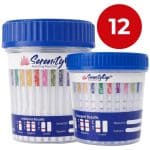
Does Tizanidine Show Up on a 12-Panel Drug Test?
Usually, no. Tizanidine is not normally included in a standard 12-panel drug test.
However, “12-panel” describes the number of substances or drug classes being screened, not one universal list that is identical across every manufacturer, laboratory, employer, or testing program.
That means two different 12-panel tests can contain different analytes.
A typical multi-panel urine drug test is designed to screen for specific drug classes such as amphetamines, cocaine, opioids, benzodiazepines, THC, or other substances depending on the product configuration. Tizanidine is not automatically added simply because a test contains 12 panels.
For an exact answer, check the panel configuration and package insert for the test being used.
If the listed analytes do not include tizanidine, a routine 12-panel screen should not be interpreted as a targeted tizanidine test.
Does Tizanidine Show Up on a 10-Panel Drug Test?
Generally, tizanidine is not included in a standard 10-panel drug screen.
A 10-panel test is designed to detect a specified group of drugs or drug classes. It does not automatically screen for every prescription medication.
The same principle applies to other multi-panel tests:
The number of panels does not tell you whether tizanidine is included. The actual analyte list does.
This is particularly important because different manufacturers can offer different configurations under similar panel names.
Does Tizanidine Show Up on a 5-Panel Drug Test?
A standard 5-panel workplace drug test does not normally test for tizanidine.
Federal workplace drug testing programs use defined drug categories rather than testing for every medication a person may be taking. SAMHSA’s current workplace testing resources identify the authorized drug categories used under the federal program.
Therefore, taking prescribed tizanidine does not normally cause a standard 5-panel test to become a tizanidine test.
However, an employer, healthcare provider, court, or laboratory can order additional testing when there is a specific reason to identify another medication or substance.
Why Isn’t Tizanidine Included in Most Standard Drug Tests?
Routine drug tests are not designed to detect every chemical present in a person’s body.
Instead, laboratories use predefined panels containing specific target analytes. The test is designed around those substances, their metabolites, and the relevant cutoff concentrations.
Tizanidine is a prescription muscle relaxant, so it is outside the drug classes commonly targeted by standard workplace panels.
This is why someone can take a legitimate prescription medication and still receive a negative result on a routine drug screen.
A negative standard panel does not necessarily mean that no medication is present in the body. It means the substances targeted by that particular test were not detected at or above the applicable reporting threshold.
What Is Tizanidine?
Tizanidine is a prescription medication used to relieve muscle spasms, cramping, and muscle tightness associated with conditions such as multiple sclerosis and spinal injuries. It belongs to the class of skeletal muscle relaxants and works through the central nervous system to reduce excessive muscle activity.
Tizanidine is also known by its brand name Zanaflex.
Because it is a prescription medication, people sometimes worry that taking it could cause a positive result during employment, probation, medical, or other drug testing.
The important distinction is that being a prescription medication does not automatically mean it is included in a standard drug panel.
Tizanidine Half-Life and Drug Testing
The FDA-approved prescribing information reports a tizanidine half-life of approximately 2.5 hours. Approximately 95% of the administered dose is metabolized, primarily through CYP1A2.
The same prescribing information reports that tizanidine metabolites are not known to be active and have half-lives ranging from approximately 20 to 40 hours. Approximately 60% of total radioactivity following radiolabeled tizanidine administration was recovered in urine, while approximately 20% was recovered in feces.
These pharmacokinetic facts help explain why “half-life” should not be presented as a guaranteed drug-test detection window.
A sensitive laboratory assay may target the parent drug, a metabolite, or another analytical marker depending on the test.
What Factors Affect How Long Tizanidine May Be Detectable?
Several factors can influence how quickly tizanidine is processed and how long it may remain measurable.
Dose and Frequency
A single dose and repeated doses do not necessarily produce the same exposure pattern.
Higher or repeated dosing can increase the amount of medication present in the body and may influence how long it takes concentrations to decline.
Liver Function
Tizanidine undergoes extensive hepatic metabolism. The prescribing information identifies CYP1A2 as the primary cytochrome P450 enzyme involved in its metabolism.
Changes in liver function can therefore affect how the medication is processed.
Kidney Function
Kidney function can also matter because metabolites and drug-related material are eliminated through the kidneys.
People with significant renal impairment may require different dosing and closer medical monitoring.
Age
Older adults can have changes in kidney and liver function that affect medication clearance.
The appropriate tizanidine dose should therefore be determined by a healthcare professional rather than adjusted based on a drug-test concern.
Drug Interactions
Some medications can substantially increase tizanidine exposure.
The prescribing information specifically warns about strong CYP1A2 inhibitors such as fluvoxamine and ciprofloxacin. In clinical pharmacokinetic studies, these medications substantially increased tizanidine concentrations and prolonged its half-life.
This is one reason patients should tell their healthcare professional about all prescription drugs, over-the-counter medications, and supplements they use.
Can Tizanidine Cause a False Positive Drug Test?
A standard drug screen is designed to detect specific substances or drug classes, so tizanidine is not expected to simply appear as a positive result for an unrelated drug class because it is present in the body.
However, unexpected screening results should not be interpreted solely from a preliminary immunoassay.
When a result has significant employment, legal, medical, or other consequences, confirmatory laboratory testing may be used to identify the specific substance with a more selective analytical method.
If you receive an unexpected positive result while taking prescribed medications, provide the testing provider or medical review officer with an accurate list of your medications.
Do not stop a prescribed medication solely because you are concerned about a drug test without first speaking with the prescribing healthcare professional.
Can You Flush Tizanidine Out of Your System?
No reliable method can guarantee that tizanidine will leave the body faster or make a drug test negative.
Drinking excessive amounts of water, using “detox” products, exercising intensely, or changing urine chemistry does not provide a dependable way to control a laboratory drug-test result.
The body processes tizanidine through normal metabolic and elimination pathways. The prescribing information identifies extensive metabolism and subsequent excretion of drug-related material.
Excessive water consumption can also be dangerous and can cause electrolyte disturbances.
If you take tizanidine as prescribed, the appropriate approach is to continue following your healthcare professional’s instructions and disclose the medication when relevant to the testing process.
Is Tizanidine a Controlled Substance?
Tizanidine is a prescription muscle relaxant, but it is not a federally controlled substance in the United States.
That does not mean it is appropriate to misuse or combine it with other sedating substances. Tizanidine can cause drowsiness, dizziness, and low blood pressure, and medication interactions can increase adverse effects.
MedlinePlus identifies tizanidine as a skeletal muscle relaxant used to relieve muscle spasms and tightness.
Can Muscle Relaxers Show Up on a Drug Test?
Some people assume that all muscle relaxants will automatically appear on a drug screen. That is not how drug panels work.
A drug test only reports substances that its methodology is designed to identify.
Different muscle relaxants can have different chemical structures and may or may not be included in specialized testing.
Therefore, the answer depends on:
- Which muscle relaxant is being taken
- Which drug panel is being used
- Which analytes the laboratory targets
- Whether the test is a screening or confirmatory assay
- The laboratory’s cutoff and analytical method
For tizanidine specifically, routine workplace panels generally do not target it.
What Should You Do If You Take Tizanidine Before a Drug Test?
If tizanidine was legitimately prescribed to you, you generally should not discontinue it just to prepare for a drug test.
Instead:
- Take the medication exactly as prescribed.
- Do not change your dose without medical advice.
- Keep a current list of prescription medications.
- Tell the appropriate healthcare or testing professional about prescribed medications when asked.
- Ask which substances the test actually screens for if you need clarification.
- If a result is unexpected, ask whether confirmatory testing is appropriate.
The exact procedure can vary depending on whether the test is for employment, medical care, probation, sports, or another purpose.
Bottom Line: How Long Does Tizanidine Show Up on a Drug Test?
Tizanidine has a short plasma half-life of approximately 2.5 hours, but that number should not be treated as a guaranteed drug-test detection period. The medication is extensively metabolized, and its metabolites have longer half-lives.
Most standard workplace drug panels do not specifically test for tizanidine. A 5-panel, 10-panel, or 12-panel test should not be assumed to include tizanidine simply because it has a certain number of panels. The actual analyte list determines what the test can detect.
A specialized laboratory assay can be designed to identify tizanidine or related analytes, and its detection window depends on the specimen, analytical method, cutoff, dose, frequency of use, and individual factors.
The key takeaway is simple: how long tizanidine stays in your body is not the same as how long a particular drug test can detect it.
Frequently Asked Questions
How long does tizanidine show up in a urine test?
There is no single universally applicable urine detection window for tizanidine. A specialized laboratory test may identify tizanidine or related analytes, but the result depends on the assay, cutoff, specimen, dose, frequency of use, and individual metabolism. Tizanidine has a plasma half-life of approximately 2.5 hours, while its metabolites have longer half-lives.
Does tizanidine show up on a 12-panel drug test?
Usually not. Tizanidine is not normally included in standard 12-panel drug testing. However, 12-panel configurations vary between manufacturers and laboratories, so the test’s specific analyte list should always be checked.
Does tizanidine show up on a 10-panel drug test?
Tizanidine is generally not included in a standard 10-panel drug screen. A 10-panel label does not mean that every prescription medication is tested.
Does tizanidine show up on a 5-panel drug test?
A standard 5-panel workplace drug test does not normally target tizanidine. Federal workplace testing uses specific authorized drug categories rather than screening for every prescription medication.
Does Zanaflex show up on a drug test?
Zanaflex is a brand name for tizanidine. Because routine drug panels generally do not target tizanidine, Zanaflex is not normally detected by a standard workplace drug screen. A specialized test can be designed to identify it.
How long does 4 mg of tizanidine stay in your system?
A 4 mg dose does not have a universal “drug-test expiration time.” Tizanidine has a half-life of approximately 2.5 hours, but individual clearance and laboratory detection can vary. Drug interactions, kidney function, liver function, dose, and frequency of use can influence exposure.
How long does 2 mg of tizanidine stay in your system?
The same pharmacokinetic principles apply to a 2 mg dose. Tizanidine has a short half-life, but the time a test can detect a substance depends on the specific testing method rather than dose alone.
Can a drug test specifically detect tizanidine?
Yes. A laboratory can use a targeted analytical method to look specifically for tizanidine or its metabolites. This is different from a routine multi-panel drug screen.
Is tizanidine a narcotic?
No. Tizanidine is a skeletal muscle relaxant rather than an opioid narcotic. It acts centrally to reduce muscle spasticity and spasms.
Can tizanidine cause a false positive drug test?
Tizanidine is not normally targeted by standard drug panels. If an unexpected positive screening result occurs, the appropriate next step may be laboratory confirmation and review of medications rather than assuming that tizanidine caused the result.
Does tizanidine show up as a benzodiazepine?
A routine benzodiazepine screen is designed to detect benzodiazepine-related analytes, not tizanidine. Tizanidine is a different type of medication.
Does tizanidine show up as an opioid?
Tizanidine is not an opioid. A standard opioid screen is not designed to detect tizanidine.
Can drinking water remove tizanidine faster?
No. Drinking excessive water cannot reliably accelerate tizanidine elimination or guarantee a negative drug-test result. The body metabolizes and eliminates the medication through its normal physiological processes.
Can I stop tizanidine before a drug test?
Do not stop or change a prescribed medication solely because of a drug test without speaking with your healthcare professional. Tizanidine dosing should be managed according to the prescribing instructions.
What affects how long tizanidine remains detectable?
Important factors include dose, frequency of use, age, kidney function, liver function, drug interactions, the specimen being tested, the laboratory method, and the test’s cutoff concentration.
How long does tizanidine stay in your blood?
Tizanidine has a relatively short plasma half-life of approximately 2.5 hours. However, a blood-test detection window cannot be reliably reduced to a single universal number because analytical sensitivity and testing conditions differ.
Can a hair test detect tizanidine?
A specialized analytical hair test could potentially be designed to look for a medication, but hair testing for tizanidine is not a routine component of standard drug screening. Hair testing should therefore not be confused with routine workplace panels.
Does tizanidine affect a workplace drug test?
Taking tizanidine does not normally cause a standard workplace panel to test positive for tizanidine because the medication is generally outside the drug categories targeted by routine workplace testing. The exact test panel should be verified if there is uncertainty.
Should I tell the testing provider that I take tizanidine?
If you are asked to disclose prescription medications, provide an accurate medication list. This is particularly important when a test result needs medical review or when confirmatory testing is performed.
What is the difference between tizanidine elimination and detection?
Elimination describes how the body processes and removes the medication. Detection describes how long a specific laboratory method can identify the drug or an analyte associated with it. These are related but different concepts.