Best Alcohol Test for Probation and Workplace Monitoring


If you need an alcohol test for probation or workplace monitoring, the question is straightforward: which option gives you dependable results without wasting time or budget? This guide breaks down how to choose, what matters most, and whether an EtG test cartridge fits your program.
What makes an alcohol test the right choice for monitoring?
The right alcohol test does one thing well: it helps you screen for alcohol use in a way that fits your setting, timeline, and level of risk. Probation officers, employers, clinic staff, and program managers usually need a test that is fast, simple to administer, and clear enough to support the next step.
That is why price should not be the starting point. The better question is What kind of alcohol use am I trying to detect, and when? A test built for post-incident workplace screening is not always the best choice for routine probation monitoring.
Why do many buyers choose EtG testing for alcohol screening?
EtG testing stands out because it does not only look for current intoxication. It detects a metabolite associated with alcohol use. That makes it useful in monitoring programs where the goal is to identify recent drinking, not just visible impairment at the time of the test.
In probation and workplace settings, that difference matters. A breath test answers, “Is this person under the influence right now?” An EtG urine test answers, “Has this person consumed alcohol within a recent detection window?” If your policy is based on abstinence or rule compliance, that second question is often the one that counts.
What questions should you ask before buying an alcohol test?
Most buyers do not need a long list of product claims. They need a practical way to make a decision. Start with these questions:
- What is the purpose of the test? Active impairment screening or recent-use monitoring?
- Who will administer it? Trained staff, supervisors, or office personnel?
- How fast do results need to appear?
- How often will testing happen? One-time, random, or repeated screening?
- What level of sensitivity fits the policy?
- Do positive screens need lab confirmation?
- What is the cost per test across the full program?
These questions cut through the noise and help you avoid choosing a test that does not match your policy or workflow.
How should probation programs choose an alcohol test?
Probation programs need consistency. They also need a testing process that supports repeat screening without slowing down case management. In that setting, a quick point-of-care EtG cartridge often makes sense because staff can screen on-site and respond to results without waiting days for a lab report on every sample.
The main issue is policy fit. If probation terms prohibit alcohol use, a recent-use marker like EtG usually offers more monitoring value than a test that only detects immediate intoxication. Fast screening also works well for routine visits, random checks, and higher-supervision cases.
Probation buyers should focus on these factors
- Clear recent-use detection for abstinence monitoring
- Low cost per test for repeat use
- Fast results for same-visit action
- Simple procedure that fits staff workflow
- Reliable screening process with confirmation plans for non-negative results
How should employers choose an alcohol test for workplace monitoring?
Employers face a slightly different decision. Some need to check for immediate impairment after an incident. Others need a tool for return-to-duty agreements, treatment follow-up, or policy-based abstinence monitoring. That is where many buyers get tripped up. Not every alcohol test solves the same problem.
If the goal is to detect recent alcohol use in an ongoing monitoring program, EtG testing usually provides more useful information than a test limited to the current moment. That can matter in safety-sensitive workplaces, last-chance agreements, or roles where policy compliance matters beyond a narrow testing window.
Workplace buyers should compare tests by use case
- Post-accident or reasonable suspicion: focus on immediate impairment tools.
- Return-to-duty or follow-up monitoring: focus on recent-use screening such as EtG.
- Routine policy enforcement: choose a test that balances speed, cost, and ease of administration.
How much does cutoff level matter?
Cutoff level matters because it determines how sensitive the test is. A lower cutoff detects smaller amounts of the target marker than a higher one. For buyers, that affects how closely the program monitors alcohol use and how well results line up with internal policies or court expectations.
A 300 ng/ml cutoff appeals to many monitoring programs because it offers sensitive alcohol detection for forensic use. If your setting calls for close supervision without sending every sample to a lab first, that cutoff is worth serious consideration. Even so, cutoff selection should always match policy language and confirmation procedures.

Do fast point-of-care alcohol tests give enough confidence?
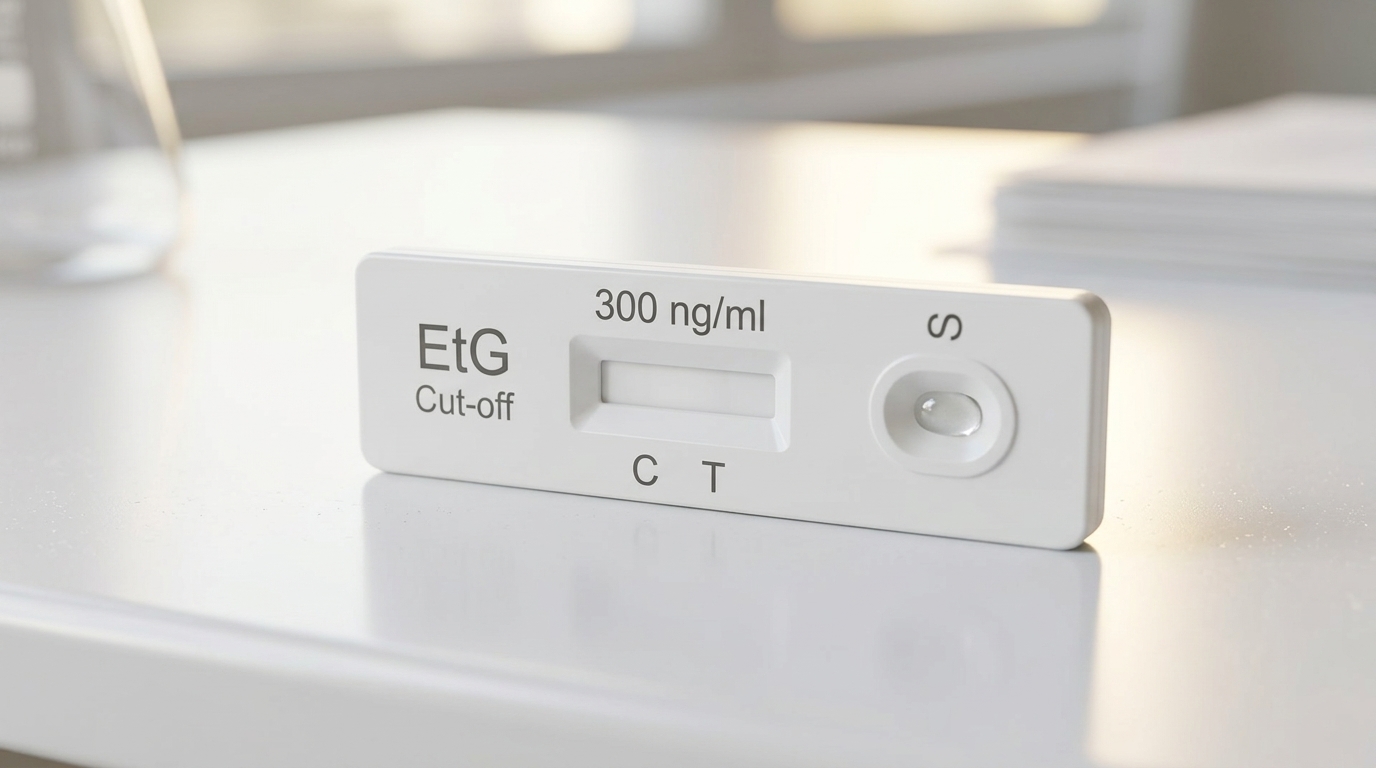
For screening, yes. Rapid point-of-care tests are practical because they deliver immediate results and reduce delays. That helps workplaces, probation offices, and clinics make same-day decisions. It also cuts down on the number of samples sent out for costly confirmation when screens are negative.
There is one rule to keep in mind: a rapid test is a screening tool. If a result carries legal, employment, or disciplinary consequences, programs should follow their confirmation policy. That protects both the organization and the person being tested.
What features matter most in real-world use?
Most buyers start with accuracy, but day-to-day usability matters just as much. A test that slows intake, confuses staff, or leads to repeated errors will cost more over time than a test with a slightly lower price tag.
In real-world monitoring, these factors matter most:
- Speed: quick read times support same-visit decisions.
- Ease of use: simple steps reduce staff error.
- Affordability: lower cost makes repeat screening easier to sustain.
- Sensitivity: the cutoff should match your policy goals.
- Fit for forensic use: especially helpful in stricter monitoring settings.
What is the simplest decision framework?
If you want a clear way to decide, use this four-step framework:
- Define the goal. Do you need immediate impairment data or recent-use monitoring?
- Match the test type to the goal. Use EtG when recent alcohol use matters.
- Check the cutoff and workflow. Make sure sensitivity and speed fit your program.
- Plan confirmation rules. Screen quickly, then confirm non-negative results when policy requires it.
This approach keeps the decision tied to how the test will actually be used. It also helps buyers avoid overpaying for the wrong tool or choosing one that does not support policy enforcement.
Who is a 300 ng/ml EtG cartridge best for?
A 300 ng/ml EtG cartridge is a good fit for buyers who need sensitive alcohol detection in a screening format that is quick and cost-conscious. That includes probation departments, treatment programs, employers with follow-up monitoring plans, and clinics that want on-site screening before sending selected samples for confirmation.
It is especially well suited for programs that test more than once and need a repeatable process. It offers a practical balance of sensitivity, speed, and per-test cost.
Common buyer fit checklist
- You need to monitor recent alcohol use.
- You want rapid on-site screening.
- You need a low-cost option for repeated testing.
- You want a cartridge suited for forensic screening use.
FAQ
Is an EtG test better than a breath test for probation?
It depends on the goal. A breath test detects alcohol at the moment of testing. An EtG test helps detect recent alcohol use. For probation terms centered on abstinence, EtG screening is usually the better fit.
Can employers use an EtG test for workplace monitoring?
Yes. Employers can use EtG screening for follow-up monitoring, return-to-duty plans, and policy-based abstinence programs. It is less useful for checking immediate impairment right after a fresh incident.
Should a positive rapid alcohol screen be confirmed by a lab?
Yes, if the result will be used for disciplinary, legal, or formal employment action. Rapid tests are effective screening tools, but confirmation adds another layer of protection when the stakes are high.
Conclusion
The best alcohol test is the one that matches your monitoring goal, your workflow, and your policy. For probation and workplace programs that need recent-use screening with speed and manageable per-test cost, EtG cartridges are a strong practical option. If that is your priority, Cartridge: ETG, Best Alcohol test 300 ng/ml from 12 Panel Now is a smart choice.