Tailoring Drug Testing Programs to Industry-Specific Regulations: The 2026 Guide for Hybrid Workforces

If you are managing a drug testing program in 2026, you already know that the “one-size-fits-all” corporate policy is completely obsolete.
Today’s compliance landscape is a highly fragmented, risk-based ecosystem. You are likely juggling a “Compliance Paradox”: balancing the pressing need for workplace safety against shifting state marijuana laws and a sophisticated subculture of test evasion. Add to this the reality of the modern hybrid workforce. How do you construct a unified testing policy for a regional healthcare system that employs clinical staff governed by HIPAA, hospital retail workers in a legal-marijuana state, and an ambulance fleet heavily regulated by the Department of Transportation (DOT)?
Navigating these overlapping mandates requires more than just knowing the rules—it requires a tactical blueprint for integrating them. Let’s break down how to tailor your screening protocols, select the right testing supplies, and audit-proof your program across different regulatory environments.
A side-by-side view of the biggest compliance differences—so you can scope the right program for each workforce segment before you write or update policy.
Decoding Sector-Specific Mandates
To build an airtight program, we first have to look at the distinct rulebooks dictating how different industries operate.
Transportation & Fleet Management (DOT/FMCSA)
The DOT remains the gold standard for technical rigor, governed by 49 CFR Part 40. But enforcement has tightened dramatically. Today, an overwhelming 94% of Federal Motor Carrier Safety Administration (FMCSA) audits include a thorough review of drug and alcohol programs. A single violation can trigger fines upwards of $16,000.
Furthermore, with the full implementation of Clearinghouse II over the last couple of years, state licensing agencies are now required to automatically downgrade Commercial Driver’s Licenses (CDLs) for drivers with unresolved testing violations. Fleet managers must maintain stringent, continuous query processes. The recent federal approvals of Oral Fluid Testing have also given DOT-regulated employers a powerful new tool to combat bathroom-related test cheating and reduce operational downtime.
Healthcare & Hospital Systems
For healthcare HR directors, the primary pain point isn’t just detecting substance use—it’s data privacy. A major, frequently penalized compliance gap in hospital systems revolves around HIPAA. Drug test results must be filed in a strictly separate, confidential medical file, not in a standard personnel file.
Additionally, hospitals must navigate post-accident testing under OSHA’s “Reasonable Possibility” standards. Policies must clearly demonstrate that testing is used to identify root causes of accidents, rather than as a retaliatory tool against employees who report injuries.
Education & University Campuses
School administrators face a completely different regulatory master: the Drug-Free Schools and Communities Act (DFSCA), specifically 20 U.S.C. § 7131. While many education programs focus heavily on student athletics, federal mandates require comprehensive Drug and Alcohol Abuse Prevention Programs (DAAPP) for all staff and students. Falling out of compliance doesn’t just invite fines; it actively jeopardizes federal funding and grants.
The Specimen Choice Decision Engine
With regulations defined, the next operational hurdle is selecting the right testing medium. The choice between urine, oral fluid, and hair depends entirely on your specific risk profile, budget, and the window of detection required.
Use this quick framework to select the specimen method that fits your risk profile—especially when tampering, downtime, or longer detection windows drive the decision.
- Multi-Panel Urine Testing: Still the most common and cost-effective method for broad screening. Urine testing provides a longer detection window (up to a few weeks for certain substances). High-quality, FDA-approved and CLIA-waived 12-panel cups offer immediate, 99% reliable results for as low as $1.69 per cup, making them the standard for pre-employment and random screenings at scale.
- Oral Fluid (Saliva) Swabs: Rapidly gaining ground in 2026 for reasonable suspicion and post-accident testing. Oral swabs detect very recent use, are completely observable (eliminating tampering), and take employees off the floor for minutes rather than hours.
- Hair Follicle Testing: Used almost exclusively for pre-employment screening in highly sensitive executive or security roles, offering a 90-day historical window but unable to detect current impairment.
Navigating the Marijuana Minefield in Legal States
“Consult legal counsel” is no longer helpful advice when dealing with marijuana legalization. HR managers need a defensible, operational framework. The most successful approach we see in 2026 is the Role-Based Safety Matrix.
Instead of blanket bans that deplete your applicant pool in legal states, bifurcate your policy. Classify roles strictly into two categories: “Safety-Sensitive” (forklift operators, CDL drivers, clinical staff handling medication) and “Administrative/Non-Safety-Sensitive” (clerical, marketing, back-office).
For safety-sensitive roles, zero-tolerance federal guidelines (like DOT) supersede state recreational laws. Document the physical risks of these roles clearly in the job descriptions to defend your testing policy should a dispute arise.
A role-based approach helps you stay consistent across states: tighten controls where safety is critical and apply clear, documented standards everywhere else.
The HR Cheater’s Guide: Defeating the Synthetic Urine Epidemic
If you rely on urine testing, you must acknowledge a startling statistic: according to Quest Diagnostics’ data, substituted urine specimens surged an incredible 600%, and invalid specimens rose 45.2% starting in 2023. This trend has only calcified into 2026.
Employees are actively purchasing advanced synthetic urine kits complete with heating pads. To combat this, Specimen Validity Testing (SVT) is non-negotiable.
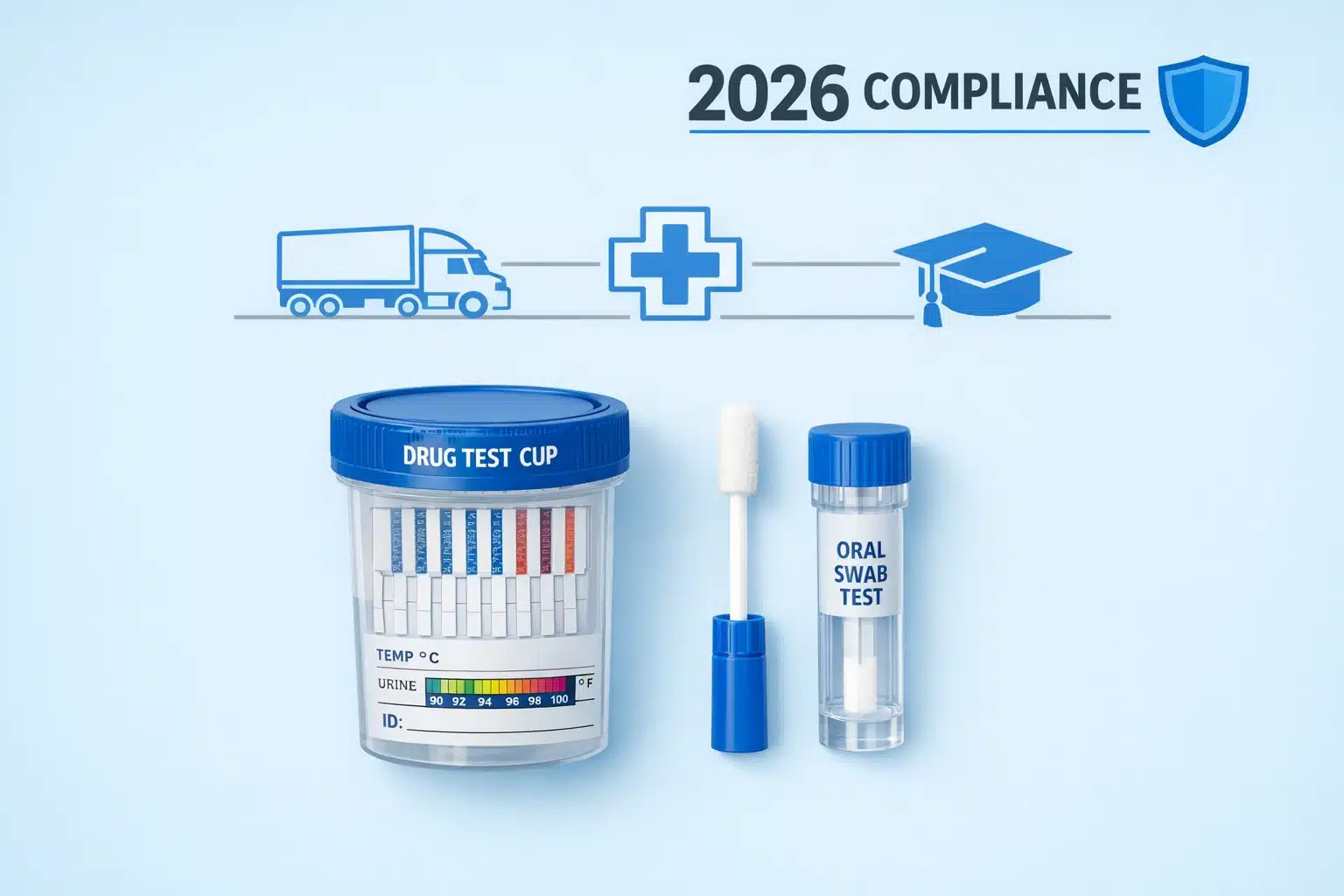
Your front-line defense isn’t the laboratory; it’s the testing cup itself. When sourcing supplies, ensure your multi-panel cups feature built-in temperature strips to verify the sample is between 90°F and 100°F immediately upon collection. Furthermore, utilize dip cards or cups equipped with adulterant panels that instantly detect pH anomalies, specific gravity manipulation, and chemical oxidizers (like bleach or glutaraldehyde) before you ever spend money sending a fake sample to a lab.
Audit-Proofing Your Program: The DER Checklist
A Designated Employer Representative (DER) carries the weight of an organization’s compliance on their shoulders. Because 94% of DOT audits now scrutinize drug programs—and non-regulated industries face rising liability claims—proactive documentation is your best shield.
Use this checklist to spot gaps before an audit: documentation, custody controls, SVT, clearinghouse steps, and privacy handling—organized into 10 reviewable controls.
Review your program quarterly. Ensure Chain of Custody (CCF) forms are flawless, Clearinghouse queries are logged prior to hiring, and your supervisor training for “Reasonable Suspicion” is updated and documented. Most importantly, ensure your physical testing supplies have not expired and are stored in a climate-controlled environment to maintain their 99% reliability rate.
Frequently Asked Questions
How do we balance DOT and non-DOT testing in the same company?
You need a “Hybrid Policy.” Maintain a strictly DOT-compliant policy for your safety-sensitive transportation workers, using only DOT-approved 5-panel tests and federal Chain of Custody forms. For your non-DOT workforce, implement a parallel “Company Authority” policy where you can utilize wider screening tools—like 12-panel instant cups—and customize your response to marijuana based on state laws.
Can we rely on instant testing for compliance?
Absolutely, for initial screening. Utilizing CLIA-waived and FDA-approved instant urine cups provides a 99% reliability rate. This allows you to immediately clear negative tests and keep your workforce moving. Only non-negative (presumptive positive) results need to be forwarded to a certified laboratory for Gas Chromatography/Mass Spectrometry (GC/MS) confirmation.
What is the most cost-effective way to test at scale without losing quality?
The key is unbundling your supply chain from your lab services. By sourcing your own drug testing supplies directly, you bypass massive markups. Organizations routinely save thousands of dollars annually by using affordable, high-quality instant testing cups (as low as $1.69 each) for their preliminary screening and only paying lab fees for the small percentage of tests that require confirmation.
Next Steps: Partnering for Reliable Program Execution
Designing a compliant, industry-specific drug testing program is complex enough without having to worry about the reliability of your supplies. Whether you are managing the strict demands of a DOT fleet, safeguarding PHI in a healthcare setting, or enforcing a drug-free campus, the foundation of your program relies on accurate, rapid, and tamper-evident testing tools.
Since 2017, 12 Panel Now has served as a trusted partner to organizations navigating these exact challenges. As a family-owned business, we focus solely on providing the highest quality testing supplies—not laboratory services—which means we pass the savings directly to you. Our CLIA-waived and FDA-approved multi-panel cups, dip cards, and oral swabs provide 99% accuracy, keeping your workplace safe and your program compliant without breaking your budget.
Empower your compliance team with tools they can trust. Evaluate your current testing protocols, identify your regulatory requirements, and ensure your supply chain is equipped to handle the realities of the modern workforce.