A clinician’s guide to drug test results: From interpretation to communication

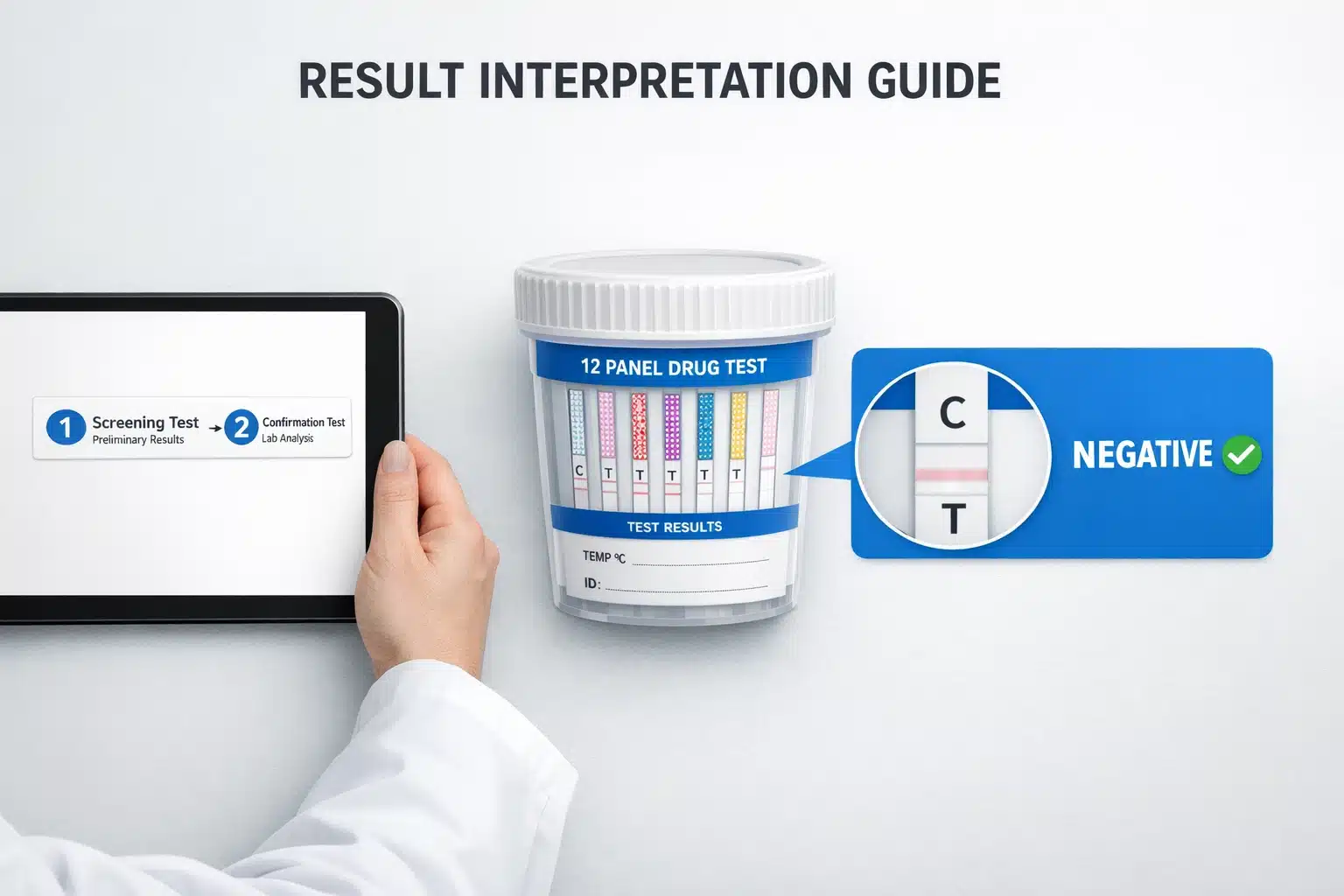
Initial drug screens for amphetamines can produce false positives in up to 35% of cases, often triggered by common over-the-counter decongestants or prescription medications like Bupropion. This single statistic highlights the critical gap between a simple test result and a clinically responsible conclusion. For healthcare providers, interpreting a drug test is never just about reading a line; it’s about understanding the technology, managing patient anxiety, and navigating a complex communication landscape.
This guide provides a clinical bridge between raw test data and responsible patient care. It translates complex lab science into actionable protocols, helping you interpret results from multi-panel cups, dip cards, and oral swabs with confidence and communicate them with precision.
The three results you’ll see: Positive, negative, and the “faint line”
The first step in any clinical testing protocol is accurate visual interpretation. On an immunoassay screening device, results are typically straightforward, but one common scenario creates significant uncertainty: the faint line.
- Positive Result: A line appears in the control region (C) but no line appears in the test region (T). This indicates the drug or its metabolite is present at or above the cut-off concentration.
- Negative Result: A line appears in both the control region (C) and the test region (T). This indicates the drug is not present or is below the test’s cut-off level.
- The Faint Line Rule: Any visible line in the test region (T), regardless of its intensity, color, or thickness, constitutes a negative result. Line intensity does not correlate with the concentration of the drug. Factors like urine composition or device manufacturing can affect line faintness, but the presence of the line itself is the only clinically relevant factor for a negative screen.
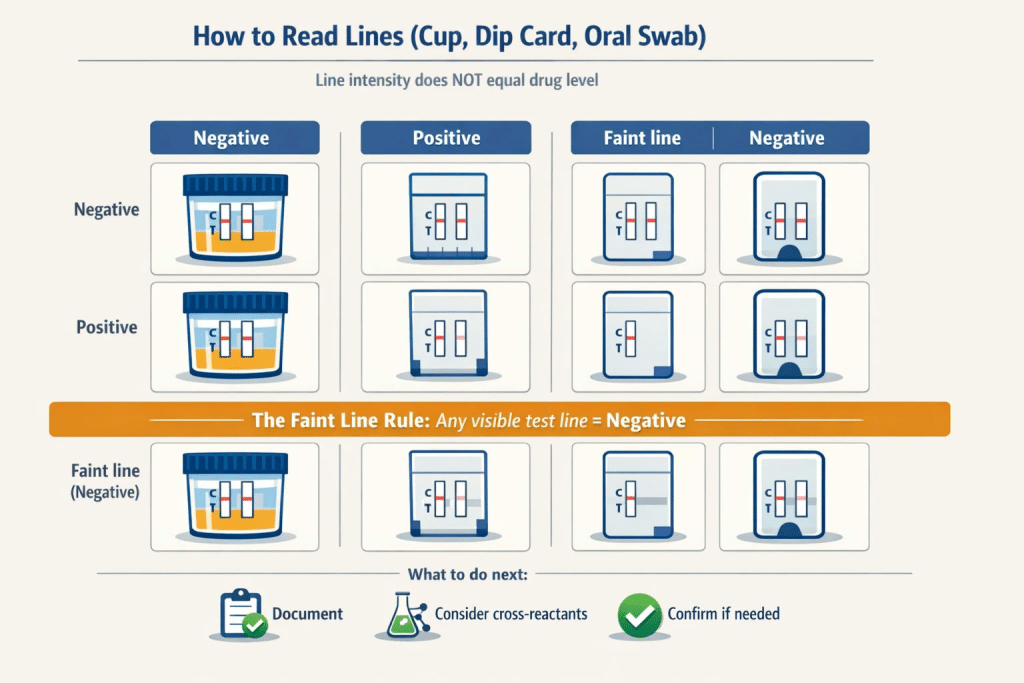
Side-by-side examples show why a faint test line still counts as negative on most immunoassay screens—use this visual to reduce uncertainty and standardize documentation.
Screening vs. confirmation: The filter and the microscope
It’s essential to understand that devices like multi-panel cups and dip cards are screening tools, not definitive diagnostic instruments. Thinking of the process with a “filter versus microscope” analogy clarifies their role and limitations.
Immunoassay Screens (The Filter): These are the rapid tests used for initial screening. They use antibodies to detect the presence of broad classes of drugs. They are highly sensitive and effective for quickly filtering out negative results. However, they can sometimes react to other substances with a similar molecular structure, leading to a presumptive positive.
Confirmation Tests (The Microscope): When a screen yields a presumptive positive, a confirmation test is required. Gas Chromatography/Mass Spectrometry (GC-MS) or Liquid Chromatography/Mass Spectrometry (LC-MS) are the gold standards. These methods act like a microscope, separating and identifying the exact molecular structure of the substances present. A confirmation test is the only way to verify a positive result, eliminate false positives, and provide a legally defensible outcome.

A protocol-first flow helps clinicians distinguish screening from confirmation, choose the next step for negative, presumptive positive, or indeterminate results, and communicate without over-claiming.
Navigating presumptive positives: The challenge of cross-reactivity
A presumptive positive from a screening device is a signal to investigate further, not a final diagnosis. The primary cause of misleading results is cross-reactivity, where the test’s antibodies bind to a substance other than the target drug.
Research shows certain drug classes are particularly prone to this. Opioids (excluding oxycodone) have a false-positive rate of around 34%, often triggered by things as common as poppy seeds or certain antibiotics. Amphetamines are even more notorious, with some studies showing initial screen false-positive rates of 14% and higher.

A quick risk view of which panels most often produce misleading initial results—use it to decide when to slow down, check cross-reactants, and order confirmation.
The 2026 cross-reactant reference
Knowing which common medications can trigger a presumptive positive is key to managing patient conversations and determining the need for confirmation. This list reflects current drug trends and medications that are frequently missed by outdated guides.
- Amphetamines (AMP): Bupropion (Wellbutrin), Phentermine, Ranitidine (Zantac), Pseudoephedrine (Sudafed), Labetalol.
- Benzodiazepines (BZO): Sertraline (Zoloft), Oxaprozin.
- Opioids (OPI/MOR): Quinolone antibiotics (e.g., Levofloxacin), Rifampin, poppy seeds.
- Cannabinoids (THC): Proton pump inhibitors (e.g., Pantoprazole), Ibuprofen/Naproxen (in high doses), Efavirenz.
- PCP: Dextromethorphan (in many cough suppressants), Venlafaxine (Effexor), Diphenhydramine (Benadryl).
Always review a patient’s current list of prescriptions and over-the-counter medications when you receive a presumptive positive result.
The communication vault: Delivering results with clarity and care
How you communicate a test result is just as important as how you interpret it. The goal is to provide clear, factual information while maintaining patient trust and adhering to privacy standards.
Scripting the conversation for a presumptive positive
Avoid definitive or accusatory language. Use precise, non-judgmental terminology that reflects the nature of the screening test.
Sample Script:
“The initial screen showed a result that we call a ‘presumptive positive’ for [drug class]. This isn’t a final result. These screens can sometimes react to other things, like common medications. To be certain, our standard protocol is to send this sample to a laboratory for a confirmation test, which will tell us exactly what’s going on. That test is much more specific and will give us a definitive answer. Do you have any questions for me about this process?”
This approach frames the confirmation test as a routine part of a careful process, reducing patient anxiety and defensiveness.
Documentation and legal safeguards
Your documentation is a legal record. It must be precise, objective, and compliant with privacy regulations like HIPAA.
- Use Precise Wording: Document the result as “presumptive positive” or “non-negative,” not “positive” or “failed.” Specify the drug panel and note that the result is pending confirmation.
- Maintain Privacy: A drug test result is Protected Health Information (PHI). Under HIPAA, it cannot be disclosed to a third party, including an employer, without explicit, written patient authorization. Be aware that once a result is shared with an employer (with consent), it may fall under different regulations outside of HIPAA.
- Follow Protocol: Always adhere to your organization’s established protocols, including when to involve a Medical Review Officer (MRO), especially in workplace testing scenarios governed by SAMHSA or DOT guidelines.

A practical privacy-first template: document precisely, use presumptive wording, obtain authorization before third-party disclosure, and rely on short scripts that keep patient trust intact.
Build a testing protocol on a foundation of reliability
Accurate drug testing protocols begin with dependable screening tools. By understanding the nuances of interpretation and pairing them with a structured communication strategy, you can ensure your clinic operates with clinical integrity and patient-centered care. A faint line is a negative result, a screen is not a confirmation, and every conversation must be handled with professional care.
Equip your practice with reliable, FDA-approved, and CLIA-waived screening supplies. High-quality multi-panel cups and dip cards from 12 Panel Now provide the accurate first step you need to build an effective and responsible testing program.