From clinical sample to court-ready evidence: A guide to specimen integrity

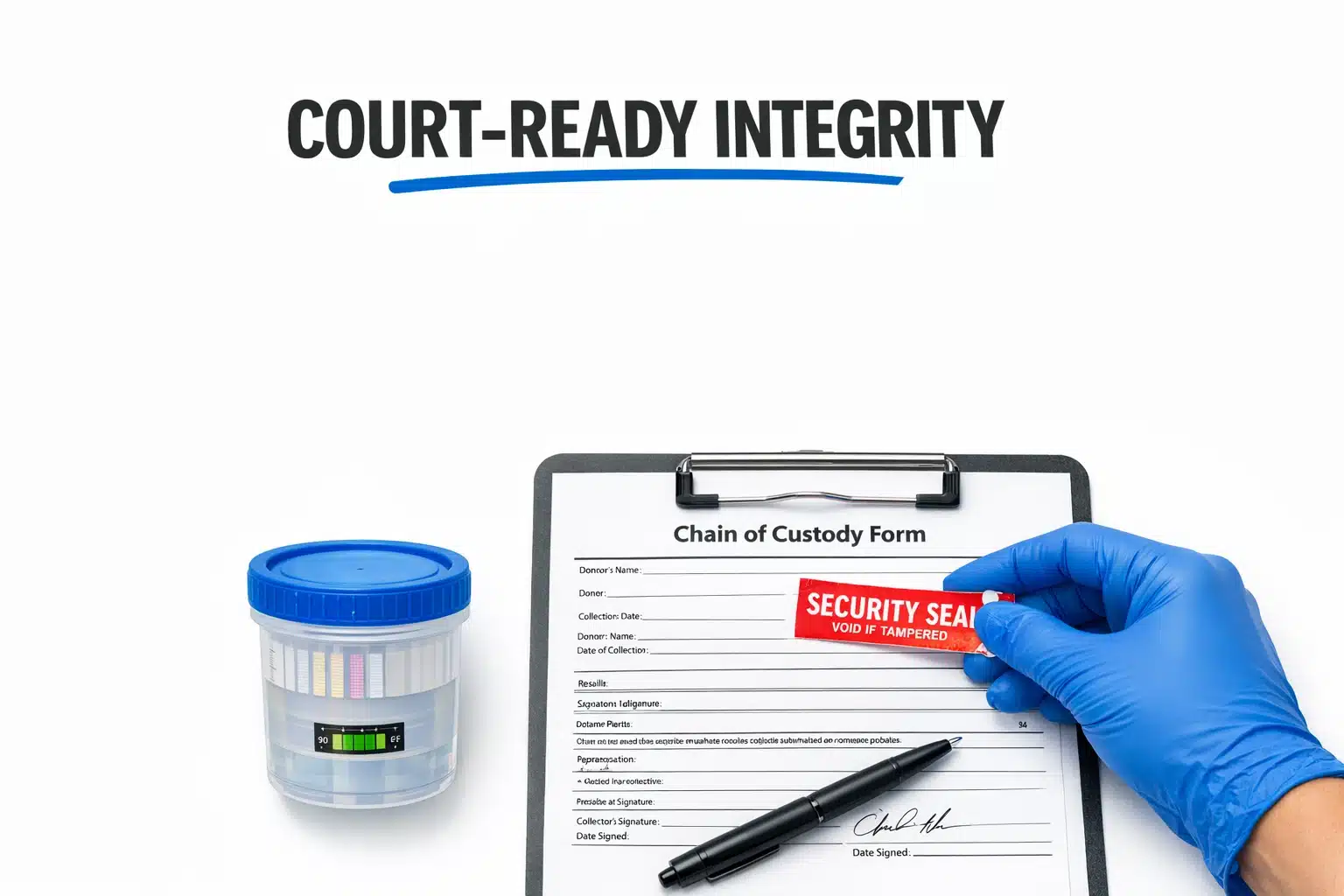
In a standard clinical setting, specimen rejection rates hover between 0.2% and 1.3%. But in high-stakes environments like emergency rooms or post-incident testing, that number can climb as high as 6%. Every rejected sample represents a potential safety risk, a legal liability, or a breakdown in patient care. The difference between a reliable result and a costly failure isn’t the test itself; it’s the integrity of the process from collection to reporting.
Federal guidelines from SAMHSA and the DOT provide a dense framework for compliance, but they don’t always translate to the fast-paced reality of a busy clinic or workplace testing site. This guide closes that gap. It provides a clinical-to-legal bridge, transforming regulatory requirements into an actionable risk management plan for your team, ensuring every specimen collected is both medically accurate and legally defensible.
First, find the weak points in your current process
Before a specimen is ever challenged in court, the vulnerabilities in its collection process already exist. A minor oversight in documentation or a brief lapse in observation can invalidate an otherwise accurate test result. Use this quick audit to identify potential integrity gaps in your current protocol.
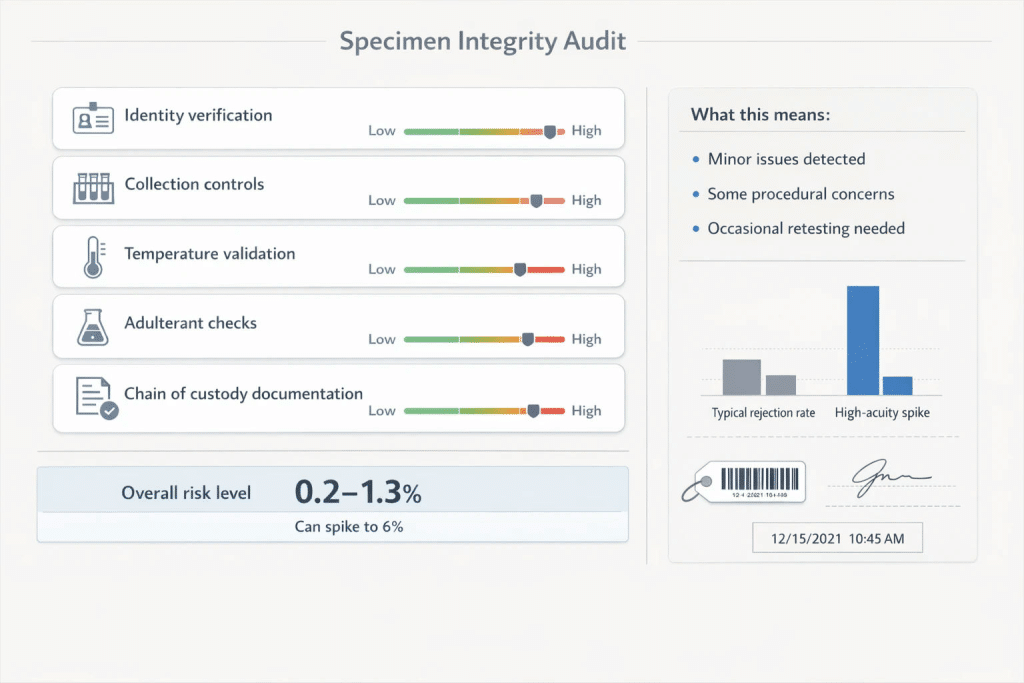
A fast integrity audit that highlights where collection sites are most likely to fail—so you can tighten controls before a rejected specimen or court challenge occurs.
A strong protocol leaves no room for doubt. If you identified any areas of uncertainty, it’s time to refine your approach, starting with the type of test you administer.
Choosing your testing medium: A decision matrix for clinicians
The debate between urine, saliva, and hair testing often centers on detection windows and accuracy. But for programs where legal defensibility is paramount, the evaluation criteria must shift to include tamper resistance and chain of custody complexity. A urine test may offer a longer detection window, but it also presents a higher risk of adulteration if collection isn’t directly observed. An oral fluid test, while having a shorter window, is collected face-to-face, nearly eliminating substitution risk.
This isn’t just about choosing a test; it’s about aligning your testing medium with your operational capacity for maintaining integrity.

Use this matrix to pick a testing medium that matches your reality—tamper risk, speed, and documentation burden—without relying on generic “accuracy” claims.
Once you’ve selected the right tool, executing a flawless collection protocol is the final and most critical step.
The perfect collection: A phase-by-phase protocol
A legally defensible drug test result is built on a foundation of meticulous, documented steps. Even a minor deviation can create an opening for a legal challenge. This workflow breaks the process into three critical phases, highlighting the most common points of failure.

A phase-by-phase workflow your team can follow under pressure—highlighting the exact moments that most often create defensible documentation gaps.
Phase 1: Pre-collection security
This phase is about preparation and preventing opportunities for tampering before the collection even begins.
- Positive Identification: Verify the donor’s identity using a government-issued photo ID. Document the ID type and number on the Chain of Custody Form (CCF).
- Secure the Environment: The donor must remove outer garments (jackets, hats) and leave personal belongings (bags, purses) outside the collection area. Instruct them to empty their pockets.
- Secure the Restroom: Ensure the collection restroom contains no accessible sources of water. Tape or secure the toilet tank and turn off the faucet. Add a bluing agent to the toilet bowl water to prevent dilution.
Phase 2: The observed void
Direct observation is the gold standard for preventing substitution or adulteration. However, this phase also requires careful management of common collection challenges.
- Managing “Shy Bladder” (Paruresis): If a donor is unable to provide a sample, do not immediately classify it as a refusal. Federal guidelines outline a clear protocol:
- Allow the donor to drink up to 40 ounces of water over a period of up to three hours.
- Explain that they must provide a single complete sample; multiple partial voids are not permitted as this can indicate dilution attempts.
- If the donor still cannot provide a sample after three hours, the collection is discontinued. This event must be documented and may require a medical evaluation to determine if a legitimate medical condition is the cause.
- Maintain Visual Contact: The collector should observe the donor throughout the collection process to ensure the sample originates directly from the donor.
Phase 3: Post-collection validation and sealing
The four minutes immediately following collection are the most critical for specimen validation. This is where integrity is confirmed and the chain of custody begins.
- The 4-Minute Rule: The specimen’s temperature must be checked within four minutes of collection. A valid human urine sample will register between 33–38°C (90–100°F). A reading outside this range is a clear indicator of substitution and requires an immediate, observed recollection.
- Splitting the Specimen: The collector, in the donor’s presence, splits the sample into two vials (an “A” bottle and a “B” bottle). This allows for re-testing if the primary sample is challenged.
- Sealing and Signing: The donor watches the collector seal both bottles with tamper-evident tape. The donor then initials the seals. Both the donor and collector sign the CCF, formally beginning the chain of custody.
Red flag appendix: Identifying integrity failures at a glance
Your collectors are the first line of defense against tampering. Training them to spot anomalies is non-negotiable. While sophisticated adulterants can be hard to detect visually, many common methods of cheating leave clear signs.
- Temperature Failure: The most definitive red flag. A sample outside the 90–100°F window is almost certainly not a valid, unadulterated specimen.
- Unusual Appearance: Watch for strange colors (e.g., green or blue) or an unusual lack of scent or cloudiness, which can indicate synthetic urine.
- Abnormal Lab Markers: If a sample passes the initial physical checks, laboratory validity testing serves as a final backstop. Key markers of adulteration include:
- pH: A normal reading is between 4 and 8. Values outside this range suggest an adulterant like bleach or ammonia has been added.
- Creatinine: Levels below 0.5 mmol/L strongly indicate the sample is diluted or is not human urine.

A quick visual checklist of the integrity markers and documentation triggers that protect results from being rejected—clinically or in court.
Build your protocol on a foundation of reliability
A defensible drug testing program relies on two components: an unbreakable process and reliable tools. Without a strict chain of custody, even the most accurate test is worthless. But a perfect protocol can be undermined by faulty supplies.
Ensuring your clinic is stocked with CLIA-waived and FDA-approved drug testing supplies is the final step in securing your process. High-quality multi-panel cups with built-in temperature strips, multi-panel tests that check for adulterants, and secure collection materials are not expenses; they are investments in risk management. They provide the confidence that every result you produce is accurate, reliable, and ready to withstand scrutiny.