How to choose the right at-home drug test

When you need an answer about substance use, whether for personal accountability or family safety, the last thing you want is more uncertainty. But the accuracy of an at-home drug test isn’t always as straightforward as the “99% accurate” label suggests. In fact, research highlighted by the National Institutes of Health (NIH) shows that real-world sensitivity can sometimes drop as low as 45% due to factors like user error or the specific drug being tested.
Choosing the right test isn’t just about picking a box off the shelf. It’s about matching the testing method to your specific situation to get the most reliable screening possible. This guide will walk you through the key differences between test types, what the results really mean, and how to select the right panel for your needs with confidence.
Urine, saliva, or dip card: Matching the format to your needs
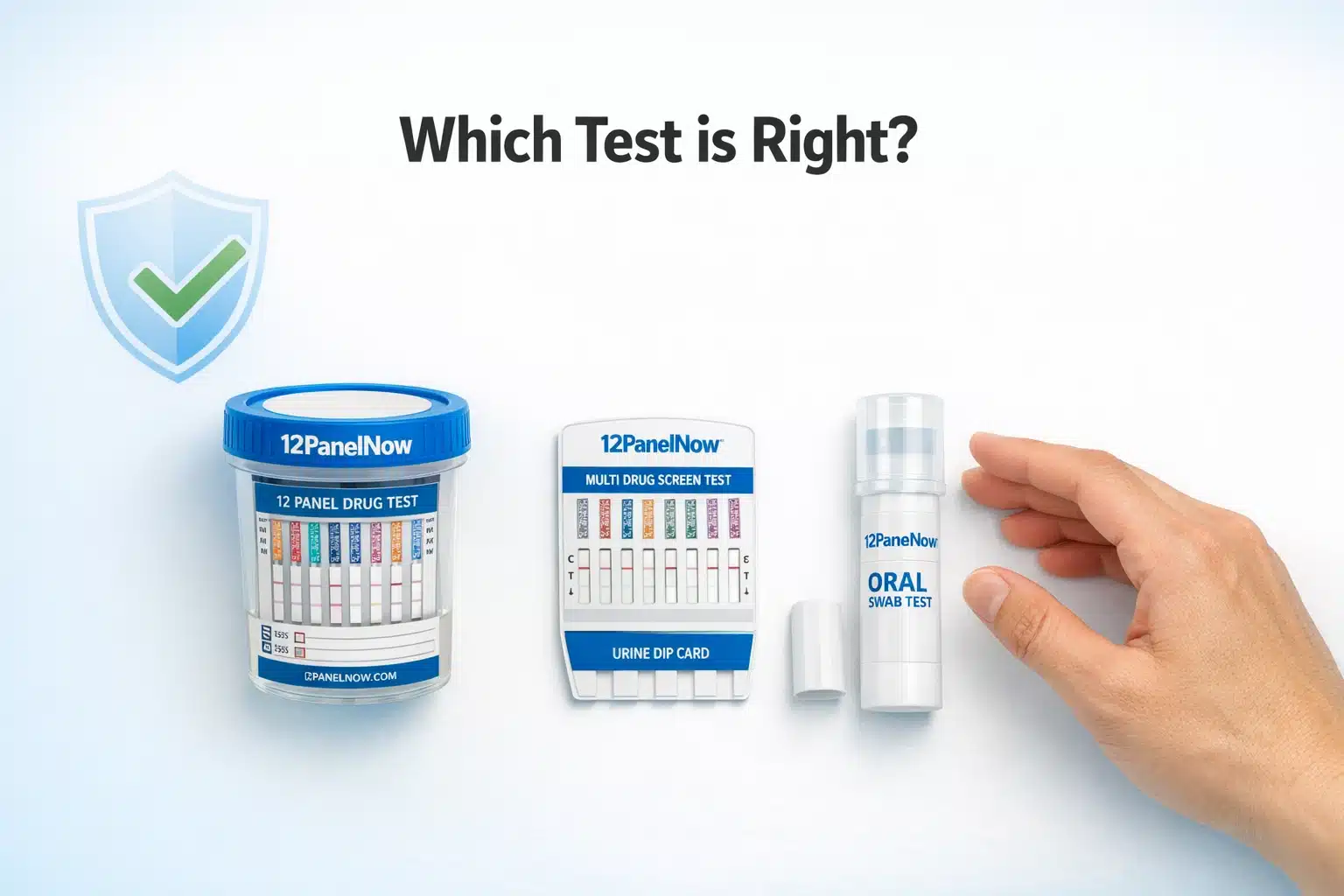
The first decision you’ll face is the test format. Each has distinct advantages for ease of use, privacy, and resistance to tampering. The three most common types of at-home drug screens are urine test cups, dip cards, and oral (saliva) swabs.
- Urine Test Cups: These are all-in-one devices and our most popular option. The collection cup has the test strips built right in, making the process clean and simple. They are ideal for unobserved testing where convenience is a priority.
- Urine Dip Cards: This format requires collecting a urine sample in a separate, clean container first. You then dip the card into the sample. Dip cards are cost-effective and accurate but involve an extra step compared to integrated cups.
- Oral (Saliva) Swabs: Saliva tests are the least invasive method. A swab is used to collect an oral fluid sample from the inside of the cheek. Because collection can be directly observed, they are very difficult to cheat.
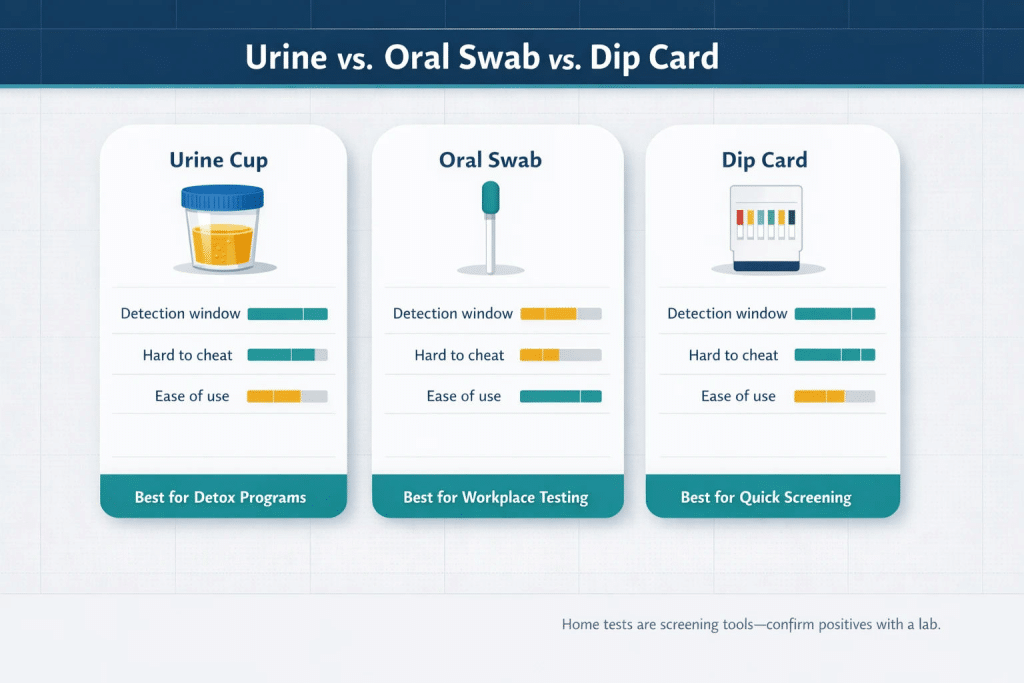
A quick visual comparison to match the test format to your situation—privacy, collection ease, and how hard it is to tamper—before choosing a panel.
Recent use vs. historical patterns: Understanding detection windows
The right test also depends on what you’re trying to find out. Are you concerned about impairment that happened in the last day, or are you looking for a history of use over the past few weeks? The answer determines whether a saliva or urine test is more appropriate.
NIH data shows a clear difference:
- Oral (saliva) tests are best for detecting very recent use. They typically identify substances used within the past 24 to 48 hours. This makes them useful for determining current impairment.
- Urine tests provide a much longer lookback period. Depending on the substance and frequency of use, a urine screen can detect drug metabolites for anywhere from 3 to 30 days. This makes it the standard for historical screening.

Use this timeline to choose a test based on what you’re trying to detect: recent impairment signals vs a longer lookback window.
What if the result is wrong? How to handle false positives
One of the biggest concerns with at-home testing is the risk of a false positive. This happens when the test incorrectly detects the presence of a drug. Most often, this is caused by cross-reactivity, where a legal prescription medication or even a common over-the-counter drug has a similar chemical structure to an illicit substance.
For example, some non-prescription cold medicines containing pseudoephedrine can trigger a false positive for amphetamines. This is why choosing a reliable test is so important. All products from 12 Panel Now are FDA-cleared and CLIA-waived, which means they meet federal standards for accuracy and are designed to minimize these occurrences. However, no screening test is perfect.
If you get an unexpected positive result, the first step is to check for potential cross-reactive substances.

A fast ‘medicine cabinet’ check to lower false-alarm stress—see common cross-reactivity triggers and the safest next step if a result looks unexpected.
A home screen is not a lab test: Interpreting your results
It is critical to understand that an at-home test provides a preliminary result. It’s a screening tool, not a final verdict. In a legal or employment setting, a non-negative result from a home test is never the final word. It must be confirmed by a laboratory using a more sophisticated method called gas chromatography/mass spectrometry (GC/MS).
GC/MS is the gold standard for drug testing. It can distinguish between illicit drugs and cross-reactive compounds, eliminating the risk of a false positive. If you receive a preliminary positive result on a home test and the stakes are high—involving probation, employment, or family trust—the only way to be certain is with lab confirmation.

This flowchart helps you interpret a home test responsibly—especially when results affect school, work, or legal outcomes—and shows when lab confirmation is the safest next step.
Choosing the right panel for your peace of mind
Once you’ve selected a format, the final step is choosing a panel. This refers to the number and type of drugs the test screens for. While a 5-panel test covers the most common substances of abuse, a 12-panel drug test cup offers a more comprehensive screen that includes prescription drugs like benzodiazepines and oxycodone.
As community health concerns evolve, testing needs have also expanded. With growing awareness around harm reduction, many families and individuals are now looking for fentanyl testing strips. These are often sold separately and can be used to check for the presence of fentanyl, providing an extra layer of safety.
Making an informed decision starts with understanding your options. By matching the test format, detection window, and panel to your unique situation, you can get the clarity you need. Browse our full selection of CLIA-waived drug testing supplies to find the right solution for your personal or family use today.