Navigating the difficult choice: A parent’s guide to the privacy, rights, and realities of teen drug testing

The fear that your child might be using drugs creates a difficult, emotionally charged dilemma. Your first instinct is to find proof, but acting on that impulse can lead to serious legal and relational consequences. The American Academy of Pediatrics (AAP) advises against involuntary drug testing, citing the potential to destroy trust at the very moment it’s needed most. Before you decide to test, it’s critical to understand the landscape of consent, privacy, and accuracy.
This isn’t just about getting an answer; it’s about choosing the right next step for your family. The path you take before collecting a sample is just as important as the result itself.
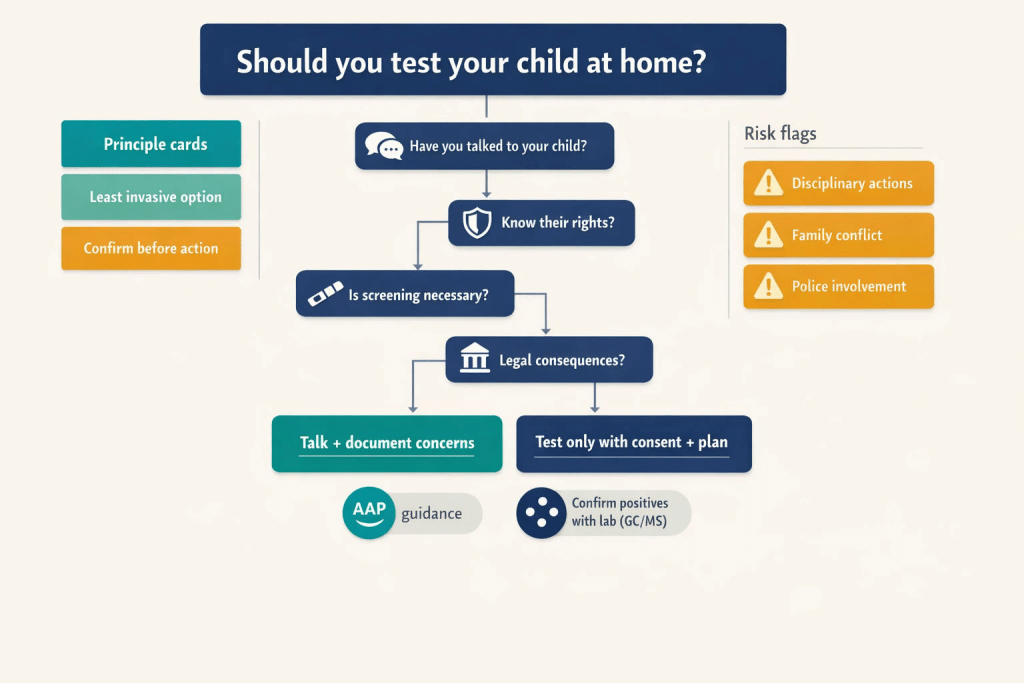
A consent-first decision path that helps parents choose conversation, screening, or clinical testing—while highlighting privacy and legal risks before acting.
Consent is not just a suggestion, it’s a legal cornerstone
While you have parental authority, that authority has limits, especially as your child gets older. The legal framework surrounding a minor’s consent is far more complex than many parents realize and varies significantly by state.
Forcing a child to provide a sample can have serious repercussions. Legal advocacy groups like CLS Philadelphia often reference Fourth Amendment rights against unreasonable searches, and while this primarily applies to state actors like schools or police, the underlying principles of bodily autonomy can surface in family court disputes.
The age of your child is a major factor. Testing a 12-year-old is legally and ethically different from testing a 17-year-old who may have specific medical privacy rights. For example, in states like Minnesota, minors have the right to consent to their own substance use treatment. This can legally prevent a clinician from sharing test results with a parent, even if the parent is paying for the services. Understanding these nuances is crucial before involving a medical professional.
Home kit vs lab test: What the result really means
If you and your child have agreed that a test is a necessary step, the next decision is where and how to conduct it. It’s essential to understand the difference between an at-home screening and a laboratory confirmation. They serve two very different purposes.
At-home drug tests, including our own urine analysis cups and dip cards, are powerful screening tools. They are designed to provide a fast, affordable, and preliminary result, known as a “presumptive” positive or negative. They are an excellent first step for getting a quick indication.
However, a presumptive positive is not a definitive diagnosis. The research is clear on this: sources like SAMHSA and NIDA state that all preliminary positive results must be confirmed by a laboratory using methods like Gas Chromatography/Mass Spectrometry (GC/MS) before they can be considered legally or medically actionable. This step is non-negotiable if the result could lead to significant consequences like therapy, legal action, or school suspension.

Compare what you gain—and what you risk—when using an at-home screen versus a lab confirmation, especially before making any legal or medical decisions.
At-home tests can also yield false positives from common over-the-counter medications or even prescription drugs like Adderall. A lab confirmation can distinguish between substances and rule these out, protecting your child from a wrongful accusation.
Timing is everything: Understanding detection windows
A negative result doesn’t always mean your child is drug-free; it could just mean the substance has already cleared their system. Different drugs have vastly different detection windows.
Most harder drugs, such as cocaine or opiates, are typically undetectable in urine after just 48-72 hours. In contrast, marijuana is an outlier. For a chronic user, THC can remain detectable for up to six weeks. This means a test taken on a Tuesday could easily miss a substance used over the weekend.
Furthermore, many standard home tests are not designed to detect substances like LSD, mushrooms, or Ketamine. If you have specific concerns about these, a standard panel may provide a false sense of security. Understanding these timelines helps you interpret results more realistically.

A timing-first view of detection windows so parents can interpret a negative or positive result more realistically—and know when a basic home panel may miss key substances.
The rise of “test cheats” and detox products
Many parents search for “easy home drug tests” because they want a simple process. But teens are searching for the same terms to figure out how to beat them. An entire industry exists to help individuals produce a false negative result.
Products with names like “Detoxify Mighty Clean” are herbal cleanses designed to dilute urine and mask the presence of drug metabolites. While their effectiveness is debated, their popularity on forums like Reddit shows that teens are actively seeking ways to subvert testing protocols.
Being aware of these methods is part of making an informed decision. If you proceed with a home test, supervision during collection can be important to ensure the sample’s integrity, but this again raises serious privacy considerations that must be handled with care and communication.

A practical way to compare consent and access across home, clinical, and legal settings—so families can avoid privacy missteps and choose the safest next step.
Turning a result into a conversation
A drug test should never be the end of the conversation; it should be the beginning. Whether the result is positive or negative, the goal is to bridge the communication gap, not widen it.
If the result is negative: This is an opportunity to rebuild trust. Acknowledge the difficulty of the situation and express your relief. Use it as a chance to discuss the pressures they face and why you were concerned in the first place.
If the result is positive: Your reaction matters more than the result itself. Avoid anger and accusations. Frame the test as a tool that confirmed your concerns and now allows you to work together on a solution. The objective shifts from proving drug use to finding help. This is the moment to transition from “parent as detective” to “parent as advocate.”
Ultimately, a drug test is just one piece of information. Your approach to privacy, consent, and communication will determine whether that information helps heal your family or harms it. Making a thoughtful, informed choice is the most important first step you can take.