Does LSD (Acid) Show Up on a Urine Drug Test?

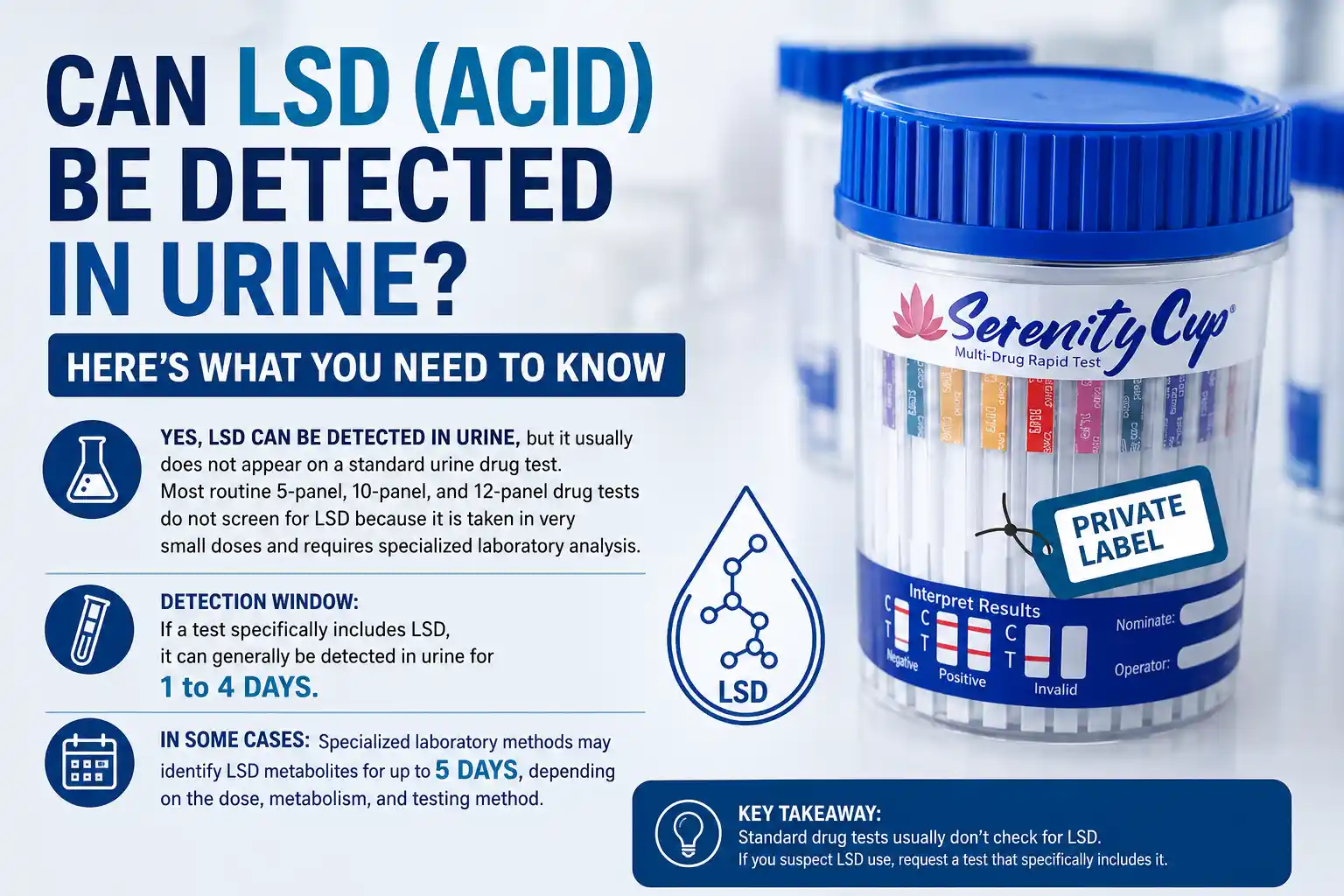
Yes, LSD (acid) can be detected in urine, but it usually does not appear on a standard urine drug test. Most routine 5-panel, 10-panel, and 12-panel drug tests do not screen for LSD because it is taken in very small doses and requires specialized laboratory analysis. If a test specifically includes LSD, it can generally be detected in urine for 1 to 4 days, although some specialized laboratory methods may identify LSD metabolites for up to 5 days, depending on the dose, metabolism, and testing method.
Key Takeaways
- LSD does not appear on most routine workplace drug tests.
- Standard 5-panel, 10-panel, and 12-panel urine drug tests typically do not include LSD.
- Specialized laboratory tests such as LC-MS/MS or GC-MS are required to detect LSD or its metabolites.
- LSD is generally detectable in urine for 1–4 days, though some laboratory tests may detect it for up to 5 days.
- Factors such as dosage, metabolism, hydration, and individual health can influence how long LSD remains detectable.
What Is LSD (Acid)?
Lysergic acid diethylamide (LSD), commonly known as acid, is a powerful psychedelic hallucinogen that alters perception, mood, and sensory experiences. Even extremely small amounts—measured in micrograms—can produce effects lasting 6 to 12 hours.
Unlike many commonly abused drugs, LSD is rapidly metabolized by the body, leaving only trace amounts in urine. This is one of the primary reasons it is not included in most routine drug screening panels.
Does LSD Show Up on a Standard Urine Drug Test?
Usually, no.
A standard urine drug test is designed to detect commonly misused substances such as:
- Marijuana (THC)
- Cocaine
- Amphetamines
- Opiates
- Phencyclidine (PCP)
Since LSD is much less commonly screened and requires highly sensitive testing methods, it is not typically included in routine urine drug screens used by employers, schools, or many healthcare providers.
If LSD testing is specifically requested, laboratories use specialized toxicology techniques capable of detecting extremely small concentrations of LSD and its primary metabolite, 2-oxo-3-hydroxy-LSD.
Why Isn’t LSD Included in Most Urine Drug Tests?
There are several reasons why LSD is rarely part of standard drug screening panels.
Extremely Small Dosages
Unlike many drugs measured in milligrams, LSD is active at microgram levels. After use, only tiny amounts remain in the body, making detection much more challenging.
Rapid Metabolism
The liver quickly breaks down LSD into inactive metabolites, reducing the amount of unchanged drug available for detection.
Specialized Equipment Is Required
Routine immunoassay drug screens are generally designed for more commonly used substances. Detecting LSD requires advanced analytical methods such as:
- Liquid Chromatography–Mass Spectrometry (LC-MS/MS)
- Gas Chromatography–Mass Spectrometry (GC-MS)
These tests are more expensive and are typically reserved for specific medical, forensic, or legal situations.
Does LSD Show Up on a 5-Panel Drug Test?
No.
A standard 5-panel urine drug test does not test for LSD.
A typical 5-panel drug test screens for:
| Drug | Included? |
|---|---|
| Marijuana (THC) | ✔ |
| Cocaine | ✔ |
| Amphetamines | ✔ |
| Opiates | ✔ |
| PCP | ✔ |
| LSD | ❌ |
For most pre-employment screenings, taking LSD would not produce a positive result unless the employer specifically orders additional LSD testing.
Does LSD Show Up on a 10-Panel Drug Test?
Generally, no.
Although a 10-panel drug test screens for more substances than a 5-panel test, LSD is still not commonly included.
Many 10-panel tests add drugs such as:
However, LSD typically remains excluded unless a laboratory performs a customized testing panel.
Does LSD Show Up on a 12-Panel Drug Test?
Usually not.
Many people assume that because a 12-panel drug test checks for additional drugs, it automatically includes LSD. In reality, panel configurations vary by manufacturer and testing laboratory.
Some 12-panel tests include substances like:
- MDMA (Ecstasy)
- Oxycodone
- Buprenorphine
Others substitute different drugs.
Unless the testing panel specifically lists LSD, it generally will not be detected.
Always review the laboratory’s testing panel rather than assuming LSD is included.
Does LSD Show Up on a Pre-Employment Drug Test?
In most cases, no.
Most employers use standard urine drug panels for pre-employment screening. These tests primarily focus on substances that are commonly associated with workplace safety concerns and regulatory requirements.
Routine employment drug tests generally do not include LSD because:
- LSD use is relatively uncommon compared with other drugs.
- Specialized testing increases laboratory costs.
- Detection requires sophisticated equipment not used in routine screening.
However, employers in highly regulated industries—or organizations with expanded drug testing policies—may request specialized LSD testing if there is a specific reason to do so.
Does LSD Show Up on a DOT Drug Test?
No.
The standard Department of Transportation (DOT) urine drug test does not screen for LSD.
Federal DOT drug testing currently focuses on the following drug categories:
- Marijuana (THC)
- Cocaine
- Amphetamines
- Opioids
- PCP
LSD is not part of the federally mandated DOT testing panel.
How Long Does LSD Stay Detectable in Urine?
If a laboratory specifically tests for LSD, urine is one of the most commonly used specimens because it provides a longer detection window than blood or saliva.
| Test Type | Typical Detection Window |
|---|---|
| Urine | 1–4 days (up to 5 days in some cases) |
| Blood | 6–12 hours |
| Saliva | 8–16 hours |
| Hair | Up to 90 days or longer (specialized testing) |
These detection windows are estimates and can vary depending on the individual’s metabolism, dosage, frequency of use, and the sensitivity of the laboratory test.
How Long Does Acid Stay in Your System?
Although the psychoactive effects of LSD often last 6 to 12 hours, the drug itself is eliminated much more quickly.
The average biological half-life of LSD is approximately 3 to 5 hours, meaning the body gradually removes half of the drug during each half-life cycle.
However, traces of LSD metabolites may remain detectable for several days when specialized laboratory methods are used.
What Factors Affect How Long LSD Stays in Urine?
Several biological and environmental factors influence how long LSD remains detectable.
Dose Taken
Higher doses generally produce slightly longer detection windows because more metabolites are formed.
Individual Metabolism
People with faster metabolic rates often eliminate LSD more quickly than those with slower metabolism.
Liver Function
Since LSD is metabolized primarily in the liver, impaired liver function may extend detection time.
Kidney Function
Healthy kidneys help eliminate metabolites through urine.
Frequency of Use
Repeated use may slightly increase the time metabolites remain detectable, although LSD does not accumulate in body fat the way THC does.
Hydration
Hydration can affect urine concentration but is unlikely to significantly shorten the actual detection window.
How Do Laboratories Test for LSD?
Routine urine drug screens use immunoassay technology, which is fast and cost-effective for detecting commonly abused drugs. However, because LSD is active in extremely small doses and is rapidly metabolized, these routine tests usually cannot detect it reliably.
When LSD testing is specifically requested, laboratories use more sensitive analytical methods.
Immunoassay Screening
Immunoassays are commonly used for initial drug screening because they can quickly identify many drugs in urine. However, they have limited sensitivity for LSD and are not part of most standard screening panels.
Liquid Chromatography–Tandem Mass Spectrometry (LC-MS/MS)
LC-MS/MS is considered one of the most accurate methods for detecting LSD. It can identify extremely small amounts of LSD and its primary metabolite, 2-oxo-3-hydroxy-LSD, even after the parent drug has largely been eliminated.
Gas Chromatography–Mass Spectrometry (GC-MS)
GC-MS is another highly accurate confirmatory testing method. It is commonly used in forensic and toxicology laboratories to verify positive screening results and reduce the risk of false positives.
Because these methods require specialized equipment and trained laboratory personnel, they are generally reserved for situations where LSD testing is specifically requested.
What Is 2-oxo-3-hydroxy-LSD?
When LSD enters the body, the liver breaks it down into several inactive compounds called metabolites.
The most important metabolite is:
2-oxo-3-hydroxy-LSD (O-H-LSD)
In many urine samples, laboratories detect this metabolite rather than LSD itself because:
- It remains in urine longer than the parent drug.
- It is present in higher concentrations.
- It provides a more reliable marker of recent LSD use.
For this reason, many specialized toxicology laboratories focus on detecting the metabolite instead of unchanged LSD.
Can LSD Cause a False Positive on a Urine Drug Test?
False positives for LSD are uncommon, especially when confirmatory laboratory testing is performed.
However, some medications and medical conditions have occasionally been reported to interfere with older screening methods.
Examples that have been discussed in medical literature include:
- Certain antidepressants
- Some antihistamines
- Rare laboratory cross-reactivity
Today, if an initial screening suggests the presence of LSD, laboratories usually perform GC-MS or LC-MS/MS confirmation, which greatly reduces the chance of a false-positive result.
If you believe a drug test result is incorrect, you can request confirmatory testing.
Can You Fail a Drug Test After Microdosing LSD?
Possibly.
Microdosing involves taking very small amounts of LSD, typically below the level that produces noticeable psychedelic effects.
Although microdoses contain less LSD than recreational doses, specialized laboratory tests may still detect LSD or its metabolites if testing occurs within the detection window.
Routine workplace drug tests, however, generally do not screen for LSD, regardless of whether the dose was large or small.
Can You Pass a Urine Drug Test After Taking LSD?
There is no scientifically proven method to speed up the body’s elimination of LSD.
Many products and online claims suggest that drinking excessive water, taking detox supplements, or using home remedies can help “beat” a drug test. These methods are not supported by reliable scientific evidence and may even lead to diluted samples that require retesting.
The only reliable way to avoid testing positive on a specialized LSD test is allowing sufficient time for the drug and its metabolites to leave your body naturally.
LSD Detection by Different Drug Tests
| Drug Test | Does It Detect LSD? | Typical Detection Window | Commonly Used? |
|---|---|---|---|
| Standard Urine Test | Usually No | Not Applicable | Yes |
| Specialized Urine Test | Yes | 1–4 days (up to 5 days) | Occasionally |
| Blood Test | Yes | 6–12 hours | Rarely |
| Saliva Test | Yes | 8–16 hours | Rarely |
| Hair Test | Yes | Up to 90 days or longer | Specialized cases |
Routine Drug Panels and LSD
Many people assume larger drug panels automatically include LSD. In reality, the drugs tested depend on the laboratory and the employer’s testing policy.
| Drug Test Panel | Includes LSD? |
|---|---|
| 5-Panel | No |
| 10-Panel | Usually No |
| 12-Panel | Usually No |
| DOT Drug Test | No |
| Customized Laboratory Panel | Yes, if requested |
Always review the specific testing panel if you need to know whether LSD is included.
Frequently Asked Questions
Does LSD show up on a routine urine drug test?
No. Standard urine drug tests used for employment or routine screening generally do not test for LSD. Detecting LSD usually requires a specialized laboratory test.
How long is LSD detectable in urine?
Most specialized urine tests can detect LSD or its metabolites for 1 to 4 days, although some sensitive laboratory methods may detect them for up to 5 days.
Does acid show up on a 12-panel drug test?
Usually not. Most 12-panel drug tests do not include LSD unless the testing panel specifically lists it.
Does acid show up on a pre-employment drug test?
In most cases, no. Standard pre-employment drug tests typically focus on commonly abused drugs such as THC, cocaine, amphetamines, opioids, and PCP rather than LSD.
Can probation drug tests detect LSD?
Routine probation drug testing often does not include LSD. However, a court or supervising agency may request specialized LSD testing if there is a specific reason to do so.
How long does LSD stay in your blood?
LSD is generally detectable in blood for approximately 6 to 12 hours after use.
Does LSD show up in saliva?
Yes, but only for a relatively short period. Saliva tests may detect LSD for approximately 8 to 16 hours, depending on the testing method.
Can a hair follicle test detect LSD?
Yes. Specialized hair testing may detect LSD for up to 90 days or longer, although it is not commonly used because of the drug’s low concentrations in hair.
Can drinking water remove LSD from your urine faster?
No. Staying hydrated is important for overall health, but drinking large amounts of water does not significantly shorten the body’s natural elimination process.
Can medications cause a false positive for LSD?
False positives are uncommon. When an initial screening result is positive, confirmatory testing with GC-MS or LC-MS/MS is typically performed to verify the result.
Is LSD included in DOT drug testing?
No. Federal DOT drug tests do not include LSD as part of the required testing panel.
Why isn’t LSD included in most drug tests?
LSD is active at extremely low doses, is rapidly metabolized, and requires advanced laboratory equipment for reliable detection. Because of these factors, it is not routinely included in standard drug testing panels.
Final Thoughts
LSD can be detected in urine, but only when a test is specifically designed to identify it. Standard 5-panel, 10-panel, 12-panel, and most pre-employment urine drug tests do not screen for LSD, making it unlikely to appear during routine workplace testing.
If specialized testing is ordered, laboratories can typically detect LSD or its primary metabolite in urine for 1 to 4 days, and in some cases up to 5 days, depending on the testing method and individual factors. Understanding the type of drug test being used is just as important as understanding the drug’s detection window.