Can a Urine Drug Test Show How Much You Took?

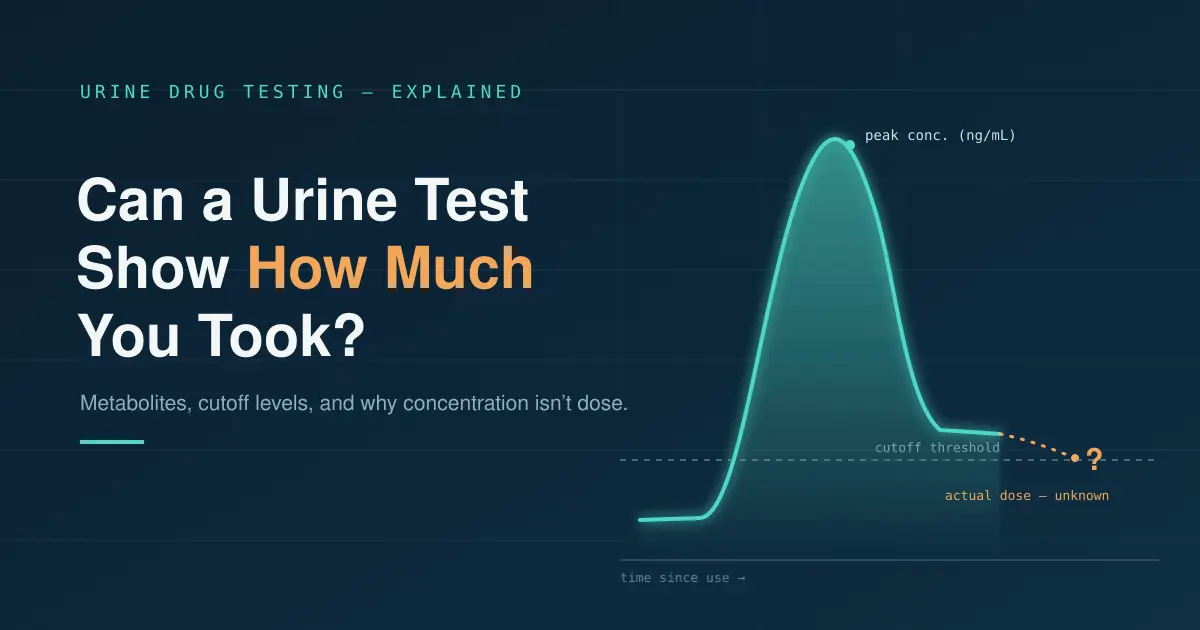
Urine drug testing is the most common screening method used by employers, treatment programs, and healthcare providers — but it has a well-known limitation: it cannot tell anyone the exact dose of a drug you took. Below is a complete breakdown of why that’s true, how urine tests actually work, and what the results really mean.
Quick Answer: No, Urine Tests Don’t Measure Dosage
A standard urine drug test cannot show exactly how much of a substance was consumed or precisely when it was taken. Urine tests detect drug metabolites — the byproducts your liver and kidneys create while processing a substance — not the raw dose itself. Two people who take the identical amount of a drug can produce very different metabolite readings depending on hydration, metabolism, body composition, and timing.
Qualitative Screens vs. Quantitative Lab Tests
Understanding urine drug testing starts with knowing there are two distinct types of results:
Standard (Immunoassay) Screening
This is the rapid cup test used in most workplaces, clinics, and at-home kits. It’s qualitative only — it returns a positive or negative result based on whether metabolite levels exceed a preset cutoff concentration. It does not report a number.
Confirmation (Definitive) Lab Testing
When a screen comes back positive, labs often run a confirmation test using Gas Chromatography-Mass Spectrometry (GC-MS) or Liquid Chromatography-Mass Spectrometry (LC-MS). These methods are quantitative, reporting an exact metabolite concentration in nanograms per milliliter (ng/mL). Even so, that number still doesn’t translate into milligrams consumed — it only reflects what’s currently in that specific urine sample.
Why Urine Concentration Isn’t the Same as Dose
Even a precise ng/mL reading can’t be converted into “how much you took.” Several biological variables distort the relationship between dose and detected concentration:
- Hydration levels — Drinking a lot of water dilutes urine and lowers apparent concentration; dehydration concentrates it, even for the same dose.
- Metabolism speed — Age, genetics, body weight, and liver function all affect how fast a substance is broken down and excreted. Fast metabolizers show quick spikes; slow metabolizers show lower, more prolonged levels.
- Frequency of use — Fat-soluble substances like THC accumulate in body tissue. A high reading could mean one large recent dose, or it could reflect small daily use building up over time.
- Time since use — A high concentration might simply mean recent use of a small amount, while a low concentration could reflect a large dose taken days earlier that’s finally clearing the system.
- Body fat and weight — Fat-soluble drugs store in adipose tissue and release slowly, extending detection time independent of dose size.
- Urine dilution and pH — Both affect how concentrated metabolites appear in a given sample, sometimes prompting labs to adjust for creatinine levels to account for hydration status.
Because of these variables, two people taking the exact same dose can generate completely different lab numbers, and the same person could test differently from one day to the next.
What Urine Drug Tests Are Actually Designed to Measure
Since dosage can’t be determined, urine testing is used for different purposes:
- Presence or absence of a substance — confirming whether a drug is in someone’s system at all.
- Prescription compliance monitoring — checking that a patient is taking a prescribed medication as directed (and not diverting it) via quantitative testing.
- Trend tracking in treatment programs — comparing creatinine-adjusted levels over weeks to see if concentrations are declining, which supports abstinence.
- Polydrug use detection — flagging when multiple substances appear in one sample.
Urine Detection Windows by Substance
Detection time depends on the drug’s half-life, frequency of use, metabolism, and body composition — not the amount taken in a single dose.
| Substance | Typical Detection Window in Urine |
|---|---|
| Marijuana (THC) | 3–30 days (longer with chronic use) |
| Cocaine | 1–3 days |
| Opiates (morphine, heroin, codeine) | 1–3 days |
| Amphetamines/Methamphetamine | 1–3 days |
| Benzodiazepines | 3–7 days (up to 30 days with long-term use) |
| Methadone | 3–10 days |
| PCP | 3–7 days |
| Alcohol (EtG) | Up to 80 hours |
Occasional users typically clear a substance faster than chronic, daily users, since repeated use allows metabolites to accumulate in fat tissue and release gradually.
Which Drugs Show Up on a Urine Panel?
Panel size determines how many substances a single test screens for:
- 5-panel: THC, cocaine, opiates, amphetamines, PCP
- 10-panel: Adds benzodiazepines, barbiturates, methadone, propoxyphene, methaqualone
- 12–14-panel: Expands further to oxycodone, fentanyl, MDMA (ecstasy), and additional substances, sometimes including EtG for alcohol
Factors That Influence Test Accuracy
- Metabolic rate — faster processing shortens detection windows
- Hydration — dilute samples can lower detectable concentrations or trigger a “dilute” flag
- Body fat percentage — affects storage and gradual release of fat-soluble drugs
- Frequency and duration of use — chronic use extends detection time
- Cutoff threshold and test sensitivity — determines how low a concentration must be to still register positive
- Time elapsed since last use — the single biggest factor in whether a substance is still detectable at all
Frequently Asked Questions
Can a urine drug test tell how many pills or doses you took?
No. It can only indicate whether metabolite levels are above or below a cutoff threshold, not a specific quantity consumed.
Can you fail a drug test for lorazepam?
Yes — lorazepam is a benzodiazepine and will typically trigger a positive result on panels that screen for that drug class.
Can sildenafil cause a false positive drug test?
Sildenafil is not chemically related to standard screened drug classes and is not a typical cause of false positives on standard panels.
Will hydroxyzine show up on a drug test?
Hydroxyzine is not usually targeted by standard drug panels, though cross-reactivity varies by test brand and cutoff sensitivity.
How can I tell if a result is diluted rather than negative?
Labs often check creatinine levels alongside metabolite concentration; unusually low creatinine combined with low specific gravity can flag a sample as diluted rather than a true negative.
The Bottom Line
Urine drug tests are excellent at confirming whether a substance is present in the body, but they were never designed to calculate exact dosage. Metabolite concentration is shaped by hydration, metabolism, body composition, and timing — not just how much was taken. For anyone facing testing for employment, legal, or treatment purposes, understanding this distinction helps set realistic expectations about what results can and can’t reveal.