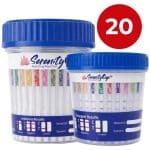
Urine Temperature for a Drug Test: What’s Normal?

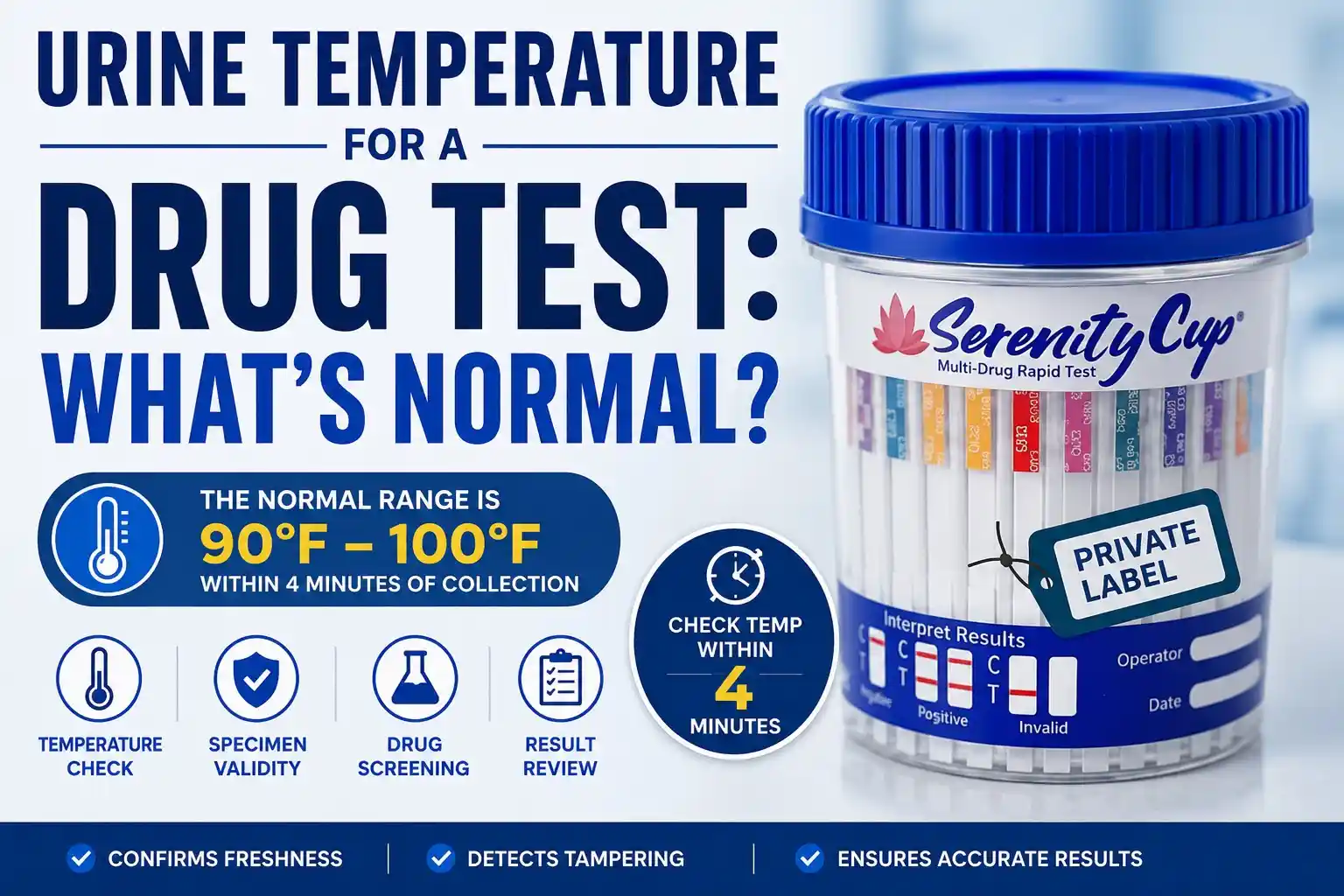
A valid urine specimen for a drug test must register between 90°F and 100°F within four minutes of collection. That narrow window matches normal human body temperature and is the first checkpoint a collection technician uses to confirm a sample was just produced by the donor — not carried in, stored, or swapped.
But temperature is only step one. Laboratories and point-of-care collectors also examine creatinine, specific gravity, pH, and oxidants before a specimen is accepted as valid. Understanding the full picture — not just the temperature strip — is what separates a compliant collection process from one that gets challenged, rejected, or sent back for recollection.
Editorial Note: This article is intended for educational purposes and summarizes standard urine specimen collection practices used in workplace, clinical, and forensic drug testing. Collection procedures may vary depending on employer policies, laboratory protocols, and applicable federal or state regulations.
How a Urine Drug Test Works
Before diving into temperature specifics, it helps to see where that check fits in the larger testing process. A standard urine drug test at a collection site typically follows these stages:
| Step | What Happens |
|---|---|
| Sample collected | Donor provides a urine specimen, often behind a private stall, with the collection technician waiting immediately outside |
| Temperature check | Collector reads the built-in strip within 4 minutes of collection |
| Specimen validity testing | pH, creatinine, and specific gravity are checked to confirm the sample is genuine and undiluted |
| Initial drug screen | An immunoassay test screens for the presence of drug analytes above a set screening cutoff |
| Confirmation (if needed) | Presumptive positive results are confirmed using GC-MS or LC-MS/MS at a laboratory |
| Medical Review Officer review | An MRO reviews any non-negative result, including any legitimate medical explanations, before it’s finalized |
| Final report | Result is reported as negative, positive, invalid, or rejected on the Chain of Custody Form (or Federal Custody and Control Form for regulated testing) |
Every stage after collection depends on the specimen passing the earlier ones. A sample that fails the temperature check or specimen validity testing never even reaches drug screening — it’s flagged for an observed recollection instead.
What Is the Normal Urine Temperature for a Drug Test?
Normal freshly voided urine falls between 90°F and 100°F (32.2°C–37.7°C), slightly below core body temperature of 98.6°F due to minor heat loss during collection. Federal collection guidelines, including those referenced by SAMHSA and DOT-regulated testing programs, use this same range as the accepted standard across workplace, clinical, and forensic specimen collections.
Any reading outside this range doesn’t automatically mean a donor used drugs — it’s a flag for potential specimen substitution or dilution, which triggers a separate review process at the collection site.
Why Temperature Is Checked Immediately After Collection
Urine begins cooling the moment it leaves the body. Checking temperature immediately — within four minutes — captures the sample close to its original physiological state, before ambient air, cup material, or handling can meaningfully shift the reading.
This short window matters for a practical reason: a substituted specimen (synthetic urine, another person’s urine, or tap water) brought in from outside the collection site has almost no way to stay within 90–100°F by the time it’s tested, unless it’s been actively concealed and warmed — something a trained collection technician is also watching for.
Why Laboratories Use the 90°F–100°F Range
The range isn’t arbitrary. It reflects the physiology of freshly excreted urine and the realistic cooling curve that occurs during a supervised collection.
- Body temperature: Internal body temperature averages 98.6°F, and urine stored in the bladder sits close to that.
- Cooling rate: Once outside the body, urine loses heat gradually, typically a few degrees within the first several minutes, which is why the four-minute check window aligns with the lower bound of 90°F.
- Physiology: Individual variation (hydration, recent activity, fever) can shift a donor’s baseline slightly, which is why the range has a built-in buffer rather than a single fixed number.
Together, these factors give collectors a realistic, evidence-based tolerance rather than a strict single temperature point.
How Temperature Strips Work on Drug Test Cups
Most drug test cups use a built-in temperature indicator strip based on liquid crystal technology. As urine fills the cup, heat-sensitive liquid crystals embedded in the strip react to the specimen’s temperature and change color to indicate a numeric reading.
Key features of these strips:
- Liquid crystal technology: Reacts to precise temperature ranges, changing color as heat transfers from the sample to the strip.
- Built-in thermometer strip: Integrated directly into the cup, so no separate device or probe is needed.
- Immediate reading: Most strips display an accurate reading within 15–60 seconds of contact with the specimen, well inside the four-minute window.
- Color indicator: A highlighted number or shaded zone lets the collector read the result at a glance, reducing interpretation error.
What the Temperature Reading Means
| Temperature | Meaning | Typical Next Step |
|---|---|---|
| Below 90°F | Possible substitution, dilution, or excessive collection delay | Observed recollection |
| 90°F–100°F | Within normal physiological range | Specimen proceeds to validity and drug screening |
| Above 100°F | Possible overheating from an attempt to warm a substituted specimen | Observed recollection |
What Happens If the Sample Is Too Cold?
A reading below 90°F is treated as out of range and is one of the most common triggers for a directly observed recollection. A cold reading can result from a specimen brought in from outside the facility, excessive delay between voiding and strip contact, or a donor attempting to dilute or tamper with the sample using cold water.
What Happens If the Sample Is Too Hot?
A reading above 100°F is equally disqualifying and often points to active tampering — for example, a donor attempting to heat a substituted specimen to mimic body temperature but overshooting the target range. Because devices used to warm synthetic or borrowed urine are hard to calibrate precisely, overheated specimens are a common giveaway of attempted substitution.
What Is Specimen Validity Testing (SVT)?
Specimen validity testing is the broader laboratory process used to confirm that a urine specimen is human, undiluted, unsubstituted, and free of adulterants — independent of whether drug metabolites are present. SVT is what determines whether a result can even be reported before any drug screening result is considered meaningful, and it’s a required component of federal workplace testing programs, including DOT-regulated collections.
Laboratories perform SVT because temperature alone can’t catch every form of tampering. A donor could theoretically bring in a specimen close to body temperature, or dilute a genuine sample with water, in ways that a temperature strip won’t detect on its own. SVT exists specifically to close that gap by examining the chemical composition of the specimen itself.
Why labs perform SVT. Federal workplace testing guidelines require that every specimen undergo validity testing as a standard part of laboratory accessioning, alongside — not instead of — drug screening. This protects the integrity of the overall program and gives both donors and employers confidence that a reported result reflects an authentic, undiluted human specimen.
Invalid specimens. A specimen is classified as invalid when lab results are inconsistent or fall outside expected physiological ranges in a way that can’t be explained by dilution, substitution, or adulteration alone — for example, conflicting creatinine and specific gravity readings. Invalid results generally require a second collection.
Dilute specimens. A dilute specimen has abnormally low creatinine and specific gravity, usually because the donor consumed excessive fluids before testing. Depending on the degree of dilution and program policy, a dilute negative result may still be reported, or a recollection may be required.
Adulterated specimens. An adulterated specimen contains a substance not normally found in urine — most often an oxidizing agent like nitrite or glutaraldehyde — introduced in an attempt to interfere with drug detection. Adulterated results are typically treated as a refusal to test under federal workplace programs.
Substituted specimens. A substituted specimen has creatinine and specific gravity so far outside the human physiological range that the lab concludes it isn’t human urine at all. Like adulteration, substitution is generally treated as a refusal to test.
Rejected specimens. A specimen is rejected for testing — rather than reported with a result — when there’s a fatal flaw in collection or chain of custody procedures, such as a broken tamper-evident seal, insufficient volume, or missing documentation on the Chain of Custody Form. A rejected specimen typically requires an entirely new collection.
Laboratory Confirmation: From Screening to Final Result
A temperature check does not determine whether drugs are present. Once a specimen passes validity checks, laboratories typically perform an initial immunoassay screen, which flags specimens where drug analyte levels exceed a preset screening cutoff.
A presumptive positive from immunoassay screening isn’t a final result. Those specimens are then confirmed using highly specific analytical methods — gas chromatography-mass spectrometry (GC-MS) or liquid chromatography-tandem mass spectrometry (LC-MS/MS) — tested against a separate, typically lower confirmatory cutoff. Only after confirmation does a Medical Review Officer (MRO) review the result, checking for legitimate medical explanations such as a valid prescription, before the final report is issued to the employer or requesting party.
Other Validity Checks Besides Temperature
| Check | Purpose |
|---|---|
| Temperature | Confirms freshness at time of collection |
| Creatinine | Detects dilution |
| Specific Gravity | Measures water/concentration content |
| pH | Flags chemical contamination or substitution |
| Nitrite | Detects common adulterant products |
| Oxidants | Identifies tampering agents like glutaraldehyde |
Point-of-care drug test cups that are CLIA Waived typically screen for temperature and, depending on the model, some combination of these additional markers, giving a collection technician an immediate first-line check before a specimen is ever sent to a laboratory for confirmatory testing.
Factors That Can Affect Urine Temperature
Several variables beyond substitution can influence a temperature reading:
- Fever or illness — An elevated body temperature can push a genuine specimen slightly above the typical range.
- Intense exercise — Physical exertion shortly before collection can raise a donor’s baseline temperature.
- Time and collection delays — Delays between voiding and strip contact allow natural cooling.
- Environment and outdoor temperatures — Cold or air-conditioned collection sites, or outdoor collection settings, accelerate heat loss.
- Cup material — Insulation and strip placement vary by manufacturer and can affect reading speed.
- Transport time — A specimen moved between rooms or facilities before the strip is read risks an inaccurate temperature reading.
- Waiting before handing the cup over — A donor who delays handing the specimen to the collector reduces the accuracy of the check.
- Storage — A cup left on a counter versus handled immediately will read differently.
Because of these variables, a collection technician is trained to read the strip promptly and document the exact time of collection alongside the temperature result.
What Happens If Temperature Is Out of Range?
When a specimen registers outside 90°F–100°F, standard chain of custody procedures call for:
- Documenting the temperature and time on the Chain of Custody Form
- Notifying the donor of the out-of-range result
- Arranging an immediate, directly observed recollection
- Retaining the original specimen per collection site policy for reference
In some programs, an out-of-range temperature combined with other red flags may also prompt a split specimen procedure, where a portion of a subsequent sample is set aside for independent testing if the donor disputes the result. This process protects both the donor and the testing program by ensuring irregular results are addressed at the point of collection rather than after laboratory results are already in progress.
Frequently Asked Questions
Why is urine temperature checked before drug testing?
Temperature confirms the sample was freshly produced by the donor at the time of collection, helping rule out substitution with an outside or previously stored specimen.
How fast does urine cool after collection?
Freshly voided urine typically drops from near body temperature toward the lower end of the acceptable range within the first few minutes, which is why the four-minute check window is used.
What happens if urine temperature is too low?
A reading below 90°F is flagged as out of range and generally requires a second, observed collection.
What happens if urine temperature is too high?
A reading above 100°F is also out of range and often indicates an attempt to substitute a warmed specimen; it also typically triggers a recollection.
How do drug test cups measure temperature?
Most cups use a built-in liquid crystal strip that changes color to display a numeric temperature reading within roughly 15–60 seconds of contact with the sample.
Does room temperature affect a urine sample?
Yes. A cold collection environment can accelerate cooling, while a warm environment can slow it, which is why prompt reading within four minutes matters.
What other validity checks are performed besides temperature?
Creatinine, specific gravity, pH, and oxidant/nitrite levels are commonly evaluated to detect dilution, substitution, or chemical adulteration.
What is specimen validity testing (SVT)?
SVT is the set of laboratory checks used to confirm a urine specimen is genuine, undiluted, and free of adulterants, separate from the screening for drug metabolites themselves.
Can a valid sample still fail a drug test?
Yes. Temperature and other validity markers confirm the sample is fresh and authentic — they don’t determine whether drugs are present. A specimen can pass SVT and still return a positive drug screening result, or vice versa.
Can temperature alone detect tampering?
No. Temperature is only the first screening step. Labs and point-of-care cups also evaluate pH, creatinine, specific gravity, and oxidants to build a complete picture of specimen integrity.
How accurate are temperature strips?
Liquid crystal temperature strips built into collection cups are generally accurate within a degree or two and are designed to give collectors a fast, visible reading well within the required four-minute window.
People Also Ask
Is urine always 98.6°F?
No. Freshly voided urine is usually slightly below core body temperature, typically landing in the 90–100°F range rather than exactly 98.6°F, due to minor heat loss during voiding and collection.
How long does urine stay warm?
Urine generally stays within the acceptable temperature range for only a few minutes after collection, which is why laboratories and collection sites require a temperature reading within four minutes.
Can room temperature affect urine?
Yes. A cold or air-conditioned room accelerates cooling, while a warm room slows heat loss, which can shift a temperature reading if the strip isn’t checked promptly.
What is considered an invalid urine specimen?
An invalid specimen has laboratory results that are inconsistent with normal human urine but can’t be clearly explained by dilution, substitution, or adulteration, usually requiring a new collection.
Can dehydration affect urine temperature?
Dehydration itself has limited direct effect on temperature, but it can affect creatinine and specific gravity readings, which are evaluated separately during specimen validity testing.
Why is urine temperature checked within four minutes?
The four-minute window captures the specimen close to its original physiological state, before ambient conditions can meaningfully cool or otherwise alter the reading.
Does urine temperature prove someone passed or failed?
No. Temperature only confirms the specimen appears fresh and human; whether someone “passes” or “fails” depends entirely on the separate drug screening and confirmation results.
What happens after an observed recollection?
The new specimen undergoes the same temperature check, specimen validity testing, and drug screening process as the original, this time under direct observation by a same-gender collector.
Can laboratories detect synthetic urine?
Yes. Synthetic urine typically fails specimen validity testing because it lacks the creatinine, urea, and other biological markers found in genuine human urine, even if its temperature is within range.
What is a split specimen?
A split specimen is a portion of a donor’s urine collection set aside at the time of collection so it can be independently tested later if the donor disputes the primary result.