How to Pass a Supervised Drug Test Female

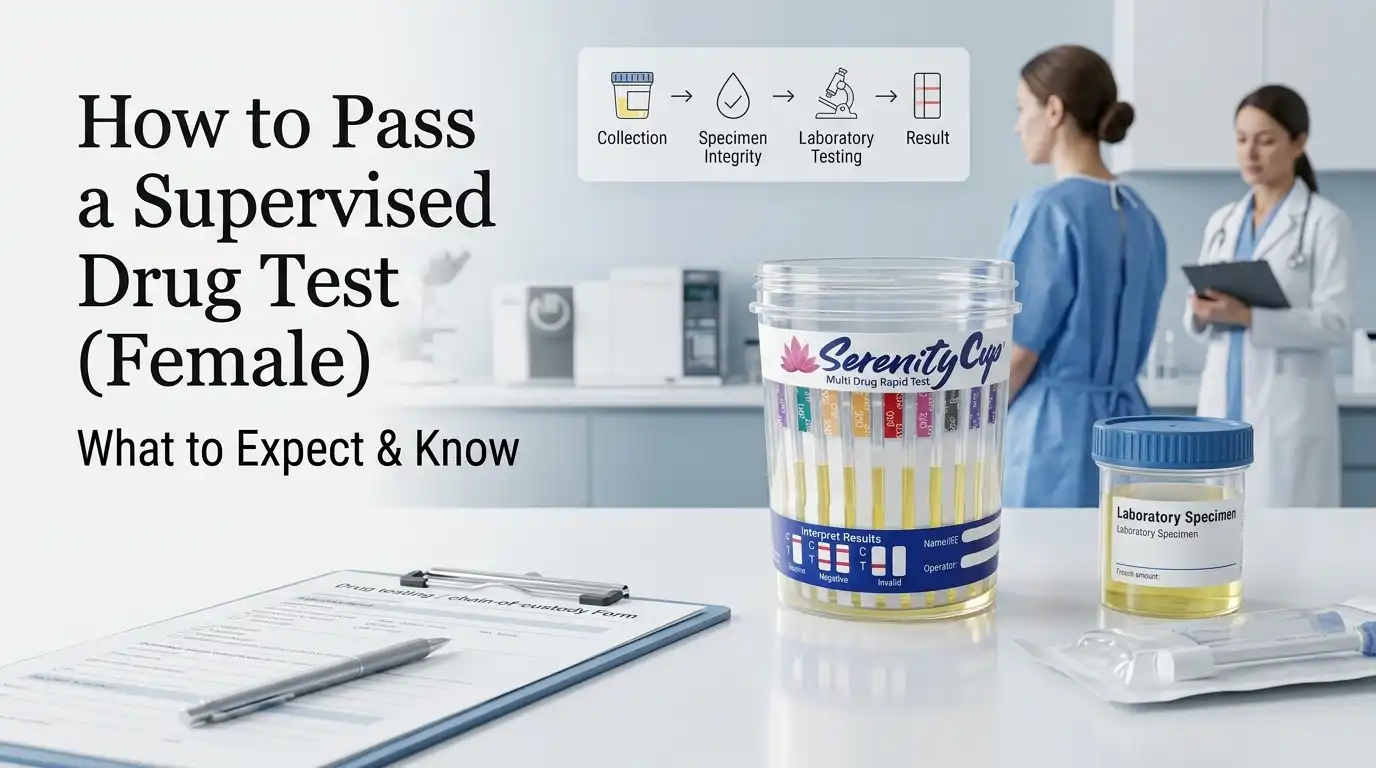
If you are searching for “how to pass a supervised drug test female,” the most important thing to understand is that there is no guaranteed method that can instantly make a drug test negative. A supervised test is specifically designed to protect the integrity of the urine sample and reduce the possibility of substitution or tampering.
For women, the process can also raise practical questions about privacy, menstruation, pregnancy, medications, anatomy, and what exactly happens during collection.
The useful approach is to understand how supervised drug testing works, what can affect a result, how laboratories analyze urine, and what happens if a result requires further review.
This guide explains the process in detail without relying on unverified detox claims or test-manipulation methods.
What Is a Supervised Drug Test?
A supervised drug test is a drug test in which the collection process receives additional observation or monitoring to protect the integrity of the specimen.
The exact procedure depends on the testing program and applicable rules. In some programs, a routine urine collection takes place privately, while a directly observed collection involves an authorized observer watching the urine pass from the donor’s body into the collection container.
For example, under U.S. Department of Transportation (DOT) rules, direct observation is used only in specified circumstances, such as certain return-to-duty or follow-up tests or situations involving suspected specimen tampering or particular invalid/dilute results. The federal procedure also specifies requirements concerning the observer.
That means “supervised” does not necessarily mean every person taking a drug test will be watched while urinating. The applicable testing program determines the collection procedure.
How Does a Supervised Urine Drug Test Work?
Although procedures vary, a supervised urine drug test generally involves several stages.
1. Identification
The testing facility verifies the identity of the person providing the specimen.
This protects the chain of custody and helps ensure that the specimen is associated with the correct individual.
2. Pre-Collection Instructions
The collector explains the collection procedure and any applicable requirements.
Depending on the program, the donor may be instructed about:
- personal belongings
- collection containers
- restroom procedures
- specimen handling
- documentation
- medications that should be disclosed
3. Urine Collection
The donor provides the urine specimen according to the applicable collection procedure.
In a directly observed collection, an authorized observer is present according to the rules governing that testing program.
For DOT-regulated testing, the observer must generally be the same sex as the employee, subject to the specific federal exceptions and procedures.
4. Initial Specimen Inspection
After collection, the specimen is handled according to the testing program’s procedures.
The collector may check aspects of the specimen and documentation necessary to protect specimen integrity.
5. Chain of Custody
The specimen is documented and transferred through the testing process.
Chain of custody means there is a documented record of the specimen from collection through laboratory processing and reporting.
DOT describes the collector as responsible for receiving and making an initial inspection of the specimen and initiating/completing the Federal Drug Testing Custody and Control Form.
6. Laboratory Testing
The specimen may undergo an initial screening process.
If an initial test indicates the presence of a targeted drug or metabolite, applicable programs may require confirmatory testing using a more specific analytical method.
SAMHSA’s current MRO guidance describes mass-spectrometry-based confirmation methods such as GC-MS, GC-MS/MS, LC-MS, and LC-MS/MS.
7. Medical Review
In federally regulated workplace testing, a Medical Review Officer (MRO) reviews certain laboratory results before the final result is reported.
The MRO can consider relevant medical information, including legitimate prescription use, when determining how a result should be reported.
SAMHSA provides current MRO guidance and resources for federal workplace drug-testing programs.
Do Women Have a Different Supervised Drug Test?
The fundamental drug-testing science is not completely different simply because the person being tested is female.
However, women can have practical and medical considerations that are worth understanding.
These may include:
- female anatomy during urine collection
- menstruation
- pregnancy
- prescription medications
- hormonal medications
- privacy concerns
- anxiety about observed collection
- medical conditions
- questions about collection accommodations
The important distinction is between factors that affect the collection experience and factors that actually change whether a drug or metabolite is detected.
Can Menstruation Affect a Drug Test?
Menstruation itself should not be treated as an automatic explanation for a positive drug result.
A urine drug test is designed to analyze specific substances or metabolites rather than determine whether someone is menstruating.
However, menstruation can create practical concerns during urine collection, particularly around privacy and specimen collection.
If you have concerns about menstruation and the collection process, ask the testing facility about its procedures rather than relying on online claims.
It is also important not to assume that hormonal changes automatically make a drug disappear faster or slower from urine. Detection depends on multiple variables, including the substance, exposure history, specimen type, analytical method, and cutoff.
Can Pregnancy Affect a Supervised Drug Test?
Pregnancy is an important medical consideration, but it does not mean that a urine drug test automatically becomes unreliable.
Pregnancy can involve changes in physiology, medications, hydration, and medical care. If you are pregnant or think you may be pregnant, it is reasonable to tell an appropriate healthcare professional or testing provider when relevant.
Do not use pregnancy as a reason to attempt to alter or manipulate a specimen.
If you are taking prescription medication during pregnancy, keep documentation of your medications and discuss concerns with your healthcare provider.
Can Prescription Medications Cause a Positive Drug Test?
This is one of the most important questions surrounding urine drug testing.
Some medications can produce results that require additional investigation, while other medications are specifically identified through confirmatory testing.
An initial screening result is not necessarily the same thing as a final verified result.
Modern workplace testing programs may use a combination of:
Initial screening → confirmatory testing → medical review
SAMHSA’s MRO guidance explains the role of confirmatory testing and medical review in federally regulated testing programs.
What should you do?
Keep an accurate list of:
- prescription medications
- over-the-counter medications
- relevant medical treatments
- supplements when requested by the testing program
If a result requires medical review, provide legitimate documentation through the appropriate process.
Do not stop prescribed medication simply because you have an upcoming drug test unless your healthcare professional tells you to do so.
How Long Do Drugs Stay Detectable in Urine?
There is no single detection window that applies to every drug or every person.
This is one of the biggest problems with online “pass a drug test” advice.
Detection can be influenced by:
- substance tested
- amount of exposure
- frequency of use
- repeated vs isolated exposure
- metabolism
- specimen type
- drug formulation
- laboratory method
- analytical cutoff
- individual biological factors
Therefore, claims such as “drink this and you’ll be clean in 24 hours” should not be treated as scientifically reliable.
A supervised collection does not necessarily change the biological detection window. What supervision changes is the integrity and security of the collection process.
What Is the Difference Between Supervised and Unsupervised Drug Testing?
The main difference concerns specimen collection and security.
| Feature | Routine/Unsupervised Collection | Supervised/Observed Collection |
|---|---|---|
| Urine specimen | Yes | Yes |
| Identification | Usually required | Usually required |
| Collection documentation | Yes | Yes |
| Chain of custody | Program-dependent | Program-dependent |
| Direct observation | Usually no | When required |
| Additional specimen-security measures | Yes | Increased |
| Laboratory testing | May be performed | May be performed |
| MRO review | Depends on program | Depends on program |
The exact terminology matters because monitored, supervised, and directly observed collections can have different meanings under different testing programs.
For example, DOT regulations distinguish monitored collections from directly observed collections.
What Happens During a Directly Observed Urine Test?
For a directly observed collection under DOT rules, the process has additional safeguards.
The observer must follow the applicable procedure and, in a federal DOT direct-observation collection, must generally be the same sex as the employee. The observer is required to directly observe the urine leaving the employee’s body and entering the collection container.
The purpose is specimen integrity, not embarrassment or punishment.
The process is intended to prevent:
- specimen substitution
- deliberate adulteration
- use of another person’s specimen
- other forms of collection interference
Because the exact requirements vary by program, people should follow the instructions provided by their testing facility or governing organization.
What Is Chain of Custody in Drug Testing?
Chain of custody is the documented history of a specimen from collection through testing and reporting.
It helps establish:
- whose specimen was collected
- when it was collected
- how it was identified
- how it was transferred
- which laboratory received it
- how the result was reported
For regulated DOT testing, the collector initiates and completes the Federal Drug Testing Custody and Control Form and follows prescribed specimen-handling procedures.
Chain of custody is particularly important when a drug-test result may have employment, legal, or regulatory consequences.
What Is Specimen Validity Testing?
A urine specimen may be evaluated for characteristics that help determine whether it is suitable for testing.
Depending on the testing program, laboratories may evaluate characteristics such as:
- creatinine
- specific gravity
- pH
- other indicators of specimen integrity
A specimen can therefore be negative for the targeted drug while still raising a specimen-validity issue.
This is one reason why simply trying to change urine characteristics is not a reliable strategy.
The purpose of specimen-validity testing is to help determine whether the sample is consistent with a valid specimen.
What Happens If a Urine Sample Is Diluted?
A diluted specimen does not automatically mean that drugs were present.
It means that the urine’s characteristics may indicate a lower-than-expected concentration of certain specimen components.
Depending on the applicable testing program, a negative-dilute result may lead to additional procedures or recollection.
Under DOT rules, certain negative-dilute results can trigger a directly observed recollection under specified circumstances.
Important:
Drinking excessive amounts of water before a drug test is not a dependable way to eliminate drug metabolites.
It can also cause health problems if water intake becomes excessive.
The goal should be normal, appropriate hydration rather than trying to manipulate urine concentration.
Can Detox Drinks Help You Pass a Supervised Drug Test?
There is no reliable evidence that a commercial “detox drink” can guarantee a negative supervised drug test.
Many detox products make claims involving:
- flushing
- cleansing
- masking
- dilution
- rapid detoxification
But drug testing is designed around specific analytes and metabolites, laboratory cutoffs, and specimen validity.
A beverage cannot be assumed to remove previously incorporated drug metabolites on demand.
This is particularly important with supervised testing because collection controls are specifically designed to protect specimen integrity.
Does Drinking Water Help You Pass?
Normal hydration is important for health.
However, excessive water consumption is not a reliable method for removing drugs from the body.
Very dilute urine can also become a specimen-validity issue.
Therefore:
Hydration is not the same thing as detoxification.
Do not intentionally consume excessive water to try to manipulate a urine test.
What About Cranberry Juice, Vinegar, Baking Soda, or Niacin?
These substances are frequently mentioned online as supposed ways to “pass” a drug test.
There is a major difference between:
Internet claims
and
validated laboratory evidence.
Cranberry juice, vinegar, baking soda, niacin, pickle juice, and similar home remedies should not be considered guaranteed methods for producing a negative drug-test result.
They also have different health risks depending on the substance and amount consumed.
The safer approach is to understand the actual testing process rather than experiment with home remedies.
Can Exercise Change a Drug Test Result?
Exercise is healthy for many people, but exercise should not be treated as an emergency drug-test solution.
The relationship between physical activity, metabolism, stored substances, and urinary metabolites is complex and varies by substance and individual.
There is no universal exercise routine that guarantees a negative drug test.
Avoid extreme exercise immediately before testing as a supposed “detox” strategy.
Can You Pass a Supervised Drug Test by Using Synthetic Urine?
Trying to substitute a specimen or introduce a synthetic specimen is not a legitimate testing strategy, and supervised/directly observed collection procedures are specifically designed to protect against substitution.
Under DOT procedures, suspected tampering can result in additional collection procedures, including direct observation under specified circumstances.
Attempting to interfere with a regulated test can also create consequences separate from the laboratory result.
What Drugs Can a Supervised Urine Drug Test Detect?
The answer depends on the specific panel ordered.
A urine drug test may be designed to screen for substances or classes such as:
- cannabinoids
- cocaine metabolites
- amphetamines
- opioids
- phencyclidine
- benzodiazepines
- methamphetamine
- other specified substances
Not every drug test includes every substance.
The test panel is determined by the employer, healthcare provider, court, treatment program, regulator, or other organization that ordered the test.
How Accurate Is a Supervised Drug Test?
Supervision primarily improves collection integrity. It does not mean that every drug test is infallible.
Drug testing generally involves analytical processes designed to identify specific substances or metabolites.
Potential issues can include:
- screening results requiring confirmation
- specimen validity problems
- laboratory errors
- analytical limitations
- medication-related questions
- insufficient specimen information
For federally regulated workplace testing, confirmatory testing uses more specific analytical techniques, including mass spectrometry methods.
So the statement “supervised means 100% accurate” is too broad.
A better description is:
Supervision helps protect the integrity of specimen collection, while laboratory methods and confirmation procedures help determine what the specimen contains.
What Is an MRO?
MRO stands for Medical Review Officer.
An MRO is a physician who reviews certain drug-testing results within regulated testing programs.
The MRO process is particularly important when a laboratory result requires medical interpretation.
For example, if a person legitimately takes a medication that could be relevant to a drug-test result, the MRO may review the available medical information according to the applicable rules.
SAMHSA publishes specific guidance for MROs involved in federal workplace drug testing.
What Happens After a Non-Negative Drug Test?
A preliminary or initial laboratory result is not necessarily the final outcome.
Depending on the testing program, the process can involve:
- Initial screening
- Confirmatory testing
- Laboratory reporting
- MRO review, where applicable
- Final reporting to the authorized recipient
SAMHSA explains that federal workplace testing uses laboratory testing and MRO review procedures, and certain programs provide rights related to testing of a retained split specimen.
If you receive a result that you believe is incorrect, ask the organization administering the test what review or retesting procedures apply to your specific program.
Can You Challenge a Drug Test Result?
The answer depends on the testing program and jurisdiction.
In federally regulated workplace testing, split-specimen procedures can provide an additional laboratory review option after an MRO-verified positive result. SAMHSA describes this process in its workplace drug-testing resources.
If the test is related to:
- employment
- probation
- court proceedings
- child custody
- professional licensing
- transportation
- treatment
the applicable procedures may differ.
If the result could have significant legal consequences, consult an appropriate professional familiar with the relevant rules.
How Can Women Reduce Anxiety About a Supervised Drug Test?
A supervised collection can feel uncomfortable, especially when someone has never experienced one before.
The following steps can make the process easier without trying to manipulate the result:
Understand the procedure
Knowing what will happen can reduce uncertainty.
Bring required identification
Follow the testing facility’s instructions.
Keep medication information available
If you take prescription medications, keep accurate information available if the testing program requests it.
Follow collection instructions
Don’t bring unnecessary items into the collection area.
Ask legitimate questions
If you’re unsure about the process, ask the collector before the collection begins.
Focus on normal hydration
Do not intentionally overhydrate.
Discuss medical concerns
If you have pregnancy-related concerns, medications, medical conditions, or accessibility needs, raise them through the appropriate channel.
Common Myths About Supervised Drug Tests
Myth 1: Cranberry juice can guarantee a negative result
There is no reliable basis for treating cranberry juice as a guaranteed method for eliminating drug metabolites.
Myth 2: Drinking huge amounts of water cleans the urine
Excessive water can dilute urine rather than remove drug metabolites and may create a specimen-validity issue.
Myth 3: Baking soda can remove drugs from the body
Online claims about baking soda should not be confused with validated drug-testing science.
Myth 4: Detox products can instantly eliminate metabolites
Drug metabolism and elimination do not work like a simple flushing process.
Myth 5: A supervised test can always be beaten with another person’s urine
Directly observed collection procedures are specifically intended to prevent specimen substitution.
Myth 6: Women automatically have longer detection windows than men
Gender alone does not provide a universal detection-window calculation. Detection depends on the substance, exposure history, specimen, analytical method, and individual factors.
Myth 7: A positive screening result always means a final positive result
Some testing programs require confirmatory testing and medical review before a final result is reported.
Supervised Drug Test Checklist for Women
Before your appointment, consider this simple checklist:
Before the test
- Know which type of drug test you are taking.
- Understand whether collection is supervised, monitored, or directly observed.
- Bring required identification.
- Know which medications you take.
- Follow the testing provider’s instructions.
- Avoid relying on online detox claims.
During the test
- Follow the collector’s instructions.
- Ask questions if the procedure is unclear.
- Provide the specimen according to the collection requirements.
- Do not attempt to alter or substitute the specimen.
- Tell the appropriate professional about legitimate medical concerns.
After the test
- Ask when and how results are reported.
- If the result requires MRO review, follow the instructions you receive.
- If you believe a result is incorrect, ask about the applicable review or retesting process.
Frequently Asked Questions
How do I pass a supervised drug test as a female?
There is no guaranteed last-minute method for making a drug test negative. The useful approach is to understand the testing procedure, know the applicable detection factors, disclose legitimate medications through the proper process, and provide a valid specimen.
What is a supervised urine drug test?
It is a urine drug test with additional collection monitoring or direct observation designed to protect specimen integrity. The exact procedure depends on the testing program.
Will a female observer be present?
For DOT-regulated directly observed urine collections, the observer must generally be the same sex as the employee, subject to the federal rules and exceptions.
Other testing programs can have different requirements.
Can my period affect my drug test?
Menstruation should not automatically be interpreted as causing a positive drug result. If you have concerns about collection during your period, ask the testing facility about its procedures.
Can pregnancy affect a drug test?
Pregnancy does not automatically make a urine drug test positive or negative. However, pregnancy can be medically relevant because of changes in health and medication use. Discuss relevant concerns with an appropriate healthcare professional.
Can birth control cause a positive drug test?
Do not assume that birth-control medication will cause a positive drug test. If a medication is relevant to your result, the appropriate medical-review process can consider legitimate medication use.
Can I drink lots of water before a supervised drug test?
Excessive water consumption is not a reliable way to eliminate drug metabolites and can result in a dilute specimen. Excessive water intake can also be dangerous.
Can detox drinks help with a supervised drug test?
There is no guaranteed detox drink that can reliably make a drug test negative on demand.
What happens if my urine is too diluted?
Depending on the testing program, a dilute result may require additional review or another collection. Specific procedures vary. DOT rules specify particular circumstances in which a negative-dilute result can trigger a directly observed recollection.
What does MRO mean?
MRO means Medical Review Officer. In regulated workplace testing, the MRO reviews certain laboratory results and relevant medical information before reporting the final result.
Can prescription medication affect a drug test?
Some medications can be relevant to a drug-test result. If a result requires medical review, legitimate prescription use can be considered through the appropriate process.
Can a supervised drug test be wrong?
No testing system should be described as infallible. Screening, confirmation, specimen validity, laboratory procedures, and medical review all play roles in determining a result.
What is chain of custody?
Chain of custody is the documented process used to track a specimen from collection through laboratory testing and reporting.
Can I request another test?
That depends on the testing program. Some regulated programs have specific split-specimen or retesting procedures. Ask the organization responsible for your test what options apply.
Final Takeaway
If you’re searching for “how to pass a supervised drug test female,” the most important point is that there is no reliable shortcut that guarantees a negative result.
A supervised drug test is designed to protect the integrity of the specimen through collection procedures, documentation, and, where applicable, laboratory and medical review.
For women, the most useful things to understand are:
- how supervised urine collection works
- the difference between monitored and directly observed testing
- detection-window variability
- prescription medications
- menstruation and pregnancy-related concerns
- specimen validity
- chain of custody
- laboratory confirmation
- MRO review
- what happens after a non-negative result
- the difference between evidence-based information and online detox claims
For DOT-regulated testing, current federal rules specify particular procedures for direct observation, specimen handling, and certain recollections. Other workplace, court, probation, or private testing programs may follow different rules, so the requirements for your specific test should come from the organization administering it.