Regulatory Compliance & Accuracy in Oral Fluid Drug Testing: The 2026 Guide for Decision-Makers

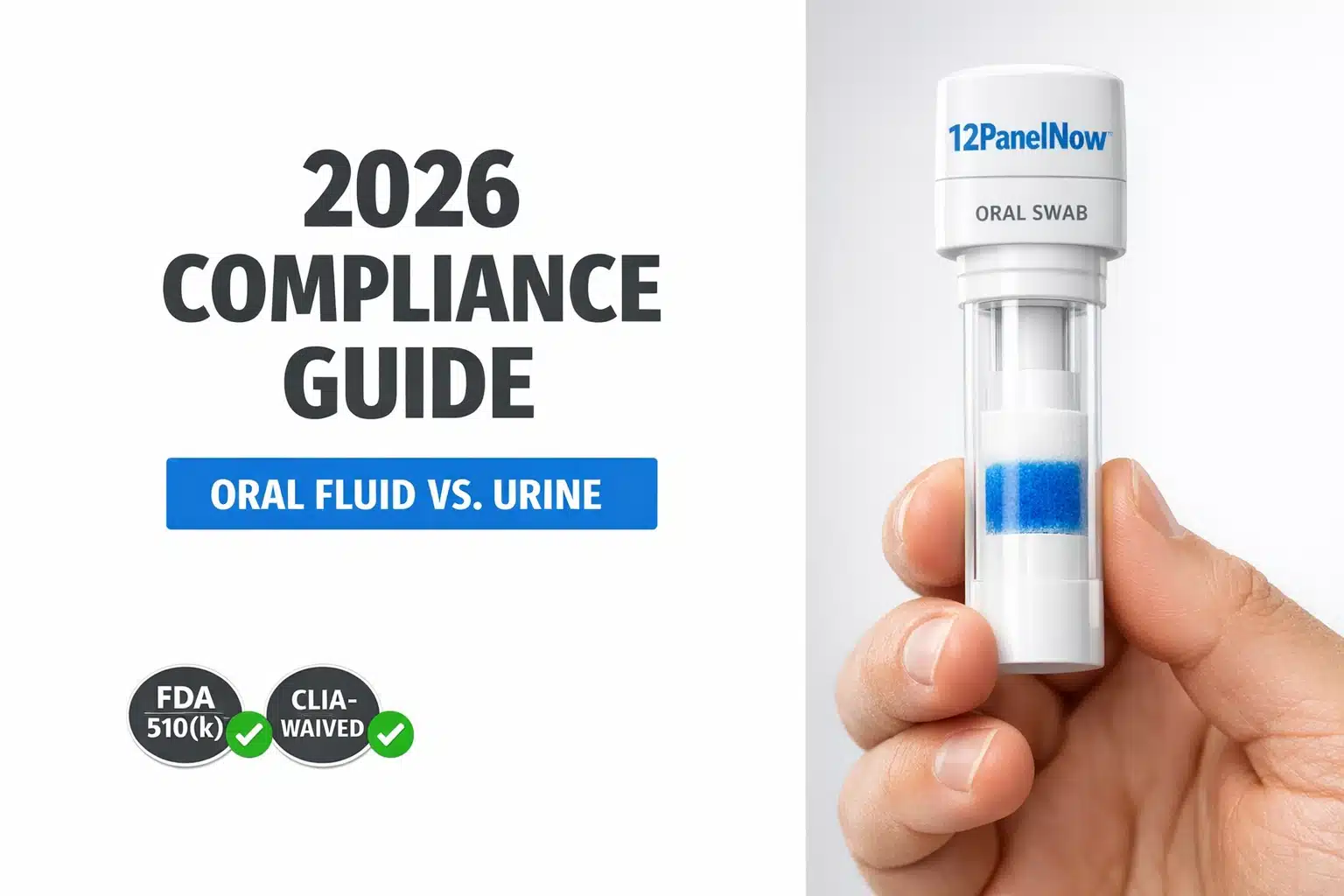
If you are currently evaluating your organization’s drug testing policy in 2026, you are likely wrestling with a fundamental shift in workplace safety: the transition from historical lookback testing to immediate impairment testing.
For decades, the standard procedure was sending employees to off-site clinics for urine analysis. However, as HR professionals and safety directors face mounting liabilities, a multi-million-dollar test-adulteration industry, and changing legal landscapes surrounding substance use, the central question has evolved. You no longer just need to know if an employee used a substance last week—you need defensible proof of whether they are under the influence right now.
Oral fluid drug testing has moved rapidly from a specialized niche to a high-intent, rigorously compliant alternative. But bridging the gap between a standard urine program and an on-site saliva protocol requires more than just buying a new product. It requires a clear understanding of legal defensibility, regulatory compliance, and scientific accuracy.
The New Era of Compliance: Why the Market is Shifting
The conversation around oral fluid testing fundamentally changed when the Department of Transportation (DOT) and the Substance Abuse and Mental Health Services Administration (SAMHSA) issued mandatory guidelines authorizing oral fluid for federal workplace testing. As HHS laboratory certifications for oral fluid have expanded into 2026, corporate America has followed suit.
Why the massive institutional shift? Because oral fluid testing solves the internal conflict between operational efficiency and safety compliance. However, to confidently transition your workplace program, you must understand the two primary regulatory labels that dictate legal defensibility: FDA 510(k) clearance and CLIA waivers.
Regulatory Decoder: FDA 510(k) vs. CLIA-Waived
When evaluating testing supplies, you will see “CLIA-waived” and “FDA-approved” frequently. For HR departments and legal teams, these aren’t just marketing buzzwords—they are the forensic trust signals that protect your organization from liability during disputes.
- FDA 510(k) Clearance: This indicates that the FDA has rigorously reviewed the device and determined it is “substantially equivalent” to legally marketed predicate devices. For oral swabs, an FDA 510(k) clearance proves that the test meets strict performance standards for accuracy, cut-off levels, and reliability. This is your primary shield for legal defensibility.
- CLIA-Waived: The Clinical Laboratory Improvement Amendments (CLIA) regulate lab testing. A “CLIA-waived” status means the test is so simple and accurate that the likelihood of an erroneous result is negligible. For employers, this is the operational green light. It means you legally do not need specialized laboratory personnel to administer the initial screen on-site.
Scientific Accuracy Deep-Dive: Parent Compounds vs. Metabolites
The most common question decision-makers ask is: “Is saliva actually as accurate as urine?”
The answer requires looking at the chemistry. Leading oral fluid devices demonstrate a greater than 98% agreement with Liquid Chromatography-Tandem Mass Spectrometry (LC-MS/MS) confirmation—the undisputed gold standard in laboratory testing.
But the true advantage of oral fluid lies in what it detects.
Urine tests detect metabolites—the chemical byproducts created after the body breaks down a drug. For example, a urine test detects THC-COOH, which can linger in a user’s system for days or weeks. This creates a liability gap: is the employee impaired on the warehouse floor today, or did they consume a substance legally over the weekend?
Oral fluid tests detect the parent compound. Because substances enter the oral cavity immediately upon use, a saliva swab detects actual THC. In a comprehensive 14-million test study, oral fluid detected twice as many recent THC users compared to urine. This is the “accuracy trigger” that safety-sensitive workplaces rely on. It directly correlates to recent use and current impairment, which is exactly what HR policies are meant to govern.
The “Cheater’s Nightmare”: Eliminating Subversion
We must have an honest conversation about the current testing landscape: adulteration is a massive industry. Synthetic urine, heating pads, and masking agents generate hundreds of millions of dollars annually.
Data shows that unobserved urine collections suffer from a 5-10% “cheat rate” (substitution or dilution). This compromises the integrity of your entire safety program.
Oral fluid testing completely neutralizes this risk through 100% observed collection. Because the swab is administered in plain sight—typically in a breakroom or manager’s office—the tampering success rate drops to less than 1%. You are no longer relying on the honor system behind a closed bathroom door.
The Total Cost of Collection (TCC): Beyond the Price Per Test
While premium urine analysis cups remain incredibly cost-effective (quality multi-panel cups can be sourced for as low as $1.69 each), evaluating oral fluid requires looking at the Total Cost of Collection (TCC).
Consider the operational friction of a urine test: the employee must be transported to a clinic, or a specialized bathroom must be secured on-site. If an employee claims a “shy bladder,” DOT guidelines allow up to three hours of waiting time. That is three hours of lost wages, lost productivity, and supervisory downtime.
Oral fluid tests are administered anywhere, anytime, in about five minutes. When you factor in the elimination of shy bladder delays, off-site clinic fees, and lost hourly productivity, the ROI of implementing a CLIA-waived saliva program becomes immediately apparent to your executive board.
Moving Forward with Confidence
Transitioning or upgrading your drug testing protocol doesn’t have to be a leap of faith. It should be a calculated decision backed by clinical accuracy, regulatory compliance, and unwavering reliability.
At 12 Panel Now, we’ve built our reputation on providing organizations with CLIA-waived testing supplies that boast a 99% reliability rate. As a family-owned, dedicated supplier, we understand that behind every test is a critical decision about workplace safety. Whether you are scaling an existing urine-based program with our highly affordable dip cards and cups, or evolving your safety-sensitive protocols with advanced oral fluid swabs, you need a partner whose primary focus is the integrity of your testing ecosystem.
FAQ: Evaluating Oral Fluid Tests for Your Organization
As you build the business case for integrating oral fluid testing, you will likely face these common objections from stakeholders:
Will saliva test results hold up in court or HR disputes?
Yes, provided you are using the right devices. By utilizing FDA 510(k) cleared testing supplies, you are using legally defensible devices validated for performance. When paired with a proper chain-of-custody for non-negative results to be confirmed by an LC-MS/MS laboratory, your program is forensically sound.
Can employees cheat an oral swab test?
It is practically impossible. Because oral fluid collections are 100% observed from start to finish, the 5-10% substitution and dilution rates associated with urine testing drop to near zero. There is no opportunity to introduce synthetic fluids.
Are oral swabs difficult to administer?
No. Because they are CLIA-waived, they are explicitly designed for layperson use. The administrator simply places the sponge in the donor’s mouth until the indicator shows sufficient fluid has been collected, then reads the results directly on the device in minutes.
How do I choose between Urine and Saliva for my program?
You don’t necessarily have to choose just one. Many sophisticated 2026 testing programs use a hybrid approach. They utilize high-quality, affordable multi-panel urine cups for pre-employment screening (where historical lookback is valuable) and deploy oral fluid swabs for reasonable suspicion and post-accident testing (where immediate impairment and rapid, on-site collection are critical).