Implementing Oral Fluid Testing in Workplace & DOT Programs: The 2026 Readiness Roadmap

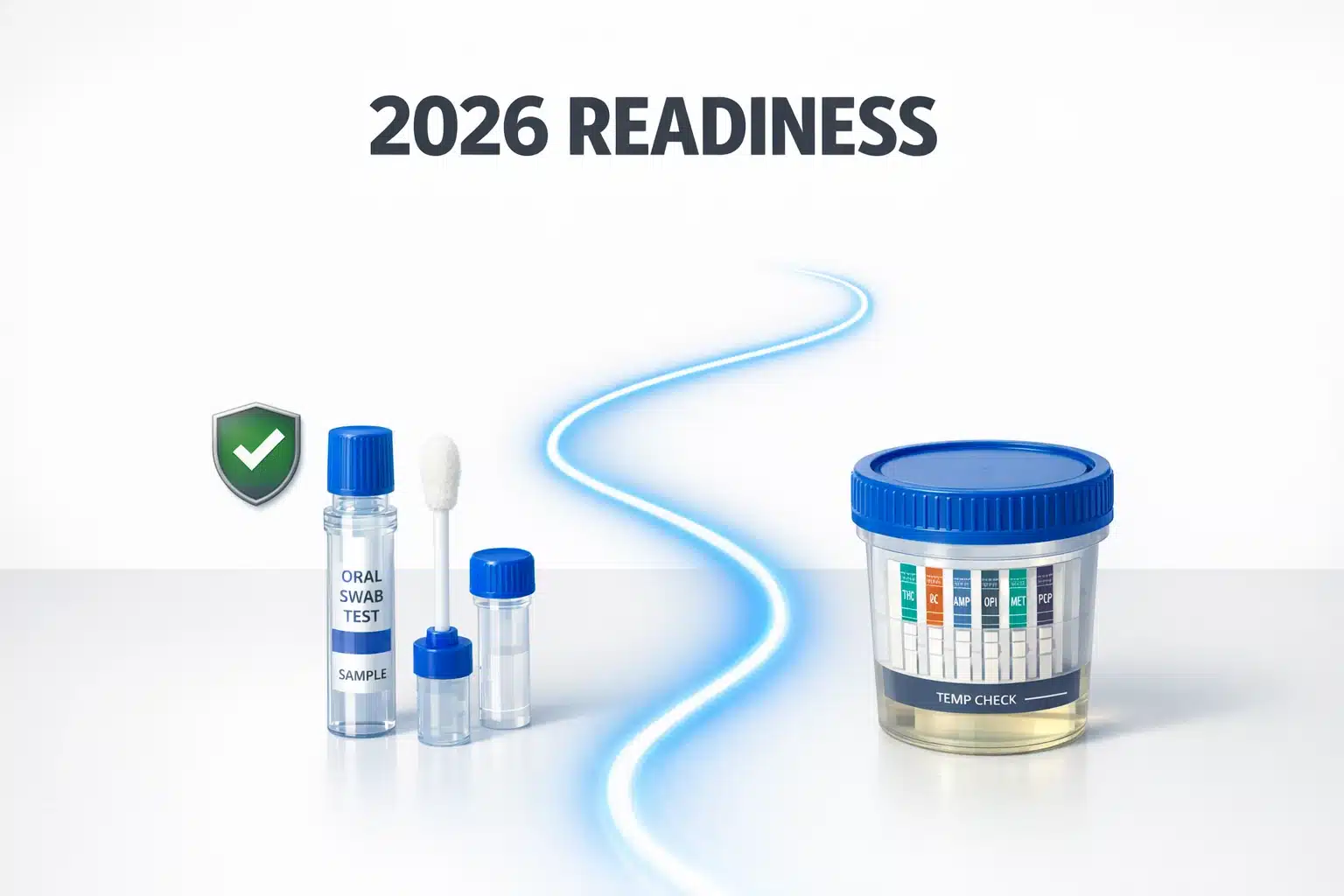
If you are evaluating your workplace drug testing policies in 2026, you are likely feeling a very specific type of administrative whiplash. You know that oral fluid testing offers incredible advantages—especially for post-accident and reasonable suspicion scenarios—but navigating the red tape of integration has felt like an uphill battle.
Since the Department of Transportation (DOT) authorized oral fluid testing in its May 2023 Final Rule, the industry has been trapped in a state of “Regulatory Purgatory.” The rule was written, the green light was flashed, but implementation stalled due to a severe bottleneck in HHS-certified laboratories.
Today, evaluating oral fluid testing isn’t just about comparing the science of saliva versus urine. It’s about operational readiness. You need a practical roadmap to update your policies, align your software, and ensure your drug-free workplace program is compliant, cost-effective, and fully prepared for the future of testing.
Let’s break down exactly how to navigate this transition and build a hybrid testing program that actually works for your organization.
Navigating the DOT Final Rule and the Lab Certification Bottleneck
Understanding where we are today requires looking at the regulatory landscape. When the DOT updated 49 CFR Part 40, they officially recognized lab-based oral fluid testing as a viable alternative to urine testing. This was a massive win for employers looking to reduce collection delays and improve recent-use detection.
However, the fine print created a temporary roadblock: before any DOT-regulated employer could begin using oral fluid, the testing had to be processed by a laboratory certified by the Department of Health and Human Services (HHS). As of mid-2024, there were zero HHS-certified labs operational for DOT oral fluid testing. Even now, as lab capacity gradually catches up to the legislation, employers are left wondering, “When can we actually start?”
The answer is that your preparation must start before the labs are fully scaled. Winning organizations are using this transitional period to draft “Policy Patches”—downloadable addendums to current DOT policies that authorize oral fluid testing the moment your chosen lab goes live.
The “Hybrid Choice” Framework: When to Use Oral vs. Urine
One of the biggest misconceptions in the evaluation phase is that oral fluid must entirely replace urine testing. In reality, the most secure and legally defensible workplace programs run a hybrid model.
To make the right choice for each testing scenario, you need to understand the fundamental difference in detection windows:
- Oral Fluid is the “Gold Standard” for Recent Use: Saliva testing captures active impairment and recent use rapidly. For example, THC can be detected within 1 to 24 hours of use. This makes oral swabs categorically superior for post-accident testing and reasonable suspicion, where you need to know if the employee is under the influence right now.
- Urine is a “Historical Record”: Urine testing provides a longer detection window, typically spanning 3 to 30 days depending on the substance. This makes it the ideal, cost-effective choice for pre-employment screening and random drug testing, where you are looking for a broader pattern of use.
By assigning different testing methods to specific workplace scenarios, you optimize both safety and budget.
Standardizing Your Program: Vendors, Mergers, and Software Logistics
If you are researching industry standards for drug testing policies, you have likely run into conflicting advice regarding DATIA and NDASA. Let’s clear up that confusion right now: the Drug and Alcohol Testing Industry Association (DATIA) and the National Drug and Alcohol Screening Association (NDASA) officially merged on June 1, 2023. Moving forward, any references in your vendor contracts or internal policies should reflect NDASA (formerly DATIA) as the unified industry standard.
The TPA Software Integration Checklist
Running a hybrid program requires your Third-Party Administrator (TPA) to have the technological infrastructure to handle complex, dual-track testing. When evaluating testing suppliers and software integration, ask your TPA these specific questions:
- Can your platform manage hybrid rosters, automatically routing an employee for a urine test for pre-employment, but an oral fluid test for post-accident?
- How does the software handle Medical Review Officer (MRO) routing when combining results from two different testing methodologies?
- Does the platform maintain an audit-ready chain of custody that strictly separates DOT from non-DOT testing data?
Why Oral Fluid Wins: Accuracy, Privacy, and ROI
Decision-makers often face pushback from stakeholders regarding the reliability of oral fluid testing compared to traditional urine cups. It’s essential to arm yourself with the data.
According to the Journal of Analytical Toxicology, lab-based oral fluid testing boasts a high accuracy rate when confirmed by LC-MS/MS (Liquid Chromatography-Tandem Mass Spectrometry). Furthermore, when you source CLIA-waived testing supplies, you are ensuring clinical-grade reliability right at the point of collection.
But the true ROI of oral fluid testing reveals itself in operational efficiency and privacy compliance:
- Solving the “Direct Observation” Challenge: Under DOT regulations, certain return-to-duty tests require direct observation. With urine, this creates significant privacy concerns and logistical hurdles, particularly for transgender and non-binary staff. Oral fluid testing provides a gender-neutral, inherently observable collection method that completely eliminates these privacy violations while maintaining strict compliance.
- Eliminating “Shy Bladder” Delays: A typical urine collection can stall for up to three hours if an employee is unable to provide a sufficient sample, draining productivity and requiring staff supervision. An oral swab takes mere minutes, dramatically reducing operational downtime.
Global Context: Managing the Singapore Workplace Nuance
For multinational organizations integrating oral fluid testing globally, localized regulations add another layer of complexity. Take Singapore, for instance—a massive hub for global logistics and corporate headquarters.
Unlike the highly structured DOT framework in the United States, there is no national law mandating workplace testing in Singapore. Instead, testing under the Ministry of Manpower (MOM) Workplace Safety and Health Act is entirely contract-based. Because it operates in this legal vacuum, your written policy wording is far more critical in Singapore than in the US. If you are rolling out oral fluid testing to your APAC offices, you must ensure your employment contracts explicitly define the testing methodology and consent protocols, as the law will not automatically back up an implied policy.
Next Steps for Your Drug-Free Workplace
Transitioning your drug screening protocols doesn’t have to be a logistical nightmare. By updating your written policies now, defining a clear hybrid framework for urine and oral testing, and partnering with vendors aligned with the latest NDASA standards, you position your organization ahead of the compliance curve.
As a family-owned business dedicated to the testing space since 2017, we know that implementing these programs requires more than just reading regulations—it requires access to reliable, affordable tools. Whether you are stocking up on traditional multi-panel urine cups for pre-employment screening or integrating oral swabs for rapid, gender-neutral reasonable suspicion testing, the key is equipping your team with solutions they can trust. Focus on getting your policies ready today, and ensure your supply chain is built on quality, affordability, and 99% reliability.
Frequently Asked Questions
Is oral fluid testing legally defensible in court?
Yes. As long as you are using devices and following strict chain-of-custody protocols for lab confirmation (such as LC-MS/MS), oral fluid results are highly accurate and routinely upheld in legal and administrative proceedings.
Does switching to oral swabs increase our testing budget?
While the per-unit cost of lab-based confirmation can sometimes vary, the total cost of ownership actually drops. When you factor in the elimination of three-hour “shy bladder” delays, reduced need for specialized collection facilities, and the availability of highly affordable, CLIA-waived rapid screening supplies, oral fluid is incredibly cost-effective.
Can we use rapid oral swabs for DOT testing?
No. While rapid oral swabs are excellent, cost-effective tools for non-regulated, internal company policies, the DOT currently requires lab-based processing. However, a rapid swab can be used immediately for non-DOT reasonable suspicion testing to secure the workplace while waiting for lab confirmation.