Why synthetic opioids cause false negatives: a guide to detection science

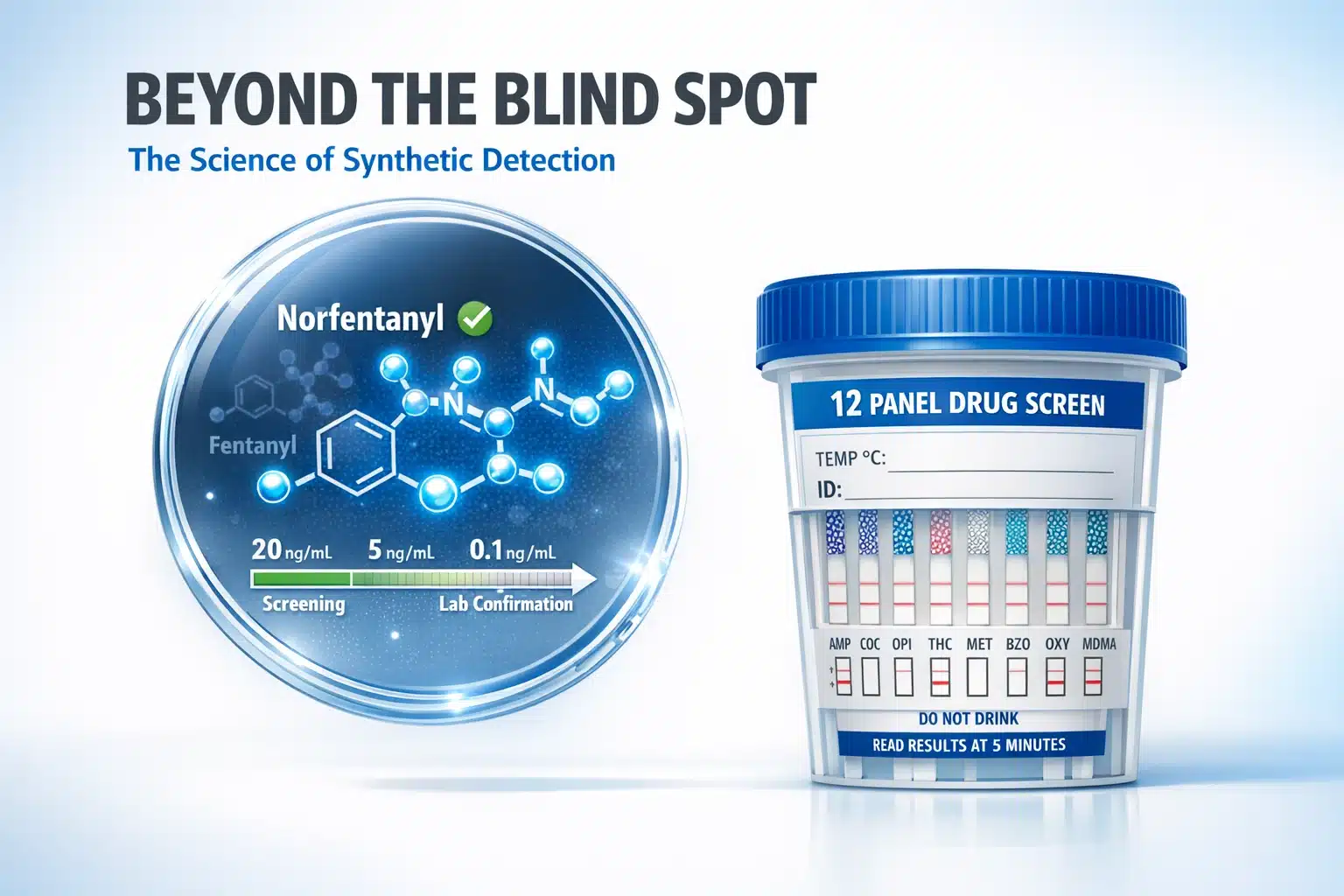
A known fentanyl user provides a sample for a routine drug screen, and the result comes back negative. For clinic directors, compliance officers, and law enforcement professionals, this scenario is more than confusing; it’s a critical failure in a system designed to ensure safety and accountability. The issue isn’t a faulty test. It’s a fundamental misunderstanding of the complex science behind detecting modern synthetic drugs.
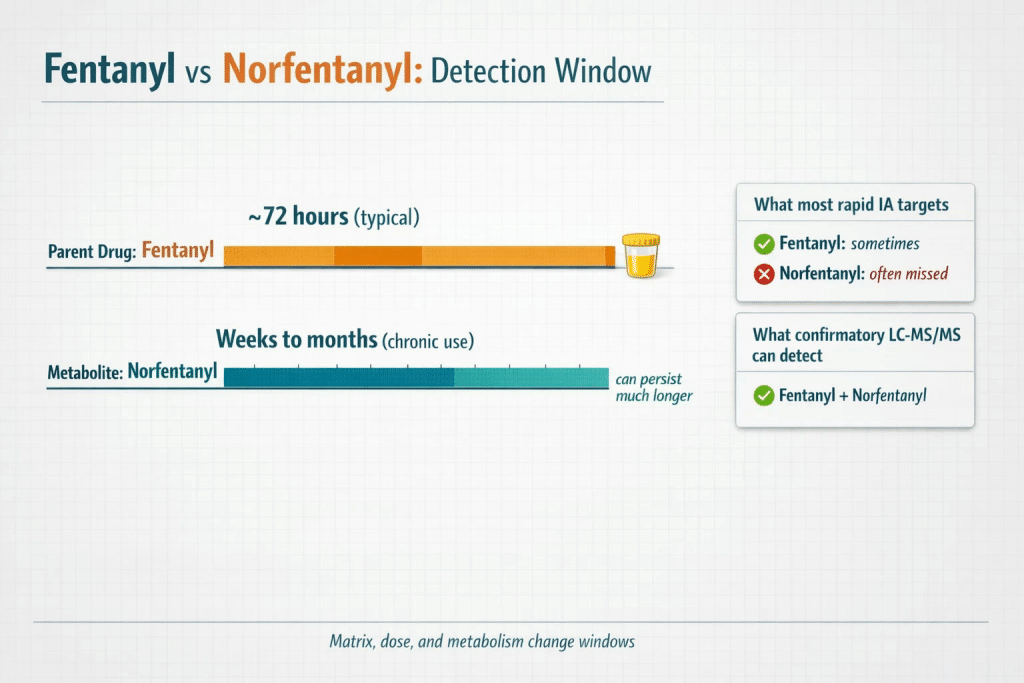
Fentanyl itself metabolizes and clears from urine in about 72 hours. However, its primary metabolite, norfentanyl, can remain detectable for months in chronic users. This staggering 72-hour versus 9-month gap is the Fentanyl Detection Paradox. Relying on tests that only look for the parent drug means you’re operating with a significant blind spot.
The two types of opioid tests: screening vs. confirmation
Not all drug tests are created equal. The difference between a presumptive screen and a confirmatory test explains the vast majority of unexpected results. It all comes down to sensitivity thresholds and the technology used.
Immunoassay (IA): the rapid screener
Immunoassay tests, like most on-site multi-panel urine drug test cups and dip cards, are built for speed and efficiency. They use antibodies to detect the presence of a drug or its metabolites. Think of it as a lock-and-key system. If the drug molecule (the key) is present in the sample, it binds to the antibody (the lock) and triggers a positive result.
- Strength: Fast, cost-effective, and easy to use.
- Limitation: They are presumptive, not definitive. They operate at higher detection thresholds, typically between 1 and 20 nanograms per milliliter (ng/mL). This means a sample could contain the drug, but if it’s below that cutoff level, the test will show a negative result.
Liquid Chromatography with Mass Spectrometry (LC-MS/MS): the definitive confirmation
When a presumptive test needs verification or when a result is contested, the sample is sent to a lab for LC-MS/MS analysis. This method is the gold standard. It separates the molecules in the sample and then weighs them to provide a precise identification and quantification.
- Strength: Extremely accurate and sensitive. It can detect substances at levels as low as 0.1 ng/mL.
- Limitation: Slower, more expensive, and requires specialized lab equipment and personnel.
The sensitivity difference is critical. A confirmatory LC-MS/MS test can be over 100 times more sensitive than a standard immunoassay screen. This gap is a primary cause of what appears to be a false negative; the drug was present, but not in a high enough concentration to trigger the initial screening test.

The norfentanyl advantage: seeing past the 72-hour window
Because fentanyl has such a short detection window, focusing on it alone is an unreliable strategy for monitoring anything beyond very recent use. This is where testing for metabolites becomes essential.
Norfentanyl, the main metabolite of fentanyl, is the key to extending the detection window. According to data in the Journal of Analytical Toxicology, norfentanyl persists in the body long after the parent drug is gone. For programs monitoring chronic use, abstinence, or long-term compliance, our fentanyl test panels include norfentanyl detection. If your current protocol only screens for fentanyl, you are likely missing crucial data points.
The xylazine blind spot: why tranq isn’t an opioid
The rise of xylazine, a veterinary tranquilizer often called “tranq,” has added another layer of complexity to drug screening. It’s frequently mixed with fentanyl, but it is not an opioid. This is a critical distinction from a chemical and testing standpoint.
Standard opioid screens, including those on a 12-panel drug test cup, have 0% cross-reactivity with xylazine. Its molecular structure is completely different, meaning the antibodies used in an opioid immunoassay will not recognize it. Xylazine is an α2-adrenergic agonist, and detecting it requires a specific test designed for that compound class or a comprehensive lab panel using LC-MS/MS.
Organizations looking to future-proof their testing protocols must recognize this blind spot. As new synthetic compounds and adulterants emerge, relying on a standard panel without understanding its specific cross-reactivity profile is a significant risk.

When high doses cause negative results: understanding the hook effect
Perhaps the most counter-intuitive reason for a false negative is a phenomenon known as the “hook effect,” or prozone effect. This can occur when the concentration of a drug in a sample is so astronomically high that it overwhelms the immunoassay test.
In a normal test, drug molecules bind to antibody sites, creating a “sandwich” that generates a positive signal. In the hook effect, the massive excess of drug molecules saturates every available antibody site individually. This prevents the “sandwich” from forming correctly, leading the test to produce an invalid or, more deceptively, a negative result.
While rare, it’s a known issue in toxicology, especially with potent substances like fentanyl where extremely high concentrations can be present. When a test result directly contradicts clear clinical evidence of use, the hook effect should be considered a potential cause. Diluting the sample and re-testing can sometimes resolve the issue, but confirmation with LC-MS/MS is the only definitive way to get an accurate reading.

Building a future-proof testing protocol
The landscape of substance use is evolving faster than ever. A drug screening protocol that was effective five years ago is likely inadequate today. To protect your organization and community, you must move beyond a simple “positive” or “negative” mindset and understand the science behind the results.
This means asking critical questions about your current tools:
- Detection Window: Are we testing for metabolites like norfentanyl to get a realistic view of use over time?
- Sensitivity: Do we understand the ng/mL cutoff levels of our on-site tests and have a clear policy for when to send a sample for LC-MS/MS confirmation?
- Scope: Does our panel cover the new threats that matter, including fentanyl analogs and non-opioid adulterants like xylazine?
By building your protocol on a solid understanding of analytical science, you can close the gaps that allow synthetic opioids to go undetected.
At 12 Panel Now, we provide CLIA-waived and FDA-approved testing supplies that give you clear, reliable data. Have questions about building your protocol? Contact our team for expert guidance. Explore our comprehensive range of drug testing supplies to find the panels that match the scientific realities of 2026.