Why you might pass a workplace drug test but fail one at home

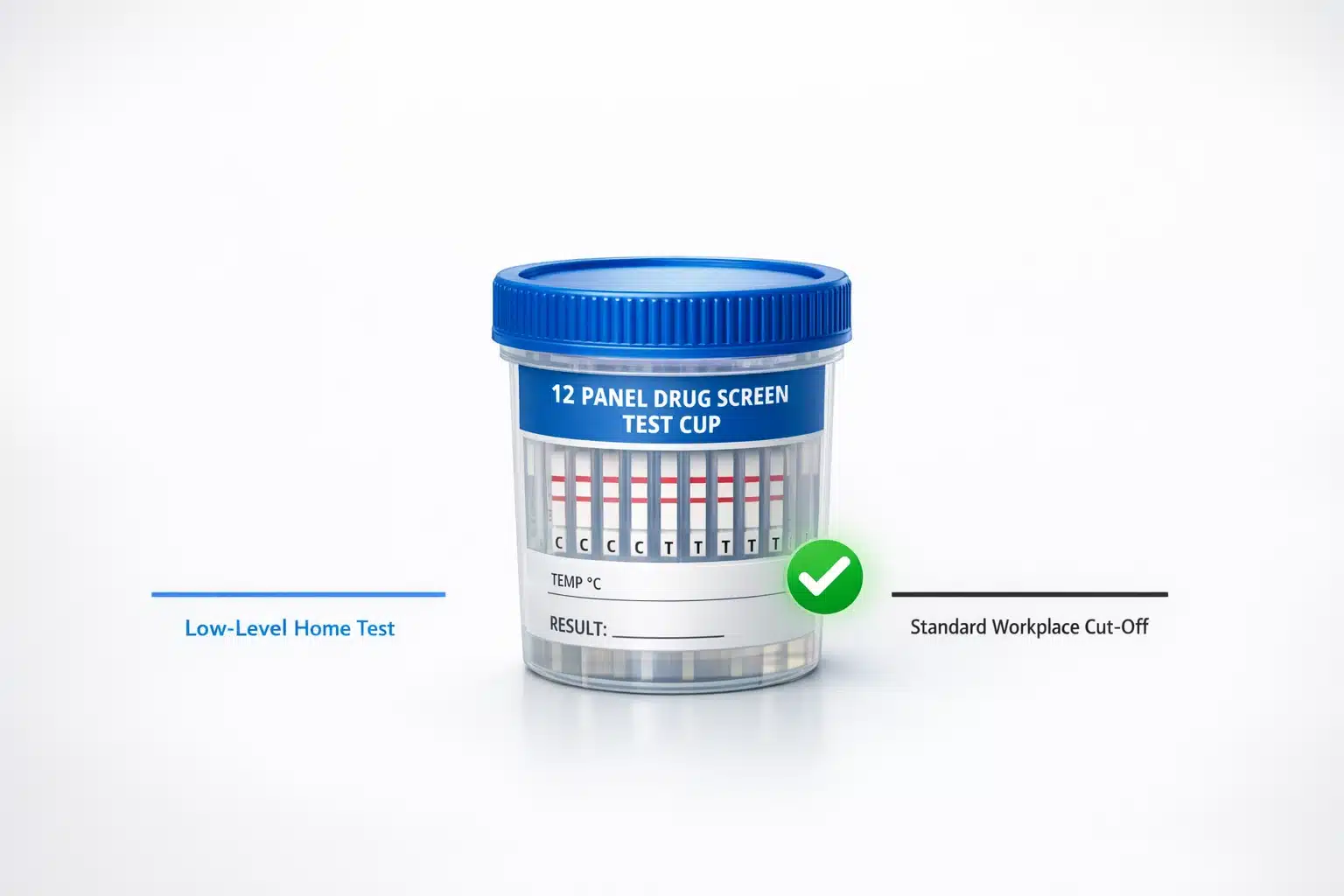
A common at-home opiate test can be over six times more sensitive than the standard mandated for federal workplace drug screening. This single fact highlights a critical and often misunderstood aspect of drug testing: not all tests are created equal. The outcome — a positive or negative result — doesn’t just depend on what was used, but on the specific concentration thresholds, known as cut-off levels, that a test is designed to detect.
For anyone navigating pre-employment screening, monitoring programs, or personal testing, understanding these nuances is essential. This guide breaks down the science behind detection windows and cut-off levels, explaining why one test might produce a different result from another and how personal factors can shift the timeline.
What is a cut-off level and why does it matter?
A cut-off level is a specific concentration of a drug or its metabolite in a sample (like urine or saliva) above which a test is considered positive. It’s not a measure of impairment; it’s simply a threshold. If the concentration is below this level, the result is negative, even if trace amounts of the substance are present.
These levels are established to balance sensitivity with accuracy, minimizing the chance of false positives from incidental exposure while reliably detecting recent use. Most professional drug testing programs, especially those following federal guidelines, use a two-step process that involves different cut-off levels.
Step 1: The initial screening (immunoassay)
The first test is a highly sensitive immunoassay screen. It’s designed to quickly and cost-effectively separate negative samples from those that might be positive. Because its goal is to catch any potential positives, it may sometimes react to similar compounds, creating a “presumptive positive.”
Step 2: The confirmatory test (GC/MS or LC/MS)
Any sample that flags as positive in the initial screen is then subjected to a more precise confirmatory test, typically Gas Chromatography/Mass Spectrometry (GC/MS). This method is considered the gold standard. It identifies the exact molecular signature of the substance, eliminating false positives and confirming the presence and concentration of the drug.
Interestingly, the cut-off level for the confirmatory test is often lower than the initial screen. This ensures that a sample that was positive on the first screen can be definitively confirmed, even if the concentration is just over the confirmation threshold.

Comparing test standards: Home tests vs. federal guidelines
The biggest source of confusion for many people is the difference in cut-off levels between various tests. A test you purchase for home use may not use the same thresholds as one mandated by the Department of Transportation (DOT) or another federal agency.

Let’s look at a side-by-side comparison of standard SAMHSA workplace levels versus those often found in widely available 12-panel drug test cups.
| Substance | SAMHSA Initial Cut-Off (ng/mL) | Common Retail/Home Test Cut-Off (ng/mL) | Key Difference |
|---|---|---|---|
| THC | 50 | 50 | Standards are often aligned. |
| Cocaine | 150 | 300 | Workplace tests are often more sensitive. |
| Opiates | 2000 | 300 | Home tests can be 6.7x more sensitive, detecting lower levels of use. |
| Amphetamines | 500 | 1000 | Home tests may require a higher concentration to show positive. |
| Oxycodone | 100 | 100 | Standards are now harmonized thanks to the 2024 SAMHSA update. |
The most significant gap is often with opiates. A home test with a 300 ng/mL cut-off is far more likely to detect residual opiate metabolites than a workplace screen set at 2000 ng/mL. This is a crucial distinction that explains many conflicting results. For programs focused on fentanyl specifically, fentanyl urine drug test strips use entirely separate cutoff thresholds designed for this specific compound.
Furthermore, staying current with regulations is vital. As of 2024, the SAMHSA Mandatory Guidelines for Federal Workplace Drug Testing Programs harmonized the initial and confirmatory cut-offs for oxycodone at 100 ng/mL. This reflects an evolving understanding of prescription drug use and ensures tests are accurately detecting these specific compounds.
The personal variables: What shifts your detection window?
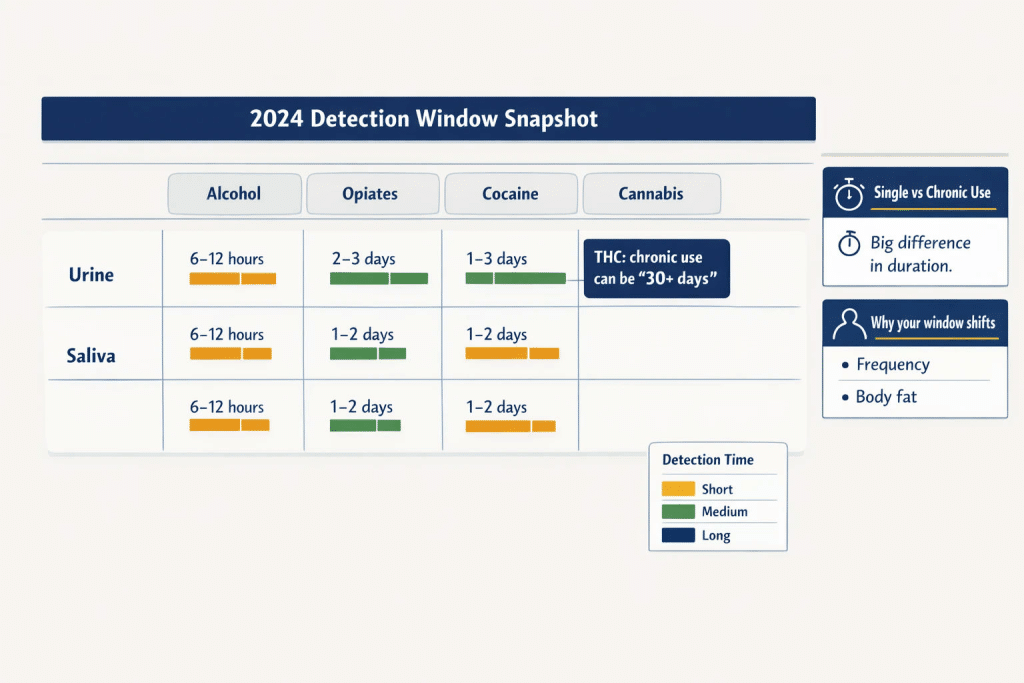
Detection windows are not fixed; they are a range influenced by individual physiology and usage patterns. While a chart might say 3-5 days, your personal result could fall on either end of that spectrum, or even outside of it.

Here are the primary factors that determine how long a substance remains detectable:
-
Frequency and Amount of Use: This is the most important factor. A single use of THC may only be detectable for about 3 days. However, for a chronic, heavy user, THC metabolites can be stored in fat cells and remain detectable for 30 days or more.
- Metabolism and BMI: Individuals with faster metabolisms process and eliminate substances more quickly. Since some drug metabolites (like THC’s) are lipophilic (fat-soluble), they are stored in fat cells. A person with a higher body mass index (BMI) has more capacity to store these metabolites, potentially extending the detection window.
- Hydration and Urine Dilution: Drinking large amounts of water can dilute the concentration of drug metabolites in urine, possibly causing the level to fall below the test’s cut-off. However, professional labs also test for creatinine and specific gravity. A sample that is too dilute will be flagged as invalid, often requiring a re-test under observation.
- Type of Sample: The detection window varies dramatically between sample types. Oral swab tests typically have the shortest window, often just 24-48 hours, making them ideal for detecting very recent use. Urine drug test cups offer a longer window, generally spanning several days to weeks.
Regional differences: U.S. vs. Canadian standards
It’s also important to recognize that testing regulations are not universal. In the United States, federal agencies and DOT-regulated industries must adhere to strict SAMHSA guidelines.
In contrast, Canada has no federal drug testing mandate for most workplaces. Instead, the focus is on “Safety Impact” and assessing impairment. Many Canadian employers voluntarily adopt the legally defensible U.S. DOT standards to build a robust and fair testing policy, but the legal landscape and enforcement are different.
Making an informed decision
Understanding the interplay between cut-off levels, testing methods, and personal physiology is the key to correctly interpreting any drug test result. A positive or negative outcome is simply a data point reflecting a concentration level at a specific moment in time.
Whether you are an employer implementing a drug-free workplace policy or an individual monitoring your own health, choosing the right tool is the first step. If you need guidance on selecting the right panel or cutoff for your program, contact our team for expert support. By selecting a test with the appropriate cut-off levels for your situation, you gain the clarity and confidence needed to make informed decisions.
For reliable, FDA-approved, and CLIA-waived testing supplies that provide clear and accurate results, explore our full range of drug testing solutions to find the product that meets your specific needs.