THC Drug Testing Explained: Detection Windows, Cut-Off Levels & Metabolites

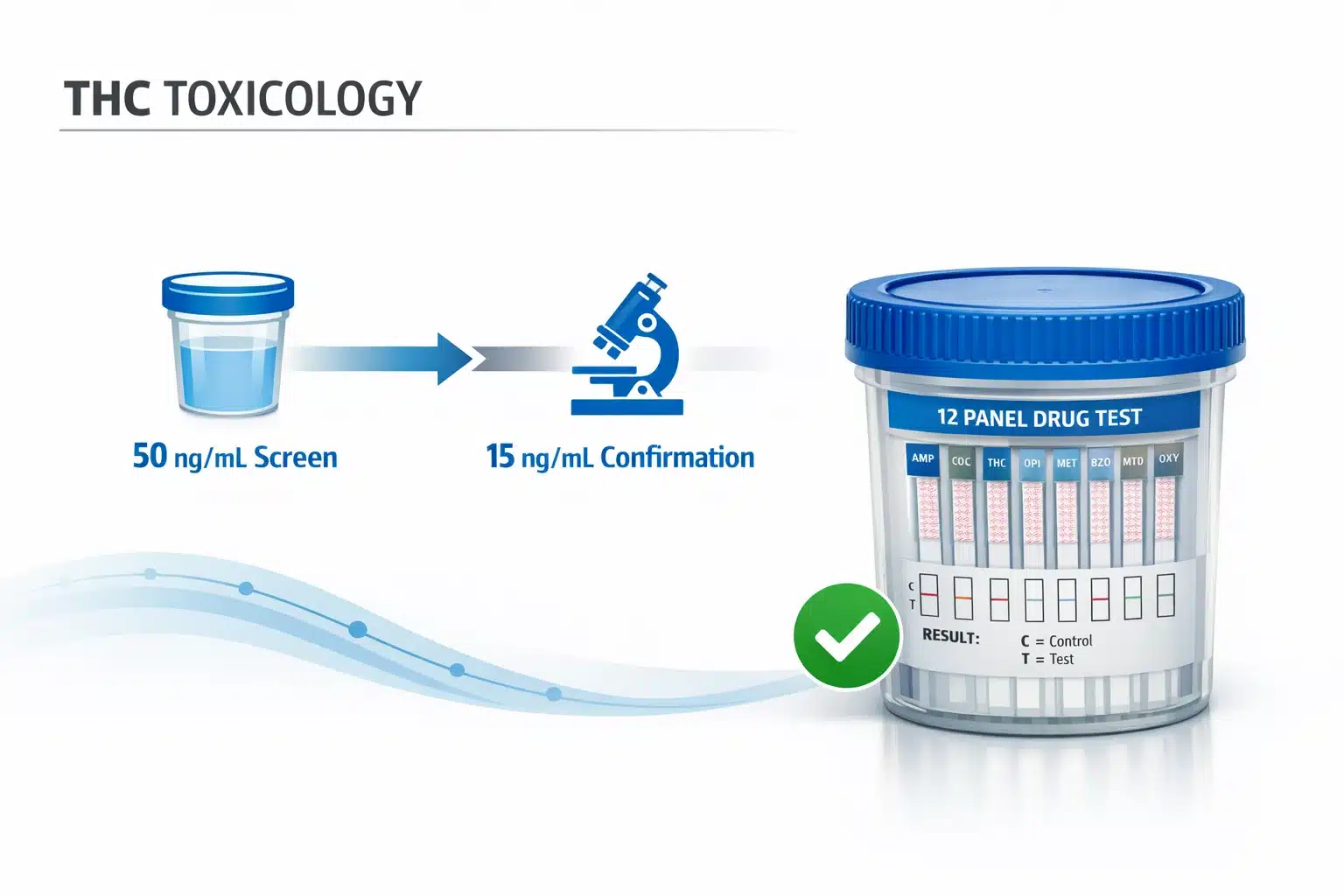
More than any other substance, Tetrahydrocannabinol (THC) detection is filled with nuance. The question isn’t just “how long does it stay in your system?” but “at what concentration level?” and “can this test tell the difference between legal Delta-8 and cannabis?” Understanding the science behind the test is the key to managing risk and getting predictable results.
This guide moves beyond generic detection windows to explain the technical details that matter: the metabolic journey of THC, the difference between a 50 ng/mL screen and a 15 ng/mL confirmation, and the real reasons behind potential false positives.
How THC Drug Testing Works
THC drug testing follows a structured workflow designed to detect cannabis use accurately while minimizing false positives. Rather than relying on a single laboratory procedure, most workplace and federally regulated testing programs use multiple verification steps before reporting a confirmed positive result.
The process typically begins with specimen collection under established chain-of-custody procedures. Depending on the testing program, the specimen may be urine, oral fluid, hair, or blood. The sample then undergoes an initial screening test designed to quickly identify potential THC metabolites above a predetermined cut-off concentration. Only specimens exceeding that threshold proceed to highly specific laboratory confirmation testing.
This layered testing approach balances efficiency with scientific accuracy. Initial immunoassay screening rapidly identifies specimens requiring further analysis, while confirmatory methods such as GC/MS or LC-MS/MS precisely identify the target analyte before a final result is reported.
A quick reference for THC detection windows
Detection times are not absolute. They depend heavily on the test matrix, usage frequency, body fat percentage, and cannabis potency. This table provides a reliable baseline for making informed decisions.
| Test Type | Occasional User (1–2x/week) | Chronic User (Daily) | Primary Target Analyte |
|---|
| Urine | 3–7 Days | 30–90+ Days | THC-COOH (Metabolite) |
| Oral Fluid | 1–3 Days | Up to 7 Days | Δ9-THC (Parent Drug) |
| Hair Follicle | Up to 90 Days | Up to 90 Days | THC-COOH (Metabolite) |

A key takeaway is that urine and hair tests look for metabolites, which indicates historical use, while oral fluid tests primarily detect the parent drug, indicating more recent consumption.
The metabolic journey: Why tests look for THC-COOH
When cannabis is consumed, the body immediately begins breaking down the psychoactive compound, Delta-9-THC. This process happens in two main steps:
- Δ9-THC is converted to 11-OH-THC: This first metabolite is also psychoactive and contributes to the “high.” It appears quickly but also disappears from the body relatively fast.
- 11-OH-THC is converted to THC-COOH: This second metabolite, 11-nor-9-carboxy-THC, is not psychoactive. Its critical feature is that it’s fat-soluble and has a long half-life, meaning it gets stored in body fat and is eliminated slowly through urine.
Because THC-COOH lingers for days or weeks after the effects have worn off, it serves as the perfect biomarker for detecting past cannabis use. A standard urine test isn’t checking if you’re high; it’s checking if you’ve consumed cannabis recently enough for this metabolite to still be present.
Understanding THC Metabolites
One of the most misunderstood aspects of THC drug testing is the distinction between the parent drug and its metabolites. Each compound represents a different stage of the body’s metabolic process and serves a different purpose during laboratory analysis.
Delta-9 THC is the primary psychoactive cannabinoid responsible for cannabis intoxication. Shortly after consumption, the liver converts Delta-9 THC into 11-hydroxy-THC (11-OH-THC), another psychoactive compound that contributes to the overall effects experienced by the user. Continued metabolism eventually produces THC-COOH, an inactive metabolite that remains detectable long after intoxication has subsided.
Because THC-COOH persists significantly longer than Delta-9 THC itself, most workplace urine drug testing programs target this inactive metabolite rather than the parent drug. Understanding this distinction helps explain why an individual may no longer experience any psychoactive effects while still producing a positive urine drug test several days or weeks later.
Modern laboratory testing may evaluate both parent compounds and metabolites depending on the specimen collected, allowing employers, healthcare providers, and laboratories to obtain information appropriate for the specific testing objective.
Screen vs. confirmation: The 50 ng/mL and 15 ng/mL thresholds
Drug testing is almost always a two-step process, especially in workplace and federal settings. Each step uses a different concentration cut-off level, measured in nanograms per milliliter (ng/mL).

1. The initial screen (50 ng/mL)
The first test is an immunoassay screen, the technology used in most rapid 12 panel drug test cups. The federally mandated cut-off set by SAMHSA for this initial screen is 50 ng/mL. This level is set to avoid positive results from passive exposure (secondhand smoke) or trace amounts that are not indicative of new use.
Some private organizations or treatment courts may use a more sensitive screening level, often 20 ng/mL, to extend the detection window and identify use earlier [1].
2. The confirmation test (15 ng/mL)
If a sample tests positive at the screening level, it is sent to a lab for confirmation testing using Gas Chromatography/Mass Spectrometry (GC/MS). This method is far more precise and can identify the specific THC-COOH metabolite. The SAMHSA cut-off for GC/MS confirmation is 15 ng/mL [3]. A sample must test positive at both the 50 ng/mL screen and the 15 ng/mL confirmation to be reported as a verified positive.
Choosing the Right THC Drug Test
Selecting the appropriate THC drug test depends on the testing objective, desired detection window, workplace policy, and regulatory requirements. No single testing method is ideal for every application, making specimen selection an important part of program design.
Urine testing remains the most common workplace testing method because it offers an extended detection window, standardized federal guidance, and broad laboratory availability. It is particularly effective for pre-employment, random, and return-to-duty testing where identifying historical cannabis use is the primary objective.
Oral fluid testing focuses primarily on recent THC exposure by detecting the parent drug rather than long-lasting metabolites. Because specimen collection can be directly observed without compromising donor privacy to the same extent as urine collections, oral fluid testing continues to gain attention for post-accident and reasonable suspicion programs.
Hair testing provides the longest historical detection window, making it useful when employers need to evaluate long-term substance use patterns. Blood testing, while less common for routine workplace programs, may be appropriate in forensic or clinical settings where recent impairment is under investigation.
Understanding the strengths and limitations of each specimen type allows organizations to develop testing programs aligned with their operational goals while maintaining regulatory compliance.
The detection decay curve: How THC-COOH leaves your body
The rate at which THC-COOH levels drop below these cut-offs depends entirely on its metabolic half-life. This is where usage patterns create vastly different outcomes.
- For an occasional user, the half-life of THC-COOH is approximately 1.3 days [3, 6]. Their metabolite levels drop relatively quickly.
- For a chronic user, THC-COOH becomes saturated in fat tissues, extending its half-life to between 5 and 13 days [6]. Each new use effectively “resets the clock,” keeping levels well above the 50 ng/mL cut-off for weeks or even months.

The impact of high-potency cannabis, such as dabs or edibles made with concentrates, can further saturate the body’s fat stores, prolonging the detection window even for less frequent users.
The Delta-8, Delta-10, and HHC trap
Many users believe that because certain cannabinoids like Delta-8-THC are federally legal, they will not cause a positive drug test. This is a critical misunderstanding.
Initial immunoassay screens cannot reliably distinguish between Delta-9-THC, Delta-8-THC, and other isomers like HHC [2]. They all trigger a positive result for the general class of “THC metabolites.” While advanced GC/MS confirmation testing can separate these compounds, most workplace policies do not require the lab to do so. For the employer, a positive result for THC metabolites is simply a positive result, regardless of the specific isomer. Relying on product packaging that claims it’s “legal” is not a defense against a positive test. When choosing the right drug test for your policy, it’s vital to assume all THC isomers will be detected.
Understanding THC Drug Test Results
Receiving a laboratory report involves more than simply reading “positive” or “negative.” Modern drug testing programs classify results according to established laboratory criteria that help determine whether additional investigation or repeat testing is necessary.
A negative result indicates that THC metabolites were either absent or below the laboratory’s reporting threshold. A confirmed positive result indicates that both screening and confirmatory testing detected THC metabolites above the applicable cut-off levels.
Other possible outcomes include dilute specimens, substituted specimens, adulterated specimens, and invalid results. Dilute specimens contain unusually low concentrations caused by excessive fluid intake or other factors that reduce analyte concentration. Adulterated or substituted specimens suggest interference with the testing process and may require recollection under established workplace policies.
Understanding these classifications allows employers and donors to interpret laboratory reports more accurately while appreciating the quality control measures built into modern THC drug testing programs.
A special note for military service members
For members of the U.S. military, this distinction is even more important. All forms of THC are prohibited, regardless of their legal status under the 2018 Farm Bill. A positive test for any THC metabolite, including Delta-8, can result in administrative action or punishment under Article 92 of the Uniform Code of Military Justice [4]. There is a zero-tolerance policy, and the “Delta-8 defense” is not recognized.
Myth-busting: What can actually cause a false positive?
The internet is full of outdated claims about substances that cause false positives for THC. For modern, highly specific immunoassays, most of these are myths. Ibuprofen and other NSAIDs, for instance, are highly unlikely to cause a false positive on a current test. The same is true for poppy seeds, which are associated with opiate tests, not THC tests.
However, a few prescription medications have been scientifically documented to cause cross-reactivity on initial screens.

The two most notable are:
- Efavirenz: An antiretroviral medication used to treat HIV [8].
- Pantoprazole: A common proton-pump inhibitor (PPI) used to treat acid reflux [10].
It’s important to remember that even if one of these substances causes a positive result on the initial screen, it will be ruled out during the GC/MS confirmation test, which specifically looks for the THC-COOH molecular structure.
Employer Drug Testing Policies
THC drug testing programs should be designed around clearly documented workplace policies that align with organizational objectives and applicable regulations. Employers often implement different testing strategies depending on whether testing is conducted before employment, following workplace accidents, after reasonable suspicion, during random testing, or as part of return-to-duty programs.
DOT-regulated employers must follow federal testing requirements established by the U.S. Department of Transportation, while non-DOT employers typically have greater flexibility when establishing testing policies, specimen types, laboratory partnerships, and cut-off standards. Regardless of program type, consistency and documentation remain essential for maintaining defensible workplace testing practices.
Organizations should also establish procedures for chain of custody, Medical Review Officer (MRO) involvement, employee notification, specimen recollection when appropriate, and documentation retention. Well-defined policies improve fairness while reducing administrative uncertainty for both employers and employees.
Laboratory Quality Standards for THC Drug Testing
Reliable THC drug testing depends not only on analytical technology but also on rigorous laboratory quality systems. Accredited laboratories operate under strict validation protocols that verify instrument performance, specimen integrity, quality control procedures, and analytical accuracy throughout every stage of testing.
Many workplace testing programs utilize laboratories accredited under recognized quality standards while following SAMHSA guidance, CLIA requirements, CAP accreditation standards, and established chain-of-custody procedures. These quality systems help ensure consistent laboratory performance while reducing analytical errors.
Routine calibration, proficiency testing, internal quality controls, specimen tracking, and standardized reporting procedures all contribute to dependable laboratory results. Selecting reputable laboratories strengthens confidence in both screening and confirmatory testing outcomes.
Making confident decisions with clear data
Navigating THC toxicology requires moving past simple timelines and understanding the thresholds and metabolites that drive results. Whether you are administering a workplace drug policy or evaluating personal risk, knowing the difference between a 50 ng/mL screen and a 15 ng/mL confirmation is essential. For more immediate results, consider exploring oral fluid drug tests, which target the parent drug and offer a shorter detection window ideal for reasonable suspicion testing.
By focusing on the science, you can implement a testing strategy that is fair, accurate, and effective.