Workplace Fentanyl Drug Testing: Complete 2026 Guide

Data from the 2025 Quest Diagnostics Drug Testing Index reveals a startling gap in workplace safety: Fentanyl positivity in random drug tests is 707% higher than in pre-employment screens. This single statistic shows that while your hiring process may filter for substance use, your current program is likely blind to the risks emerging within your existing workforce.
For years, organizations have operated with a standard 5- or 10-panel test. But with the rise of potent synthetics and a major regulatory realignment underway, relying on those outdated panels is no longer a viable strategy. As federal mandates from SAMHSA and the DOT begin to officially include Fentanyl and its metabolite Norfentanyl, private organizations must move from simple awareness to active evaluation and implementation. This guide provides the blueprint for adapting your program, updating your policies, and selecting the right tools to protect your organization.
Why Workplace Fentanyl Drug Testing Matters
Traditional workplace drug testing programmes were designed around commonly abused drugs such as cocaine, cannabis, amphetamines, heroin, and PCP. While these remain important, synthetic opioids like fentanyl present a different challenge because of their potency, increasing prevalence, and ability to contribute to workplace impairment at extremely low concentrations.
For employers, workplace fentanyl drug testing is about more than identifying substance use. It supports broader workplace safety initiatives by helping reduce accident risks, protecting employees operating vehicles or heavy machinery, supporting compliance with occupational health obligations, and reinforcing a drug-free workplace culture. Businesses operating within transportation, construction, manufacturing, healthcare, logistics, utilities, and other safety-sensitive industries are increasingly recognising the value of expanding beyond traditional drug testing panels.
Reviewing your testing programme before regulations require change allows organisations to implement updates in a controlled manner while ensuring managers, HR teams, and employees fully understand new procedures and expectations.
The 2026 regulatory roadmap: Why action is no longer optional
The timeline for federal action is set, creating a clear mandate for safety-sensitive industries and a strong recommendation for all others. As HHS and DOT finalize their guidelines, the question is no longer if you should test for Fentanyl, but how you will integrate it into your existing framework. Waiting for an incident to occur exposes your organization to significant legal and safety risks, including potential violations of OSH Act’s “General Duty Clause.”
The path forward requires a coordinated effort between HR, legal, and safety departments to align your internal policies with the new reality of substance use.

Who Should Consider Workplace Fentanyl Testing?
Although federal mandates primarily focus on safety-sensitive industries, many private organisations are also reviewing their workplace drug testing programmes. Employers responsible for vehicles, heavy equipment, hazardous materials, patient care, or critical infrastructure often benefit from expanding testing beyond a standard 5-panel programme.
Industries commonly adopting expanded testing include transportation, warehousing, manufacturing, construction, healthcare, energy, utilities, mining, and public safety. Even businesses outside these sectors may choose to include fentanyl testing where employee impairment could create operational, financial, or reputational risks.
Each organisation should assess its own workplace hazards, legal obligations, and operational requirements before deciding whether to introduce expanded synthetic drug testing.
Is your current program blind? Auditing your safety gap
A standard 5-panel drug test typically looks for Cannabinoids (THC), Cocaine, Amphetamines, Opiates (like heroin and morphine), and Phencyclidine (PCP). While effective for those substances, it has a complete blind spot for synthetic opioids like Fentanyl and non-opioid sedatives like Xylazine.
This isn’t just a panel configuration issue; it’s a fundamental safety gap. Research shows that 60% of Fentanyl-positive tests also contain Marijuana or Amphetamines, indicating polydrug use is common. By only testing for traditional substances, you miss the most dangerous part of the equation. Before you can select a new solution, you must first understand the specific vulnerabilities in your current program.

Types of Workplace Drug Testing
Most organisations rely on more than one type of workplace drug test. Each testing situation serves a different purpose within a comprehensive drug-free workplace programme and helps employers manage risk throughout the employee lifecycle.
Pre-employment testing helps identify substance use before hiring, while random testing acts as an ongoing deterrent and may identify issues that develop during employment. Reasonable suspicion testing supports managers when observable signs of impairment are present, and post-accident testing may assist investigations into workplace incidents where substance use could have been a contributing factor.
Some employers also use return-to-duty and follow-up testing after rehabilitation programmes or policy violations. Combining multiple testing approaches creates a more consistent workplace safety strategy than relying solely on recruitment screening.
Selecting the right tools: From 5-panel to synthetic-ready
Closing your safety gap means choosing testing methodologies that explicitly detect Fentanyl, its long-lasting metabolite Norfentanyl, and Xylazine. Fentanyl itself is detectable in urine for a relatively short window of 8 to 72 hours. However, Norfentanyl can persist for up to 13 days in chronic users, making its detection critical for a comprehensive program.
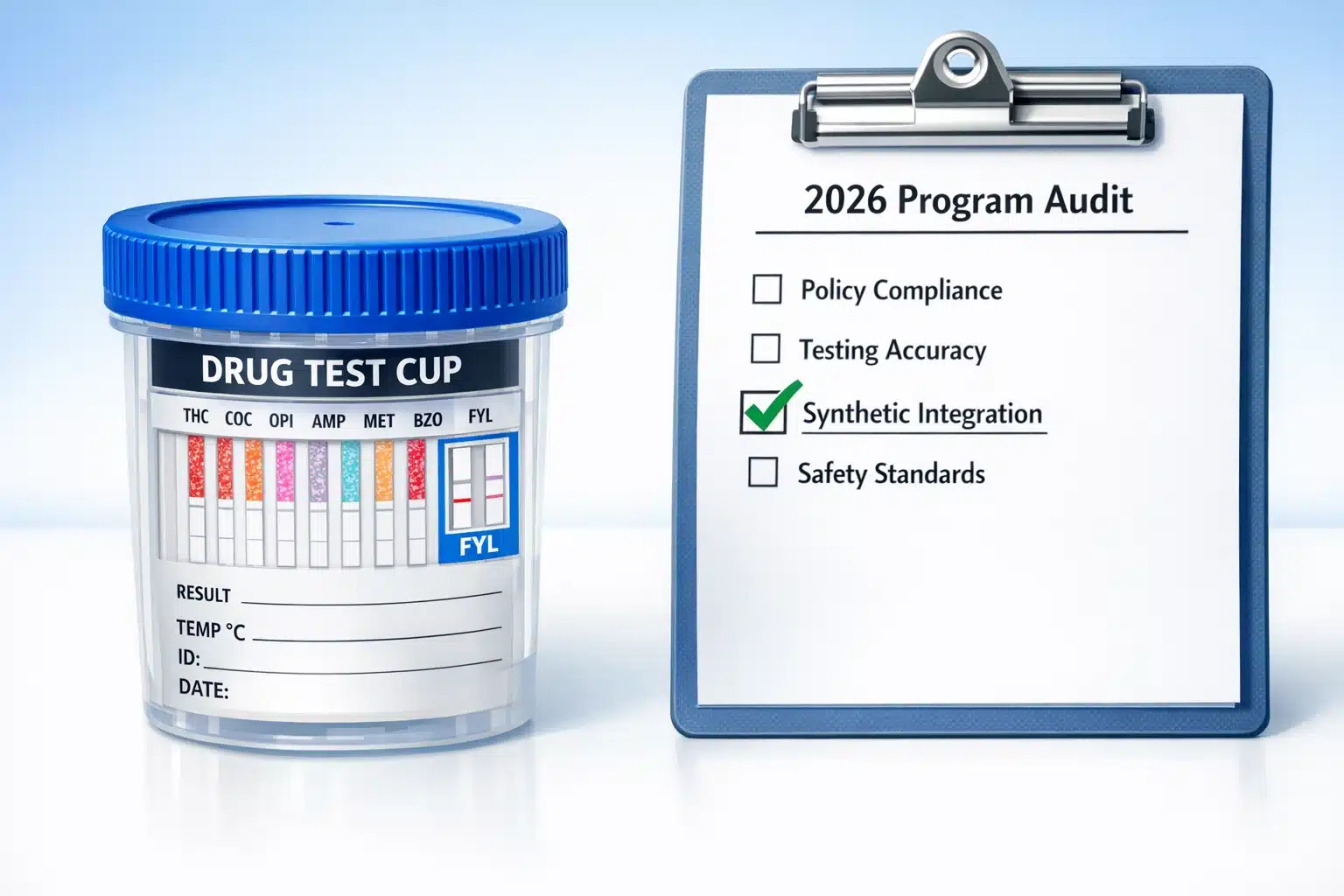
Moving from a standard 5-panel test doesn’t require reinventing your entire program. It involves selecting more comprehensive 12-panel drug test cups or supplementing your existing protocol with specific Fentanyl urine test strips. The key is to choose reliable, CLIA-waived, and FDA-approved products that provide rapid, accurate results your team can trust.

Understanding Workplace Drug Testing Methods
Selecting the appropriate testing method is equally important as choosing the right testing panel. Different biological samples provide different detection windows, operational benefits, and suitability depending on workplace requirements.
Urine testing remains the most widely used workplace drug testing method because it provides reliable detection for many commonly abused substances, including fentanyl when appropriate assays are used. Urine testing is cost-effective, widely accepted by employers, and supported by established laboratory confirmation procedures.
Oral fluid testing has become increasingly popular because samples can be collected under direct observation, reducing opportunities for sample tampering while providing a useful indication of more recent drug use. This makes oral fluid testing particularly valuable for reasonable suspicion and post-incident investigations.
Hair drug testing offers a significantly longer detection window, often identifying historical drug use over several months. Although it is less suitable for identifying very recent substance use, hair testing may be appropriate for organisations requiring longer-term screening as part of pre-employment or specialist programmes.
The most appropriate testing method depends on organisational objectives, industry requirements, workplace policies, and applicable regulations. Many employers combine multiple testing methods to create a more comprehensive workplace drug testing programme.
Why Norfentanyl Detection Matters
While fentanyl itself remains detectable for a relatively short period, its primary metabolite, Norfentanyl, often remains present in urine for considerably longer. Including Norfentanyl within workplace drug testing programmes increases the likelihood of detecting previous fentanyl use, particularly among individuals with repeated or chronic exposure.
Testing for both fentanyl and Norfentanyl provides a more complete understanding of recent opioid use and reduces the risk of missing cases where fentanyl itself has already been metabolised. As more laboratories expand their synthetic opioid testing capabilities, combined detection is becoming an important feature of comprehensive workplace drug testing programmes.
Laboratory Confirmation and Accurate Results
Initial workplace drug tests are typically designed as screening tools rather than definitive diagnostic tests. Screening devices provide rapid results but should always be supported by laboratory confirmation whenever a non-negative result is obtained.
Confirmation testing commonly uses highly specific laboratory techniques such as Gas Chromatography-Mass Spectrometry (GC-MS) or Liquid Chromatography-Tandem Mass Spectrometry (LC-MS/MS). These methods accurately identify individual substances while significantly reducing the possibility of false positive results.
Using confirmation testing protects both employers and employees by ensuring workplace decisions are based upon verified laboratory evidence rather than preliminary screening alone. It also supports compliance with recognised workplace drug testing standards and strengthens confidence in organisational testing procedures.
The Role of Medical Review Officers and Chain of Custody
A Medical Review Officer (MRO) is an independent physician responsible for reviewing laboratory-confirmed drug test results and determining whether there is a legitimate medical explanation for a positive finding. The MRO may review prescription medications, medical history, and supporting documentation before verifying a result.
Equally important is maintaining a documented chain of custody throughout the testing process. Chain of custody procedures record every stage of sample collection, transport, laboratory handling, and reporting to demonstrate that specimens have been securely managed without contamination or tampering.
Robust chain of custody procedures, combined with independent MRO review, strengthen the legal defensibility of workplace drug testing programmes while protecting employee rights throughout the testing process.
Updating your policy: A clause-by-clause blueprint
Technology is only one part of the solution. Your company’s drug-free workplace policy must be updated with clear, unambiguous language. Generic clauses are not enough; specificity is your best defense.
Clause A: Adding Fentanyl and Norfentanyl
Your policy must explicitly name “Fentanyl” and its metabolite “Norfentanyl” as prohibited substances. Relying on a general “opioids” category is a common mistake, as synthetic opioids behave differently and are tested for with specific assays. This ensures there is no room for legal challenges or misinterpretation.
Clause B: The critical Xylazine addendum
One of the most significant gaps in current policies is the handling of Xylazine, or “Tranq.” It is crucial to understand that Xylazine is a non-opioid sedative, not an opioid. Lumping it into the wrong category can invalidate test results and disciplinary actions. Your policy needs a distinct clause that defines Xylazine and prohibits its unauthorized use.
Clarifying notification and retesting rights
Policy updates are also an opportunity to clarify procedural timelines. Be specific about employee obligations, such as a 5-day window for reporting relevant convictions, versus their rights, like a 72-hour period to request a retest of a sample. Clear protocols reduce confusion and strengthen the legal standing of your program. A well-structured rollout plan ensures every stakeholder understands the changes.

Beyond the basics: Regional compliance and industry benchmarks
For multi-state or multinational organizations, compliance requires a nuanced approach. A policy that works in one region may conflict with regulations in another.
- Regional Nuances: In the United States, a company in New Orleans must align its policy with both Louisiana’s privacy laws and federal DOT regulations. In contrast, a company in South Africa must ensure its program meets the “reasonableness” standard under its Occupational Health and Safety Act (OHSA). A one-size-fits-all policy is rarely sufficient.
- Industry Benchmarks: When seeking executive approval for policy changes, it helps to see what industry leaders are doing. Publicly available codes of conduct from companies like Valvoline and Aaron’s often detail rigorous safety standards. Analyzing these benchmarks provides a powerful justification for investing in a more comprehensive testing program.
How to Roll Out an Updated Workplace Drug Testing Program
Introducing workplace fentanyl drug testing should be treated as a structured organisational project rather than a simple policy amendment. A phased implementation allows employers to communicate changes clearly while minimising disruption to existing operations.
The process typically begins with reviewing current workplace policies and identifying where fentanyl, Norfentanyl, and other synthetic substances should be incorporated. Organisations should then confirm that their chosen laboratory and testing products support the required testing panels before updating employee handbooks and internal procedures.
Before launch, managers and supervisors should receive training on recognising workplace impairment, applying testing procedures consistently, and documenting incidents appropriately. Employees should also be informed about why changes are being introduced, what substances will be tested, and how confidentiality and confirmation testing are managed.
Following implementation, organisations should periodically review testing outcomes, regulatory developments, and workplace risks to ensure the programme continues meeting operational and legal requirements.
Clearing up common confusion in synthetic testing
As you adapt your program, you may encounter technical terms and acronyms that cause confusion. It’s important for administrators to distinguish between clinical tools and workplace screening methods.
- ICD-10 Codes vs. Screening: Codes like ICD-10 Z79.891 (“Long-term (current) use of opiate analgesic”) are used by healthcare providers for medical billing and diagnostics. They are not a basis for a workplace drug test.
- Questionnaires vs. Biological Tests: Tools like the Addiction Assessment Questionnaire (AAQ-SA) are psychological instruments used to assess substance use disorders. They are not a substitute for a biological urine or oral swab test.
Finally, a modern program must have a clear protocol for handling potential false positives. Common over-the-counter medications like Benadryl or prescription drugs like Seroquel can sometimes trigger initial non-negative results, and having a clear, respectful confirmation process is essential for maintaining employee trust.
Common Mistakes Employers Make When Updating Drug Testing Programs
Many organisations recognise the need to strengthen workplace drug testing but overlook key implementation steps that reduce programme effectiveness.
One of the most common mistakes is relying exclusively on a traditional 5-panel drug test despite increasing evidence of synthetic opioid use. Others update their testing panels without reviewing workplace policies, creating inconsistencies between what is tested and what company procedures actually prohibit.
Some employers also overlook supervisor training, resulting in inconsistent reasonable suspicion decisions or incomplete documentation following workplace incidents. Failing to educate employees about policy updates can create unnecessary confusion and reduce confidence in the programme.
Another frequent issue is treating rapid screening results as final outcomes without laboratory confirmation or Medical Review Officer (MRO) review where appropriate. Following recognised confirmation procedures strengthens the integrity of workplace drug testing while reducing the likelihood of disputes.
Conclusion
Your program is only as strong as the tools you use. The threat posed by synthetic drugs requires a decisive response built on updated policies and reliable, accurate testing technology.
However, effective workplace fentanyl drug testing extends beyond selecting a new testing panel. Organisations should regularly review policies, monitor regulatory developments, train managers, educate employees, and evaluate whether current testing procedures continue addressing emerging workplace risks. A proactive approach helps reduce liability while supporting a safer and more resilient workplace.
By combining comprehensive testing products with well-defined policies and robust confirmation procedures, employers can strengthen workplace safety while remaining adaptable as drug testing standards continue to evolve.
Ready to close your safety gap? Explore our full range of CLIA-waived and FDA-approved drug testing supplies designed for the challenges of today’s workplace.