CLIA Waived Vs. Non-CLIA Waived Drug Tests: Essential Compliance Info

When you are managing a facility—whether it’s a pain management clinic, a rehabilitation center, or a corporate HR department—the decision to implement on-site drug testing is usually driven by a need for speed and efficiency. You need immediate answers to make critical decisions.
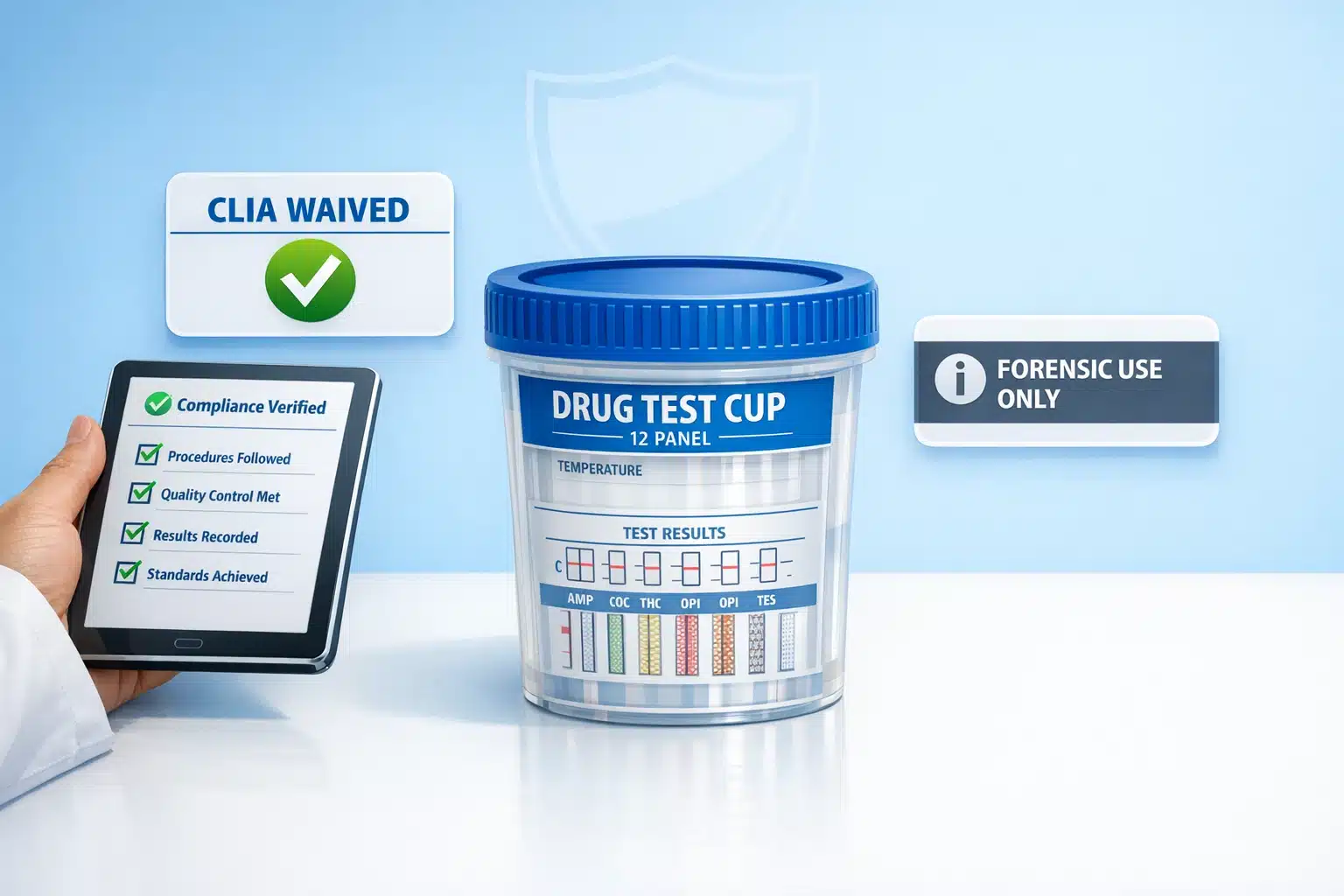
But as you browse through catalogs of 12-panel cups and dip cards, you inevitably hit a regulatory wall: the distinction between CLIA Waived and Non-CLIA Waived (often labeled “Forensic Use Only”).
This isn’t just a labeling nuance. For many organizations, choosing the wrong classification isn’t just an operational error; it is a liability that carries significant financial risk. If you are conducting testing for medical purposes—diagnosis, treatment planning, or health assessment—federal regulations are not optional.
The High Stakes of Compliance: It’s More Than Just a Certificate
Most buyers enter this conversation looking for a definition. However, what you should be looking for is risk mitigation.
The Clinical Laboratory Improvement Amendments (CLIA) of 1988 established quality standards for all laboratory testing to ensure the accuracy, reliability, and timeliness of patient test results. If your facility performs tests on human specimens for health assessment or the diagnosis, prevention, or treatment of disease, you are considered a “laboratory” under federal law.
The Cost of Ignorance
The financial implications of non-compliance are severe. According to the Centers for Medicare & Medicaid Services (CMS), penalties for regulatory violations are not trivial slaps on the wrist:
-
- Civil Money Penalties: Fines for conditions that pose “immediate jeopardy” to patients can reach up to $10,000 per day.
- Standard Infractions: Even minor or non-immediate jeopardy infractions can result in fines ranging from $50 to $3,000 per day until compliance is achieved.
- Operational Shutdown: Beyond fines, CMS has the authority to suspend or revoke your certificate, effectively shutting down your ability to perform on-site testing and bill for those services.
When you weigh the cost of a compliant, CLIA Waived drug test cup—often available for under $2.00 per unit—against a potential $10,000 daily fine, the investment in compliance becomes the only logical business decision.
Understanding the CLIA Complexity Spectrum
Not all tests are created equal. The FDA categorizes diagnostic tests by their complexity—meaning the level of training and risk involved in performing them.
-
- High Complexity: These require highly trained scientists and sophisticated equipment (e.g., PCR testing in a major hospital lab).
- Moderate Complexity: These require automated analyzers and specific personnel training (e.g., standard blood work).
- CLIA Waived: These are simple, low-risk tests cleared by the FDA for home or non-laboratory use. They are designed to be so simple that there is little risk of error.
For your facility, the CLIA Waived designation is the “sweet spot.” It allows your staff to perform tests on-site without being certified laboratory technicians. This includes the Point-of-Care (POC) urine drug cups widely used for screening opiates, cocaine, amphetamines, and other substances.
The “Employer Loophole”: Forensic Use Only (FUO) vs. Clinical Use
This is where the confusion often peaks for our clients. You might see products labeled “Forensic Use Only” (FUO) and wonder if they are legal to use.
The key lies in intent.
-
- Clinical/Medical Use (Requires CLIA Waiver): If the result affects a patient’s medical treatment plan, prescription management, or diagnosis, you must use a CLIA Waived device. This applies strictly to pain clinics, addiction treatment centers, hospitals, and physician offices.
- Forensic/Non-Medical Use (Does Not Require CLIA): If the testing is for legal or employment purposes only—such as court-ordered probation, prison intake, or pre-employment screening—it is generally considered “forensic.” In these settings, CLIA regulations typically do not apply because the test is not being used for “medical diagnosis or treatment.”
However, just because you can use non-waived tests in a forensic setting doesn’t always mean you should. Many employers and corrections facilities prefer CLIA Waived and FDA-approved products because they offer a higher documented standard of quality assurance, which holds up better if a result is ever contested.
Your Industry Compliance Matrix
To simplify your decision-making, we have mapped common facility types to their required testing standards.
1. Healthcare & Pain Management
-
- Requirement: Mandatory CLIA Waived.
- Why: You are treating patients. Whether you are monitoring adherence to a pain management contract or screening for illicit substances in a detox center, these are medical decisions. Using a non-waived test here invites immediate audit failure.
- Recommended Solution: Stick to FDA Approved, CLIA Waived cups that screen for your specific concerns, such as Oxycodone (OXY), Buprenorphine (BUP), and Methadone (MTD).
2. Substance Abuse Rehab Centers
-
- Requirement: Mandatory CLIA Waived.
- Why: Similar to healthcare, rehab is a treatment environment. Accurate screening is vital for determining the level of care.
- Operational Note: Many rehabs utilize 12 to 14-panel cups to catch a broad spectrum of abuse, ensuring nothing slips through the cracks during intake.
3. Corrections, Probation, and Law Enforcement
-
- Requirement: Forensic Use Only (FUO) is acceptable; CLIA Waived is optional but preferred.
- Why: These are legal proceedings, not medical treatments. However, accuracy is still paramount.
- Strategy: Agencies often choose our bulk 5-panel or 12-panel cups for cost-effectiveness, as they allow for high-volume screening without the administrative burden of CLIA waivers.
4. Workplace & Staffing Agencies
-
- Requirement: Generally Forensic/Non-Medical.
- Why: Pre-employment and random drug testing are conditions of employment, not medical exams.
- Risk: While FUO products are legal here, many employers opt for CLIA Waived versions to demonstrate maximum diligence in their safety protocols, specifically for DOT (Department of Transportation) or safety-sensitive roles.
The Truth About Accuracy: 99% vs. “Presumptive”
A common fear among decision-makers is the label “presumptive” found on rapid test kits. Does this mean the results aren’t real?
Not at all. “Presumptive” simply means the test is a qualitative screen. It tells you if the drug is present above a specific cutoff level. It does not tell you the exact quantity of the drug.
Modern CLIA Waived immunoassay urine tests are incredibly sophisticated. Research published in Clinical Chemistry and other journals indicates that properly validated point-of-care tests demonstrate over 95% agreement with laboratory confirmation methods (GC/MS or LC/MS).
When we state that our cups are 99% reliable, it is backed by FDA clearance data. However, for any “positive” result that will lead to a significant consequence (firing an employee, discharging a patient), best practice—and often legal requirement—dictates sending the sample to a lab for confirmation. This two-step process (Screening + Confirmation) is the gold standard for liability protection.
Action Plan: How to Secure Your “Compliance Shield”
If you fall into the medical/clinical category, you cannot just buy the cups; you must have the paperwork to match. Here is your roadmap to becoming a compliant testing site.
-
- Apply for a Certificate of Waiver (CoW):
-
- Complete the CMS Form 116.
- Pay the biennial certification fee (typically around $150-$180).
- Wait for your CLIA number to be assigned.
-
- Source the Right Product:
-
- Ensure your supplier provides products explicitly labeled “CLIA Waived.”
- At 12 Panel Now, our product pages clearly distinguish between CLIA Waived and Forensic options to prevent purchasing errors.
-
- Follow Manufacturer Instructions:
-
- A CLIA Waiver is only valid if you follow the test instructions exactly.
- Using a test cup improperly (e.g., reading results after the validation window) technically voids the waiver status for that specific test event.
-
- Maintain Documentation:
-
- Keep a log of the tests performed.
- Retain the package inserts of the test kits you use; auditors will ask for them.
The Final Verdict on Your Testing Strategy
Regulatory compliance can feel like a maze, but it is actually a shield. By securing a CLIA Waiver and utilizing FDA-approved testing supplies, you protect your organization from fines, your patients from misdiagnosis, and your business from liability.
At 12 Panel Now, we don’t just ship boxes; we supply confidence. Whether you need a 5-panel screen for a small office or a comprehensive 14-panel configuration for a large treatment center, our inventory is structured to keep you compliant and efficient.
Don’t leave your facility open to risk. Evaluate your needs, check your status, and choose a partner who understands the difference between a simple cup and a compliant solution.
Frequently Asked Questions
Q: Are CLIA Waived tests more expensive than FUO tests?
A: Marginally, if at all. Because we specialize in bulk supply chain efficiency, 12 Panel Now offers CLIA Waived cups at highly competitive rates, often comparable to non-waived pricing. The “cost” of the waiver is mostly in the application fee to the government, not the price of the cup.
Q: Can I use a CLIA Waived cup for forensic purposes?
A: Absolutely. You can always “trade up” in quality. Using a clinical-grade test for employment screening is perfectly legal and often preferred for its proven accuracy.
Q: Do I need a Laboratory Director to get a CLIA Waiver?
A: For a Certificate of Waiver, the requirements for a director are significantly less stringent than for high-complexity labs. In many cases, a physician or a qualified site administrator can serve as the director.