The Essential Guide to Selecting Drug Test Cups for Treatment Centers & Detox Facilities

Today, that approach is a liability.
The illicit drug supply has become increasingly toxic and complex. With the rise of synthetic adulterants like Xylazine (Tranq) and high-potency synthetic opioids (Nitazenes), standard legacy panels are returning false negatives for high-risk patients. According to the 2024 DEA National Drug Threat Assessment, approximately 30% of seized fentanyl powder now contains Xylazine—a substance that most standard 10-panel cups miss completely.
For clinical directors and procurement managers, the goal has shifted from simple inventory management to ensuring clinical integrity. You aren’t just buying plastic cups; you are securing a diagnostic tool that dictates patient care plans, billing compliance, and facility safety.
This guide is designed to help you navigate the critical criteria for selecting a drug testing solution that protects your patients and your license.
The 2024 Substance Landscape: Why Your Standard Panel Is Failing
The most common frustration we hear from facility directors is the discrepancy between clinical observation and test results. You see a patient exhibiting clear signs of intoxication—sedation, respiratory depression, skin ulcers—yet their standard opioid screen comes back negative.
This is the “blind spot” of legacy testing.
The market for Point-of-Care (POC) testing is growing at a 5.1% CAGR, driven largely by the urgent need to detect chemical-based synthetics. If your facility is relying on off-the-shelf 12-panel cups designed for the drug trends of 2015, you are likely missing:
-
- Xylazine (Tranq): Often mixed with fentanyl to extend the high, it is not an opioid and requires a specific reagent strip to detect.
- Fentanyl Analogs: Generic opiate strips often fail to trigger for synthetic fentanyl structures.
- Kratom & K2/Spice: These psychoactive substances are popular specifically because they evade standard detection.
The Solution: Drug Test Cups Custom Configurations
Reliability in 2024 requires adaptability. You need the ability to configure your testing panels based on what is actually circulating in your community, not just what is standard in a catalog.
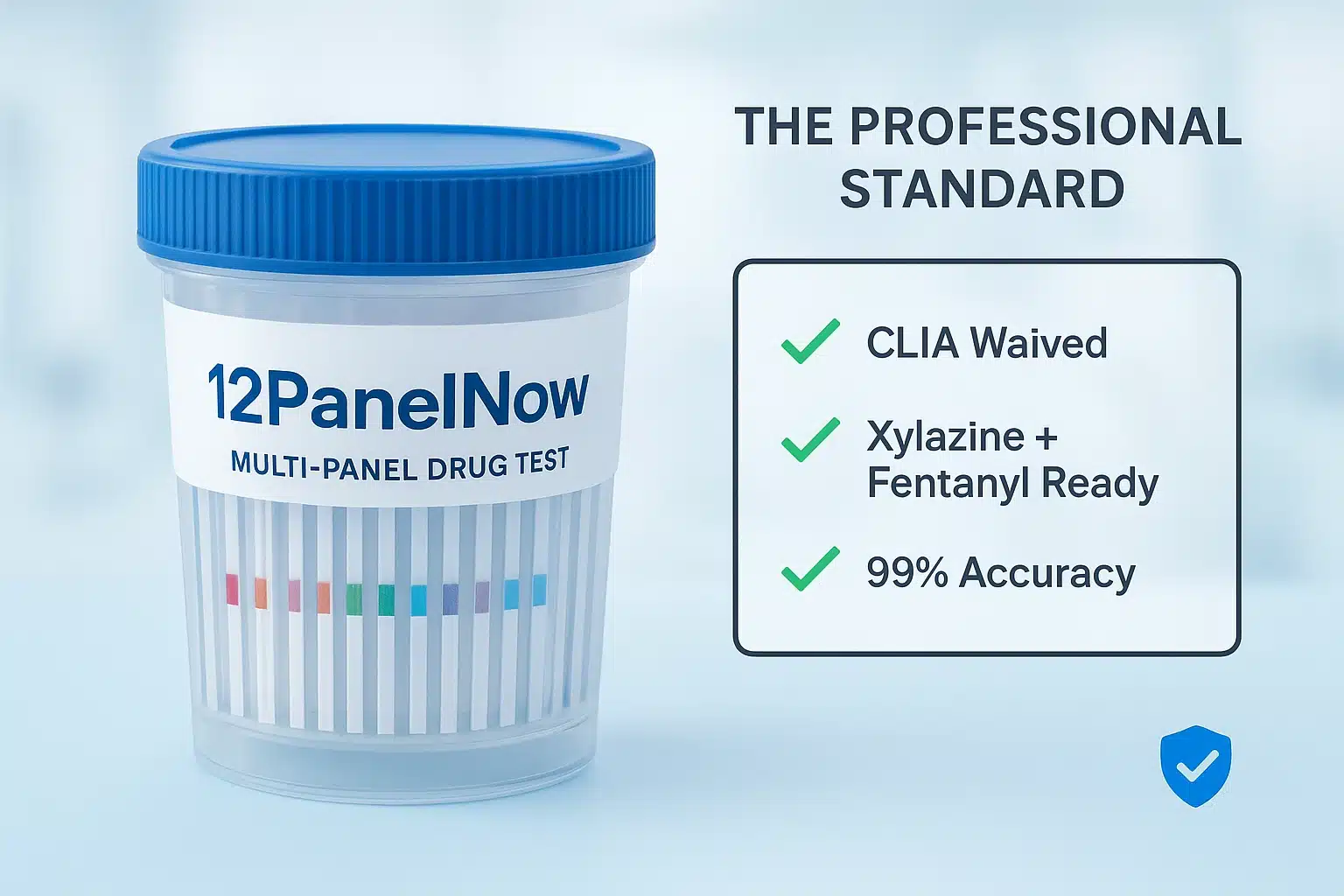
At 12 Panel Now, we offer custom configurations with over 54 drugs to choose from. This allows facilities to build a “Tranq-Proof” cup that includes Xylazine, Fentanyl, and Tramadol alongside standard panels, without carrying multiple different inventory items or using separate dip cards.
The Procurement Checklist: Balancing Reliability and Cost
Once you have determined what you need to test for, the next hurdle is validating the quality of the test itself. In the world of clinical toxicology, reliability is measured by regulatory clearance and accuracy rates.
For a treatment center, two acronyms matter more than any others: CLIA and FDA.
CLIA Waived vs. FDA Approved Drug Test Cups
-
- FDA Approved (510k Cleared): This means the device has undergone rigorous review by the Food and Drug Administration to demonstrate it is substantially equivalent to a legally marketed device. It validates the accuracy (in our case, 99%) and safety of the product.
- CLIA Waived: The Clinical Laboratory Improvement Amendments (CLIA) waiver categorizes a test as “simple” with a “low risk of erroneous results.” This is the gold standard for Point-of-Care testing because it allows your staff to administer the test without being a certified high-complexity laboratory.
Why it matters for your budget:
Using non-CLIA waived cups can lead to denied insurance claims. When you submit for reimbursement under CPT codes (like 80305), payers often require the device used to be CLIA waived. Saving fifty cents on a non-compliant cup could cost you hundreds in denied reimbursements per patient.
To help you evaluate potential vendors, we have created a procurement scorecard to compare options side-by-side.
Operational Mastery: Reducing False Positives and Confrontation
Procurement buys the cups, but your nursing and tech staff have to live with them. The operational friction in drug testing often comes down to two issues: tampering and interpretation.
Countering the Surge in Tampering
Recent data indicates that invalid urine specimens have surged by 45.2%. Patients in active addiction are becoming more sophisticated, using synthetic urine or adulterants to mask use.
To combat this, a clinical-grade cup must include built-in validity checks (Adulteration strips) that test for:
-
- pH & Specific Gravity (SG): To detect dilution.
- Oxidants (OXI): To detect bleach or peroxide.
- Temperature: A strip that verifies the sample is between 90°F–100°F immediately upon collection.
The “Faint Line” Protocol
One of the most common sources of stress for staff is the “Ghost Line.” A faint line on an immunoassay cup is a negative result, but untrained staff often misinterpret it as a “borderline positive,” leading to unnecessary confrontation with patients.
At 12 Panel Now, we don’t just sell cups; we act as an extension of your clinical training. We emphasize high-contrast reagent strips to minimize ambiguity. However, even with the best technology, biology varies. We recommend implementing a clear protocol: Any line, no matter how faint, indicates the presence of the antibody reaction—it is a negative.
Beyond the Drug Test Cup: Billing Codes and Lab Confirmation
While instant cups provide immediate answers for intake and privileges, they are often the first step in a billing workflow that includes laboratory confirmation (LC/MS).
Administrative efficiency relies on mapping your point-of-care (POC) results to the correct CPT codes for billing and the correct requisitions for LabCorp or Quest. A common bottleneck occurs when facility admins struggle to match the screening cup panels with the correct confirmation codes.
As a partner to your facility, we believe in streamlining this process. Below is a reference guide for common codes used in conjunction with urine drug screens.
The 12 Panel Now Difference: Your Clinical Partner
In an industry dominated by massive, faceless medical conglomerates, the nuance of customer care is often lost. 12 Panel Now was founded in 2017 as a family-owned business in Boynton Beach, Florida, with a different philosophy: we treat your facility’s urgency as our own.
We understand that if you run out of cups on a Friday, you cannot perform intakes on Saturday. That is a break in the continuum of care.
Why Treatment Centers Choose Us:
-
- Agility: We maintain a massive inventory to ensure same-day shipping on almost all orders.
- Affordability: With bulk pricing starting as low as $1.69 per cup (and some products as low as $0.49), we help you maintain margins without sacrificing CLIA-waived quality.
- Empathy: We are not associated with any lab; we don’t compete with you. Our sole focus is supplying the tools you need to save lives.
Next Steps: Secure Your Facility Against Emerging Threats
The drug supply isn’t waiting, and neither should your testing protocol. Upgrading your drug testing supplies is one of the fastest ways to improve patient safety and reduce liability in your treatment center.
Whether you need a specific Xylazine solution or a reliable bulk supplier for standard panels, 12 Panel Now is ready to support your mission.
Frequently Asked Questions (FAQ)
Q: Can I really customize a cup for just my facility?
A: Yes. Unlike competitors who force you into standard “12-panel” buckets, we offer custom configurations. If your region is seeing a spike in Tramadol or Xylazine, we can build a panel that targets those specific threats.
Q: Are your cups CLIA waived?
A: Yes, our major product lines are FDA approved and CLIA waived, ensuring you meet the compliance standards required for insurance billing and state licensing.
Q: How accurate are the results?
A: Our cups boast a 99% accuracy rate. We use high-quality reagent strips designed to maintain stability and sensitivity, even during high-volume testing.
Q: What if I need to detect alcohol?
A: We offer EtG (Ethyl Glucuronide) panels that can detect alcohol consumption up to 80 hours prior, which is essential for zero-tolerance recovery environments.