A Complete Guide of Creatinine Level on a Drug Test

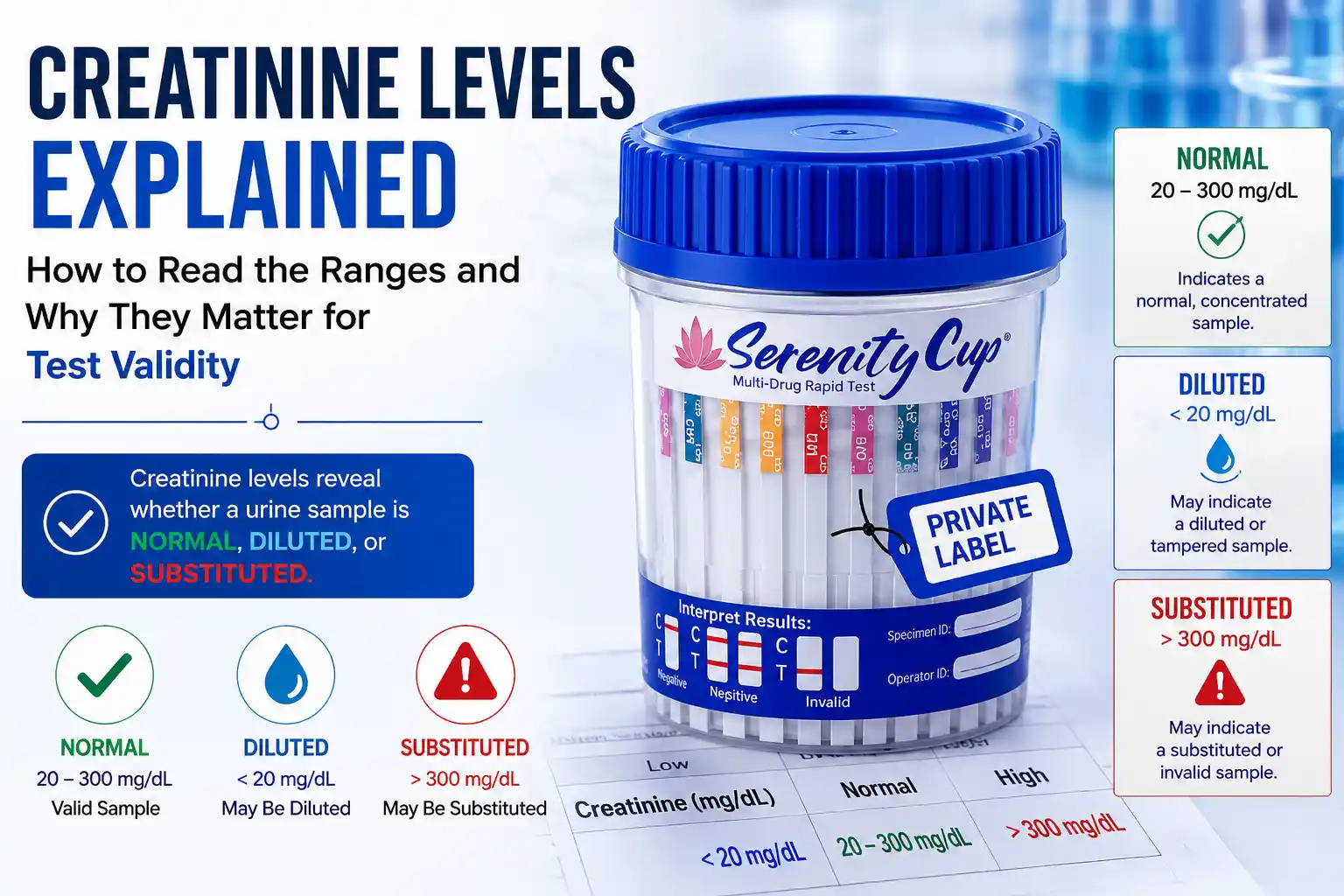
On a urine drug test, creatinine is a naturally occurring waste product used to check whether a sample is genuine, diluted, or substituted. Because healthy human urine normally contains a fairly steady concentration of creatinine, testing for it is one of the simplest ways to verify a sample is authentic before the drug results themselves are even considered.
This guide breaks down what the standard creatinine ranges mean, why labs and test cups check for it, and what happens when a result falls outside the normal range.
What Is Creatinine, and Why Is It in Urine Drug Tests?
Creatinine is a byproduct of normal muscle metabolism. It’s produced at a relatively constant rate and filtered out of the blood by the kidneys, which is why its concentration in urine stays within a predictable range for most healthy individuals. That consistency is exactly what makes it useful for drug testing: if a urine sample doesn’t fall within the expected creatinine range, it raises a flag that something about the sample isn’t right, independent of whatever the drug panel itself shows.
Standard Creatinine Ranges on a Drug Test
- Normal: 20 mg/dL to 300 mg/dL — considered a valid, unaltered human urine sample
- Dilute: 5 mg/dL to 20 mg/dL — typically caused by excessive fluid intake before the test, which lowers the concentration of both creatinine and drug metabolites
- Substituted or invalid: Below 5 mg/dL — strongly suggests the sample either isn’t human urine or has been heavily manipulated
These cutoffs are the standard reference points used across most workplace, clinical, and lab-based testing programs, though exact thresholds can vary slightly by lab or jurisdiction.
Why Would Creatinine Levels Be High on a Drug Test?
Elevated creatinine on its own isn’t typically treated as a red flag for tampering. High readings are more commonly tied to hydration status, diet (high protein intake, in particular), or higher muscle mass. Creatinine testing on a drug screen is primarily used to catch abnormally low levels rather than high ones.
What Does It Mean When Creatinine Is Low on a Drug Test?
A low creatinine reading usually points to one of two things:
- Dilution — the person drank an unusually large volume of fluid before providing the sample, lowering the concentration of everything in the urine, including creatinine and drug metabolites
- Substitution — the sample isn’t human urine at all, or has been tampered with in a way that removes or replaces its natural composition
A “dilute” result and a “substituted” result are treated differently. A dilute sample is usually still human urine, just less concentrated, and often leads to a retest. A substituted sample, with creatinine below about 5 mg/dL, is generally treated as a much stronger indicator of intentional tampering.
How Does Creatine Affect a Drug Test?
Creatine (the dietary supplement) and creatinine (the metabolic waste product measured on a drug test) are related but distinct. Taking a creatine supplement can influence how much creatinine your body naturally produces over time, since creatinine is a breakdown product of creatine phosphate in muscle tissue. However, there’s no reliable evidence that creatine supplementation can be used deliberately to manipulate a drug test’s creatinine reading in the way some online claims suggest.
Creatinine vs. Kidney Function: Two Different Contexts
It’s worth separating two uses of the word “creatinine” that show up in search results:
- Drug test creatinine checks whether a urine sample is valid, diluted, or substituted, for testing integrity purposes.
- Clinical/kidney creatinine tests (blood or urine) are used by doctors to assess kidney function, since consistently abnormal creatinine levels outside of a testing context can be a sign of kidney issues.
A single low or high creatinine reading on a workplace drug test is not a kidney diagnosis; it’s a specimen validity check. If you have ongoing concerns about your creatinine levels in a medical context, that’s a conversation for a doctor, not something a workplace drug test is designed to evaluate.
Why This Matters for Employers and Clinics
Creatinine is one of the core markers built into specimen validity testing, alongside specific gravity, pH, and oxidants. Drug test cups with integrated validity strips check these markers automatically at the point of collection, which means a diluted or substituted attempt can be flagged immediately rather than discovered later after a lab result comes back inconclusive. For programs handling regular testing, employer, clinic, or probation-based, validity-integrated cups reduce the number of samples that need to be sent for confirmation retesting due to dilution alone.
Frequently Asked Questions
What is a good creatinine level for a urine drug test?
A result between 20 mg/dL and 300 mg/dL is considered within the normal range and treated as a valid sample.
When should you worry about creatinine levels in a urine test?
In a drug testing context, a reading below 20 mg/dL (dilute) or below 5 mg/dL (substituted) is the threshold that triggers additional scrutiny or a retest.
Is it better to have high or low creatinine in urine on a drug test?
Neither “high” nor “low” is inherently better; the goal is a result within the normal range. Low creatinine is far more likely to trigger a dilute or substituted flag than high creatinine is to cause a problem.
Does creatinine show up on a drug test?
Yes. Creatinine is measured as part of the specimen validity check that typically accompanies standard drug panels, separate from the actual drug/metabolite results.
What level of creatinine indicates kidney failure?
That’s a clinical determination made by a doctor using blood and urine creatinine testing over time, not something a single workplace drug test screening is designed to assess. If kidney function is a genuine concern, consult a healthcare provider.
How do you read urine drug test results overall?
Most panels report two layers: the drug/metabolite results (positive, negative, or non-negative pending confirmation) and the specimen validity results (normal, dilute, substituted, or adulterated). Both are typically needed to interpret a result correctly, since a “negative” reading on a diluted sample often isn’t treated as conclusive.
What are normal creatinine levels by age?
For clinical blood/kidney creatinine testing, reference ranges do vary by age, sex, and muscle mass, and should be interpreted by a healthcare provider. For urine drug test validity purposes specifically, the 20–300 mg/dL range is the standard benchmark used regardless of age.
Can dehydration affect creatinine levels on a drug test?
Yes. Dehydration tends to concentrate urine, which can push creatinine toward the higher end of the normal range or above it. This is generally not flagged as a problem the way low creatinine is, since testing programs are primarily watching for dilution, not concentration.
Does drinking water lower creatinine levels?
Yes, drinking large amounts of water in a short period lowers urine creatinine concentration, which is exactly the mechanism specimen validity testing is designed to catch. This is why “just drink a lot of water” is not a reliable way to influence a drug test result.
What happens if creatinine level is too low on a drug test?
A reading in the dilute range (5–20 mg/dL) typically requires a retest under most testing policies. A reading below 5 mg/dL is usually treated as a substituted specimen, which carries more serious implications and is often handled as a policy violation separate from the drug results themselves.
Can medications or medical conditions affect creatinine levels?
Certain medications and underlying kidney or muscle conditions can influence creatinine levels outside of a testing context. If a legitimate medical explanation applies, it’s typically something to raise with the testing administrator or a doctor rather than something the test itself can account for automatically.
Is a diluted drug test the same as failing?
Not usually. Most policies treat a dilute result as inconclusive rather than a fail, which is why it typically leads to a required retest instead of an automatic negative or positive outcome. Repeated dilute results, however, can sometimes be treated as a policy violation depending on the organization.
What is specific gravity, and how is it different from creatinine?
Specific gravity measures the concentration or density of a urine sample compared to water, while creatinine measures the actual concentration of that specific waste product. Labs typically use both together, along with pH, since a sample can occasionally show an unusual reading on one marker but not the other, and cross-checking multiple markers gives a more reliable validity picture than any single test alone.
What is creatinine clearance?
Creatinine clearance is a clinical measurement comparing blood and urine creatinine levels over time to estimate kidney filtration function. It’s a different test used in medical settings and is not part of standard drug test specimen validity screening.
Can exercise affect creatinine levels?
Intense exercise can temporarily raise creatinine production, since it’s a byproduct of muscle metabolism. This is generally not a concern for drug test validity purposes, since testing focuses on abnormally low readings rather than elevated ones.
What is the BUN/creatinine ratio?
The BUN (blood urea nitrogen) to creatinine ratio is a clinical kidney function marker used in medical bloodwork, unrelated to the urine creatinine check used in drug test specimen validity screening. The two shouldn’t be confused, even though both involve creatinine.