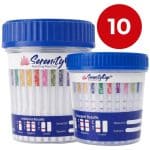
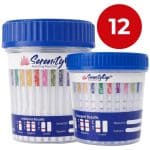
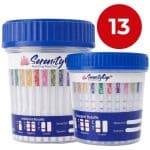
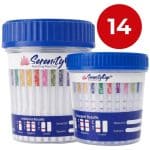
Does Ketamine Show Up on a 12 Panel Drug Test?

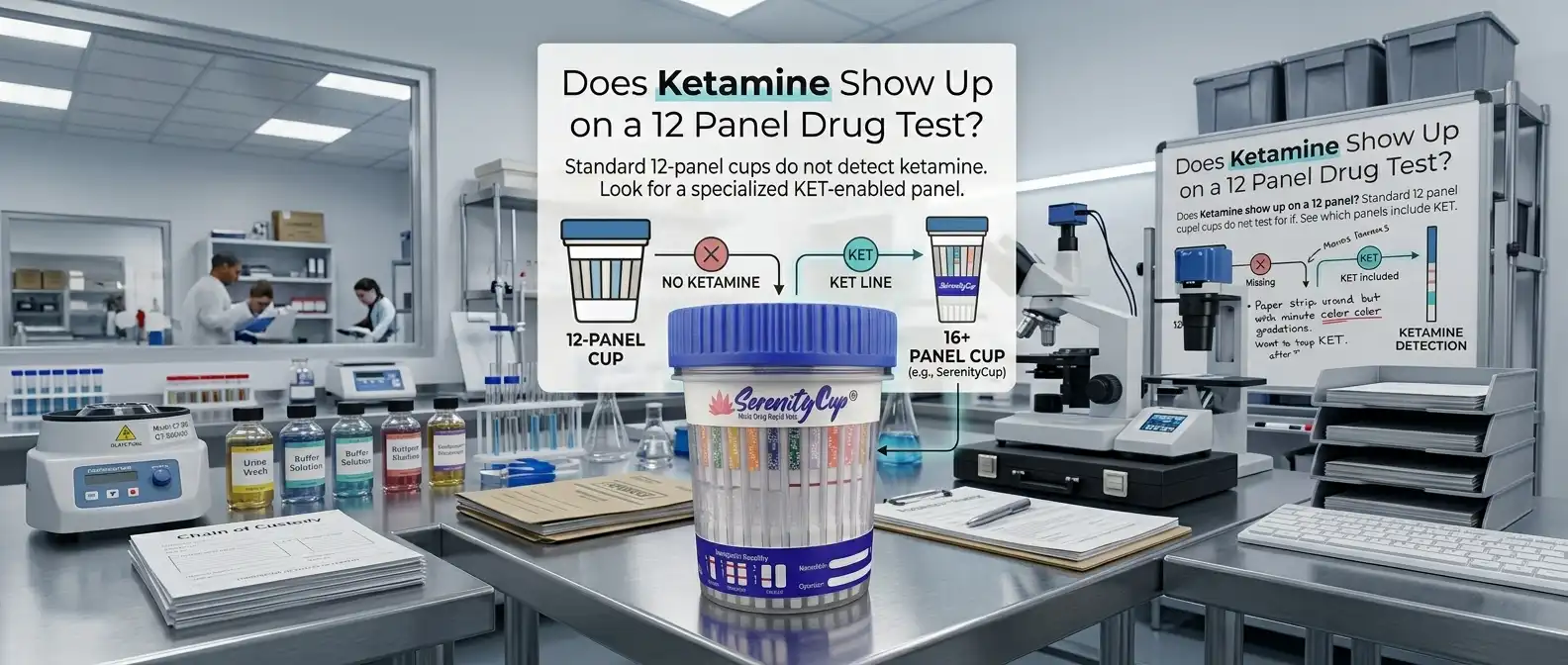
No, a standard 12 panel drug test does not detect ketamine. The usual 12 panel urine cup covers AMP, BAR, BUP, BZO, COC, MDMA, MET, MTD, OPI, OXY, PCP and THC, and ketamine (KET) is not on that list. To screen for it, you need a single-drug ketamine drug test strip or a higher-panel cup that lists KET on its label.
Ketamine is chemically related to PCP, so people often assume a PCP line on a 12 panel will catch it. It will not. Each line on a panel screens for one drug or drug class, and the test only reports what it is built to detect. The sections below show which panels include ketamine, the cutoff used, how long it can be detected, and how to choose a test.
Last checked against the live product pages on October 13, 2026.
What a standard 12 panel cup tests for
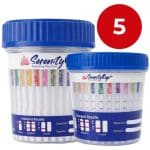
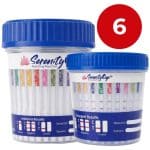
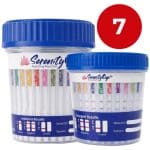
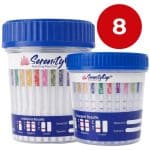
A 12 panel cup tests for 12 drug groups, and ketamine is not one of them. The 12 panel drug test cups category lists the core 12 as amphetamines (AMP), barbiturates (BAR), buprenorphine (BUP), benzodiazepines (BZO), cocaine (COC), methamphetamine (MET), MDMA (ecstasy), methadone (MTD), opiates (OPI), oxycodone (OXY), phencyclidine (PCP) and marijuana (THC).
Some 12 panel variants swap one line for another, for example TCA, EtG (alcohol) or fentanyl (FEN), as shown on the same category page. None of the 12 panel cups listed there carry a KET line. If you are comparing sizes, the guide to 12 vs 13 vs 16 panel cups explains what each step up adds.
Which panels do include ketamine?
Ketamine appears as a KET line on 12 Panel Now’s 16 panel and larger cups, and on single-drug strips and dip cards. The table below compares the ketamine-capable products we checked on October 13, 2026, with their panel contents and listed price ranges.
| Product | What it tests | Ketamine cutoff | Price range (per test, by quantity) |
| Ketamine drug test strip | Ketamine only | 1000 ng/mL | $0.29 to $0.79 |
| Ketamine dip card (KET/1000) | Ketamine only | 1000 ng/mL | $0.38 to $0.79 |
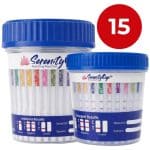
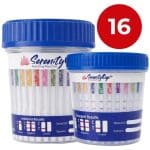
| 16 panel cup with ETG, FEN, K2, KET | AMP, BAR, BUP, BZO, COC, MET, MDMA, OPI, MTD, OXY, PCP, THC, ETG, FEN, KET, K2 + PH/SG/CR | KET/1000 | $1.99 to $3.29 |
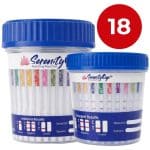
| 18 panel cup with ETG, FEN, K2, KRA, KET, TRA | Core drugs plus ETG, FEN, K2, TRA, KRA, KET + PH/SG/CR | KET/1000 | $2.09 to $3.39 |
| 18 panel multi-drug cup with GAB, KRA, KET | Core drugs plus GAB, TRA, KET, KRA, FEN, ETG + PH/SG/CR | KET/1000 | $2.09 to $3.49 |
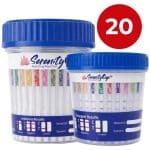
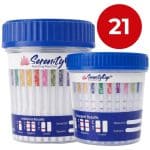
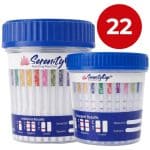
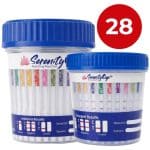
Prices fall as quantity rises. Check each product page for current pricing, because ranges change. The site’s 20, 21, 22, 24 and 28 panel cups also list KET on the drug test cup range, and an 18 panel cup category collects the 18 panel options in one place.
What cutoff does a ketamine test use?
A ketamine urine test on 12 Panel Now’s product pages uses a 1000 ng/mL cutoff, written as KET/1000. A cutoff is the concentration at which a result reads positive: a sample with ketamine below 1000 ng/mL can read negative even if some drug is present. The drug test cutoff levels page explains how cutoffs work across other drugs.
The ketamine strip, dip card and the KET cups above are labeled Forensic Use Only. According to the disclaimer on the product page, that label means the device is intended for forensic drugs-of-abuse testing, such as courts, probation, corrections and forensic laboratories, and is not a clinical diagnostic device. An Employment & Insurance designation does not apply automatically to every product, so read the label of the exact product before buying.
How long does ketamine show up on a test?
Ketamine itself clears quickly, but its metabolite norketamine can remain in urine for days. A 2005 study in the Journal of Analytical Toxicology by Adamowicz and Kala collected urine for up to 16 days from children given ketamine as an anesthetic. With GC-MS-NCI, ketamine was found from the day of dosing up to 2 days afterward, and norketamine up to 14 days. With LC-MS-APCI, ketamine was found up to 11 days and norketamine up to 6 days.
Those numbers show that the window depends on the lab method, and the study also noted differences between individuals. Dose, how often ketamine is used and body chemistry also play a role. A rapid strip at a 1000 ng/mL cutoff is less sensitive than lab methods, so its practical window is usually shorter than the laboratory ranges above. For general timing across other drugs, see how long drugs stay in your system on a 12 panel urine test and the drug test detection time guide.
Need a ketamine screen today? The ketamine drug test strip reads in 5 minutes at a 1000 ng/mL cutoff. Prices on the product page run from $0.29 to $0.79 per strip depending on quantity. Forensic Use Only. View the ketamine test strip
How to test for ketamine: strip, dip card or higher-panel cup
There are three practical ways to screen for ketamine in urine, and the right one depends on whether ketamine is the only drug you need to check. Each option uses the same 1000 ng/mL cutoff on the products listed above.
- Single strip or dip card. Choose a ketamine dip card or strip when ketamine is the only question. It is the lowest-cost option per test, and a ketamine urine test kit like this adds one line to a screening you already run.
- A multi-panel cup with KET. Choose a 16 panel or 18 panel cup when you want ketamine alongside the common drugs, alcohol (EtG) and fentanyl in a single collection.
- A standard 12 panel plus a ketamine strip. Run the 12 panel cup for the core drugs, then dip a ketamine strip in the same specimen. The cups vs strips comparison covers the trade-offs, and the 12 panel dip card guide shows the dip format.
How to use a ketamine dip strip
The manufacturer’s instructions on the product page give five steps:
- Remove the strip from the sealed pouch and use it as soon as possible, ideally within an hour.
- Hold the strip by the end with the product name and avoid touching the membrane.
- Dip the strip vertically into the urine for at least 10 to 15 seconds, not past the MAX line.
- Lay the strip flat on a non-absorbent surface and start a timer.
- Read the result at 5 minutes, and do not interpret it after 10 minutes.
One colored band in the control region (C) with none in the test region (T) is a positive. Two bands, one in C and one in T, is a negative. No control band means the result is invalid and the test should be repeated with a new one. Our drug testing instructions page has a general walkthrough for cups and cards.
How to choose the right ketamine test
Pick the test that matches your reason for screening, your volume and the labeling you need. Four questions settle most decisions:
- Only ketamine, or several drugs? Only ketamine points to a strip or dip card. Several drugs points to a 16 or 18 panel cup.
- Does the label match your use? Ketamine products here are Forensic Use Only. Confirm that your use fits the labeling before ordering.
- How many tests do you need? Strips and cards drop in price at higher quantities, and free shipping applies at 100 or more strips or cups, per the product pages.
- Do you also need alcohol or fentanyl? The 16 and 18 panel KET cups include EtG and fentanyl lines.
Compare panels before you buy. See every cup that lists KET, from the 18 panel cups to the ketamine strip, and pick the panel that fits your screening. Shop ketamine tests
Preliminary results and lab confirmation
A rapid ketamine screen gives a preliminary result, and a positive should be confirmed by a laboratory. Confirmation uses GC-MS or LC-MS/MS, which identify the exact compound. Product pages also note that the antipsychotic quetiapine has been reported to cause false positives on ketamine tests, though the page says more studies are needed. Ketamine is also a prescribed medication, so a positive does not show how the drug was taken. Anyone acting on a result, whether an employer, court or clinic, should follow its own testing policy and legal requirements.
FAQ
Does a 12 panel drug test show ketamine?
No. A standard 12 panel urine test lists AMP, BAR, BUP, BZO, COC, MDMA, MET, MTD, OPI, OXY, PCP and THC, and ketamine is not among them. A test only detects what its panel lists. Look for a KET line on the cup label.
Does ketamine show up on a 10 panel or 16 panel test?
It depends on the panel list. Check for a KET line. The 16 panel cup with EtG, fentanyl, K2 and KET on 12 Panel Now includes ketamine at 1000 ng/mL, while a cup without KET does not test for it. The 10 panel vs 12 panel guide shows what the smaller panels cover.
How long does ketamine show up on a 12 panel?
It does not show up on a standard 12 panel at any point, because the panel has no ketamine line. On a test that does include KET, the window depends on method. A 2005 study found norketamine in urine for up to 14 days with GC-MS-NCI, and a rapid strip is less sensitive than that method.
What is the best ketamine urine test kit?
The best choice depends on whether ketamine is your only target. A ketamine test strip or dip card suits a single-drug screen, and an 18 panel cup suits a broader screen. Match the product’s Forensic Use Only labeling to your use.
Can a ketamine test give a false positive?
Yes, it can. The product page reports that quetiapine has been associated with false positives, with further study needed. Positive screening results should be confirmed by a laboratory using GC-MS or LC-MS/MS.
Is a ketamine strip enough to confirm use?
No. A strip is a preliminary screen. The ketamine knowledge base page has more background, and any positive needs lab confirmation before decisions are made.