Ensure Drug Test Reliability: Achieve 99% Accuracy Results

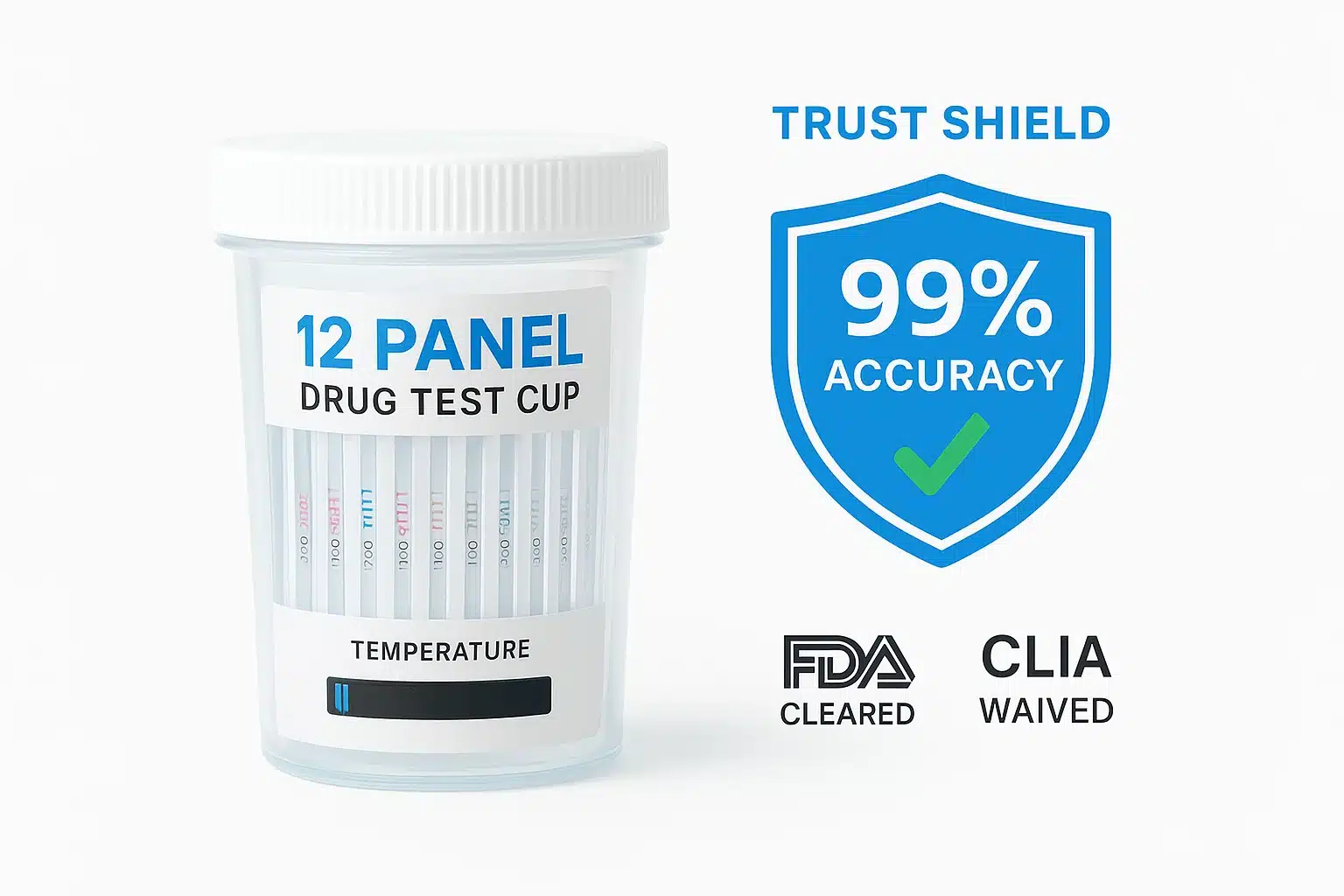
When you implement a drug testing program—whether for a rehab facility, a workforce environment, or a probation department—you aren’t just purchasing plastic cups. You are purchasing risk mitigation.
Every positive result triggers a cascade of consequences: employment termination, legal probation violations, or changes in medical treatment plans. In this high-stakes environment, the cost of a false positive isn’t measured in dollars; it’s measured in potential litigation, damaged reputations, and lost trust.
Most buyers see the “99% accuracy” sticker and assume all tests are created equal. They aren’t. True reliability is a combination of biochemical sensitivity, rigorous manufacturing standards, and resistance to environmental variables.
This guide decodes the science and certifications behind trustworthy rapid tests, giving you the framework to evaluate solutions that offer not just results, but legal defensibility.
The “Why” Behind the 99%: Immunoassay Technology Explained
To trust the result, you must understand the mechanism. Rapid drug tests, like the 12 Panel Now cups and dip cards, utilize lateral flow immunoassay technology.
When a urine specimen is introduced to the test strips, it travels through absorbent capillary beds containing specific antibodies. These antibodies are chemically programmed to bind only to specific drug metabolites (the byproducts left after the body processes a substance).
The Critical Role of Cut-Off Levels
Reliability is strictly defined by cut-off levels—the concentration threshold at which a test triggers a positive result. These aren’t arbitrary numbers; they are standardized by SAMHSA (Substance Abuse and Mental Health Services Administration) to balance accuracy with fairness.
For example, if a test is too sensitive, eating a poppy seed bagel could trigger an opiate positive. If it isn’t sensitive enough, it misses actual drug use. High-quality tests adhere to these “Gold Standard” cut-offs to ensure that a positive result indicates recent use, not just environmental noise.
The Regulatory Shield: FDA Clearance vs. CLIA Waived
In the search landscape for drug testing supplies, you will see two badges of honor repeatedly: FDA Approved/Cleared and CLIA Waived. These are not marketing terms; they are your primary defense against liability.
Understanding the difference helps you select a product that is both legally compliant and operationally simple.
FDA 510(k) Clearance: The Design Standard
FDA clearance validates the safety and effectiveness of the device itself. It means the manufacturer has proven to the federal government that the test is substantially equivalent to a legally marketed device. This is your baseline for technical validity.
CLIA Waiver: The “User Error” Safety Net
For most facilities, the CLIA waiver is arguably more critical. The Clinical Laboratory Improvement Amendments (CLIA) program regulates testing. A “waived” test has been proven to be so simple and accurate that there is an insignificant risk of an erroneous result.
The Data Behind the Waiver:
To receive a CLIA waiver, a manufacturer must demonstrate that their test has a false positive/negative rate of less than 1.2% in non-laboratory settings. This is the statistical backbone of the “99% accuracy” claim. When you choose a CLIA-waived cup, you aren’t just getting an easy-to-use product; you are using a device federally recognized to have a negligible error rate, even when used by non-scientists.
The Anatomy of the 1% Error: Cross-Reactivity and Process
If a test is 99% accurate, decision-makers naturally ask: “What about the other 1%?”
Understanding the source of errors allows you to eliminate them. The gap usually stems from two areas: low-quality reagents causing cross-reactivity, or procedural drift.
1. Cross-Reactivity (The “Advil” Problem)
Cheaper tests use generic antibodies that struggle to distinguish between illicit drugs and common over-the-counter medications. This is known as cross-reactivity.
-
- The Risk: Low-quality assays might flag Ibuprofen as Marijuana (THC) or pseudoephedrine as Amphetamines.
- The Solution: Premium suppliers use highly specific reagents designed to ignore these structural look-alikes. When evaluating a supplier, ask about their specific antibody quality. 12 Panel Now’s formulation is specifically engineered to minimize this interference, protecting your donors from false accusations.
2. Procedural Integrity
Even the best test can fail if the process is flawed. Reliability extends to how the sample is collected and stored.
-
- Temperature: Urine must be between 90°F and 100°F within 4 minutes of collection. A built-in temperature strip is non-negotiable for preventing tampering.
- Read Time: Reading the result too early (before the chemical reaction finishes) or too late (after the strip dries) invalidates the result.
Strategic Evaluation: A Checklist for Buyers
When comparing bulk drug testing supplies, view the purchase as “Litigation Insurance.” A savings of pennies per cup is irrelevant if the product lacks the documentation to stand up in a grievance hearing or court case.
Use this checklist to validate a product’s reliability before you buy:
1. Verification of Certifications
Does the product explicitly state it is CLIA Waived and FDA Approved? Be wary of “forensic use only” labels if you are testing in a workplace or clinical medical setting, as these may not meet the same regulatory rigor for employment decisions.
2. Specimen Validity Testing (SVT)
Does the cup screen for adulterants? Donors trying to mask drug use may add bleach, oxidants, or water to the sample. A reliable 12-panel cup should often include SVT strips to verify that the urine is human, unaltered, and valid.
3. Reagent Specificity
Does the manufacturer provide data on cross-reactivity? Ensure the test is calibrated to distinguish between structurally similar compounds, particularly for sensitive panels like Amphetamines and Opiates.
4. Supply Chain Reliability
Reliability is also about availability. Can the supplier guarantee same-day shipping? In clinical and corrections environments, running out of inventory creates a gap in monitoring that can be exploited.
Conclusion: Confidence in Every Cup
In the world of drug testing, accuracy creates authority. When you choose a testing solution backed by FDA clearance, CLIA waivers, and superior reagent quality, you are protecting your organization’s integrity.
12 Panel Now provides the “Litigation Insurance” you need through rigorous quality control and a commitment to keeping compliant inventory ready for same-day shipment. Don’t leave your safety protocols to chance—rely on science, certification, and proven performance.
Frequently Asked Questions About Test Reliability
Q: Can a rapid test be used as the final legal authority?
While 99% accurate, rapid tests are technically “screening” devices. For situations involving legal action or denying employment, it is industry best practice to utilize laboratory confirmation for any non-negative result. This validates the initial screening with gas chromatography/mass spectrometry (GC/MS).
Q: Do faint lines affect reliability?
No. This is a common misconception. In immunoassay testing, any line, no matter how faint, indicates a negative result. The intensity of the line is not a measure of the drug concentration in the donor’s system.
Q: How does the detection window impact accuracy?
Accuracy depends on testing within the correct window. For example, oral swabs have a shorter detection window (often hours to days) compared to urine (days to weeks). Choosing the right matrix (urine vs. saliva) is part of ensuring the reliability of your program’s goals.