The Science of Drug Detection Windows: Metabolite Identification and Clearing Times in 2026

If you’re evaluating a drug testing policy or preparing for an upcoming screening, you’ve likely stumbled across dozens of charts telling you exactly how long a substance stays in your system. But as anyone managing workplace compliance or clinical diagnostics in 2026 can tell you, those standard 30-day rules of thumb are dangerously outdated.
You might be asking: Why did a candidate test positive 45 days after their last use? Or, Why did a rapid saliva test come back negative while a urine panel triggered a positive result for the exact same person?
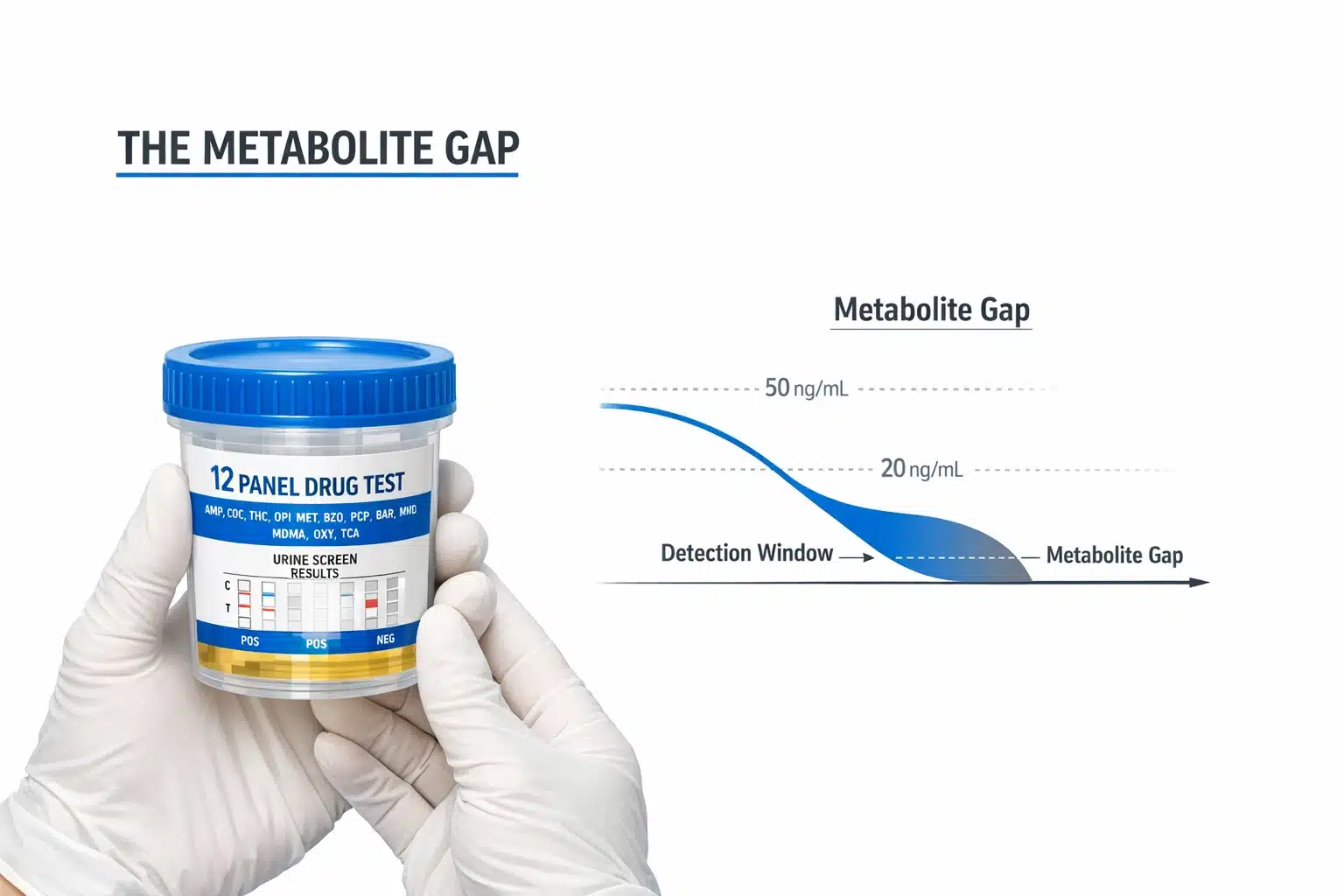
The answer lies in the “Metabolite Gap.” Today’s advanced clinical diagnostics don’t just look for the drug itself; they map the high-precision biochemical footprints left behind as your body processes a substance. Understanding these detection windows requires moving past generic timeframes and diving into the science of metabolite pathways, biological variables, and ultra-sensitive cut-off levels.
Let’s break down exactly what modern drug tests are looking for, why detection times vary so wildly, and how to evaluate your testing needs with absolute confidence.

Demystifying Cut-Off Levels: The 50/15 ng/mL Rule and the 20ng/mL Threat
Before we can accurately estimate a detection window, we have to understand the threshold of the test being used. A detection window doesn’t measure when a drug is entirely eradicated from the body; it measures how long the concentration remains above a specific, measurable threshold—known as a cut-off level.
Under standard SAMHSA (Substance Abuse and Mental Health Services Administration) guidelines, laboratory and high-quality point-of-care testing operates on a two-tiered system:
- The Initial Screen (e.g., 50 ng/mL for THC): This is the baseline test. High-quality multi-panel urine cups use this threshold to cast a wide, accurate net.
- The Confirmation Screen (e.g., 15 ng/mL): If the initial screen is non-negative, the sample undergoes GC/MS (Gas Chromatography/Mass Spectrometry) confirmation at a much stricter 15 ng/mL threshold to rule out false positives.
However, the testing landscape has shifted. In 2026, we are seeing a significant rise in organizations utilizing ultra-sensitive 20 ng/mL initial screening panels. This creates a massive variable in detection windows. While a chronic cannabis user might drop below a 50 ng/mL threshold in 30 days, their metabolite levels can hover around 25 ng/mL for weeks longer. Facing a 20 ng/mL ultra-sensitive test, that same user might trigger a positive result for up to 60 days.

The Science of Metabolite Identification: What Tests Actually Target
When you consume a substance, your liver acts as a chemical processing plant, breaking the parent drug down into smaller, water-soluble byproducts so they can be excreted through urine. These byproducts are called metabolites.
This is the key difference between testing methods:
- Saliva tests generally look for the active parent drug (which is why their detection windows are incredibly short—often just 24 to 48 hours).
- Urine tests look for the metabolites, which linger in the body far longer.
Let’s look at cannabis as the prime example. Labs don’t test your urine for active Delta-9 THC. They test for its primary inactive metabolite: 11-nor-9-carboxy-THC (THC-COOH). Because THC is highly lipophilic (fat-soluble), your body stores it in fat cells. As those fat cells burn energy over days and weeks, they slowly release THC back into the bloodstream, where the liver converts it into THC-COOH, which is eventually flushed out in urine.
Other drugs follow similar metabolic pathways. Cocaine is broken down into benzoylecgonine, and heroin metabolizes into 6-Monoacetylmorphine (6-MAM) before becoming morphine. A clinically reliable 12-panel drug cup is specifically calibrated with antibodies that react exclusively to these specific metabolic structures.

Biological Variables: Why Standard Detection Windows Fail
If you’re dealing with “metabolic anxiety”—wondering why a standard chart says you should be clear, but a test says otherwise—you need to look at biological variables. Two people can consume the exact same dosage and test entirely differently due to these three factors:
1. BMI and Adipose Tissue
Because metabolites like THC-COOH are fat-soluble, your Body Mass Index (BMI) is the single largest indicator of your personal detection window. Individuals with higher body fat percentages have more storage capacity for lipophilic metabolites. When these individuals lose weight or exercise heavily, they can inadvertently cause a “transient spike,” pushing stored metabolites back into the renal system and triggering a positive result long after their last use.
2. The CYP2C9 Enzyme Factor
This is the scientific variable most people miss. The breakdown of drugs in your liver relies heavily on specific enzymes, primarily the cytochrome P450 family. Forensic toxicology research reveals that genetic variants in the CYP2C9 enzyme can reduce drug oxidation by up to 80%. If you genetically possess “slow-clearing” enzymes, your biological detection window could easily double compared to someone with high metabolic enzyme function.
3. Hydration and Urine pH
The acidity of your urine impacts renal clearance rates. Highly acidic urine tends to speed up the excretion of certain alkaline drugs (like amphetamines), while alkaline urine can cause the kidneys to reabsorb the drug, extending the detection window.
Scenario-Based Evaluation: Calculating Your Clearance Time
To put this science into practice, you have to match usage patterns with testing expectations.
- “I used once, four days ago.”
For an isolated, single-use scenario, the body’s metabolic pathways clear out most substances rapidly. Even at a strict 20 ng/mL cut-off, a single exposure to THC will typically clear the urine within 3 to 5 days, as there hasn’t been enough time or volume for deep adipose tissue storage.
- “I am a heavy/daily user.”
Chronic use fundamentally alters the equation. Continual intake saturates the fat cells. Once saturated, the slow-release phase takes over. For heavy users, a standard 50 ng/mL screen will usually detect use for 30 to 45 days. If facing a 20 ng/mL ultra-sensitive panel or dealing with slow CYP2C9 enzymes, that window expands to upwards of 60 days.

The “Fake Detox” Warning: Why Masking Fails Clinical Testing
The internet is flooded with herbal teas, detox drinks, and flushes promising to “cleanse” metabolites overnight. Scientifically, this is impossible. You cannot speed up the half-life of hepatic enzymes or magically erase adipose storage in 24 hours.
What these drinks actually do is artificially dilute the urine by flooding the body with water and B-vitamins (to maintain color). However, clinical-grade testing supplies and laboratory validations combat this through Specimen Validity Testing (SVT).
Modern tests check for:
- Specific Gravity: Measures the density of urine. Diluted urine falls below normal human levels.
- Creatinine Levels: Creatinine is a natural metabolic byproduct of muscle wear-and-tear. If you drink a gallon of water to dilute your urine, your creatinine levels plummet. A test reading low creatinine and low specific gravity will immediately be flagged as “Negative-Dilute” or “Tampered,” which most employers and clinics treat as a failure.
Frequently Asked Questions (FAQ)
What is a CLIA-waived drug test, and why does it matter?
CLIA (Clinical Laboratory Improvement Amendments) standards regulate laboratory testing. A CLIA-waived designation means the test is simple to use, highly accurate, and poses a virtually zero risk of an incorrect result when used properly. Choosing an FDA-approved, CLIA-waived test guarantees you are using the same clinical-grade diagnostic tools trusted by hospitals and law enforcement.
Will second-hand smoke trigger a positive test at a 50 ng/mL cut-off?
Scientific consensus in 2026 confirms that under normal circumstances, passive exposure to second-hand smoke will not elevate THC-COOH metabolite levels high enough to trigger a 50 ng/mL positive urine screen.
Does exercising right before a drug test help clear metabolites?
No. In fact, it can do the opposite. Vigorous exercise immediately before a urine test burns fat, which forces stored lipophilic metabolites (like THC-COOH) back into your bloodstream and subsequently into your urine, creating a temporary spike in detection levels.
Why should I choose multi-panel urine cups over single strips?
Efficiency and comprehensive risk management. A high-quality 12-panel cup screens for over a dozen distinct metabolic signatures simultaneously within minutes. It is the most cost-effective way to ensure complete compliance without paying lab fees for individual GC/MS panels upfront.
Taking Control of Your Testing Strategy
Whether you are a clinic manager optimizing your diagnostic budget, a rehabilitation center monitoring patient compliance, or an individual taking control of your own biological data, relying on guesswork is a massive liability.
You need testing supplies that remove the guesswork. By understanding the science of metabolite identification, enzyme factors, and strict cut-off levels, you can make informed, confident decisions.
To evaluate exactly where you or your organization stands, you need diagnostic tools that adhere strictly to SAMHSA cut-off levels. With CLIA-waived, FDA-approved multi-panel urine tests starting at highly accessible price points, you can implement clinical-grade testing in minutes, backed by 99% reliability. Don’t let metabolic anxiety dictate your outcome—test with authority, precision, and confidence.